Friday, December 11, 2020

Man of a Thousand Chances - Tulsi Badrinath


"Harihar Arora: second-generation north Indian in Madras, museum curator, indifferent husband, indulgent father – and thief. Desperate to meet his beloved daughter’s wedding expenses, the otherwise honest Harihar steals a rare gold coin minted by Mughal Emperor Jahangir and pawns it, with every intention of returning it after the wedding. But when he finds himself in a position to redeem it, he learns that it has been melted by the pawnbroker. What follows next forces Harihar to readdress his place in the world, and in his own marriage. Beneath the deceptively simple surface of a story about an ordinary man in a rather extraordinary fix, are questions about the workings of karma, causality and the power of art, that offer profound matter for debate. " - So says the back cover of the book and this was my 85 of 2020.

Ancient sculptures, did not have blueprint of what they were about to do, they meditated on the image they were about to sculpt or mould, before they actually cast it. No wonder some of the images seem alive.....

The famous folk tale about the Pregnant deer and Faith is also mentioned here, as they have have a painting in the museum. 
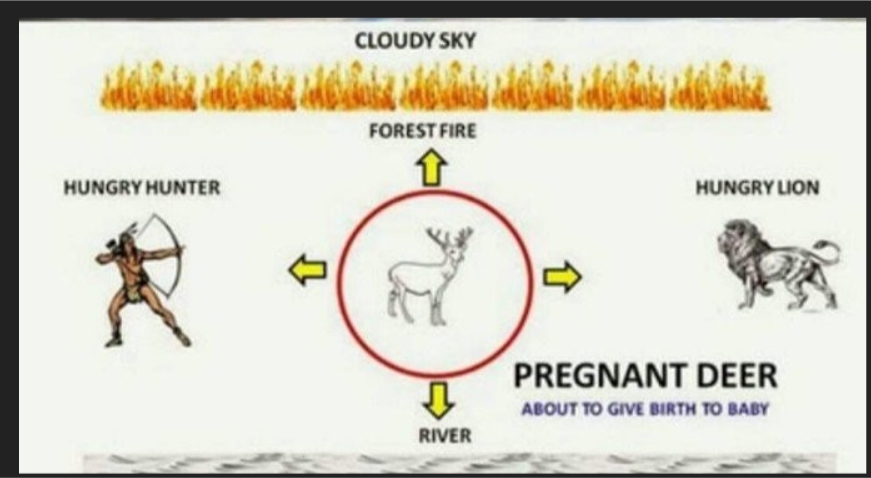


In a forest, a pregnant deer is about to give birth.

She finds a remote grass field near a strong-flowing river.

This seems a safe place. Suddenly labour pain begin.

At the same moment, dark clouds gather around above & lightning starts a forest fire.

She looks to her left & sees a hunter with his bow extended pointing at her.

To her right, she spots a hungry lion approaching her.

What can the pregnant deer do?

She is in labour!

What will happen?

Will the deer survive?

Will she give birth to a fawn?

Will the fawn survive?

Or will everything be burnt by the forest fire?

Will she perish to the hunters’ arrow?

Will she die a horrible death at the hands of the hungry lion approaching her?

She is constrained by the fire on the one side & the flowing river on the other & boxed in by her natural predators.

What does she do?

She focuses on giving birth to a new life.

The sequence of events that follows are:

– Lightning strikes & blinds the hunter.

– He releases the arrow which zips past the deer & strikes the hungry lion.

– It starts to rain heavily, & the forest fire is slowly doused by the rain.

– The deer gives birth to a healthy fawn.

In our life too, there are moments of choice when we are confronted on αll sides with negative thoughts and possibilities.

Some thoughts are so powerful that they overcome us & overwhelm us.

Maybe we can learn from the deer.

The priority of the deer, in that given moment, was simply to give birth to a baby.

The rest was not in her hands & any action or reaction that changed her focus would have likely resulted in death or disaster.

Ask yourself,

Where is your focus?

Where is your faith and hope?

In the midst of any storm, do keep faith on the Creator always. He will never ever disappoint you. NEVER.

Was it fate that saved the dear or Divine grace?

Then after Harihar's event, Mahadevan tells "Karma is stark in terms of accountability. You are responsible for your life, indeed you shape it by your own actions'. God does not figure in the theory of Karma. An act might be finished here and now, in the present, but it has eternal consequences though those may affect other people as well. So you see there is no room in this for God or divine compassion or grace"

There was a German philosopher called Schopenhauer who said one can do as he wills, but not will as he wills.    

It is not even our endeavors alone that count or all of us would be millionaaires. 

"Instead  we see that some people work very hard their whole lives and never get recognized for it, not even paid adequately, Then we have the opposite - some people don't work at all but the world is at their feet, some of our politicians for example. I could go on. " 

Both operate in the world fate and endeavour. Only human endeavour must come first before fate can have a say. 

Krishan says to the Pandavas that he will do everything in his power to help but it is not in his power to alter providence!

Fate  and effort are not effective by themselves, they work in combination. 

"Kalaha Srujati bhutani kalaha samharate prajaha....." " Time creates all beings and Time destroys what is created. Destroying what is created, Time pacified by Time".

--------------------------------------------

Harihar loosing money on account of CBF and Sarla's making money on the stock-exchange, was an act that they had performed on their own will: investing money and day trading. How then was one to know the consequence of one's action in advance, protect oneself from misfortune? He had acted rationally, having taken the ordinary precautions one would take before investing money and yet, far from the expected outcome of an increase in savings, he had lost everything he had. Sarla too could have ended up with a huge loss she could not afford, but she had profited instead from other people's panic. 

All through there is the sorry of Ratan, their son's disappearance. 

Indeed a thought provoking book. 


Wednesday, December 09, 2020

Year of Covid

We never wanted to see Covid 19,

Wish I could get rid of it, 

2020 has taught us how a bridge is build,

Through courage helping cross the unknown,

To value friends like family,

And get together on computer

I salute you all,

Diverse and connected soul,

Hugs will ignite,

You know what I mean,

Here is a memory you will save,

One day this will stop, 

Lovely people!

Happiness Always!


This year, the poem that was always in my mind was one of my father's favorite:


Ode on Solitude

BY ALEXANDER POPE

Happy the man, whose wish and care

   A few paternal acres bound,

Content to breathe his native air,

                            In his own ground.


Whose herds with milk, whose fields with bread,

   Whose flocks supply him with attire,

Whose trees in summer yield him shade,

                            In winter fire.


Blest, who can unconcernedly find

   Hours, days, and years slide soft away,

In health of body, peace of mind,

                            Quiet by day,


Sound sleep by night; study and ease,

   Together mixed; sweet recreation;

And innocence, which most does please,

                            With meditation.

Tuesday, December 08, 2020

Pati Patni Aur Woh


Title reminded me of Sanjeev Kumar’s 1978 hit ‘Pati Patni Aur Woh’ the original film starred Sanjeev Kumar as Pati (Husband), Vidya Sinha as Patni (Wife) and Ranjeeta as Woh (the mistress), the new starring Kartik Aaryan, Bhumi Pednekar and Ananya Panday. It is produced by T-Series and BR Studios. The concept of extra-marital affairs has probably existed ever since the institution of marriage came into existence, and this is the premise of Pati Patni Aur Woh.

Abhinav "Chintu" Tyagi is an ordinary, middle-class man from Kanpur, and a government engineer in the Public Works Department. He has been married to Vedika Tripathi, a physics tuition teacher from Lucknow, for three years at the time of the story. Chintu is happy in Kanpur, but he is harassed by his controlling parents for not planning a child, and by Vedika who wants to move to a big city. He often seeks advice from his PWD colleague and childhood friend Fahim Rizvi.

Bored in his day-to-day life, Chintu suddenly finds comfort in Tapasya Singh, a young wannabe fashion designer from Delhi he met at his office. Chintu finds himself drawn towards Tapasya and decides to enjoy his life. At a hotel pool, he lies to her that Vedika is having an affair with a certain Rakesh Yadav, who is actually a student of her class besotten with her. Fahim is peeved when he comes to know of the matter, and laments that, in trying to save Chintu repeatedly from various situations, he will himself fall into serious trouble, and so it does.

Vedika see both of them in a mall, and realise he is cheating on her, so leaves home early to attend Kanupriya's wedding. There she discovers her ex-boyfriend Doga, a local bad boy whom she had left for Chintu, and the two get on well. Meanwhile Chintu goes to Tapasya's home in Delhi and meets her friends. One morning, Rakesh Yadav, a flirt and Vedika's student, who has come with Fahim, finds a morose and depressed Chintu at his home and informs him that Vedika is leaving for Canada for good. The three rush to the Lucknow airport, with Chintu's family and the police in hot pursuit. At the airport, Chintu finds Vedika, Tapasya and Doga. He tries to stop them, but Tapasya spares him, saying that she will not slap him no matter how much she wants to, because he did not get physical with her while in Delhi. He finds out that it is Doga who is going to Canada and that this was Doga's plan to make him realise Vedika's worth. Vedika forgives him and they reconcile.

Nothing new, nothing unexpected. Mudassar Aziz's masala entertainer was a stark contrast to the one made in 1978 ; in that the female characters appeared to be helpless in the earlier one, but in this both of them are strong women, available and ready to help one another. Comming of age ha?

International Day of Persons with Disability - 3rd Dec.

As we learn to be inclusive of people with disability and become more self-aware, empathetic  and kind we must remember that Mental disorder is one of the not visible disability. 

A disability is any condition of the body or mind (impairment) that makes it more difficult for the person with the condition to do certain activities (activity limitation) and interact with the world around them (participation restrictions).Disability inclusion means understanding the relationship between the way people function and how they participate in society, and making sure everybody has the same opportunities to participate in every aspect of life to the best of their abilities and desires. Employers with strong disability inclusion programs can expect higher engagement from all employees.

Nearly 1 In 7 People On Earth Is Disabled, Survey Finds : Shots - Health News Worldwide, the most common disability for people under age 60 is depression, followed by hearing and visual problems, according to a new international survey. The study found more than 1 billion people live with some sort of disability.

A socially inclusive environment is one where everyone is welcome and permitted to establish their identity and express their feelings. Social inclusion assures that one’s opinions and experiences are honoured like anyone else’s.

With social inclusion, people:

 • Feel associated,

• Are acknowledged, accepted and recognised for who they are within their communities,

• Feel worthy of their roles in the community,

• Actively participate in the community,

• Have the right to choose their activities based on their personal preferences,

• Have the right to choose their social relationships where they choose and share common interests,

• Have companions and don’t feel left out nor be treated as an inconvenience.

Social inclusion involves:

  •  Non-discrimination

• Making products, communications, and the physical environment more usable by as many people as possible, i.e. Universal Design

• Modifying and retrofitting items, procedures, or systems that would make a person with a disability

• Bringing awareness and shattering the stigma that surrounds disability

The prerequisite for achieving social inclusion is the involvement of inputs from people with disabilities along with disability-focused and independent organisations and government agencies in the programme or structural design, implementation, monitoring, and evaluation.

There is a significant focus needed to spread awareness in the understanding of disabilities that are not visible such as mental illnesses, partial or complete visual or hearing impairments, learning and cognitive disabilities.  Studies show that two-thirds of people with these conditions do not seek professional help due to stigma and also feel that they may be discriminated, especially at the workplace. Although the pandemic has normalized some conversations around mental wellbeing, there is still a lot more that can be done.

Sad to hear of the passing away of a cousin at the tender age of 18 during this pandemic. He asked for two shawarma, his brother got it for him, he had it, went to his room and hanged himself with a smile on his face.  The trauma and the tendency of his mom to give away her life is a sad plight. 

Social isolation, loneliness, not getting enough caregiving support, lack of access to information and services, and disruption in routines are some of the common experiences among people during these challenging times. 

Self-awareness, empathy, and kindness are some of the traits that we develop when we focus towards the inclusion of persons with disabilities and this can improve our personal emotional wellness.

Here are some simple ways to get started at being inclusive: -                       

  1. Create a safe non-judgemental space, where people with disabilities can have open conversations about what they are experiencing and respect their privacy
  2. Listening and showing empathy during these challenging times can be valuable
  3. Offer assistance but do not make assumptions about what they need, especially while offering support to people who may have hidden disabilities
  4. Do not use terms such as handicapped, crippled, wheelchair-bound, physically challenged
  5. At work, ensure that all communication shared with your team is accessible and disability-inclusive. 
  6. Send out the meeting agenda and reference documents in accessible formats prior to any of your meetings. Or ask in advance if any attendees would require specific accommodations
  7. Identify yourself by name before you speak or present. This will be helpful for persons with visual and auditory disabilities to identify who is speaking.
Inclusion can and does happen when people have positive attitudes as well as the willingness to make it happen.

Putham Puthu Kaalai

 "Putham Puthu Kaalai" (PPK) - An anthology of 5 different short movies by 5 different directors, with covid as pivotal theme in each of the stories, PPK is easy, breezy, simple and identifiable making you ponder are all houses so beautiful so the ladies        !


By Source, Fair use, https://en.wikipedia.org/w/index.php?curid=65536957

The first segment directed  Sudha Kongara is called "Ilamai Idho Idho" and stars Jayaram, Urvashi, Kalidas Jayaram and Kalyani Priyadarshan in the lead. A love story that blossoms during the autumn years of its protagonists, the narrative uses the lock down as an opportunity for the seniors to convey their feelings for each other to their respective families. Jayaram impersonating as a  yoga center head over phone and the Urvashi's silent expressions while closeted inside the cupboard are quite nostalgic.  The smart use of the younger couple and the easy chemistry that they share with each other adds further to the narrative. 

Up next is  Gautam Vasudev Menon's - "Avarum Naanum, Avalum Naanum" - that is about a granddaughter (Ritu Verma looking every bit the new age working professional - tastefully clothed by Eka Lakhani) rediscovering her grandfather (M S Bhaskar ) during the lock down. The grandfather had shut his doors on her mother who had married against his wishes and has been living a secluded life thereafter. A sensitive tale that has been narrated very carefully without getting into melodrama, this one also benefits from P C Sreeram's visuals and Bombay Jayashree's vocals towards the climax. Ritu Verma's  stands up competently against M S Bhaskar who is in excellent form making in engrossing!

Next comes Suhasini Maniratnam's "Coffee Anyone?" - a family affair starring the Hassan cousins - Suhasini, Anu and Shruti - along with the director's mother - Komalam Charuhassan and is about the daughters visiting their ailing, bed ridden mom during the lock down. Suhasini's trump card here is the casting of veteran stage actor Kattadi Ramamoorthy as the father - the senior actor stands tall among the cast members and delivers the most honest and nuanced performance in this segment. I know not many are fans of Suhasini Maniratnam, and the most negative review of the lot was for this, nevertheless, I lied it and for me it was the most emotional.

Rajiv Menon's "Reunion" is about a young musician (Andrea Jeremiah ) who takes shelter in the residence of her old school friend during the lock down. The friends discover and rediscover things about each other over the course of the lock down and how it impacts their lives there after is what this segment is all about. The graceful Leela Samson as the friend's mother and  one of the most promising young Carnatic musicians in the country - Sickle C Gurucharan as the male lead deserves a round of standing ovation. 

If all these 4 were about upper middle class families, Karthik Subburaj comes up with the final segment "Miracle" that is totally different from the others in terms of mood and setting - it is about 2 petty thieves who depend on the food parcels delivered by the corporation authorities for survival and are conspiring to do something big during the lock down days. They come up with an idea which you think will work but as the title suggests, "Miracle" happens and as is customary with Subburaj, he throws an enjoyable twist at you. Bobby Simma, a Subburaj regular, is in good form as are Muthukumar and Sharath Ravi playing the other 2 prominent characters.

Five stories of love, hope, beginnings and chances  set in the times of COVID-19 is a treat to watch. 

Invisible Lines - Rub Zaman


84th of 2020 was Invisible Lines by Ruby Zaman, on the partition of East and West Pakistan, and its effect especially on the people. India's support,  people divided with their desire of  United Pakistan and love for Ethnicity, fear of selfish motives behind kindness, commitments, convictions and conveniences. Country appeared to be full of miscreants, to one beliver others were villainous. Literal meaning of miscreant is disbeliving person, one who holds a false religious belief. 

The story keeps moving from 1984 when Zeb is wanting to revisit Bangladesh and is visiting the London Embassy, and her mind drifts to 1971.

Young Zebunnesa Rahim was born in East Pakistan to a Bihari father and a Sylheti mother, her maternal grandfather’s family being an affluent political empire. The prim and proper Zeb grew up in Chittagong- a melting pot of cultures amidst wealth and warmth. She knew peace until 1971, when her seemingly perfect world came crashing down and she became a victim of both sides of the war. The events in the run up to the war catch the protagonist and her upper middle class surroundings completely off guard. Families are torn apart; lovers are separated by previously negligible cultural differences and countless lives are lost. The spotlight is almost equally shared by Shafiq, first a determined young boy and then a valiant freedom fighter who loses a leg in the war. Yet another strong presence is Zeb’s caretaker ‘Didi’, a woman of unmatched dignity, wisdom and loyalty that even some of the more educated characters lacked. The story starts to jump time and place and shuttles back and forth from Chittagong to Sylhet to London.

The murder of Biharis during and after the Liberation War for example has never been considered as part of our poignant wartime losses. This for Bengali writers is a taboo topic, and hence not many have touched it in their works. Ruby deserves praise for developing the Bihari’s character in an unemotional way. When the story moves to Sylhet, and as the war breaks out, Zeb’s world turns upside down. Her father was brutally murdered in a train and her mother tortured and killed by Pakistani soldiers. Ironic was the fact that in spite of her grandfather’s pro-Pakistani political stand and reputation, it was the Pakistan army that caused havoc in her life.

Shiver run down her spine as she reads Bismillah hir Rahman nir Rahim - In the name of Allah, the Beneficent, the Merciful. Those with brain, tact and most prized ingredient of success - adaptability, survived. 

In a way, Invisible Lines is a journey, not only Zeb’s journey but also those of various families - the three Musketeers - Sakina, Husna and Zeb; Thareq and Shilu through the maze of war and human relationships. 

All in a family - Including Politics


Indian politics is a complex game of snake and ladder which involves making friends and enemies time to time and when family members are involved in different parties, it is all the more interesting with debates and discussions going in all the directions.  


Freedom to chose whichever ideology suits you is the beauty of Indian democracy. The ideologies in Indian politics, if taken to extreme levels, called extremism, can lead to civil wars and unrest which is the way things appear to be moving. Opposition in Indian politics plays an important rule in keeping democratic values such as debates and dissent alive in India. Without any opposition, the government will go unchecked and the country might turn into a fascist regime. India is the largest democracy in the world, and let us exercise our right until it last. The General  to Local Self Government is scheduled in three phases across districts in Kerala. 

8th December 2020 (Tuesday) Thiruvananthapuram, Kollam, Pathanamthitta, Alappuzha, Idukki
10th December 2020 (Thursday) Kottayam, Ernakulam, Thrissur, Palakkad, Wayanad
14th December 2020 (Monday) Malappuram, Kozhikode, Kannur, Kasargod

Exercise your right to vote, Respect differences. 

Please also ensure that you adhere to the COVID safety protocols while visiting the polling booths. 

Stay Safe !!!. 

Best Wishes!!
------------------------------------------------------------------------

Greed, hate and corruption are all part of Indian democracy since the birth of the Republic of India .

Politicians usually choose their parties, not because they believe in the ideologies of the party, but because of the winnability quotient in the elections. Elections, unfortunately, is all about money power and muscle power. The ideologies and promises are just the sugar coating that politician do to get votes from people. But even if they follow the ideology of a party, the ideologies itself is flawed and broken from its core. Divide and rule policy followed by the British to rule India is followed by today’s politicians to get votes. Political parties, across the spectrum, try to divide people of India on the basis of religions and class. This is usually called by the term communal polarisation. The gullible voters play into the hands of these political parties and belive the fancy promises they show in the name of development. In a good democratic system, a common man should also be well aware of their rights and responsibilities as a law-abiding citizen.

Happen to read:  https://akarshnalawade01.medium.com/does-eating-dog-make-you-a-liberal-dfa3ceb4c3af

Right vs Wrong, Left vs Right, Liberal vs Conservative, Us vs Them — partisanship impacts our discourse every day, more so in these times of rampant tribalism. But are our political views rational or intuitive? Emotional reactions or calculated responses? How did we, a slightly advanced breed of chimp, glean obscure concepts such as morality? From what age do we let bias (conscious or otherwise) seep into our psyche?

Waiting to get hold of Jonathan Haidt’s “The Righteous Mind: Why good people are divided by politics and religion”.  Haidt provides an evidence-based, experiment-backed, rigorously researched treatise of these in “The Righteous Mind”. He attempts to convince us, through multiple experiments, that we are essentially intuition-driven information processors, constantly scanning the world around us, morally interpreting information and coloring narratives with our unique worldview.

Monday, December 07, 2020

The Namesake By Jhumpa Lahiri


The novel, 'The Namesake', by Jhumpa Lahiri, also a major motion picture in the same name by Monsoon Wedding fame Mira Nair is a very simple story, with an interesting subject the one all own - their name. This was 83rd of 2020.   The story depicts struggles of different generations, especially their ways of adapting to different culture and with one another.  

The story begins as Ashoke and Ashima Ganguli, a young Bengali couple, leave Calcutta, India, and settle in Central Square in Cambridge, Massachusetts. Ashoke is an engineering student at the Massachusetts Institute of Technology (MIT). Ashima struggles through language and cultural barriers as well as her own fears as she delivers her first child alone. Had the delivery taken place in Calcutta, she would have had the baby at home, surrounded by family. The delivery is successful, but the new parents learn they cannot leave the hospital before giving their son a legal name.

The traditional naming process in their families is to have an elder who will give the new baby a name, and the parents waited for the letter from Ashima's grandmother. The letter never arrives, and soon after, the grandmother dies. Ashoke suggests the name of Gogol, in honor of the famous Russian author Nikolai Gogol, to be the baby's pet name, and they use this name on the birth certificate. As a young man, Ashoke survived a train derailment with many fatalities. He had been reading a short story collection by Gogol just before the accident, and lying in the rubble of the accident he clutched a single page of the story "The Overcoat" in his hand. With many broken bones and no strength to move or call out, dropping the crumpled page is the only thing Ashoke can do to get the attention of medics looking for survivors. Though the pet name has deep significance for the baby's parents, it is never intended to be used by anyone other than family. They decide on Nikhil to be his good name. By the time he turns 14, he starts to hate the name. His father tries once to explain the significance of it, but he senses that Gogol is not old enough to understand. By the time he turns 14, he starts to hate the name. His father tries once to explain the significance of it, but he senses that Gogol is not old enough to understand. Gogol introduces Maxine to his parents. Ashima dismisses Maxine as something that Gogol will eventually get over. Shortly after this meeting, Ashoke dies of a heart attack while teaching in Ohio. Gogol travels to Ohio to gather his father's belongings and his father's ashes, and in attempting to sort out his emotions, Gogol gradually withdraws from Maxine, eventually breaking up with her. He begins to spend more time with his mother and sister, Sonia.

Later, Ashima suggests that Gogol contact Moushumi, the daughter of one of her friends, whom Gogol knew when they were children, and whose intended groom, Graham, broke up with her shortly before their wedding. Gogol is reluctant to meet with Moushumi because she is Bengali, but does so anyway, to please his mother.

Moushumi and Gogol are attracted to one another and eventually are married. But their marriage do not last long. Gogol is once again alone. He is nonetheless comforted by the fact that Ashoke, prior to his death, finally told his son why he had chosen that name for him. Gogol comes to accept his name and picks up a collection of the Russian author's stories -'The short stories of Nikolai Gogol', that his father had given him as a birthday present many years ago. On it was written 'For Gogol Ganguli', in red ballpoint ink, the letter rising gradually, optimistically, on the diagonal toward the upper right-hand corner of the page. " The man who gave you his name, form the man who gave you your name", 1982. Dostoyevsky once said, "We all came out of Gogol's overcot", his father had told him on his birthday then. 

In so many ways, his family's life feels like a string of accidents, unforseen, unintended, one incident begetting another. It had started with his father's train wreck, paralyzing him at first, later inspiring him to move as far as possible, to make a new life, on the other side of the world. ...and then a series of them...They were things for which it was impossible to prepare but which one spent a lifetime looking back at, trying to accept, interpret, comprehend. Things that should never have happened, that seemed out of place and wrong, these were what prevailed, what endured, in the end. 

The Catcher in the Rye - J. D. Salinger

The language is something that was outstanding about this book, seemed queries, free flowing and natural which made me pick this book to be 82 of 2020


Example: "Boy, it began to rain like a bastard. In buckets, I swear to God. All the parents and mother's and everybody went over and stood right under the roof of the carrousel, so they wouldn't get soaked to the skin or anything, but I stuck around on the bench for quite a while....."

Comparing rain to bastard; and parents and mother so parents don't include mother? Was fascinated. 

Catcher In The Rye is hailed because of it's 'direct', hard hitting nature. The writer unabashedly uses the language, pretty much the same way as any teenager does. It was banned in schools and was criticized because of the tone used and the rebellious central character portrayed in it. Like Holden, we all face dilemmas in our lives - of not being able to decide to give a call to someone who we miss for the fear of being judged, the monotony of our lives frustrates us and I guess we all, at sometime or the other have felt like a loser at school or college or office. However, we find solace in little things of life, like Holden does in his sister.

"People always think something's all true. I don't give a damn, except that I get bored sometimes when people tell me to act my age. Sometimes I act a lot older than I am - I really do - but people never notice it. People never notice anything." 

And how true. Holden is a really important character in literature because of the way he is. One could easily think he's a stupid young boy who hates everything and is depressed all the time. But actually Holden is a an extremely emphatic intellectual who just figured out that it is easier to be "stupid" and a failure that it is for him to explain what is going on inside his head because, while observing the world, especially people around him, he figured that no one could actually, fully understand his thoughts. Holden is this guy that values honest human relationships above everything else and he constantly dreams about a world where that is possible to have, that's why he adores his younger brother Allie and younger sister Phoebe, they are kids and therefore honest, pure, playful and they don't understand what it means to be fake and act and pretend. When Holden was talking to Phoebe in D.B.'s room, she in a way accused him of there not existing one thing that can make him happy and it took him quite a while to think of something that did. Phoebe doing that perfectly showcased what everybody that knew him thought of him, but only Phoebe, because she is a kid, had the guts to say it to his face, and that killed Holden because it is not true. He couldn't think of something that made him happy because the things that make him happy aren't specific, concrete things but abstract ideas that in a way don't really exist because they are all based on human relationships and values. And that is when Holden thought about being the catcher in the rye. All he truly wants in life is for the kids not to die while playing, but not in a literal sense. What he wants to say with that is, that he wished people would stay honest and pure, as kids are, their whole life and not just fall off the edge while playing and becoming all the things he, and a lot of us, hate about adults. Because that's one thing he can't stand, people not paying attention and running towards the edge, falling off and ruining everything because they didn't care.  When Phoebe asks Holden what he wants to be when he grows up, he answers “the catcher in the rye” – a person he imagines as responsible for “catching” children in the field before they “start to go over the cliff.” The field of Holden’s fantasy is free of adult ideas and artificiality. The field is reminiscent of Peter Pan’s Neverland or the Garden of Eden, both of which are realms that protect innocence from the corrupting influence of experience. By contrast, the fall from the cliff represents the “fall” into adulthood—that is, into lust, greed, ambition, and “phoniness.”  And the ending quote too add to this:

"Don't ever tell anybody anything. If you do, you start missing everybody."

And that just confirms how much Holden actually cared about all the people he encountered even if he "hated" them, because he had a relationship with them and that is what he is all about; people.


Friday, December 04, 2020

To Sir with Love - E R Braithwaite

 To Sir with Love by  E R Braithwaite was 81st of 2020 again a recap from school days both of movie and the book, but it gave so much more insight now on the diversity and inclusion.


Born in Guyana on 27 June 1912, Eustace Edward Ricardo Braithwaite was the child of privileged parents, both graduates of Oxford University. His father was a diamond miner while his mother raised the family. During the second world war, he joined the Royal Air Force to fight as a pilot before going on to Cambridge to read physics. Ricky Braithwaite is an engineer from British Guiana who has worked in an oil refinery in Aruba. Coming to Britain just before the outbreak of World War II, he joins the RAF and is assigned to aircrew. Demobbed in 1945, he is unable to find work despite his qualifications and experience due to racism. After discussing his situation with a stranger, he applies for a teaching position and is assigned to Greenslade School, a secondary school in London's East End.

Ricky Braithwaite of this world cannot by themselves,  uproot prejudice, but they can point to its existence. And this, after all, is the beginning of change, one must first identify the location of the problem before one can set about addressing it. There were lessons he too had to learn, particular about humility and patience.

Most of the pupils in his class are unmotivated to learn, and are only semi-literate and semi-articulate. He persists despite their unresponsiveness to his approach. Students attempt to discourage and demoralise him by disruptive noises, constant use of the adjective "bleeding" in the classroom and, finally, the burning of a used sanitary towel in the fireplace. This last causes Braithwaite to lose his temper and reprimand all the girls.

Braithwaite decides to try a new approach, and sets some ground rules. The students will be leaving school soon and will enter adult society, so he will treat them as adults and allow them to decide what topics they wish to study. In return, he demands their respect as their teacher. This novel approach is initially rejected, but within a few weeks the class is largely won over. He suggests out-of-school activities including visits to museums, which the students have never experienced before. A young teacher, Gillian Blanchard, volunteers to assist him on these trips. Some of the girls start to speculate whether a personal relationship is budding between Braithwaite and Gillian. The trip is a success and more are approved by the initially skeptical headmaster.

The teachers and the Student Council openly discuss all matters affecting the school including curricula. The general feeling is that Braithwaite's approach is working, although some teachers advocate a tougher approach. The mother of one of the girls speaks privately to Braithwaite about the girl's troubling attraction to nightlife, feeling that he has more influence with her impressionable daughter.

Braithwaite and Gillian fall deeply in love and discuss marriage. Her parents are openly disapproving of a mixed-race marriage, but realise that the couple are serious and intelligent and must be trusted to make the right decision.

At the end of the year, even he too leave the school, and the title of the book is what the students had written on the gift to him. 

Following this was successful career as a social worker and a diplomat. He died in 2016 at the age of 104, at his home in Maryland. 

Tenali Rama and A Tale of Two Cities....

Unrelated though,  wanted to refresh these - also included with Matilda by Roald Dahl and Wizard of Oz by L.Frank Baum, but the latter two was already reviewed.  Together I would say 76 to 78 of 2020. How illogical it may seem that I mention two unrelated books together - but so is life; never know what , why or who two come together - when and how?

Per Wiki "Tenāli Rāmakr̥ṣṇuḍu was an Indian poet, scholar, thinker and a special advisor in the court of Sri Krishnadevaraya who ruled from C.E. 1509 to 1529. He was a Telugu poet who hailed from what is now the Andhra Pradesh region, generally known for the folk tales which focus on his wit."    


Many years ago, when the kingdom of Vijayanagar was  ruled by Krishnadeva Raya, a youth named Rama lived in Tenali Village.   He was given a mantra by a holy man who brought rain to the drought effected village. Ram doubted him but had good memory so  remembered the mantra that would evoke Goddess Kali, and he was successful in doing that. When Goddess appeared before him, he had a hearty laugh, instead of being scared or surprised. On asking why, he said I have trouble in managing one nose with two hands, how do you manage with your many noses and just two hand? Goddess blessed him with the gift of making people laugh and said he would be remembered as Vikatakavi or a jesting poet.

She granted him another boon, and asked him to choose between golden cup in right hand with milk of learning and silver cup in left hand with curds of wealth. He said he would need to taste before choosing, asked her to give both, mixed them and in a flash drank both. Then humbly said what is the use of mere learning to me without the comfort of wealth? His wit and prosperity helped him gain many friends and enemies. He became the court jester  & then on interIntere stories in court.

-----------------------------------------------------------------------------------

A Tale of Two Cities by Charles Dickens

1775. King George 111 of England busy dealing with the nascent English colonies in America and King Louis XVI of France lost in pleasure of wealth and living in perpetual merriment. Both monarch completely oblivious of the state of their countries heading towards a revolution.


Dickens' famous opening sentence introduces the universal approach of the book, the French Revolution, and the drama depicted within:

"It was the best of times, it was the worst of times, it was the age of wisdom, it was the age of foolishness, it was the epoch of belief, it was the epoch of incredulity, it was the season of Light, it was the season of Darkness, it was the spring of hope, it was the winter of despair, we had everything before us, we had nothing before us, we were all going direct to Heaven, we were all going direct the other way—in short, the period was so far like the present period, that some of its noisiest authorities insisted on its being received, for good or for evil, in the superlative degree of comparison only"

 Lucie Manette: Daughter of Dr. Manette; an ideal pre-Victorian lady, perfect in every way. About 17 when the novel begins, she is described as short and slight with a "pretty figure, a quantity of golden hair, a pair of blue eyes..." Although Sydney Carton is in love with her, he declares himself an unsuitable candidate for her hand in marriage and instead she marries Charles Darnay, with whom she is very much in love, and bears him a daughter. However, Lucie genuinely cares about Carton's welfare and defends him when he is criticised by others. She is the "golden thread" after whom Book the Second is named, so called because she holds her father's and her family's lives together (and because of her blonde hair like her mother's). She also ties nearly every character in the book together. Lorry and Tellson bank definitely being the key.

The narrative suggests that Sydney Carton's death secures a new, peaceful life for Lucie Manette, Charles Darnay, and even Carton himself. 

Few interesting quotes:

"For your happiness I have no qualms about giving up my own.


"A wonderful fact to reflect upon, that every human creature is constituted to be that profound secret and mystery to every other."

& The ever green:

“It is a far, far better thing that I do, than I have ever done; it is a far, far better rest that I go to than I have ever known.”

An extraordinary saga of love, betrayal, loyalty and human struggle, this is a tale that keep attracting me. 

Thursday, December 03, 2020

Devdutt Pattanaik's 7 Secrets - Trilogy

 Devdutt Pattanaik's 7 Secrets from Hindu Calendar Art, & of Shiva and Vishnu is my 73 to 75 of 2020.


Dr Devdutt Pattanaik is a medical doctor by training, business consultant by profession and the mythologist by passion. He writes and lectures extensively on the relevance of secret stories symbols and rituals. 

The Caveat common in all three books is :

Within infinite myths lies the eternal truth 

who sees it all?

Varuna has but a thousand eyes

 Indira, a hundred.

And I, only two


Hindu Calendar Art

Hindu mythology abounds with fascinating Gods, Goddesses and characters whose visual representations through calendar art are equally colourful. Hindu calendar art may seem fantastic and kitsch, but it is in fact the most democratic expression of a mythic imaginary that was once restricted to temple was and Palm leaf manuscript. This portraits of the Hindu Pantheon of Gods and the stories that surround them can be found on the walls and Pooja rooms of almost every Hindu household in India . Rich in symbols each image is a piece of an ancient metaphysical Jigsaw puzzle. In this book Dr Devdutt Pattanaik decode the symbols to reveal a wisdom that has nourished India for thousands of years.

The book covers Ganesha, Narayan , Ardhanari, Shiva, Devi, Vishnu and Brahma.

In the first Ganesha secret, the author throws light on how different people see different things differently including God.

The chapter begins with the famous story of Ganesha and Kartikeya going around the world thrice for the mango. Kartikeya literally Goes Around The World while Ganesha goes around his parents three times and declares that he has won. Explanation is interesting:

You went around the world. I went around my world.  Tell me which world matters more the world is objective; my world is subjective. 

 Every culture views the world through different lenses. For some there is one formless divine for others the divine has many forms; for some there is only one life with no rebirth for others this is just one of many lives answers to these questions are never Universal they are cultural. They spawn beliefs. From beliefs comes behaviour that can make us either less tolerant or more accommodating that is why views matter.

Myth is an idea churned in my world, mythology is the set of stories symbols and rituals that communicate a myth.

Among other stories it also has the story of Ganesha and the elephant head. Ganesha also represents a balance between mortal body and an Immortal head. His human body created by his mother represents the material world which is impermanent going through cycles of death and rebirth and his elephant head secured by his father represents the spiritual world.  Ganesh  thus represents the union of a desire to want to marry and have a family and a desire to focus on the soul within.

 Narayana's secret: what dies is always Reborn.  His images are mostly that of waking up. Our universe exist only when we wake up.

 Ardhanaris secret: God is stillness within ; goddess is movement around.

Shiva's secret: withdrawal leads to destruction

Devi's secret: Desire and destiny create life

Vishnu secret: detached engagement brings order.

 Brahma's secret: human life is an opportunity

General belief is that Karma is manifested through nine celestial bodies the navagrahas Who rule time. Through divine beings the grahas have no will of their own they are compelled to influence our life at a particular time for a particular period depending on what is written in our fate.

Space and time are manipulated through Vastu Shastra and Jyotisha Shastra to generate material wealth and to harness Fortune, fertility and household prosperity. Rituals and prayers directed at the grahas and the Digga- palas do not seek any spiritual goal like enlightment.

Vastu Purusha was a demon who tried to rise from the earth and block the sky the various Gods pinned him down each god is ruler of the point where he still holds down the demon the north is ruled by Kubera the treasurer of the Gods the South is your ruled by Emma the god of death the East is ruled by Indira the god of rain the west is ruled by Varun the god of the sea the Northeast is ruled by Soma the moon the Southwest is ruled by surya the Sun The Northwest is ruled by the wind the south-east is ruled by Agni fire opposite directions complement Each Other thus a balance is created in the Cosmos in the centre stands Brahma the naval man himself the centre of his world.

Vishnu

Anointed with perfumes 
Draped in silk
He reclines on the ocean of milk
Eyes open 
Ever smiling 
Securing the world with his attention 
He is God who is chased by Fortune 
Perumal, Balaji, Narayana Vishnu
who walks the earth as Krishna and as Ram

The seventh secrets covered are that of mohini, Matsya, Kurma, trivikrama, Rama, Krishna and kalkis.

The first chapter focuses on how gender is used to explain fundamental metaphysical concepts integral to Hinduism, the second chapter discusses the difference between man and animal, the third and fourth chapter focuses on the Devas and asuras as both of whom are unhappy as one struggles with insecurity and other with ambition, 5th and 6th chapter resolves Around The Ramayana and Mahabharata as Man struggles with humanity and the 7 chapter is about the wisdom of letting go with faith in Renewal.


Vishnu takes the form of an enchantress and becomes Mohini and dances before Shiva Shiva is compelled to open his eyes and looked at Mohini he recognises Mohini is Vishnu she is spiritual reality clocked in material reality she is Vishnu playing with Prakriti and maya in full control of time and space and subjective realities. Immersed in Brahmin she is inviting spiritual reality to enter a playground and join the game of material reality the Leela provoking Shiva to open his eyes to material reality.

 Vishnu's way is called pravritti Marga or outward looking path while shivas way is called nivritti-marga the inward looking paath. Vishnu plays with Maya without getting overwhelmed by her while shiva rejects her totally .Vishnu is there for a more worldly form of the divine King a warrior and alava by Shiva is more monistic form of divine a permit such as I stood all things word free he refuses to engage with the Prakriti.

Shiva

Smeared with Ash 

Draped in animal hide 

He sits atop the snow-capped mountains

Skull in hand 

Withdrawn, with dogs for company 

Destroying the world with his Indifference 

He is God who the Goddess shall awaken

His name is Shiva

The various chapters or Secrets in this book revolve around Lingeshwara, Bairava, Shankara, Bholenath, Ganesha, Murugan and Natarajan.

The first chapter looks at the meaning of the Shiva Linga beyond the conventional titillation offered by a Phallic symbol, the second chapter focuses on shivas violent disdain for territorial behaviour among humans the third and fourth chapter deal with how the Goddess get Shiva to engage with the world out of compassio,  the next two chapters revolve around shivas two sons Ganesha and Murugan through whom he connects with the world, the final chapter present Shiva as a wise teacher who expresses system through dance.

Lingeshwara, imagination makes us human

Bairava, from fear comes all corruption. Bhaya means fear.  Shiva is called kaal Bhairava, because he removes the bhaya of kaal, Which is time, the devourer of all living things

Shankara, without empathy there is no evolution

Bholenath,  culture is a human delusion

Ganesha, food alone does not satisfy hunger

Muruganan face fear to outgrow it

Natarajan. Destruction is deconstruction.

Hindus worshipped nature, plants and animals. To fire the imagination of the people moving towards monasticism this had to be communicated using a tool that the masses understood and it was stories.

Stories of Vishnu communicate the world view from the point of view of the householder this is complemented by stories of Shiva that communicate an equally valid but alternate view point of a hermit.

Vishnu is bedecked in Gold,  Shiva is smeared in ash, Vishnu is offered springs of tulsi, grown at home while Shiva is offered leaves of Bhilwa that is grown outside the house Vishnu dances with eyes open while Shiva dances with his eyes shut through these differences different ideas were communicated.

These books have little gems scattered all over.


Wednesday, December 02, 2020

Siddhartha - Hermann Hesse

Siddhartha - Hermann Hesse is a 1922 novel by Hermann Hesse that deals with the spiritual journey of self-discovery of a man named Siddhartha during the time of the Gautama Buddha, my 71 of 2020.


 Wikipedia has summarized the plot so well - I cannot word it better: "The story takes place in the ancient Indian kingdom of Kapilavastu. Siddhartha decides to leave his home in the hope of gaining spiritual illumination by becoming an ascetic wandering beggar of the Śamaṇa. Joined by his best friend Govinda, Siddhartha fasts, becomes homeless, renounces all personal possessions, and intensely meditates, eventually seeking and personally speaking with Gautama, the famous Buddha, or Enlightened One. Afterward, both Siddhartha and Govinda acknowledge the elegance of the Buddha's teachings. Although Govinda hastily joins the Buddha's order, Siddhartha does not follow, claiming that the Buddha's philosophy, though supremely wise, does not account for the necessarily distinct experiences of each person. He argues that the individual seeks an absolutely unique, personal meaning that cannot be presented to him by a teacher. He thus resolves to carry on his quest alone.

Siddhartha crosses a river and the generous ferryman, whom Siddhartha is unable to pay, merrily predicts that Siddhartha will return to the river later to compensate him in some way. Venturing onward toward city life, Siddhartha discovers Kamala, the most beautiful woman he has yet seen. Kamala, a courtesan, notes Siddhartha's handsome appearance and fast wit, telling him that he must become wealthy to win her affections so that she may teach him the art of love. Although Siddhartha despised materialistic pursuits as a Shramana, he agrees now to Kamala's suggestions. She directs him to the employ of Kamaswami, a local businessman, and insists that he have Kamaswami treat him as an equal rather than an underling. Siddhartha easily succeeds, providing a voice of patience and tranquility, which Siddhartha learned from his days as an ascetic, against Kamaswami's fits of passion. Thus Siddhartha becomes a rich man and Kamala's lover, though in his middle years he realizes that the luxurious lifestyle he has chosen is merely a game that lacks spiritual fulfillment. Leaving the fast-paced bustle of the city, Siddhartha returns to the river fed up with life and disillusioned, contemplating suicide before falling into a meditative sleep, and is saved only by an internal experience of the holy word, Om. The very next morning, Siddhartha briefly reconnects with Govinda, who is passing through the area as a wandering Buddhist.

Siddhartha decides to live the rest of his life in the presence of the spiritually inspirational river. Siddhartha thus reunites with the ferryman, named Vasudeva, with whom he begins a humbler way of life. Although Vasudeva is a simple man, he understands and relates that the river has many voices and significant messages to divulge to any who might listen.

Some years later, Kamala, now a Buddhist convert, is traveling to see the Buddha at his deathbed, accompanied by her reluctant young son, when she is bitten by a venomous snake near Siddhartha's river. Siddhartha recognizes her and realizes that the boy is his own son. After Kamala's death, Siddhartha attempts to console and raise the furiously resistant boy, until one day the child flees altogether. Although Siddhartha is desperate to find his runaway son, Vasudeva urges him to let the boy find his own path, much like Siddhartha did himself in his youth. Listening to the river with Vasudeva, Siddhartha realizes that time is an illusion and that all of his feelings and experiences, even those of suffering, are part of a great and ultimately jubilant fellowship of all things connected in the cyclical unity of nature. After Siddhartha's moment of illumination, Vasudeva claims that his work is done and he must depart into the woods, leaving Siddhartha peacefully fulfilled and alone once more.

Toward the end of his life, Govinda hears about an enlightened ferryman and travels to Siddhartha, not initially recognizing him as his old childhood friend. Govinda asks the now-elderly Siddhartha to relate his wisdom and Siddhartha replies that for every true statement there is an opposite one that is also true; that language and the confines of time lead people to adhere to one fixed belief that does not account for the fullness of the truth. Because nature works in a self-sustaining cycle, every entity carries in it the potential for its opposite and so the world must always be considered complete. Siddhartha simply urges people to identify and love the world in its completeness. Siddhartha then requests that Govinda kiss his forehead and, when he does, Govinda experiences the visions of timelessness that Siddhartha himself saw with Vasudeva by the river. Govinda bows to his wise friend and Siddhartha smiles radiantly, having found enlightenment. Thus he experiences a whole circle of life. He realizes his father's importance and love when he himself becomes a father and his own son leaves him to explore the outside world."

 He concludes  that no teacher would have ever been able to bring his salvation. Knowledge can be transferred but not wisdom.          

Red Oleanders - Rabindranath Tagore

Red Oleanders, a powerful and moving play by Rabindranath Tagore, is the story of Nandini, a girl who recognizes no social barriers and taboos and who disregards them in her search for happiness. This was my 72 of 2020.


Nandini is one of those individuals who bring out the best in human nature. Entering a town where men are enslaved to mine gold, she makes them aware of their bondage and creates in them a desire to be free.

Her symbol, the red oleander, can be variously interpreted as frailty or as the red badge of courage. But Nandini escapes being defined as just a symbol. The tremendous verve with which Tagore invests her, makes her a real living personality, and her death is actually a rebirth for the gold diggers.

Perhaps the most obvious use of symbolism is used to illustrate the absolute power that the antagonist—the Governor—and the King have over Yaksha Town and its citizens. The Governor and the King have complete authority in their hands and are the sole beneficiaries of the direful situation. However, it is the Governor who is “[…] nice and polished, like the crocodile’s teeth, which fit into one another with so thorough a bite that the King himself can’t unlock the jaw, even if he wants to.” (Tagore 34). It can, then, be seen that the Governor is the ultimate “puppet master” of the play who appears to be kind, but is manipulative and cunning in nature. The Governor emulates a crocodile who clasps its teeth together in a smile before it captures its prey; he is a “boa-constrictor […] who remains in hiding and swallows [and suffocates] men” (Tagore 105). In the play, other kinsmen are also obsequious to the Governor and try to gain power through nepotism. In the grand scheme of things, Tagore is excoriating the British Raj that colonized the Indian subcontinent in the mid-1800s to mid-1900s. As such, he is mirroring the regime’s rule over Yaksha Town to the Hindu Caste System, sectarianism, and the British Empire’s conquest of India. Throughout his life, Tagore, albeit raised in a wealthy family, saw the disparity between the lower class and higher class members of society; he especially empathized with the proletarians—the “Untouchables”—in India. Red Oleanders is one of many of Tagore’s works where he devotes himself to speaking up for alienated groups. Therefore, through the means of animal symbolism, Tagore effectively highlights the ways in which the groups in power capitalize on the powerless.

This play is a masterful piece in that it allows us, as readers, to not only gain a deepened understanding of the underlying meaning of this play, but also gain perspective of our own lives. We may have all means to support ourselves, but Tagore reminds us to be grateful and stay humble, for there will always be people who are less fortunate than us. Despite the fact that Tagore published this play nearly a century ago, the themes and motifs used express a timeless universal truth that resonates with people from all backgrounds and all walks of life.

Like the real oleander flower happiness  too must be the fruit of love, of labour that is true, that is civil, that is honest, the fruit of human sympathy and consideration,  and of human sacrifice  in the course of that real unity which is truth.

The hidden gains of 2020


There has been a great deal of loss, fear and unexpected changes throughout 2020, and even now the future is uncertain. But along with it have come some valuable lessons in survival, resilience and positive change that may have gone unnoticed. 

The year 2020 has truly thrown a curveball our way with the spread of Covid-19 which has assumed unprecedented proportions; more than half the year has been spent in the midst of lockdowns, quarantine, and travel bans, and life as we know it has drastically changed for many. However, being the resilient species we are, human beings have found ingenious ways to keep things going. Thanks to the digital age, many of us are able to continue our daily business of working, studying, and even shopping using the online platform with relative ease. The year has seen a lot of trials and heartbreaking loss, but it is important to note some of the good we may have gained, perhaps without even realizing it.

Here are a few hidden gains from this tumultuous year:

A new way of doing things. This year stands tribute to our resilience and adaptability in the face of sudden and extensive change. It has compelled us to see ordinary things like going out or how we interact with others in a completely new way, to approach problems with novel solutions, and provided us with a much-needed refresher’s course in personal health and public safety.

Quality time with loved ones. Social distancing may be the new norm, but the social connection has always been the cornerstone of rich emotional lives. Staying at home more has allowed families to reconnect emotionally, adjust with physically being in each other’s company for extended periods of time, and it has also helped establish healthy boundaries for being together.

Revisiting ourselves. Deluged with our work, familial or social responsibilities, we often put our own interests in the backseat. We promise we will come back to them when we have time, but the time never seems to come. The lockdown put us in a forced break and many have rediscovered forgotten hobbies or finally got the time to pursue new ones.

An existential wake-up call. The pandemic has brought us face to face with our own mortality, and so this year has brought with it some much-needed perspective. It may have each of us questioning whether we are living our life to the fullest, or it may have reaffirmed aspects about ourselves we already knew. In any case, it has nudged us to engage in a healthy dose of self-reflection.

Over the past decades of advancement, we have taken many things for granted. We may not have given many of our personal relationships the attention it deserved. We didn’t often acknowledge the privilege of clean air and freedom to be outside without anxious thoughts about our own or our family’s health. And all too often in the midst of our fast-paced lifestyles, we have even forgotten what our own needs and desires are. 2020 may have been the “Pause” button we needed but couldn’t take until it was thrust upon us by nature – a chance to contemplate about our lives, to redefine its meaning, and to appreciate its value.

One of the beautiful quote I read from one of our Ex-managers in the company I once worked in her FB page; from the book Helen Macdonald’s ‘Vesper Flights.’

“What people see in me is the successful woman, the leader, but all of this is built on sweat and work and temper, you know? It’s losses, tragedy, death and tears. I guess you cannot be strong if you never have been hurt and learn how to survive that.”

Great lives are born of grit, sweat and tears.  Boiling down to 'Tough time do not last, but tough people do'.

Monday, November 30, 2020

Vivekananda A Born Leader By Asim Chaudhuri

 Vivekananda A Born Leader By Asim Chaudhuri was 70 of 2020.

This came as a new thought to me, and why not?

Jack welch the highly acclaimed ex CEO of General Electric defines a leader as:

"someone who can develop a vision of what he or she wants their business, the unit, their activity to do and be somebody who is able to articulate the entire unit what the unit is and gained through a sharing of the discussion -listening and talking - an acceptance of that vision and then relentlessly drive implementation of that vision to a successful conclusion."

Did Vivekananda not do that?


4 criterias of the followers behaviour that defines leadership as per Daniels and Daniels is :

 1 followers deliver discretionary behaviour directed toward the leaders goal 

 2 followers make sacrifices for the leaders cause 

3 followers tend to reinforce the correct others so they also confirm to the leaders teachings and examples and

 4 followers set guidelines for their own personal behaviour based on the perceived estimate of that which the leader would approve or disapprove.


The leadership traits and managerial skills of Vivekanand are having a vision,  bias for action, capacity for empathy, capacity for empowerment, organising power, aligning goals and objectives, developing people , integrity , self confidence,  fairness , propensity for hard work , ability to transform others, communication skill ,wisdom, magnanimity, being impersonal, patience, building loyalty, interpersonal skills, unselfishness, process focus, root cause emphasis, constancy of purpose, sense of humour and foresight. He amazingly managed paradoxes. He could treat commoners and Elite alike he could manage internal conflict and had a good grip over money.  Promptitude was his skill as well. The leader manager who laid down strict rules and at Korum for the Ramakrishna organisation he founded Vivekananda that did not always follow rules in his personal b being a perspective person he had definitely recognised that punctuality order and allegiance were Cardinal virtues.

According to him along with political and social Independence   if one is a slave to his passion and desires one cannot feel pure Joy of real freedom. Also according to him no one was ever taught by another. Each of us has to teach himself. The external teacher office only the suggestion which houses the internal teacher to work to understand things.

To appreciate him fully we have to go beyond the specific traits or skills and look at some of his major thoughts and utterances that are at the core of leadership development and organizational strategy. These are listed below with short summary comments:

1.  Man-making education: education difined;  infinite knowledge in human mind can be access by developing power of concentration 

2. Influence of nature's  three forces how Sattva, Rajas and Tamas influence personality and character.

3. Human capital:  workers are the only real asset in an organisation especially in the present knowledge based economy

4. Personal mastery: how it leads to creating a learning organisation 

5 core competency: blending spiritual and human services in a unique way

Finally in chapter 5 on measuring leaders accomplishment it begins with the quote by Vivekananda:

Take up one Idea. Make that one Idea your life - think of it, dream of it, live on that idea. Let the brain, muscles, nerves, every part of your body, be full of that Idea and just leave every  other idea alone This is the way to success.

Enter appropriately titled book 'measure of a leader' Daniels and Daniels suggest three dimensions of this measurementme:

 1. Did the leader grow the Enterprise ?

2.  Did the leaders enterprise achieve some level of prominence?

3. Did the leader leave a positive legacy?

Success in leadership is not measured in numbers alone. Being a leader brings with it a responsibility to do something of significant that makes families, communities, work organisations, Nations ,the environment and the world a better place than they are today. Not all of these things can be quantified.

Good Motives, sincerity and infinite love can conquer the world. One single soul possessed of these virtues can destroy the dark designs of millions of hypocrites and routes so said Vivekananda.


The Gift - Kochouseph Chittilappilly

 The Gift by  Kochouseph Chittilappilly was 69 of 2020. 


This book was with me since quite some time. Having worked at Veegaland, was fortunate to see how he used to write the editorial for the in-house magazine v and we and later as per suggestion from Ravikumar sir compiled it into a book called Practical Wisdom.  Having known the story of the gift  delayed reading it but for some reason I just took it and read through it in half a day.


 The gift is a book on humanity.

It is a book that restores faith in the power of good at a time when indiscriminate greed and violence both in thought and deed has overtaken people and few have the time to pause and reflect.  The gift is also a book on what business leadership should be all about in a country like India. Business leaders are also social leaders as well and they must see the purpose of Business and the power of wealth as turners of the wheel of wellbeing for all people KC is a shining example of that

In life we do not know how it will all end we can only hope for the best. Little thought can sometimes end up changing our entire lives. One thought could make us or break us. It could raise us or raze us down. That's the power of thought. Some say thoughts become tangible ,   they earn a power on their own to grow within us. Decisions come from ideas. Actions follow.

We all come with varying capacities be it physically and mentally . Yet we try to draw the best out of ourselves so we can be at par with everyone.  For some, their body organs might be weak or non functional. For others, disorders of body functions might trouble them, for some it could be learning disability of various degree but life arranges us.

In life isn't it true that we don't get answer to a lot of questions ? Why we are born in  the shape, size and colour ? why do we have the parents we have? Location we chose we will never know for sure we might know more on the what's and how's of life but not many of those why's will be answered.

Life is a matter of picking and choosing what you want.

Bhagavad Gita

A book which I have been reading since my childhood;  not sure  how many number of times and how many variations, but this is 68 of 2020 and it continues to be a Treasure house of wisdom.

Some facts about Bhagavad Gita:

 1 It is popularly known as the Gita, the Sanskrit word Geeta means a song. Since this song is sung by Shri Krishna The God incarnate this is called Bhagavad Gita or the song of God 

2. The Geeta has 700 versus which are divided into 18 chapters it forms a part of the Epic Mahabharata in the Bhishma Parva chapters 25 to 42 

3 Every chapter of the Gita is regarded as a yoga that is a way to self perfection and has a separate name such as Jnana yoga,Karma Yoga, ,Bhakti yoga and so on. These names are mentioned at the end of each chapter 

4 the book is in the form of a dialogue between Arjuna who is seriously addressed as Partha, Pandav , Bharat, Mahabhao and so on and Shri Krishna.  Arjuna was one of the five Pandava brothers who have been deprived of their Right To Rule The Kingdom and were much persecuted by the rival Kauravas  cousins. After all negotiations and alternatives filled the Pandavas were forced to wage a war against Kauravas.

 5 Shri Krishna The God incarnate councils Arjuna,  he uses the personal pronoun me throughout the dialogue I or me in the Gita refers to God or ultimate reality 

 6. the term self refers to body or mind or  ego the terms Self or Atma refers to the deepest code for divinity of one of our being

7. Shri Krishna draws Arjun's attention to is inherent strength and wisdom that originate from his divine core within called Atma

 8 The war is supposed to have been fought in Kurukshetra a small town in the state of Haryana some 120 km from the modern day Cosmopolitan city of New Delhi

 9 Kurukshetra however can also be symbolically understood as the battlefield of life with pandavas representing forces of good and the Kauravas the evil forces of wickedness born of an impure, undisciplined and indiscriminate mind

 10 Gita deals with various issues such as the result of selfish and unselfish works the process of meditation, devotion to God methods to control ones passion and temper and how to be spiritually and morally free and strong.

Interstingly as I voice type today lying on my bed a little unwell, as I say Kauravas, the phone listens and types it as Coronavirus.


Indira Gandhi - H.Y. Sharara Prasad

Indira Gandhi Prime Minister of India for over 16 years was a brave freedom fighter and a passionate patriot deeply committed to the Honour and integrity of India.  She was also a devoted mother and grandmother who was great fun to be with she loved books, nature, arts, sports and puzzles. Indira Gandhi by H.Y. Sharara Prasad was 67th of 2020


Born into the illustrious Nehru family in Allahabad Indira Priyadarshini Gandhi was educated at Shantiniketan,  Geneva and Oxford and was determined since childhood to serve the people of India. This biography with the forward by Rajiv Gandhi and illustrated with photographs portrays very simply the Life Of 'The Iron Lady of India' from her birth on 19th November 1917 to her assassination on 31st October 1984.


One of her favourite statements was that "a person who was interested become interesting".


She identified herself with the Joan of Arc because she too was a girl who had stood against British domination.  Though she was still very young she took the pleasure of Independence which declared "the British government in India has not only deprived the Indian people of the freedom but has based itself on the exploitation of the masses and has ruined India economically, politically, culturally and spiritually. We believe  therefore  that India must Sever the British connection.

The advice Jawaharlal Nehru gave her on 13th birthday was " it is no easy matter to decide what is right and what is not. One little test I shall ask you to apply whenever you are in doubt never do anything in secret or anything that you would wish to hide for the desire to hide anything means that you are afraid and fear is a bad thing and unworthy of you. Be brave and all the rest follows.

Indira and Feroze were married on 26 March 1942 at Anand Bhavan the old Hindu wedding ritual of going round the sacred fire 7 times although Firoz was not a Hindu. On 20th August 1944 their first son Rajiv was born. On Motherhood she said "to bring a new being into this world to see its tiny perfection and to dream of its future greatness is the most moving of all experiences."

In September 1960 heroes died of heart attack within four years Jawaharlal Nehru was also did he had been Prime Minister of India for 17 years. Indira hoped that she could now retire to the high mountains. Shastri had taken over as the Prime Minister of India but his stay in office was shot as he died unexpectedly in January 1966 soon after Indira became the Prime Minister of India. In 1975 she placed the country under a state of emergency arresting a large number of opposition leaders and workers and introduced censorship of the press.  21 months later in March 1977 Indira Gandhi called for an election but she lost but soon the sympathy of the people of India brought her to power.  In the January 1980 polls for the Lok Sabha Indira Gandhi was swept back to power within 6 months tragedy struck her Sanjay was killed while flying an aircraft. Indira board the blow with great come despite her popularity Indira Gandhi like all political leaders had Harshad of enemies on the morning of 31st October 1984 as Indira came out onto the launch of a house she was shot dead just 19 days short of her 67th birthday.

Indira Gandhi died as she would have wanted to active until the last minute.  She a fond of saying that the was a watch store of within everyone but people fail to recognise and develop it. The evening before her death she said:

"I am here today but I may not be here tomorrow. Nobody knows how many attempts have been made to shoot me. I do not care whether I live or die I have enjoyed a long life and I am proud that I spend the whole of it in the service of my people I shall continue to serve till my last breath and when I die I can say that every drop of my blood will invigorate India and strengthen it"