Showing posts with label Economics. Show all posts

Wednesday, October 29, 2025

The End of Poverty ~ Jeefrey D Sachs (55 of 2025)


https://www.economia.unam.mx/cedrus/pdf/jeffrey_sachs_the_end_of_poverty_economic_possibilities_for_our_time__2006.pdf

Thanks to Rajesh Gopalakrishna for sharing the link

Here is a chapter-by-chapter breakdown and synopsis of The End of Poverty: Economic Possibilities for Our Time by Jeffrey D. Sachs, published 2005. 

1 A Global Family Portrait Presents a vivid portrait of extreme poverty in places such as Malawi, showing how basic human needs (food, water, health) are unmet despite modern global wealth. Introduces the moral as well as economic urgency of ending extreme poverty. 

2 The Spread of Economic Prosperity Traces how economic growth and prosperity spread in some parts of the world over centuries, thanks to markets, institutions, technology — showing that prosperity is possible. 

3 Why Some Countries Fail to Thrive Explores the “poverty trap” concept: how geography, disease, poor infrastructure, weak institutions and history combine to keep some countries from developing. 

4 Clinical Economics Introduces a “clinical” approach to economics: diagnosing country-by-country, identifying needs (health, water, infrastructure), and treating them rather than only theorising. 

5 Bolivia’s High-Altitude Hyperinflation Case study: Bolivia’s economic crisis, hyperinflation and reform in the 1980s, showing how macroeconomic instability derailed development and how reforms matter. 

6 Poland’s Return to Europe Case study of Poland’s market transition after communism: how policy reforms enabled growth, illustrating that change is possible when institutions align. 

7 Reaping the Whirlwind: Russia’s Struggle for Normalcy Looks at Russia’s post-Soviet transition, the failures of reform, weak institutions, and how development can stall even when growth prospects exist. 

8 China: Catching Up After Half a Millennium Examines China’s dramatic leap in growth, the role of economic reforms, agricultural development, infrastructure and opening to world trade. 

9 India’s Market Reforms: The Triumph of Hope Over Fear Focuses on India’s reforms, services and industrial growth, but also the still large challenges of infrastructure, health, and inequality in a big emerging economy. 

10 The Voiceless Dying: Africa and Disease A central chapter on Africa: how disease (malaria, HIV/AIDS, TB) and weak infrastructure combine to keep millions in poverty, despite global knowledge of solutions. 

11 The Millennium, 9/11, and the United Nations Connects global poverty to security, the UN’s Millennium Development Goals (MDGs), and how modern threats (terrorism, instability) link to underdevelopment. 

12 On-the-Ground Solutions for Ending Poverty Moves from diagnosis to action: what kind of investments (in health, education, infrastructure) are needed in poor countries to enable growth. 

13 Making the Investments Needed to End Poverty Details the scale of investment required: cost estimates for infrastructure, health, education, agriculture, and how they can be mobilised. 

14 A Global Compact to End Poverty Argues for a global partnership: rich and poor countries working together, trade, aid, technology transfers — a compact to make eradication possible. 

15 Can the Rich Afford to Help the Poor? Addresses concerns about affordability: how rich countries can finance foreign aid, how return on investment is not only moral but also economic and security-related. 

16 Myths and Magic Bullets Warns against simplistic solutions: ending poverty isn’t about one policy or one charity — it requires many coordinated policies and sustained commitment. 

17 Why We Should Do It Makes the moral, economic, humanitarian and security case for ending extreme poverty — why it is in our interests and the right thing to do. 

18 Our Generation’s Challenge A concluding chapter: setting out the challenge for our generation, the timeframe (he argues by ~2025 it is possible to end extreme poverty), and the call to action. 

Key themes to take away

Extreme poverty is not inevitable — it can be ended within our generation with the right mix of investments, institutions and global cooperation.

Markets matter, but only when the preconditions are met — health, infrastructure, education, property rights and connectivity.

Rich countries have a stake: helping the poor is not just charity but smart economics and global security.

Avoid over-simplified “magic bullet” solutions; real change is systemic and sustained.

Why extreme poverty persists

Sachs begins by showing how, despite global wealth, about a billion people live in extreme poverty (less than US $1/day). 

 He argues that many poor countries are caught in a poverty trap: adverse geography, disease burden, poor infrastructure, weak institutions and high transport costs mean these countries cannot progress using only local resources. 

 He also shows how the gap between rich and poor nations widened dramatically since the Industrial Revolution. 

2. Case studies of development

Sachs provides country-level narratives: e.g., how Bolivia suffered hyperinflation and economic collapse; how Poland transitioned from communism to a market economy; how China achieved rapid growth; how India opened and grew; and how many African nations still face the most severe challenges. Through these he illustrates that development is possible when the right conditions align (health, education, infrastructure, markets, institutions). 

3. Solutions and investments

A core part of the book outlines the kinds of investments needed: public health (malaria, HIV/AIDS, maternal/child health), education, clean water and sanitation, infrastructure (roads, ports), agricultural improvements, and technology access. Sachs argues that with modest but well-targeted aid (often cited as ~0.7% of rich countries’ GDP) and strong domestic policy, extreme poverty can be eradicated. 

4. Global compact & moral case

He then frames ending poverty as an achievable moral, economic and security imperative. The rich countries, he argues, have both the ability and interest (global stability, markets, human dignity) to help. He advocates a global compact: aid + trade reform + technology transfer + strong commitments from poor-country governments. 

5. Myths and challenges

Sachs also warns about oversimplified “magic bullet” solutions. He stresses that one-size-fits-all approaches don’t work; each country must tailor strategies to its geography, history and institutional capacity. He recognises risk: aid misuse, weak governance, investment failure. 

6. Call to our generation

Finally, the book closes with a call: this generation has the chance to end extreme poverty within our lifetime — not an idealistic fantasy but a realistic project if the right policies, commitments and resources are aligned. 

Key takeaways

Extreme poverty is not inevitable — Sachs argues it can be ended with sound economic policy + global cooperation.

Development requires more than markets: health, education, infrastructure and institutions matter.

Rich countries and poor countries are interconnected — aiding the poor helps everyone (economically and in terms of security).

Solutions must be tailored, sustained, and free from overly-optimistic “magic bullet” thinking.

The challenge is urgent and moral: our generation has the opportunity to make a lasting difference.

One of the central themes in the book and particularly interesting to a medical professional is the idea of “clinical economics”. The theory is that an economist should approach a problem in the same way as a doctor does, by first coming up with a differential diagnosis. In this, he makes several references to his wife Sonia, a practising paediatrician. He also devotes a great deal of the book to health‐related issues and tries to come up with public health approaches to lessen the burden of the major diseases in the world.

The challenge is our generation’s moral and practical project — Sachs suggests the year 2025 as a realistic target for ending extreme poverty.

The challenge is our generation’s moral and practical project — Sachs suggests the year 2025 as a realistic target for ending extreme poverty.

The book The End of Poverty: Economic Possibilities for Our Time by Jeffrey D. Sachs was first published in 2005. 

(Some editions list publication in early 2006 but the original publication year is 2005.)

Regarding the target year of 2025 that Sachs suggested for ending extreme poverty: we are now in 2025, and global data show the goal has not yet been achieved. For example:

As of 2025, approximately 808 million people are estimated to be living in extreme poverty (about 1 in 10 globally) under the updated poverty line. 

(Source: UNSD)

The progress, while real in many regions, has slowed and key regions (especially Sub-Saharan Africa) remain far from the finish line. 

(Source: World Bank Blogs)

So in short: the book was published in 2005, and though significant advances have been made, ending extreme poverty by 2025 remains a challenge rather than a completed achievement.

Wednesday, March 16, 2022

CR - Real life Corporate Movie


Chitra Ramkrishna sent to Judicial custody till March 28... but where is Ravi Narain ?? Sources say he is in London & was interrogated via video conferencing by CBI hence his arrest has been delayed.

Am reminded of Bhipasa Basu, in the movie corporate, which has stuck to me for a long time.

Wishing and praying that she alone not suffer, and truth be brought to light soon. 

I think most important thing that a women should be taught is not to endure and take upon self everything with regret, but to speak out. 

She might be wrong, but my heart goes to her, may be because she is a woman. 

She should not compromise on her values, she is the one who spoke of Darma, and need for data and analysis and not accepting things blindly, but being quick to decision making. 

What is making her take the decision to not speak out? Or has she already? 

Thursday, February 17, 2022

The Bourses - Institution Building

When in my 9th Standard, I remember, Picking the book 'The Dalal Street' from the library, and a passer-by remarked, what would people this age understand about Dala Street? I loved knowing about stock exchanges since then, but have never understood, or invested there. 

A stock exchange is a place where people buy and sell commodities. India has 8 active National Stock Exchanges, and 21 regional stock exchanges in this only one, i.e. Calcutta is operative but not functional, there is a legal case going on as of 2022. All the regional stock exchanges were closed in the last two decades.  All these exchanges render the facility to trade in numerous financial segments such as equity, currency, derivates, etc. The active stock exchanges are:

A Complete List of active stock exchanges in India


Name                                                                     Location

Bombay Stock Exchange                                     Mumbai

Calcutta Stock Exchange                                     Kolkata

India International Exchange (India INX)             Gandhinagar

Indian Commodity Exchange                                     Navi Mumbai

Metropolitan Stock Exchange of India                     Mumbai

Multi Commodity Exchange of India                     Mumbai

National Commodity & Derivatives Exchange         Mumbai

National Stock Exchange of India                         Mumbai

NSE IFSC                                                         Gandhinagar

Bombay Stock Exchange was started by Premchand Roychand in 1875. While BSE Limited is now synonymous with Dalal Street, it was not always so. In the 1850s, five stock brokers gathered together under a Banyan tree in front of Mumbai Town Hall, where Horniman Circle is now situated. Established in 1875 by cotton merchant Premchand Roychand, a Rajasthani Jain businessman, it is BSE is the oldest stock exchange in Asia,  and also the tenth oldest in the world.  The BSE is the 9th largest stock exchange with an overall market capitalisation of more than ₹276.713 lakh crore, as of January 2022.  With a rapid increase in the number of brokers, they had to shift places repeatedly. At last, in 1874, the brokers found a permanent location, the one that they could call their own. The brokers group became an official organization known as "The Native Share & Stock Brokers Association" in 1875. The Bombay Stock Exchange continued to operate out of a building near the Town Hall until 1928. The present site near Horniman Circle was acquired by the exchange in 1928, and a building was constructed and occupied in 1930. The street on which the site is located came to be called Dalal Street in Hindi (meaning "Broker Street") due to the location of the exchange. On 31 August 1957, the BSE became the first stock exchange to be recognized by the Indian Government under the Securities Contracts Regulation Act. In 1986, the BSE developed the S&P BSE SENSEX index, giving the BSE a means to measure the overall performance of the exchange. In 2000, the BSE used this index to open its derivatives market, trading S&P BSE SENSEX futures contracts. The development of S&P BSE SENSEX options along with equity derivatives followed in 2001 and 2002, expanding the BSE's trading platform.Historically an open outcry floor trading exchange, the Bombay Stock Exchange switched to an electronic trading system developed by Cmc ltd. in 1995. It took the exchange only 50 days to make this transition. This automated, screen-based trading platform called BSE On-Line Trading (BOLT) had a capacity of 8 million orders per day.

Shri Ashishkumar Chauhan is the MD & CEO of BSE (Bombay Stock Exchange), the first stock exchange of Asia. He is one of the founders of India's National Stock Exchange ("NSE") where he worked from 1992 to 2000. He is best known as the father of modern financial derivatives in India due to his work at NSE. Incorporated in 1992, the NSE has developed into a sophisticated, electronic market, which ranked fourth in the world by equity trading volume. It was recognised as a stock exchange by SEBI in April 1993. Trading commenced in 1994 with the launch of the wholesale debt market and a cash market segment shortly thereafter. 

Dr Ramachandra H Patel Patil had said, “Indian capital market around the early 1990s was akin to the Stone Age.” Patil, then an executive director at state-owned Industrial Development Bank of India, was hand-picked by the lender’s Chairman SS Nadkarni to end the rule of broker-ruled exchanges and to build a bourse run by public institutions. This was a time when the existing exchanges were riddled with bad delivery, fake certificates and price manipulations, all leading to small investors being gypped.  Patil, whose firm belief in automation and paperless trading, would change the way trading would be done in the country. Under him, the NSE linked trading terminals across India using the V-SAT technology and introduced electronic order matching system.

Patil pioneered in creation of not just NSE, but also of National Securities and Depositories and the Clearing Corporation of India. Investors who have been in the market in the last few days would recall the problems of shares in certificates before NSDL- which held and transferred shares in dematerialised form-came into the picture. Patel was open to new ideas and was willing to experiment. 

BSE’s current chief executive officer Ashish Kumar Chauhan, who was part of NSE’s founding team, recalls an incident where imported computer and telecom material meant for NSE was stuck at the Bombay port due to a customs strike. Patil requested the then customs chief commissioner to release the material. Behind the institution builder’s persona was a calm persona, unfazed by brokers’ clubs or any other challenge for that matter. Simplicity was another attribute that defined his success as a manager of the national bourse.

Once, on a trip to Cochin to inaugurate Geojit’s NSE trading terminal, Patil insisted staying in the IDBI guest house which cost about Rs 100 instead of an accommodation in a five-star hotel. His closest colleagues remember him as a person who encouraged young talent. Indeed, when he stepped down from his role as MD & CEO, he passed on the mantle to Ravi Narain, who went on to serve at the position for 12 years. Patil passed away in 2012 after battling lung cancer for over three years. He was 74. At the time of his death, he was the chairman of NSDL and Clearing Corporation of India.

In life, he inspired a change in other organisations and not just NSE.

National Stock Exchange was incorporated in the year 1992 to bring about transparency in the Indian equity markets. Instead of trading memberships being confined to a group of brokers, NSE ensured that anyone who was qualified, experienced, and met the minimum financial requirements was allowed to trade. In this context, NSE was ahead of its time when it separated ownership and management of the exchange under SEBI’s supervision. Stock price information that could earlier be accessed only by a handful of people could now be seen by a client in a remote location with the same ease. The paper-based settlement was replaced by electronic depository-based accounts and settlement of trades was always done on time. One of the most critical changes involved a robust risk management system that was set in place, to ensure that settlement guarantees would protect investors against broker defaults.

Ravi Narain and Chitra Ramkrishna as well as J Ravichandran, were part of NSE’s founding team. Narain occupied the chief executive’s chair after RH Patil, NSE’s founding chairman. Within a few years, NSE, with its electronic trading platform overtook BSE.

Major Difference between BSE and NSE:- 

BSE  is the oldest stock exchange. It was founded in 1875. NSE is Largest stock exchange in India in terms of daily turnover and number of trades.  It was founded in 1992 Benchmark Index of BSE is Sensex 30. Benchmark Index of NSE is NIFTY 50. Total Listed companies in BSE is around 7500. Total Listed companies in NSE is around 1900. BSE is 9th largest in world while NSE is 10th largest in world Indices: – The main Index of BSE is SENSEX while that of NSE is CNX Nifty. The other indices at BSE are: BSE 500, BSE 100, BSE 200, BSE PSU, BSE MIDCAP, BSE SMLCAP, BSE BANKEX, BSE Teck, BSE Auto, BSE Pharma, BSE Fast Moving Consumer Goods (FMCG), BSE Consumer Durables (SYMBOL: Cons Dura), BSE Metal. NSE also set up as index services firm known as India Index Services & Products Limited (IISL) and has launched several stock indices, including: S&P CNX Nifty, CNX Nifty Junior, CNX 100, S&P CNX 500, CNX Midcap (introduced on 18 July 2005 replacing CNX Midcap 200).

NSE was formed with a Purpose Committed to improve the financial well-being of people.

Every once in a while, there occurs an event in the life of institutions that shakes up carefully built reputations and raises questions on their governance and integrity. National Stock Exchange of India Ltd (NSE) managing director and chief executive officer Chitra Ramkrishna’s resignation was one such moment. That it came close on the heels of the publicly unknown, yet forced exit of the NSE group’s chief operating officer, Subramanian Anand, adds to the mystery.

The story that emerges reeks of hubris, favouritism, disregard for corporate governance and a casual approach to institutional processes.

It's sad to see educated Women continuing to be the targets and falling prey to the misdeeds of the society, when the real beneficiary get away with. 

Financial well being of all stakeholders was the mandate - Dharma.  Demutualisation.  Market framework - objective and rule bound. While setting up the process was the learning, none had the domain knowledge. What helped was:

  1. Open mind - go out and meet brokers. With absolute no knowledge - so was not sceptical. 
  2. Took lot of risk, and experimented, under radar.  Environment then - college learning feeling, true sense of entrepreneurship. Kind of risk taken were - figuring out, where to get members from. Latent demand to become first generation entrepreneur/broker who had no opportunity. People from outside Bombay, took membership, was not sure if they would bring business. There are crossroads, and choices that institutions have to take. We need to have the risk taking ability. No pain, No Gain.
  3. Team, not worried about the constraints - consider them of something to be overcome. - Telecom not so popular, needed Satellite communication. First became telecom company before becoming an exchange.- Do whatever it takes mindset. 
  4. To install confidence - if we commit to something, we do it. Put in discipline of having a settlement calendar in the beginning of the year. - 52 settlement went through like a clock. - commitment, and culture of discipline - to deliver what is promised. 

Nothing is so sophisticated or path breaking - it's not a great product or technology - but our sense of urgency. 

Quarter to quarter focus is needed from discipline perspective, but that do not build an institution. Short term approach should match the long term approach. 

Strong facet of regulatory responsibility. It runs counter to business development - we can argue. But it is what helps us improve the governance in the sector and manage risk, improve intermediary standing with the end customer. 

Derivetive market in 1997 - It was said to be weapons of mass destruction - it was like letting the Gini out of the box. 

Merck - we create medicine for the wellbeing of the patients - profits follow. Same thing apply for the industry. Conscience keeper. Integrity, fairness, deep social impact, financial well being - are you delivering the same end goal. Keeping up your values. 

Closing - 18 years - every day new opportunity. Do new things - there is progress; Questioning the basics everyday - learning every day. Are we taking risk or is it making us sloppy. Passion, discipline, commitment. These are the things that has worked for NSE, and the lessons learnt. Constituently contributing to the society, to last beyond our times. 

Financial Literacy is a life skill. Lifecycles - Save/Non risk instrument/Mgt. by others/self managed. - Cycle of investment. 

Provide variety of instruments, that satisfy the market appetite. So we teach people. Understand risk/return - Get into non risk products and only then get into risk products. 

NSE - growth and regulatory - Any down turn marking is an opportunity to get into service; and look into new products innovations.  It is the time to look for better opportunity. When going is good nobody has time. 

Takeover, mergers and trends - American market - rate of growth slowed down, so their way was Balance Sheet expansion - go to the market and find more opportunity. Technology integration, people integration are not trivial. Jury is still out. 

In India there is huge opportunity for domestic growth, they should plan that, before any acquisitions. There should be business strategic alliances between countries. But that does not mean we need mergers and acquisitions.  

Beauty of Index is that even the retail investor can make decision without looking at Balance sheet. So Nifty helps. It is the second most widely traded product. 

Business decisions at times by instincts and not by analysis, is it fine - To be completely instinct driven is perils. One has to look at data and understand what the story tells. Data will not give solution. You need to know the point when the data cannot tell anything more, and make decision. 

No SEBI, No NSDL, No Technology. - Parallel Stock Exchange when BSE was there for more than 100 years - is an institutional building. 

Ended up just like Chanda Kochar. Both had god fathers; but no morals or competence

Saturday, February 05, 2022

World of Cryptocurrencies.....

 With discussions around banning 'private' cryptocurrencies, it has been brought under tax net in the latest budget. Currently it s in a 'grey zone' as there is no legal backing or ban. However, existing laws (like anti-money laundering, cheating) are applicable. 


Cryptocurrencies are a digital form of money that represent financial freedom and privacy. Unlike traditional currencies, they are not issued by central banks. They also aren't controlled by any individual or institution and are instead governed by a code. They enable secure transactions free from government or corporate influence. Due to encryption, it is not possible to issue counterfeit currency or double-spend. 

To invest in Crypto, we can open an account with a crypto exchange by submitting KYC details online. The investment process is similar to buying stocks on online platforms. Most cryptocurrencies don't have any intrinsic value. Five years ago, the value of 1 Bitcoin was about $1,000. Now, it is near the $37,000 level - a rise of 3,600% However, it has been a rollercoaster ride with many crashes over the years. Demand and supply competition, and regulation are some factors that determine the value of cryptocurrencies. Though there is no central authority, it is controlled. Bitcoin has been designed to have a limit of 21 million and the rate of generation is also pre-decided - the last Bitcoin is set to be mined in the year 2140. Other cryptocurrencies have their own rate of supply. Bitcoins finite nature has led to it being called an anti-inflation hedge. 

Bitcoins are the biggest cryptocurrency in terms of market cap and also the oldest. Other cryptocurrencies are termed.

Different sides of coins are:

Altcoins or alternative coins. Cryptocurrencies linked to an asset like gold or dollar are called  Stablecoins as they are less volatile. 

Blockchain is a decentralised public ledger tech, which is the base for crypto. Process through which block chain transactions are verified and new tokens created is called mining. 

CBDC is the legal tender - Digital currency issued by Central Bank. 

NFTs or Non fungible tokens  are cryptocurrencies that are mostly used as certificates of ownership of digital assets like art, audio or photos. 

Crypto threatens state control over monetary policy. Regulators feel private currency will erode public trust in money and lead to financial instability. In India, the RBI has called for a full ban on crypto as partial restrictions won't be effective. Some countries are developing legal frameworks to treat crypto as assets and not modes of payment. Most people are acquiring crypto as an asset and not for payments. They are speculating that it will appreciate as the value of fiat currency deteriorates due to excess supply. Investors see it as a high-risk, high-reward opportunity. 

Crypto payments are enabled by a decentralised computer network, where those who verify the transaction suing cryptography are rewarded with tokens. However, avenues to spend crypto are limited. El Salvador is the only country where it has legal tender status as of today. Last year, Tesla had announced it would accept payments in certain cryptocurrencies. The first Bitcoin payment was made to buy pizza in 2010. The bill  worth $40 was paid using 10,000 Bitcoins, which would be worth $370 million today. 

To remove third-party risks, cryptocurrencies use a trust-less computer network. The identities of the two parties are not disclosed but their transaction is recorded and verified publicly. 

Wednesday, February 02, 2022

Budget 2022


 The Finance Minister said, India is celebrating Azadi ka Amrit Mahotsav and it has  entered into Amrit Kaal, the 25-year-long leadup to India@100, the government aims to attain the vision of  Prime Minister outlined in his Independence Day address and they are: 

  • Complementing the macro-economic level growth focus with a micro-economic level all-inclusive welfare focus, 
  • Promoting digital economy  & fintech, technology enabled development, energy transition, and climate action, and 
  • Relying on virtuous cycle starting from private investment with public capital investment helping to crowd-in private investment.

India’s economic growth in the current year is estimated to be 9.2 per cent, highest among all large economies. The overall, sharp rebound and recovery of the economy from the adverse effects of the pandemic is reflective of our country’s strong resilience.

The Finance Minister informed that the Productivity Linked Incentive in 14 sectors for achieving the vision of AtmaNirbhar Bharat has received excellent response, with potential to create 60 lakh new jobs, and an additional production of Rs 30 lakh crore during next 5 years. Dwelling on the issue of implementation of the new Public Sector Enterprise policy, She said, the strategic transfer of ownership of Air India has been completed, the strategic partner for NINL (Neelanchal Ispat Nigam Limited) has been selected, the public issue of the LIC is expected shortly and others too are in the process for 2022 -23.

PART A

 India’s economic growth estimated at 9.2% to be the highest among all large economies.
 60 lakh new jobs to be created under the productivity linked incentive scheme in 14
sectors.
 PLI Schemes have the potential to create an additional production of Rs 30 lakh crore.
 Entering Amrit Kaal, the 25 year long lead up to India @100, the budget provides
impetus for growth along four priorities:
  • PM GatiShakti
  • Inclusive Development
  • Productivity Enhancement & Investment, Sunrise opportunities, Energy Transition, and Climate Action.
  • Financing of investments
PM GatiShakti
 The seven engines that drive PM GatiShakti are Roads, Railways, Airports, Ports,
Mass Transport, Waterways and Logistics Infrastructure.

PM GatiShkati National Master Plan
 The scope of PM GatiShakti National Master Plan will encompass the seven engines for
economic transformation, seamless multimodal connectivity and logistics efficiency.
 The projects pertaining to these 7 engines in the National Infrastructure Pipeline
will be aligned with PM GatiShakti framework.

Road Transport
 National Highways Network to be expanded by 25000 Km in 2022-23.
 Rs 20000 Crore to be mobilized for National Highways Network expansion.

Multimodal Logistics Parks
 Contracts to be awarded through PPP mode in 2022-23 for implementation of
Multimodal Logistics Parks at four locations.

Railways
 One Station One Product concept to help local businesses & supply chains.
 2000 Km of railway network to be brought under Kavach, the indigenous world class
technology and capacity augmentation in 2022-23.
 400 new generation Vande Bharat Trains to be manufactured during the next three
years.
 100 PM GatiShakti Cargo terminals for multimodal logistics to be developed during
the next three years.

Parvatmala
 National Ropeways Development Program, Parvatmala to be taken up on PPP mode.
 Contracts to be awarded in 2022-23 for 8 ropeway projects of 60 Km length.

Inclusive Development
Agriculture
 Rs. 2.37 lakh crore direct payment to 1.63 crore farmers for procurement of wheat
and paddy.
 Chemical free Natural farming to be promoted throughout the county. Initial focus is on
farmer’s lands in 5 Km wide corridors along river Ganga.
 NABARD to facilitate fund with blended capital to finance startups for agriculture &
rural enterprise.
 ‘Kisan Drones’ for crop assessment, digitization of land records, spraying of insecticides
and nutrients.

Ken Betwa project
 1400 crore outlay for implementation of the Ken – Betwa link project.
 9.08 lakh hectares of farmers’ lands to receive irrigation benefits by Ken-Betwa link
project.

MSME
 Udyam, e-shram, NCS and ASEEM portals to be interlinked.
 130 lakh MSMEs provided additional credit under Emergency Credit Linked Guarantee
Scheme (ECLGS)
 ECLGS to be extended up to March 2023.
 Guarantee cover under ECLGS to be expanded by Rs 50000 Crore to total cover of Rs
5 Lakh Crore.
 Rs 2 lakh Crore additional credit for Micro and Small Enterprises to be facilitated under
the Credit Guarantee Trust for Micro and Small Enterprises (CGTMSE).
 Raising and Accelerating MSME performance (RAMP) programme with outlay of
Rs 6000 Crore to be rolled out.

Skill Development
 Digital Ecosystem for Skilling and Livelihood (DESH-Stack e-portal) will be
launched to empower citizens to skill, reskill or upskill through on-line training.
 Startups will be promoted to facilitate ‘Drone Shakti’ and for Drone-As-A-Service
(DrAAS).

Education
 ‘One class-One TV channel’ programme of PM eVIDYA to be expanded to 200 TV
channels.
 Virtual labs and skilling e-labs to be set up to promote critical thinking skills and
simulated learning environment.
 High-quality e-content will be developed for delivery through Digital Teachers.
 Digital University for world-class quality universal education with personalised learning
experience to be established.
Health
 An open platform for National Digital Health Ecosystem to be rolled out.
 ‘National Tele Mental Health Programme’ for quality mental health counselling and
care services to be launched.
 A network of 23 tele-mental health centres of excellence will be set up, with
NIMHANS being the nodal centre and International Institute of Information TechnologyBangalore (IIITB) providing technology support.
Saksham Anganwadi
 Integrated benefits to women and children through Mission Shakti, Mission Vatsalya,
Saksham Anganwadi and Poshan 2.0.
 Two lakh anganwadis to be upgraded to Saksham Anganwadis.
Har Ghar, Nal Se Jal
 Rs. 60,000 crore allocated to cover 3.8 crore households in 2022-23 under Har Ghar,
Nal se Jal.
Housing for All
 Rs. 48,000 crore allocated for completion of 80 lakh houses in 2022-23 under PM Awas
Yojana.
Prime Minister’s Development Initiative for North-East Region (PM-DevINE)
 New scheme PM-DevINE launched to fund infrastructure and social development
projects in the North-East.
 An initial allocation of Rs. 1,500 crore made to enable livelihood activities for youth and
women under the scheme.
Vibrant Villages Programme
 Vibrant Villages Programme for development of Border villages with sparse population,
limited connectivity and infrastructure on the northern border.

Banking
 100 per cent of 1.5 lakh post offices to come on the core banking system.
 Scheduled Commercial Banks to set up 75 Digital Banking Units (DBUs) in 75
districts.

e-Passport
 e-Passports with embedded chip and futuristic technology to be rolled out.
Urban Planning
 Modernization of building byelaws, Town Planning Schemes (TPS), and Transit Oriented
Development (TOD) will be implemented.
 Battery swapping policy to be brought out for setting up charging stations at scale in
urban areas.
Land Records Management
 Unique Land Parcel Identification Number for IT-based management of land records.
Accelerated Corporate Exit
 Centre for Processing Accelerated Corporate Exit (C-PACE) to be established for
speedy winding-up of companies.

AVGC Promotion Task Force
 An animation, visual effects, gaming, and comic (AVGC) promotion task force to be
set-up to realize the potential of this sector.
Telecom Sector
 Scheme for design-led manufacturing to be launched to build a strong ecosystem for 5G
as part of the Production Linked Incentive Scheme.

Export Promotion
 Special Economic Zones Act to be replaced with a new legislation to enable States to
become partners in ‘Development of Enterprise and Service Hubs’.
AtmaNirbharta in Defence:
 68% of capital procurement budget earmarked for domestic industry in 2022-23, up
from 58% in 2021-22.
 Defence R&D to be opened up for industry, startups and academia with 25% of defence
R&D budget earmarked.
 Independent nodal umbrella body to be set up for meeting testing and certification
requirements.

Sunrise Opportunities
 Government contribution to be provided for R&D in Sunrise Opportunities like Artificial
Intelligence, Geospatial Systems and Drones, Semiconductor and its eco-system, Space
Economy, Genomics and Pharmaceuticals, Green Energy, and Clean Mobility Systems.
Energy Transition and Climate Action:
 Additional allocation of Rs. 19,500 crore for Production Linked Incentive for
manufacture of high efficiency solar modules to meet the goal of 280 GW of installed
solar power by 2030.
 Five to seven per cent biomass pellets to be co-fired in thermal power plants:
 CO2 savings of 38 MMT annually,
 Extra income to farmers and job opportunities to locals,
 Help avoid stubble burning in agriculture fields.
 Four pilot projects to be set up for coal gasification and conversion of coal into
chemicals for the industry
 Financial support to farmers belonging to Scheduled Castes and Scheduled Tribes, who
want to take up agro-forestry.

Public Capital Investment:
 Public investment to continue to pump-prime private investment and demand in 2022-23.
 Outlay for capital expenditure stepped up sharply by 35.4% to Rs. 7.50 lakh crore
in 2022-23 from Rs. 5.54 lakh crore in the current year.
 Outlay in 2022-23 to be 2.9% of GDP.
 ‘Effective Capital Expenditure’ of Central Government estimated at Rs. 10.68 lakh
crore in 2022-23, which is about 4.1% of GDP.
GIFT-IFSC
 World-class foreign universities and institutions to be allowed in the GIFT City.
 An International Arbitration Centre to be set up for timely settlement of disputes
under international jurisprudence.

Mobilising Resources
 Data Centres and Energy Storage Systems to be given infrastructure status.
 Venture Capital and Private Equity invested more than Rs. 5.5 lakh crore last year
facilitating one of the largest start-up and growth ecosystem. Measures to be taken to help
scale up this investment.
 Blended funds to be promoted for sunrise sectors.
 Sovereign Green Bonds to be issued for mobilizing resources for green infrastructure.

Digital Rupee
 Introduction of Digital Rupee by the Reserve Bank of India starting 2022-23.

Providing Greater Fiscal Space to States
 Enhanced outlay for ‘Scheme for Financial Assistance to States for Capital
Investment’:
 From Rs. 10,000 crore in Budget Estimates to Rs. 15,000 crore in Revised
Estimates for current year
 Allocation of Rs. 1 lakh crore in 2022-23 to assist the states in catalysing overall
investments in the economy: fifty-year interest free loans, over and above normal
borrowings
 In 2022-23, States will be allowed a fiscal deficit of 4% of GSDP, of which 0.5% will
be tied to power sector reforms

Fiscal Management
 Budget Estimates 2021-22: Rs. 34.83 lakh crore
 Revised Estimates 2021-22: Rs. 37.70 lakh crore
 Total expenditure in 2022-23 estimated at Rs. 39.45 lakh crore
 Total receipts other than borrowings in 2022-23 estimated at Rs. 22.84 lakh crore
 Fiscal deficit in current year: 6.9% of GDP (against 6.8% in Budget Estimates)
 Fiscal deficit in 2022-23 estimated at 6.4% of GDP

PART B

DIRECT TAXES

To take forward the policy of stable and predictable tax regime:
 Vision to establish a trustworthy tax regime.
 To further simplify tax system and reduce litigation.
Introducing new ‘Updated return’
 Provision to file an Updated Return on payment of additional tax.
 Will enable the assessee to declare income missed out earlier.
 Can be filed within two years from the end of the relevant assessment year.
Cooperative societies
 Alternate Minimum Tax paid by cooperatives brought down from 18.5 per cent to 15
per cent.
 To provide a level playing field between cooperative societies and companies.
 Surcharge on cooperative societies reduced from 12 per cent to 7 per cent for those
having total income of more than Rs 1 crore and up to Rs 10 crores.
Tax relief to persons with disability
 Payment of annuity and lump sum amount from insurance scheme to be allowed to
differently abled dependent during the lifetime of parents/guardians, i.e., on parents/
guardian attaining the age of 60 years.
Parity in National Pension Scheme Contribution
 Tax deduction limit increased from 10 per cent to 14 per cent on employer’s
contribution to the NPS account of State Government employees.
 Brings them at par with central government employees.
 Would help in enhancing social security benefits.

Incentives for Start-ups
 Period of incorporation extended by one year, up to 31.03.2023 for eligible start-ups to
avail tax benefit.
 Previously the period of incorporation valid up to 31.03.2022.
Incentives under concessional tax regime
 Last date for commencement of manufacturing or production under section 115BAB
extended by one year i.e. from 31st March, 2023 to 31st March, 2024.
Scheme for taxation of virtual digital assets
 Specific tax regime for virtual digital assets introduced.
 Any income from transfer of any virtual digital asset to be taxed at the rate of 30 per
cent.
 No deduction in respect of any expenditure or allowance to be allowed while computing
such income except cost of acquisition.
 Loss from transfer of virtual digital asset cannot be set off against any other income.
 To capture the transaction details, TDS to be provided on payment made in relation to
transfer of virtual digital asset at the rate of 1 per cent of such consideration above a
monetary threshold.
 Gift of virtual digital asset also to be taxed in the hands of the recipient.
Litigation Management
 In cases where question of law is identical to the one pending in High Court or Supreme
Court, the filing of appeal by the department shall be deferred till such question of law
is decided by the court.
 To greatly help in reducing repeated litigation between taxpayers and the department.

Tax incentives to IFSC
 Subject to specified conditions, the following to be exempt from tax
 Income of a non-resident from offshore derivative instruments.
 Income from over the counter derivatives issued by an offshore banking unit.
 Income from royalty and interest on account of lease of ship.
 Income received from portfolio management services in IFSC.
Rationalization of Surcharge
 Surcharge on AOPs (consortium formed to execute a contract) capped at 15 per cent.
 Done to reduce the disparity in surcharge between individual companies and AOPs.
 Surcharge on long term capital gains arising on transfer of any type of assets capped at 15
per cent.
 To give a boost to the start up community.

Health and Education Cess
 Any surcharge or cess on income and profits not allowable as business expenditure.
Deterrence against tax-evasion
 No set off, of any loss to be allowed against undisclosed income detected during search
and survey operations.

Rationalizing TDS Provisions
 Benefits passed on to agents as business promotion strategy taxable in hands of agents.
 Tax deduction provided to person giving benefits, if the aggregate value of such benefits
exceeds Rs 20,000 during the financial year.

INDIRECT TAXES

Remarkable progress in GST
 GST revenues are buoyant despite the pandemic – Taxpayers deserve applause for this
growth.

Special Economic Zones
 Customs Administration of SEZs to be fully IT driven and function on the Customs
National Portal – shall be implemented by 30th September 2022.

Customs Reforms and duty rate changes
 Faceless Customs has been fully established. During Covid-19 pandemic, Customs
formations have done exceptional frontline work against all odds displaying agility and
purpose.

Project imports and capital goods
 Gradually phasing out of the concessional rates in capital goods and project imports; and
applying a moderate tariff of 7.5 percent – conducive to the growth of domestic sector
and ‘Make in India’.
 Certain exemptions for advanced machineries that are not manufactured within the
country shall continue.
 A few exemptions introduced on inputs, like specialised castings, ball screw and linear
motion guide - to encourage domestic manufacturing of capital goods.
Review of customs exemptions and tariff simplification
 More than 350 exemption entries proposed to be gradually phased out, like exemption
on certain agricultural produce, chemicals, fabrics, medical devices, & drugs and
medicines for which sufficient domestic capacity exists.
 Simplifying the Customs rate and tariff structure particularly for sectors like chemicals,
textiles and metals and minimise disputes; Removal of exemption on items which are or
can be manufactured in India and providing concessional duties on raw material that go
into manufacturing of intermediate products – in line with the objective of ‘Make in
India’ and ‘Atmanirbhar Bharat’.

Sector specific proposals

Electronics
 Customs duty rates to be calibrated to provide a graded rate structure - to facilitate
domestic manufacturing of wearable devices, hearable devices and electronic smart
meters.
 Duty concessions to parts of transformer of mobile phone chargers and camera lens of
mobile camera module and certain other items – To enable domestic manufacturing of
high growth electronic items.

Gems and Jewellery
 Customs duty on cut and polished diamonds and gemstones being reduced to 5 per cent;
Nil customs duty to simply sawn diamond - To give a boost to the Gems and Jewellery
sector
 A simplified regulatory framework to be implemented by June this year - To facilitate
export of jewellery through e-commerce.
 Customs duty of at least Rs 400 per Kg to be paid on imitation jewellery import - To
disincentivise import of undervalued imitation jewellery.

Chemicals
 Customs duty on certain critical chemicals namely methanol, acetic acid and heavy feed
stocks for petroleum refining being reduced; Duty is being raised on sodium cyanide for
which adequate domestic capacity exists – This will help in enhancing domestic value
addition.

MSME
 Customs duty on umbrellas being raised to 20 per cent. Exemption to parts of umbrellas
being withdrawn.
 Exemption being rationalised on implements and tools for agri-sector which are
manufactured in India
 Customs duty exemption given to steel scrap last year extended for another year to
provide relief to MSME secondary steel producers
 Certain Anti- dumping and CVD on stainless steel and coated steel flat products, bars of
alloy steel and high-speed steel are being revoked – to tackle prevailing high prices of
metal in larger public interest.

Exports
 To incentivise exports, exemptions being provided on items such as embellishment,
trimming, fasteners, buttons, zipper, lining material, specified leather, furniture fittings
and packaging boxes.
 Duty being reduced on certain inputs required for shrimp aquaculture - to promote its
exports.
Tariff measure to encourage blending of fuel
 Unblended fuel to attract an additional differential excise duty of Rs 2/ litre from the 1st
of October 2022 - to encourage blending of fuel.


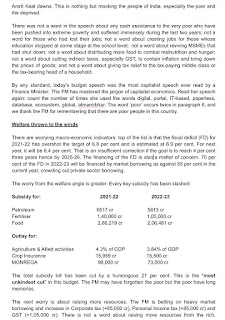
In every budget the poor get subsidies,  the rich get rebates and the middle class debates.

Thursday, January 20, 2022

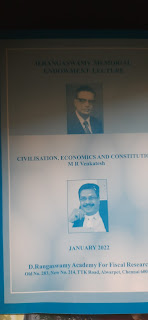
Civilisations, Economics and the Constitution - Dr M R Venkatesh


Anusha Srinivasan Senior Partner and daughter of D Rangaswamy,  in the Memorial Lecture, it made her feels taller and emotional lecture. A person with lot of wit, wisdom, there is a book on him called a compassionate accountant. 

Dr M R Venkatesh, CA in 1992, 2018 awarded doctorate by Shastra University, practising advocate. Authored and published several book. He speaks on 'civilisation, economics and constitution'. He said he was humbled and privileged to address the audience from where he had listened to so many people. 


Now to the subject proper,  'civilisation, economics and constitution', fascinating that debates are held without ill will. Fascinating, illuminating people from diverse walk of life wrote the constitution. It is concerning that aspect of public life, that all are passionately involved. At the time of Independence, Nehru a known agnostic, who never spoke about soul of people, used the phrase soul of nation. 

14th of 2022 as I got the book only on 4th of Feb.


"Long years ago we made a tryst with destiny, and now the time comes when we shall redeem our pledge, not wholly or in full measure, but very substantially. At the stroke of the midnight hour, when the world sleeps, India will awake to life and freedom. A moment comes, which comes but rarely in history, when we step out from the old to new, when an age ends, and when the soul of a nation, long suppressed, finds utterance...

...The ambition of the greatest man of our generation has been to wipe every tear from every eye. That may be beyond us, but so long as there are tears and suffering, so long our work will not be over. And so we have to labour and to work, and work hard, to give reality to our dreams. Those dreams are for India, but they are also for the world."

An excerpt from Jawaharlal Nehru's Tryst of Destiny speech, August 15, 1947

What is the soul of nation? Bushido : Bu-Shi-Do : The soul of Japan. There are different civilisations in the world driven since 1776 and 1789 resolution of America and France - and there would be clash of civilisation - would there be clash of the souls as well? West is a compass driven civilisation, others are determined by geography. Nations wanted sovereignty and freedom. American's civilisation, wanted absolute freedom. French wanted equality, liberty and fraternity. Freedom and Equality are antithesis. America today, is following more of French ideologies. 

Core of our issues and how we have created our Macro Economics. - 5th Dec. 1947, based on Nandini Sarkar report, tax structure was decided and implemented based on 1935 Govt. of India act. We cannot fix an economic policy for future generation to follow - Ambedkar said. The term Welfare state, which is not in the constitution, crept into the judgment. London School of Economics have a secret document by Labour party, for development of London, found in Hitler's bunker. First we became socialist country, we became obsessed with tax, and felt all the rich are villains. This socialism did not find a great landing, and Animal Farm movement was started. 1990's we had our liberalisation and we started progressing. World Economic Forum - WEF wants to bring back, Wealth tax, inheritance tax, if we go by history, taxes have created broken democracy. Roman emperor fall, was because of the inefficient democracy. Taxes have never helped any country to prosper. 

People always thought of duties and not rights. People happily went to the gallows. We are a nation, where the state have always been residual. Privacy is the fundamental right, but you want things delivered to your bedroom free of cost. Unfortunately this part - 'what is the duty of the state?' Article 12 only say what is a state, but don't define the duties. Then what you do? You tax people to a limit beyond which you cannot. Then you keep borrowing. If you have equal assets, it's fine, but when liabilities are not represented by assets, its risky. We do not know what is the exact position of each states. Single largest expenditure is salary, wages and pension - around 40%, 12% is interest. We should not pass on the liability to the next generation, irrespective of we giving asset or not. Miniscule Govt employees are sucking up huge percentage of the state revenue , disproportionate to their duties and responsibilities,  in the name of welfare state leaving very little for the development , resulting in large percentage of the population remaining poor despite their long years of hard work.

Robust individualism for the poor , and socialism for the rich is where we are. We have to see if the core mechanism of rights given, is workable from economic perspective. Article 292 - There must be a sealing for debts. Most abused act is the budget. We have always exceeded the fiscal deficit, revenue deficit is far more dangerous year of year since 1980. Socialism has failed India. Recklessness has paved way into lives. We cant bear this in silence. We need to proactively educate govt. Rajaji said it is easy to govern India, if we make people understand the duties. We have to go back, and make amends. We are oblivious to the effect this is having on economy. 

We have to draw from spirituality. When we look inward, we will derive strength. We have been looking out for strength. We should take best practises from everywhere in the world. We were prosperous civilisation upto 18th century. India was a sustainable prosperous civilisation. Spirituality was the soul of civilisation, with rule of Dharma.  We should not be carbon copy of the west. There should be a positive list and negative list for the states on what that can be done and not. Politicians promise, money to be paid - from our money. 

Solutions has to come from all of us, these are the thoughts. 

MRV's speech was shining light on certain dark spaces in our economy which was not seen hitherto and given its due attention.. Memorable, memorial lecture. Confessed, the thoughts expressed, were not learned in the classroom. It is way above. 

Huge topics, how are these going to be connected? Fundamental thing - 

  • Dimension to look at taxation , public policy and nation by looking at the souls. 
  • Civilisation of duties - is a timely call, and we need to participate in the nation's growth. Research should touch the soul of the nation. 

This was followed by unveiling of Flying High - 2 in the next post.  

Sunday, May 30, 2021

Soft Power & American Economist Nouriel Roubini's predictions


Craze around American way of things, lifestyle, around few stars you can't measure it, you cant put your hand over it, but you can feel and sense it, you can exert it. It is the ability to get what you want through attraction than coercion. How did they sell the American Dream? Through Hollywood. People want American culture - though an oxymoron. 

Film's are made  to entertain us. American superhero's step up to save the world, and Washington is projected as the harbinger of world peace. In American moves first Russia and now China is the villain. They are in tune with Geopolitics. While Indian films show falling in love with someone from the enemy country all we care for masala, entertainment. Bollywood can do what it want. Hollywood gives grant for filming in the country, but India don't. Hollywood can shoot at NASA and also include logo. But India don't offer symbiosis or incentives. 

The film industry is recession proof, and is watched globally. People outside India talk about Indian films. We are called the land of Bollywood. Bollywood is powerful and it is fact. But It's a private industry. China is pushing the narratives with science. London invited James Bond to promote Olympics, what is stopping India? 

Interestingly, these soft power is becoming the world power in real. 


https://www.project-syndicate.org/commentary/greater-depression-covid19-headwinds-by-nouriel-roubini-2020-04?utm_term=&utm_campaign=&utm_source=adwords&utm_medium=ppc&hsa_acc=1220154768&hsa_cam=12374283753&hsa_grp=117511853986&hsa_ad=499567080225&hsa_src=g&hsa_tgt=aud-963711450924%3Adsa-19959388920&hsa_kw=&hsa_mt=b&hsa_net=adwords&hsa_ver=3&gclid=Cj0KCQjw78yFBhCZARIsAOxgSx1tEwHznKWdtjSOOw6Y_jYdAXviJmdG-LY75ecfrkOxq6TML9z-m3oaAi_CEALw_wcB&barrier=accesspaylog

While there is never a good time for a pandemic, the COVID-19 crisis has arrived at a particularly bad moment for the global economy. The world has long been drifting into a perfect storm of financial, political, socioeconomic, and environmental risks, all of which are now growing even more acute. Even if the Greater Recession leads to a lackluster U-shaped recovery this year, an L-shaped “Greater Depression” will follow later in this decade, owing to ten ominous and risky trends.

The first trend concerns deficits and their corollary risks: debts and defaults. The policy response to the COVID-19 crisis entails a massive increase in fiscal deficits – on the order of 10% of GDP or more – at a time when public debt levels in many countries were already high, if not unsustainable. Worse, the loss of income for many households and firms means that private-sector debt levels will become unsustainable, too, potentially leading to mass defaults and bankruptcies. Together with soaring levels of public debt, this all but ensures a more anemic recovery than the one that followed the Great Recession a decade ago.

A second factor is the demographic time bomb in advanced economies. The COVID-19 crisis shows that much more public spending must be allocated to health systems, and that universal health care and other relevant public goods are necessities, not luxuries. Yet, because most developed countries have aging societies, funding such outlays in the future will make the implicit debts from today’s unfunded health-care and social-security systems even larger.

A third issue is the growing risk of deflation. In addition to causing a deep recession, the crisis is also creating a massive slack in goods (unused machines and capacity) and labor markets (mass unemployment), as well as driving a price collapse in commodities such as oil and industrial metals. That makes debt deflation likely, increasing the risk of insolvency.

A fourth (related) factor will be currency debasement. As central banks try to fight deflation and head off the risk of surging interest rates (following from the massive debt build-up), monetary policies will become even more unconventional and far-reaching. In the short run, governments will need to run monetized fiscal deficits to avoid depression and deflation. Yet, over time, the permanent negative supply shocks from accelerated de-globalization and renewed protectionism will make stagflation all but inevitable.

A fifth issue is the broader digital disruption of the economy. With millions of people losing their jobs or working and earning less, the income and wealth gaps of the twenty-first-century economy will widen further. To guard against future supply-chain shocks, companies in advanced economies will re-shore production from low-cost regions to higher-cost domestic markets. But rather than helping workers at home, this trend will accelerate the pace of automation, putting downward pressure on wages and further fanning the flames of populism, nationalism, and xenophobia.

This points to the sixth major factor: de-globalization. The pandemic is accelerating trends toward balkanization and fragmentation that were already well underway. The United States and China will decouple faster, and most countries will respond by adopting still more protectionist policies to shield domestic firms and workers from global disruptions. The post-pandemic world will be marked by tighter restrictions on the movement of goods, services, capital, labor, technology, data, and information. This is already happening in the pharmaceutical, medical-equipment, and food sectors, where governments are imposing export restrictions and other protectionist measures in response to the crisis.

The backlash against democracy will reinforce this trend. Populist leaders often benefit from economic weakness, mass unemployment, and rising inequality. Under conditions of heightened economic insecurity, there will be a strong impulse to scapegoat foreigners for the crisis. Blue-collar workers and broad cohorts of the middle class will become more susceptible to populist rhetoric, particularly proposals to restrict migration and trade.

This points to an eighth factor: the geostrategic standoff between the US and China. With the Trump administration having made every effort to blame China for the pandemic, Chinese President Xi Jinping’s regime will double down on its claim that the US is conspiring to prevent China’s peaceful rise. The Sino-American decoupling in trade, technology, investment, data, and monetary arrangements will intensify.

Worse, this diplomatic breakup will set the stage for a new cold war between the US and its rivals – not just China, but also Russia, Iran, and North Korea. There is every reason to expect an upsurge in clandestine cyber warfare, potentially leading even to conventional military clashes. And because technology is the key weapon in the fight for control of the industries of the future and in combating pandemics, the US private tech sector will become increasingly integrated into the national-security-industrial complex.

A final risk that cannot be ignored is environmental disruption, which, as the COVID-19 crisis has shown, can wreak far more economic havoc than a financial crisis. Recurring epidemics (HIV since the 1980s, SARS in 2003, H1N1 in 2009, MERS in 2011, Ebola in 2014-16) are, like climate change, essentially man-made disasters, born of poor health and sanitary standards, the abuse of natural systems, and the growing interconnectivity of a globalized world. Pandemics and the many morbid symptoms of climate change will become more frequent, severe, and costly in the years ahead.

These ten risks, already looming large before COVID-19 struck, now threaten to fuel a perfect storm that sweeps the entire global economy into a decade of despair. By the 2030s, technology and more competent political leadership may be able to reduce, resolve, or minimize many of these problems, giving rise to a more inclusive, cooperative, and stable international order. But any happy ending assumes that we find a way to survive the coming Greater Depression.

In May 2020, within two months of Covid lakhs of people lost their job, which would be crores. There could be food shortage.  People will reduce their spend on luxuries. Technology and AI will replace human labor and pay would be hourly.  Epidemics will be recurring again. The world would be divided into two sides one supporting America and other China as they are strong with technology - both having economic warfare. So the third world war, need not be with the use of arms, but it could be in other ways. 

Monday, February 01, 2021

5 Trends to guide India's strategy By Gravitas Plus

The global economic order is changing. There are opportunities for radical reform. As  Nirmala Sitaram unveils IndiaBudget2021,  @palkisu presents in GravitasPlus  how does New Delhi plan to secure its place in the new global framework? Gets you 5 trends that should guide India's strategy.


This time last year, the world was a different place. The fears of Virus going global destroying the economy became true, with recession hitting all 5 continents. There were insolvency and closures. Global FTI's collapsed. We do not want history and China to repeat. Global GDP is forecasted to expand. India is targeting to be 5 trillion economy and need a GDP above 10%, we need to realign our priority. Need to 

1) Attract companies leaving China. Countries are looking to diversify supply chain and new 

2) Diversify economy: Tourism, real estate, project standing out is Neom in Saudi ; Dubai has entered space, 

3) Made in America: Trade war with China and Pandemic made many loose job in China, so Biden wants, America tax payers money, to be used to buy American goods, to be paid to American workers, who make American parts. This is said to revitalize the manufacturing sector. They are planning to look inward. India must strengthen its ties with America.

4) Lethiam is the new oil - used in batteries in electronic vehicle. Argentina, Chilie and Bulivia together they form the Lethiam triangle with 50% . India has set up a company in 2019 to buy Lethiam suppy, to have giant stock pile - Khanij Bidesh India Ltd. was set up in collaboration with Nalco, Hindustan Copper, and Mineral Exploration Ltd. 

5) Preparing for the future: E Vehicle manufacture to be up. Planning to be largest EV market. Help reduce pollution. Online market is expected to grow to 30% to USD 200 billion by 2026; Morgan Stanley. FDI increase in 2020. 

Indian Economy is seeing a V shape recovery. Looking at global trends, that will secure India's place in the future. 

WION -The World is One News, examines global issues with in-depth analysis. WION's Palki is the only channel and person that can uplift "Indian Media" ratings.

Hope.

Budget 2021: Aatmanirbhar Barat Ka Budget


Nirmala Sitharaman had ditched the long-standing tradition of carrying budget documents in a leather briefcase and had gone swadeshi with a 'bahi-khata' for her 2019 Budget. For the presentation of Budget 2021, Finance Minister Nirmala Sitharaman  has switched to a 'Made In India' tablet. In her speech after the budget she mentioned:

This budget comes at a time, when all of us decide to give a greater impetus to the economy, done qualitatively, to give demand push. Two important feature is to spend big on infrastructure - roads, bridges, power etc and second is to attend to the need of the health sector. Capacity building in health, like establishing of labs, National Institute of Virology, districts having better health care.  Agriculture infrastructure development is in focus. 

Reforms in financial sector, disinvestment to continue, LIC to have IPO, Insurance sector to open for 74% FDI; in order that bank books are cleared, capital infusion was being done, formulation   - holding company like structure is being created to help NPA's as banks only had provisioning, for funding the infrastructural requirements development finance instution is being created. DFI is being created with lessons learned from IDBI. In future it will be open to private sector. We are cleaning up Government's own books as well. Accounts are more transparent and open. Capital expenditure was reviewed but spending was encouraged, and done, borrowing increased. Fiscal deficit which was 3% has gone upto 9%, We have spend, we have spend and we have spend. Pure glide path has been created for Fiscal deficit. There are specific items as well. 

PM in his speech after the budget said, the budget is neither reactive or active, but proactive budget. Focus is on  Wealth and wellness.  Vikas - all round development for Atmanirbar Bharath continue to be the focus. Reserach and Development is given a priority and Unexplored potentials are looked at. 


In the heart of this budget is the village and agriculture. Ease of living for Individual, investor, industry and infrastructure is aimed at - so lot of changes will happen - The end result may take time, project completion may happen later, but demands will be immediate with more jobs etc. 


"At 11 AM today, almost everyone expected a Shakespearean tragedy to unfold in the central hall of the Parliament, and a pall of gloom to surround the budget speech. The FM put paid to everything within the first thirty minutes or so with announcements that thundered spends by government far exceeding the most optimistic expectations.


With her listing out of the fairly critical reforms in the financial sector, infrastructure outlays, and opening the insurance industry to additional foreign investments, the Sensex already on light wings got more aviation fuel. While it was quite expected that TamilNadu and West Bengal will get more attention than usual, the pointed announcements of significant infrastructure investments should make the industry in the respective states quite energised. 


The fiscal deficit of 9.5% for the FY 2021 carries a spend of an additional Rs 4.6 lac cr for the current year over the budgeted spend of little over Rs 30 lac cr. The estimate for next year which is approx Rs 35 lac cr should be appreciated in this light. The budgeted borrowing of Rs 12 lac cr allows for additional allocations to the States and factors in significantly higher spend on health care almost touching Rs 2.5lac cr for the FY 2022. The numbers toted out regarding spends on MSP compared to what the previous regime did has stolen the thunder out of the farmers fight over the new laws.


The purported push for privatisation and asset monetisation are the other cornerstones of the current budget. There have been pointed criticisms that the government was slow off the block in the current year and missed the market buoyancy to hawk off its assets. Hopefully, the present budget should keep markets up for more time and give the government an opportunity to monetise assets at rich valuations.


The moderations in customs duty rates is encouraging as some of the changes should help industrial inputs are reasonable rates and improve competitiveness and keep inflation low in the country. There is always worry about fine prints in the budget documents but barring some corrective  amendments to tax procedures there is little by way of an unpleasant surprise on the taxation front. Thankfully Covid bond or cess as feared by the market rumours didn’t materialise leaving more smiles on the face of everyone when the speech ended. While it is difficult to please all, perhaps there are exceptions when a Nirmala in a red saree presents the country’ budget!!"

CA. V Ranganathan, formerly with EY

The Budget: 99 touch points by V.Pattabhiram


*Top 100 Highlights of Historic Budget 2021 by FM*


1. No tax returns for Senior Citizens, age 75 years and above who have pension and interest income

2. Income Tax returns will have prefilled data from capital gains etc. To ease compliance for taxpayers, details of salary income, tax payment and TDS are prefilled currently

3. Faceless Income tax Appellate Tribunals National faceless ITAT centre to be set up

4. Reduce time limit for reopening of tax assessments to 3 years. Reduction in Time for Income Tax Proceedings – Presently an assessment can be opened in 6 years, and in serious tax fraud cases for up to 10 years. FM proposes to revise this limit for reopening of assessments to 3 years from the present 6 years

5. Tax Audit threshold of turnover further increased for digital transactions to 10 crores

6. Dispute Resolution Panel for small taxpayers

7. Advance tax on dividend to accrue only after it is declared.

8. Affordable housing is a priority area Rs1.5 lakh for loans to purchase affordable house is now extended by one more year

9. To further extend efforts towards unorganised labour force, I propose to launch a portal to collect relevant information on workers, building/construction workers among others

10. To enable deduction of tax on dividend income at lower treaty rates for FPIs

11. India FY21 budget deficit is said to be 9.5% of GDP. FY’21 fiscal deficit (Revised Estimate) pegged at 9.5% of GDP; fiscal deficit seen at 6.8% for FY22

12. India is said to estimate FY22 expenditure at about Rs 35 lakh crore.

13. 11,000 kms of national Highway to be Completed

14. Divestment target for FY22 at Rs 1.75 lakh cr. Asking Niti Aayog to work on the next list of PSU cos that could be taken up for divestment. Other than IDBI Bank, two other PSBs and one general insurance company to be divested in FY22

15. Introduce Investor Charter as a right of all investors across financial instruments.

16. 100% Electrification of Rail Routes by DEC 2023.

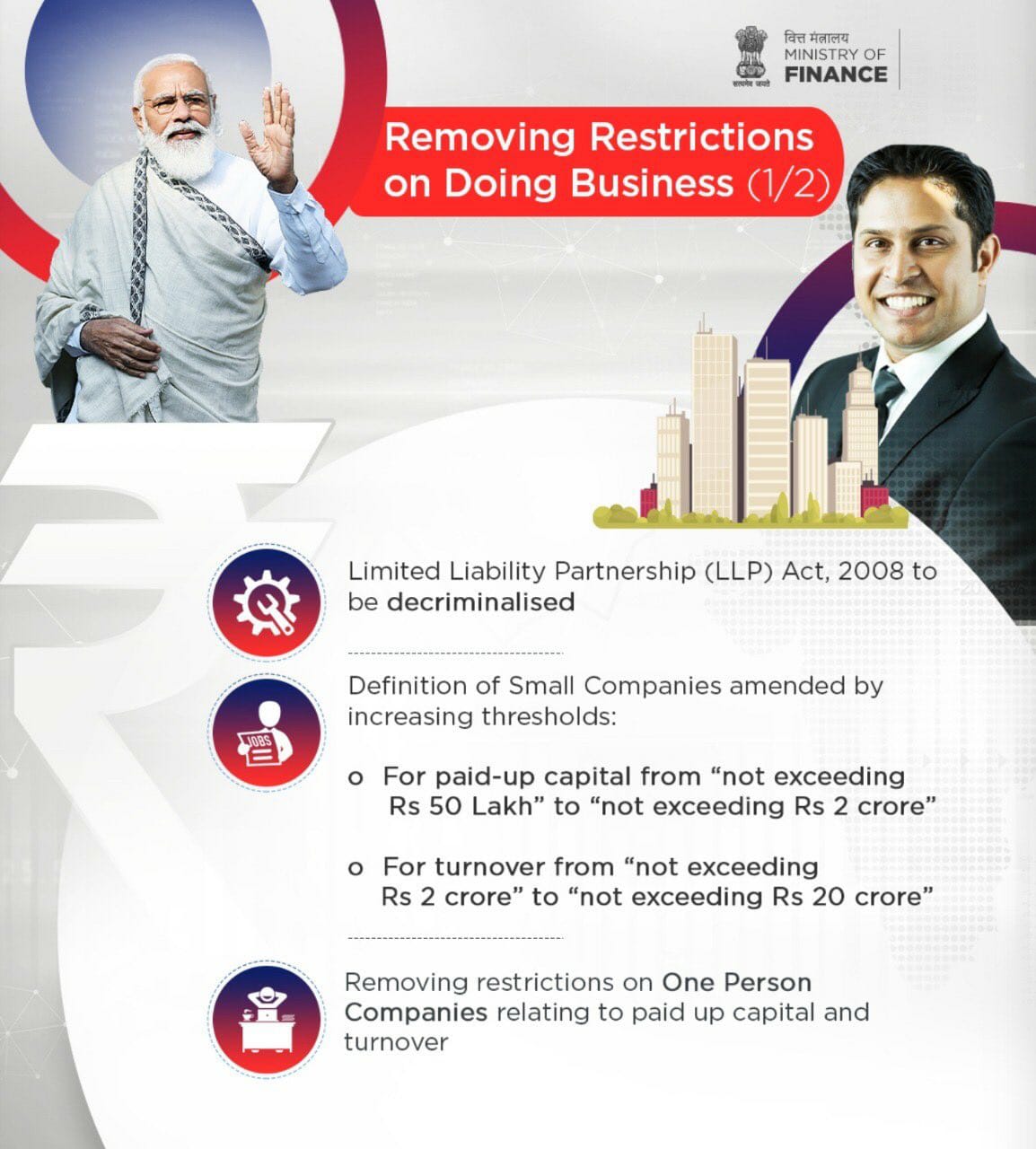
17. Decriminalisation under LLP Act Small Company definition changed, One Person Company revamped will be Big Boost to Startups

18. NRIs to be allowed to set up One Person Companies

19. The total estimate of all relief measures announced by govt & RBI so far is Rs 27.1 lakh cr (13% of GDP) in Covd19

20. Forthcoming census will be a digital census, allocating Rs 3768 crores for the exercise

21. The National Statistical Office has projected a 7.7% contraction in GDP in 2020-21.

22. Through the past year, the Finance Minister announced a Rs 30-lakh-crore plan, in ‘mini-budgets’ to beat Covid

23. Aim to double farmers income. The total financial impact of all AatmaNirbhar packages including measures taken by RBI was estimated to be about Rs 27.1 lakh crores

24. A portion of the agricultural fund will be allocated to APMC for furthering their infrastructure

25. New scheme called PM Aatmanirbhar Swastha Bharat to be launched, outlay of `64,180cr over 6 yrs

26. Announcing a voluntary scrapping policy to phase out polluting vehicles. Vehicles to undergo fitness tests after 20 years for personal vehicles and 15 years for CVs

27. Jal Jeevan Mission Urban to be launched at outlay of Rs 2.87 lakh crore.

28. 17,000 rural and 11,000 urban health and wellness centres to be set up.

29. India has two COVID-19 vaccines available and we expect two more vaccines soon

30. A vision for Atmanirbhar Bharat in part of Sitharaman’s first part.

31. FY22 budget proposals based on six pillars namely Health & Well-being, Inclusive Development Human Capital, Innovation and R&D, Physical & Financial capital and infrastructure, Minimum government, maximum governance

32. FY22 outlay (budget estimate) for health & well-being up 138%, is Rs 2,23,846 cr.

33. Scheme of mega invt textile park will be launched in addition to PLI scheme, 7 textiles parks to be unveiled over 3 years. Rs5 lakh cr will be lent by DFI in 3 years time

34. Professionally managed development financial institution (DFI) will be introduced with an allocation of 20,000cr

35. Asset monetisation dashboard will be created to provide clarity to investor Monetization of gas pipeline of GAIL, HPCL planned

36. A scheme of Mega Investments Textile Park will be launched in addition to PLI Scheme which will create world class infrastructure with plug & play facilities to enable global champions in exports

37. To tackle the problem of air pollution, propose, Rs 2200 crore for 42 urban centres; also announcing a vehicle scrapping policy towards reducing vehicular pollution

38. Rs. 2.86 Cr. Household tap connection to be established.

39. For 2021-22; capital expenditure seen at Rs 5.54 lakh cr, +34.5% increase YOY

40. 3500 km of national highway work being planned in Tamil Nadu at an investment of Rs 1.3 lakh cr

41. FY21 capital expenditure seen at Rs 4.39 lakh crore

42. Rs 44,000 crore under capital expenditure to be given to Department of Economic Affairs in FY22

43. Over and above this, Rs 2 lakh crore will be provided to states and autonomous bodies to nudge their expenditure.

44. Rs 1.03 lakh for highway project for Tamil Nadu

45. FY 22 allocation for Railways at Rs 1,10,055cr

46. Highway works proposed: 3500kms corridor in TN 1,100km in Kerala at investment of Rs 65,000 cr 675km in West Bengal at cost of Rs 95,000 cr 1300 kms in Assam in coming 3 years

47. Over 13,000 km length of roads at a cost of Rs 3.3 lakh cr has already been awarded under Rs 5.35 lakh cr Bharatmala project of which 3,800 kms have been constructed

48. Main interventions under PM Aatmanirbhar Swasth BharatYojana include Support for Health and Wellness Centres, Setting up Integrated Public Health labs in all districts, Critical care hospital blocks, Strengthening of NCDC

49. National Monetisation Pipeline of potential brownfield infra projects to be launched. Details a few road and power assets to be transferred to NHAI, PGCIL InvITs.

50. Scheme to assist Discoms will be launched with an outlay of over Rs 3 lakh cr

51. Railway to monetise dedicated freight corridors,

52. Four Acts converged into Securities Market Code, Investor Charter Introduced to Protect Investors, Insurance Act Amended to introduce FDI and AMC to be set up to take over stressed debts of Banks

53. Propose to amend the Insurance Act, propose to hike FDI limit to 74 percent from 49 percent. Also to allow foreign ownership & control with safeguards

54. Proposes to consolidate provisions of SEBI Act, Depositories Act, Securities Contracts Regulation Act, Government Securities Act

55.

56. Proposes to change the definition of a small company under the Companies Act 2013 by increasing their threshold for paid-up capital, from not exceeding Rs 50 lakhs, to not exceeding Rs 2 crores  and Turnover from not exceeding Rs 2 crores to not exceeding 20 crores

57. Scheme for promoting flagging of merchant ships in India will be launched by providing subsidy support

58. Privatisation of one General Insurance PSU and IPO of LIC proposed

59. PM Swastha Bharat Yojana with an outlay of over Rs64000 cr

60. Govt to announce a policy for the privatisation of state-run cos & to create new list of companies for Divestment

61. Ujjwala Scheme to Cover 1 Crore more Beneficiaries

62. 100 more Dist. to be added under city Gas Expansion

63. In case of wheat, the amount paid to farmers in 2019-2020 was ₹62,802 crore and in 2020-2021 it was further increased to ₹75,060 crore

64. To provide Rs 20,000 crore in FY22 for recapitalisation of public sector banks.

65. 1.54 crore farmers benefited from MSP in paddy and what in FY21 vs 1.24 crore YoY

66. Asset reconstruction and management company to be set up for stressed assets of banks:

67. Ujjwala scheme will be expanded to over 1 crore more beneficiaries. We will add 100 more districts in the next three years to the city gas distribution network. A gas pipeline project will be taken up in Jammu and Kashmir

68. The MSP regime has undergone a change to assure price that is at least 1.5 times the cost of production across all commodities:

69. National Infrastructure Pipeline was launched with 6835 projects

70. Propose PSU Bank RECAP worth Rs. 20,000 Cr. FY 22.

71. Government sets agriculture credit target of Rs 16.5 lakh crore for FY22.

72. One-nation, one-ration plan under implementation by 32 states and union territories

73. Five major fishing harbours to be developed as hubs for economic activity

74. Micro irrigation corpus doubled to Rs 10,000 cr. Agriculture infra fund will be made available to APMCs

75. 100 new sainik schools will be set up in partnership with NGOs. There are other ‘umbrella’ structures to be created for higher education

76. For further setting up of Higher Education in Ladakh under NEP 2020, I propose to set up a central university in place

77. Provided Rs. 15,700 crore to MSME sector. MSME allocation to be doubled. Government to set aside Rs 15,700 crore in FY22. Government also proposes to reduce margin money requirement from 25% to 15% for startups.

78. Propose Rs 40000 Crore outlay for FY22 Rural Infra Fund

79. After achieving target of 8 crore LPG connections, Pradhan Mantri Ujjwala Yojana to cover another additional 1 crore beneficiaries.

80. Green scheme to be expanded to 22 perishable vegetable products

81. More than 15,000 schools in the country will be qualitatively strengthened to include all components of the National Education Policy:

82. On the recommendations of the 15th Finance Commission, a detailed exercise has been undertaken to rationalize and bring down the number of Centrally Sponsored Schemes. This will enable consolidation of outlays, for better impact

83. Enhanced outlay of ₹ 1,18,101 crore for Roads

84. 1,000 more mandis will be integrated with electronic national market

85. A scheme for tea farmers will be introduced for the welfare of women and Children in Assam

86. Proposing substantial investments in the development of modern fishing harbours & fish landing centres. 5 major fishing harbours – Kochi, Chennai, Visakhapatnam, Paradip and Petuaghat will be developed as hubs for economic activities:

87. Record sum of ₹ 1,10,055 crore to be provided for Indian Railways, out of which ₹ 1,07,100 is for capital expenditure only

88. New scheme at a cost of ₹ 18,000 crore for augmentation of public bus transport services

89. Will facilitate deployment of innovative PPP models enabling private players to finance, acquire, operate and maintain over 20,000 buses

90. Y’22 Gross borrowing target at Rs 12 lakh crore;  Need another Rs 80,000cr in next 2 months, will approach market to raise it

91. Govt proposes portal to collect info on gig-workers, building and construction workers, among others

92. Govt proposes to amend apprenticeship law to enhance opportunities for youth

93. Contingency Fund of India corpus to be raised to Rs 30,000 crore.

94. Normal ceiling for net borrowing for states at 4% of GSDP as per Finance Commission recommendations

95. Rs 1,500 cr earmarked for scheme to incentivise digital payments:

96. FM says government committed to bringing down fiscal deficit below 4.5 pc of GDP by 2025-26

97. Big boost for startups. Incorporation of one person companies to incentivize innovation in startups. Reducing residency limit for Indian citizen to set up 1 person company from 182 to 120 days

98. Govt proposes national language translation initiative

99. States to get 41 pc share of taxes as per 15th Finance Commission recommendation; govt has accepted the recommendation

100. proposes to review 400 old exemptions in Customs duties in FY22.

The comments on budgets by public figures were, there is nothing  in fact less for education. 'The vision is to sell India. It had to be one in 100 years budget.' & It's like, I couldn't fix your break, so I made your horn louder. Let's hope for the best!

The farmers have rejected the three Farm laws. The MSMEs have said that they had got no relief at all. The Trade Unions have rejected the four Labour Codes! What is reform is what the people have rejected. It is the new definition of  ‘reform’ and ‘democracy’ . According to the Survey, the top three ‘structural reforms’ were the (1) anti farmer laws (2) the new MSME definition and (3) the four Labour Codes. Chapter 2 of the Economic Survey can be summaries in three words: "Borrow and Spend"