Showing posts with label Finance. Show all posts

Wednesday, July 08, 2026

Against the Gods: The Remarkable Story of Risk” ~ Peter L. Bernstein


“Against the Gods: The Remarkable Story of Risk” by Peter L. Bernstein is a landmark book that traces the history of probability and risk management — showing how humanity moved from superstition and fate to scientific methods of quantifying uncertainty. It explains how probability theory, insurance, and financial markets evolved, and why understanding risk is central to modern economics and decision-making.

Core Themes of the Book:


Evolution of Probability

Begins with ancient gambling practices and superstition.

Highlights breakthroughs by mathematicians like Pascal, Fermat, Bernoulli, and Gauss.

Shows how probability became a tool to measure uncertainty.

Birth of Risk Management

Development of actuarial science and insurance.

Rise of financial markets and capitalism.

Role of institutions like Lloyd’s of London in underwriting risk.

Risk in Modern Society

Application of probability in economics, finance, engineering, and public policy.

How risk management influenced events like the Industrial Revolution and Great Depression.

Modern challenges: environmental hazards, technological failures, systemic financial risks.

Human Behavior & Risk

Explores psychology and emotions in decision-making.

Introduces concepts like expected utility and regression to the mean.

Shows how rational models often clash with human irrationality.


Bernstein’s book is not just about mathematics — it’s about how risk defines progress. By learning to measure and manage uncertainty, humanity unlocked insurance, investment, and innovation. It’s widely regarded as one of the most influential books in finance and economic history.


As you move up the pyramid, both risk and potential return increase, while safety and stability decrease.
The goal is to balance your portfolio wisely — combining secure base investments with moderate and high‑growth options for long‑term wealth creation.


This infographic captures Bernstein’s central message: risk moved humanity from fate to forecast. By learning to measure uncertainty, we unlocked insurance, investment, and innovation — shaping civilization itself.

Friday, June 12, 2026

Finance Matters: Success Principles on Money


1. Develop a Positive Money Consciousness

Your financial success reflects your mindset. Identify limiting beliefs ("money is scarce," "rich people are greedy"), write them down, challenge them with logic, and replace them with abundance-oriented statements. Your unconscious money blueprint — shaped by parental conditioning and past experiences — determines your wealth more than talent or education ever will. Visualize your desired future as if you already have it.


2. You Get What You Focus On

Truly decide to be wealthy. Define what wealth means to you, calculate its exact cost, and become money-conscious daily. Track your net worth, define your retirement needs, and optimize your human, intellectual, financial, and civic assets. Success follows your focus — not luck, not timing, not talent.


3. Pay Yourself First

Before any expense, bill, or lifestyle cost — set aside a portion of every rupee you earn for yourself. This is the foundation of wealth-building. Automate investments and savings so they happen before you even have a chance to spend. Your future self is your most important creditor.


4. Master the Spending Game

Flip the switch from consumption to conservation. Know exactly how much you spent last year. Pay cash, reduce lifestyle costs, stop borrowing, and eliminate debt by tackling the smallest debts first while steadily increasing payments. This single mindset shift becomes your greatest financial superpower.


5. To Spend More, First Make More

Spending without earning is a fast track to struggle. Ask constantly: "What product, service, or added value can I deliver to generate more income?" Become an intrapreneur — find a need, fill it, think outside the box. Build multiple income streams through online business or network marketing with minimal initial investment.


6. Give More to Get More

Service to others is the highest-return investment strategy. Volunteer your unique skills, clarify your core values, and choose to contribute. Giving first leads to multiplied returns — career success, business opportunities, unexpected connections, and rewards far beyond what you gave.


7. Find a Way to Serve

True wealth is ultimately a choice to serve. When your financial journey is rooted in contributing to others rather than just accumulating for yourself, the impact multiplies back — in money, meaning, relationships, and legacy. The decision to serve is where magnified success truly begins.

Friday, October 10, 2025

Talk the Talk ~ Angelo M. D'Amico (48 of 2025)


This book is a practical guide for network marketers, packed with communication strategies and motivational insights. It’s designed to help readers improve their presentation skills, handle objections confidently, and build successful relationships in the world of direct selling and multi-level marketing (MLM).

 Core Themes & Structure

The book is divided into several parts, each focusing on a key aspect of network marketing:

Part One: Power Phrases & Mindset

  1. How to ask effective questions: "May I ask you a question?"
  2. Dream building and positive attitude. Why you do something is more important than what you do or how you do it.
  3. Principles of success, persistence, and commitment
  4. Building lifelong relationships and leadership skills . Let Money work for you.

Have fun! Success is a journey,  not a destination!

Affirmation

  1. I will accomplish my dreams of tomorrow by acting today.
  2. I will make a life long commitment of learning,  growing and changing. 
  3. I will make things happen,  instead of waiting for things to happen. 
  4. I consider it a privilege,  not a sacrifice,  to be able to work to accomplish my dreams.
  5. I will ask questions not to doubt the system, but to find out how I can better make it work for me.
  6. I will act with courage and boldness in all my endeavors. 
  7. Without exception,  I will do unto others, as I would have them do unto me.
  8. If I must doubt something,  I will doubt my limits.
  9. I will lead my group into positiveness and prosperity. 
  10. Each morning when I look in the mirror,  I'll be able to honestly say to myself,  "I'm a better person today than I was yesterday."
  11. I will eventually realize my biggest dreams by working daily on my littlest goals.
  12. I will become an active, eager learner by listening to tapes & CDs, reading books, attending meetings & seminars and associating upline at every opportunity. 
  13. I will live each moment of each day with passion,  conviction and courage. 
  14. I trust in my actions. I will do what needs to be done on a daily basis trusting that money will follow.
  15. I believe in myself,  in my opportunity and in The Education System.

Part Two: Contacting

Using the FORM method (Family, Occupation, Recreation, Money) to initiate conversations.

Be a Business Builder,  a product mover.

Setting appointments and making meaningful connections

16. I will read, study and practice what I will say to Prospects so that I can present the opportunity with confidence and posture. 

Part Three: Inviting

Creating prospect lists

Conducting one-on-one meetings

17. I will become successful by following the advice of my active upline, for he or she has done what I seek to do.

Part Four: Qualifying Prospects

Identifying serious candidates before presenting your business plan.

18. This is my business,  I'm treating it like a million dollar business and I'll run it on my terms , not my prospects terms!

Part Five: Handling Objections

Techniques to calm concerns and respond to 15 common objections

19 Every day I will incorporate something new, I have learned from a tape or book into my business. 

Part Six: Follow-Up

Ensuring consistent engagement and follow-through

20. I will follow up and follow through on every prospect who has listened to a tape, read a book of seen a pĺan. 

Part Seven: Building Success

Goal setting, personal growth, and financial freedom

My people are destroyed from a lack of knowledge.  

The book emphasises

21  that great networkers aren’t born—they’re made through practice and dedication. It’s a motivational toolkit for anyone looking to grow their influence and success in the network marketing space.

* Money is not the most important thing in the world. Love is. Fortunately I love Money. 

Width builds profitability. Depth builds security.  So do both simultaneously. 

There are three kinds of people. People who make things happen,  people who watch things happen and people who are wondering 'what's happening'?

Leadership is lonely,  but it pays very well.

You gotta believe in something or you'll fall for anything.  

Faith is the opposite of fear. Fear not doubt is the opposite of faith. 

SIBKIS : See it big, keep it simple. 

Saturday, October 04, 2025

Who Stole the American Dream? by Burke Hedges (46 of 2025)


Who Stole the American Dream? by Burke Hedges

This 1992 book—often subtitled The Book Your Boss Doesn’t Want You to Read—is a motivational and educational guide that critiques traditional career paths and promotes network marketing as a viable alternative to achieve financial freedom.

Book covers:

The American Dream is not dead—but it’s been hijacked. Hedges argues that corporate downsizing, job insecurity, and rising costs have made traditional paths to success unreliable. 

Network marketing offers a new path. The book positions network marketing as a legitimate and empowering business model, contrasting it with exploitative pyramid schemes. 

Financial freedom is central. True success means having control over your time, income, and lifestyle—not just climbing a corporate ladder. 

Chapter Breakdown:

The book is structured into five phases, each building on the idea that the American Dream has shifted—and that individuals must adapt to reclaim it:

Introduction

Opens with a metaphorical story about loss and powerlessness, setting the tone for the book’s central question: What happened to the American Dream? 

Phase One: The American Dream

Explores the myth of the traditional dream—college, job, retirement—and questions whether it still holds true.

Phase Two: Who Stole the Dream and Why

Introduces the concept of pyramid schemes and explains the difference between illegal scams and legal network structures.

Highlights how corporate America and systemic changes have eroded job security. 

Phase Three: Why Traditional Paths Don’t Work

Discusses the failure rates of small businesses and the instability of corporate jobs.

Introduces the concept of a “paradigm shift” as a necessary mindset change.

It asks us to whisper the word 'Distribution'. 

Phase Four: The Truth About Network Marketing

Defines network marketing and explains how it works.

Offers ethical guidelines and distinguishes it from exploitative models.

Phase Five: Network Marketing and You

Encourages readers to evaluate their current path and consider network marketing as a tool for personal and financial empowerment.

Includes real-life success stories and motivational insights. 

Notable Quotes from Burke Hedges

“Did you know that 90% of all small businesses fail in the first year?” — A stark reminder of the risks in traditional entrepreneurship. 

“In any other business, the business ends up owning you. Not in Network Marketing.” — Emphasising freedom and ownership. 

Friday, October 03, 2025

Cash Flow Quadrant ~ Robert Kiyosaki (45 of 2025)


Cashflow Quadrant is the sequel to Rich Dad Poor Dad, and it expands on the idea of achieving financial freedom by understanding how people earn money. Kiyosaki introduces a model called the Cashflow Quadrant, which categorises income earners into four types:

E – Employee: Works for someone else and earns a salary.

S – Self-employed: Works for themselves and earns by selling their services.

B – Business owner: Owns a system or business that generates income.

I – Investor: Invests money to earn passive income.

The cashflow quadrant means E/S/B/I, in which E means employee, S represents the self-employed or small business owner, B means business owner, and I means investor. So whichever quadrant our income comes from, we are part of that quadrant.

Different quadrants, different values ​​-

Each quadrant has a different value of its own. For example, the core value of the E quadrant is “security.” You will always hear people in this quadrant say – “I need a right and secure job,” “how much do we get for overtime,” and “how much do we get paid for vacations.”

The core value of the S quadrant is “freedom.” These people want freedom, and they want to do what they like. Most of the people in this quadrant are small business owners etc.

People of the S quadrant wish to be the best in their field. If the people of this quadrant stop working, their income also stops.

The people of the B quadrant look for people who are the best in their field and can work in their team. When it comes to money, the people of the B quadrant keep earning even if they leave their businesses.

And finally, the logs of the I quadrant are financially free. Money works for them, they don’t work for money. So the people of these four quadrants are different, they have different mindsets, and their values ​​are also different.

Network marketing businesses fall into the “B” quadrant. This business is for those who want to be a part of the B quadrant. Due to the unlimited income potential, it is placed in the B quadrant while the income of the E or S quadrant is limited.

If your business becomes very big, you can move from the “B” quadrant to the “I” quadrant.

The book’s central message is that financial freedom is best achieved by moving from the E and S quadrants to the B and I quadrants, where income is generated through systems and investments rather than direct labour.

Kiyosaki argues that traditional education prepares people to be employees, not entrepreneurs or investors. He encourages readers to seek financial education, take calculated risks, and build or invest in assets that generate passive income.

Chapter Breakdown:

Here’s a high-level overview of the chapters and their key themes:

Part 1: The Cashflow Quadrant

Chapter 1: Why Don’t You Get a Job?

Introduces the quadrant and Kiyosaki’s personal journey from homelessness to financial freedom. Emphasises the importance of choosing freedom over job security.

Chapter 2–6: Understanding the Quadrants

Explores each quadrant in detail, including the mindset and financial behaviours typical of each. Discusses how people can transition from E/S to B/I.

This covers the three type of business system namely:

1. Traditional corporations

2. Franchises

3. Network Marketing

Your goal is to own a system and have people work that system for you. System is a bridge to freedom. 

 There are five different level of investors namely:

Level 1: Buys depreciating assets (e.g., consumer goods); lacks financial literacy.

Level 2: Savers who avoid risk and prefer low-return vehicles like savings accounts.

Level 3: “Too busy” to learn about investing; may delegate decisions without understanding.

Level 4: Do-it-yourself investors who actively learn and manage their investments.

Level 5: Business owners who invest in the I quadrant, leveraging systems and people

Part 2: Bringing the Quadrant to Life/Bringing out the best in you:

It tells us to be the bank and not the banker. 

Chapter 6–9: Real-Life Examples

Shares stories of individuals who moved across quadrants and the challenges they faced. Highlights the importance of mentors and support systems.

Seek advise from right kind of people, depending on where you want to be. There are different kind of advisors for different type of people - Rich, Poor and Middleclass. 

Part 3: Becoming Who You Are

It starts with telling us to take baby steps. Use power of compounding, have long term plan, break it down and work towards it and believe in delayed gratificaiton. 

Chapter 11–18: Mindset and Transformation - Provides 7 steps to finding your financial fast track. 

Focuses on the psychological and emotional aspects of financial change. Encourages readers to overcome fear, develop financial intelligence, and take action.

  1. It's time to mind your own business
  2. We have to take control of our Cash flows
  3. Know the difference between risk and risky
  4. Decide what kind of  investor you want to be - One who seek problem, one who seek answers or one who seek an expert? Be all three. 
  5. Seek Mentors
  6. Make disappointment your strength
  7. The power of faith

The book reinforces the idea that financial freedom is a journey that requires education, courage, and persistence. Begin building pipeline of cashflow to support you and your family. 


Copy Cat Marketing ~Burke Hedges (44 of 2025)


Copycat Marketing 101 is a short, motivational book that explores how imitation—when applied wisely—can be a powerful strategy for achieving financial freedom. The central idea is that we all copy behaviours from childhood, but few people learn to copy the habits and systems of wealthy individuals. The book encourages readers to “copycat” successful models, especially in the realm of network marketing.


Key Concepts & Chapters

1. We Live in a World of Copycats

We naturally imitate others—from how we speak to how we behave. The book argues that this instinct can be harnessed to replicate success, not just habits.

2. What Is “True” Wealth?

Wealth isn’t just money—it’s freedom from debt, stress, and the constraints of traditional employment.

3. Linear Growth: Trading Time for Money

Most people earn income by exchanging time for money, which limits their potential. This is referred to as the “time-for-money trap.”

4. Leverage Growth: Working Smarter, Not Harder

The book introduces the concept of leverage—using systems, people, or tools to multiply your efforts and income.

5. Exponential Growth: Formula for Building a Fortune

By leveraging systems like network marketing, individuals can achieve exponential growth rather than incremental gains.

6. Synergism: Marriages Made in Heaven

Combining complementary strengths—such as people and systems—can create powerful outcomes.

7. Network Marketing: The Ultimate Copycat System

Network marketing is presented as the ideal model for copycat success. It allows individuals to follow a proven path, replicate successful behaviours, and build wealth without reinventing the wheel.


“If you want to be rich, copy rich people—not poor ones.”


The book’s moral is simple yet profound: success leaves clues. By observing and emulating the strategies of successful individuals, especially in scalable systems like network marketing, anyone can improve their financial situation.


A potpourri of sorts, this book tries to be many things at once - self-help, business, finance, and finally and mainly, network marketing. The author emphasizes on network marketing as one of the trusted ways to become rich quick and on one's own terms. As if we haven't heard it all from those impassioned distributors trying to enroll us into their pyramid selling. In fact, a simple Google search will tell you that there have been people who have become millionaires through this mode, but this is not for everyone and not for everywhere.


Filled with anecdotes, jokes and a few inspirational quotes, this book is really for those people who are frantically searching for ways and means to become rich quick. And, if you take away those quotes, anecdotes and jokes, the rest of the book could be presented neatly in two A4-sized sheets.


Saturday, September 27, 2025

Business School ~ Robert Kiyosaki (43 of 2025)


"The richest people in the world build Networks. Everyone else is trained to look for work"

The book Business School is a deep dive into the world of network marketing, which Robert Kiyosaki presents not merely as a way to earn money, but as a platform for personal development, financial education, and entrepreneurial growth.

He begins by saying network marketing business is not for everyone.  By reading the book you will know if it is for you.

Thomas Edition did not invent light bulb, he only perfected it. What they teach in school is not always right and complete. He was a business person and telegraph operator. 

"The richest people in the world build Networks,  Everyone else is trained to look for work."

Telegraph network, radio network,  TV network,  satellite network,  Amazon, Google 

Having a system and building a network makes people rich. There are many ways to become rich, but ultra-rich people create networks.


Birds of a feather come together, which means humans live with people like themselves. It can also be understood that rich people create network with rich people, and poor people network with other and more poor people.


So if you want to become rich, you have to  networking to help you become more affluent. But it is a challenging task to build your own business and convince people to have the power to do your network.


According to Robert Kiyosaki – If we want to be financially free, we should have three types of education which are – academic, professional, and financial.


Academic education teaches us to read, write and do maths; business education teaches us to work for money, and financial education teaches us how money works.


If our financial education is poor, we will work for rich people. How money works for us If it is not learned, we will have to work for money.


Building your business is the best way to become rich. Once the company is strong, or the cash flow is there, investing in other assets can be considered.


Other ways to get rich

A person can become rich by marrying another person for money.

A person can become wealthy by fraud.

You can become rich by being greedy.

People dream of becoming rich even by doing cheap things.

A person can become wealthy even by working hard.

One can become rich by being intelligent, talented, brilliant, or attractive.

Only by luck sometimes can one become rich.

One can also become rich by building a business.

Building a network marketing business is one of the newest ways to become rich.

This is a new and revolutionary way to become rich. This is a setup that gives the possibility to share wealth with anyone.


Network marketing businesses can also be called personal franchises or invisible extensive business networks. This new form of business is like a revolution because it allows sharing a property only for a few selected people for the first time in history.


There are many controversies regarding this business, and many people want to earn money quickly by fraud in this type of business.


But if you try to understand this business properly by taking a step, it is a socially responsible system of sharing wealth. This is not a good business for greedy people.


This is the only business where you can become rich, by helping others become rich.


Robert Kiyosaki says I support this business because some companies work with great compassion. If you stick with the business, the company stays with you. And some network marketing companies give the possibility of equal opportunity business.

Life-changing business education

Robert says there is no doubt about the massive earning potential of a network marketing business, but I recommend something other than such a business just for the money. Robert says the biggest reason for recommending this business is its “system of education.”


From the company’s compensation and products, it should be seen how much a company is interested in learning or training you. Skill makes us rich and not theory.


That’s why Robert named this book Business School for those who like to help people because network marketing business, real-life business school works for those who want to learn fundamental world skills to become an entrepreneur.

Cash Flow Quadrant

The renowned name in the franchise world is McDonald’s. Some people even called it illegal initially, but today McDonald’s franchise is in the big country to very remote places. The franchise is a business network comprised of multiple owners working together. In 1970, another type of network marketing business started gaining momentum.


Today this business is known as a network marketing business. This business has also been criticized a lot, but the speed from this industry, franchise, and traditional businesses are increasing continuously.


Many people need to see the rapid growth of this industry because, in most cases, it is an invisible business that does not have large sign boards like McDonald’s and Starbucks. It is hidden because it is virtual, so this business is mainly criticized by those not doing business.


In this business, we have to make people like ourselves, and our economic value will double as soon as they become like us. That’s why the success here in working hard comes not arithmetically but exponentially.


Many people found it sensible to start this business because it does not require lakhs and crores of money to do old-style business, nor does it need lakhs to buy a famous franchise. Instead, doing this business with excellent training at a meager cost is a much better idea.


To do this business, you need to open your mind because this business is increasing all over the world. The future of this industry is perfect because this industry gives you a chance to control your life and take your financial future into your hands.


Even if the old-thinking people refuse to see the growth of this industry, but still this industry will continue to grow with time.


Developing your most important business skill.


The ability to sell anything is the number one skill of any business. Selling ability is the most critical skill of B quadrant business. If you can’t sell, then forget about becoming a business owner.


We are all born with the talent to sell. In childhood, when we wanted something, we started crying; it was part of selling. In childhood, when we want something, we go to the father, then to the mother, and if we do not get that thing, we speak to the grandparents. As we grow up, this anything-seeking attitude gets lost somewhere.


Why is it important to have sales potential? How is this an essential skill in the B quadrant?


The answer is – the more we sell, the more we can buy. If you want to buy something, you have to deal with something first. That’s why selling is the number one skill.


When you apply for a job, you sell your professional skills; when you go home, every item in your house, whether it is frozen, a bed, sofa, television, and anything else, someone has sold to you.


Politicians are the biggest salesmen; the best teachers are the best salespeople. People are poor, unsuccessful, and lonely because they have failed to sell somewhere.


Whenever there is fear in us, our confidence and doubts get stronger—learning to sell means defeating your inner fear. The unique thing about network marketing business is that it gives you a chance to face your fears, deal with them, overcome them and bring out the winner inside you.

Only those people who are afraid of rejection do not want to sell. But in history, the most successful people in the world were rejected the most. So we should follow a formula in our life: Rejection and Correcton = Education and Acceleration. Education starts with rejection because we get a chance to do things better or differently next time.

Ability to sell is the most important business skill. Skill take you to places not theory. Network marketing is not for all, this book will help you know if it is for you.

We are not afraid to sell, we are afraid of rejections. Rejection = Success.

Fear of rejection,  low self esteem and lack of confidence will ruin your life.

 Success in network marketing business is teaching others to sell.

Not working for the money

People choose to work for money and not wealth. Wealth should never be counted with money but always measured in time. For example, if there is a savings of Rs 1000 and our day’s expenditure is Rs 100, then our assets are ten days. If the cost is Rs 50, then the wealth is 20 days.


Health or wealth is always according to time. Money comes in two ways: one is property, and the other is labor. To be rich, you must work for the money that comes from wealth.


But if you want to work hard for your whole life, then work only for cash, as most people do. Rich Dad says our financial statement is like our school report card, which tells our financial IQ.


People in the “B” and “I” quadrants work on building and growing their assets, not money.


Living your dreams

A lot of people don’t have dreams because dreams need money. The great value of network marketing companies is that they insist on fulfilling the dream.


Our friends or family sometimes innocently or sometimes intentionally kill our dreams. Those who have given up on their goals mainly kill the dreams of others. Rich Dad believes that it is not necessary to become rich or buy a big house, but the person we become in purchasing a significant home is significant.


Marriage and business

In Network Marketing BUS Business INESS, many couples build a business together. This business is perfect for those couples who want to do business together for some reason. These reasons are:


This business can be started together part-time.

You can work according to your schedule.

It helps industry families together.

In this industry, Most of the successful people are couples.

These businesses provide education for couples to grow and learn together.

Family business

Some of the primary benefits of network marketing business are –


It can be started at a low cost.

It does not require any formal education or degree.

These industries are equally open to all, regardless of age, gender, and race.

Companies are already providing established and successful systems that you can use to build your business.

Some companies provide excellent training and education so that you can become successful.

In this, your mentors are successful people from the industry ready to assist you in your journey.

By starting this business part-time, you can BUILD with your job.

It gives you a lot of tax benefits as a business owner, which you cannot get as an employee.

The most significant value of this industry is – it brings you closer to your family. There are many successful families in this business. Some of the qualities of the families involved in this business are –


They are all family focused

They understand the value of spending time with family

Children understand the benefits of their industry as well as their parents

They do more family vacations and business trips

Children learn passive income and financial education at an early age

Children choose to be part of the business of their own free will

In Most parents, one parent builds a full-time business, and the other with his job

The nature of this industry is to promote family togetherness and unity


The most significant gift of network marketing business is that we can build a business, not for our family, with them. The more successfully we spend with family, the more time and freedom we will have.


So, that was all in this book. Hope you would have learned the pearls of wisdom to implement in your life.


Business School Book Review

While reading Business School, I constantly reflected on my financial journey and reassessed my approach to money. Kiyosaki’s unique perspective challenged my preconceived notions and sparked a desire for lifelong learning and self-improvement in finance.


If I were to offer any critique, it would be that the book occasionally veers into repetition, reiterating certain points multiple times. However, this repetition also reinforces the core messages, which may benefit some readers who prefer reinforcement.


In conclusion, Business School is an eye-opening and motivational book encouraging readers to think differently about money, business, and wealth creation. Robert T. Kiyosaki’s insights and practical advice make this book a valuable resource for anyone seeking to break free from the traditional path and embark on an entrepreneurial journey. I highly recommend it to aspiring entrepreneurs and individuals looking to enhance their financial intelligence.

Core Themes and Values

The book outlines 10 core values of network marketing that go beyond financial gain:

True Equal Opportunity – Anyone can succeed regardless of background.

Life-Changing Business Education – Real-world skills like sales, leadership, and self-management.

Supportive Community – Friends and mentors who uplift rather than discourage.

Power of Networks – Wealth creation through systems and connections.

Leadership Development – Building influence and guiding others.

Not Working for Money – Focus on passive income and asset creation.

Living Your Dream – Aligning business with personal purpose.

Overcoming Rejection – Learning resilience through sales and outreach.

Changing Quadrants – Moving from employee to business owner/investor (Cashflow Quadrant model).

Education Over Commissions – Prioritising learning over short-term earnings. 

In Appendix he also talks about #Marriage and Business, #The Family Business  #How you can use the same Tax loop the rich use

Why Kiyosaki Advocates Network Marketing?

Although Robert Kiyosaki did not build his wealth through network marketing, he strongly recommends it as a low-barrier entry point for aspiring entrepreneurs. He believes it teaches:

Emotional intelligence through rejection and correction.

Financial literacy via practical exposure to income statements, balance sheets, and asset acquisition.

System thinking, especially the importance of duplicating successful behaviours (Metcalf’s Law).

Leadership and teaching, which are key to scaling a network marketing business. 

Not a Traditional Business School

Kiyosaki critiques conventional education for preparing people to be employees rather than entrepreneurs. He argues that Business School fills this gap by offering:

Hands-on entrepreneurial training

Mindset shifts from scarcity to abundance

Real-world application of business principles.

"Network marketing gives millions of people  throughout the world the opportunity to take control of their lives and their financial future."

Saturday, July 05, 2025

Basics of Investing

*CA S Srinivasa Raghavan*

Founder, HappyMentor.com

*This session is for educational and awareness purposes only. It does not constitute investment advice.*


 Don't try to second guess the market.


Have an advisor. Like a driver.


Have three things:

Insure first, invest next.

Have 3 investment:

1. Life Insurance

2. Medical Insurance

3. SIP


Ditto Insurance advisors.


Work for something better,but be grateful for what you have.


Key to success:


ACR. Accept the Unchangable. Remove yourself from totally unacceptable situation.

 Get out of people who can drain your energy.  Somepeople can drain and you cannot avoid. Use mudras.


 Happiness is in small things, Success is in big things, Meditation in nothing,  God is in everything.


8 Pillar Approach he would take in next session.


Monday, May 26, 2025

How to Read Your Financial Statements


https://www.youtube.com/watch?v=3jVAgr7mq9E

Never use Short term fund to use long term assets. It is suicidal.  You can't use a one year loan to buy a home. Then you will have to sell the long term asset. 

Working capital should not be used to buy long term assets - never swipe credit cards to buy long term assets. 

Current Ratio should be 2:1 or 2.5:1

There is another ration inside this called Liquidity or Quick ratio. 

Inventory, Cash and Bank Balances and Debtors are parts of Current Assets.  Of these three, Inventory is one which has no guarantee. 

Liquid is only Cash and Bank and Debtor. It should be 1:1.

Working Capital Cycle - 

Less is bad, more is worse. 

Leverage is deep and fascinating topic. To have a leverage you need to have Debt. 

Fulcrum is Fixed cost, that leads to leverage. Operating fixed cost will lead to operational leverage and financial fixed cost leads to financial leverage. Debt/interest is financial leverage. 

Companies with operational leverage is given. Financial leverage should react. If operational leverage is high, they should avoid debt. If operating leverage is low you can go for debt. 

Ratio's can be compared in two ways: Inter company and Intra company. It is meaningful only when we compare. 

Revenue minus Direct cost is Gross Profit. 

Good will/Brand Value are misunderstood items. 

Know that in your Balance Sheet you will never have your own Good will. 

Asset side is what you have purchased. You have paid someone else. 

You good will is in the Balance sheet of the buyer. 

So it is the worst item to have in your balance sheet. 

Return on Capital Employed is a key ratio ignored. Bank's will take care of Debt service coverage ratio. 

Profit margin vary from 8% to 18%. But I say don't invest until I can earn 50% return. 

To increase profit, improve the cycle not the margin. 

Business runs for bottom line and not top line. Top line is also important, without it there would be no bottom line.  Top line should be that with which bottom line is positive. 

Bottom line is Net profit and Semi bottom line is Operating profit - which is more important. Consistency comes from Operations. 

Bottom line we might manipulate for Tax. 

What is more important? Profit or Cash - Both. 

1. Ability to generate profit

2. Ability to manage Cash

Are the two pillars of business. 

Make Financially intelligent decision. This should be ultimate aim of every business. 

Key things to take care of when reading a cash flow are:

Red flag is having free cash. 

Requirement, pain area are all same globally. 

Blue Ocean: Corporate Finance. 

Saturday, April 26, 2025

Getting Started With Stock Markets

 Thanks a ton to Rashmi for getting me interested and involved into the world of stock markets. My real interest began when I was in my 10th standard. Still remember the day I got the magazine  'Dalal Street' from library and another borrower mocked saying 'what would a girl this age Understand from this'?

Soon after Harshad Mehta's scam broke out, and there was a mindset shift. For me stock market equalled to speculation, until  I read the book 'The Intelligent Investor'. 

But then I felt I was too old to start stock market trading.  Never took a demat account until now, though I had filled manual application forms years before. Then came the news of Himalayan Swami. My stock market investing dreams took a back burner after reading 'The Market Mafia' by Palak Shah.

https://arunoday.blogspot.com/2022/02/the-market-mafia-palak-shah.html?m=1


Investing in stocks means buying shares of ownership in a company. When you buy a stock, you become a shareholder, and you can earn money if the company does well (through price appreciation or dividends).

 
The key is to set your goals before you begin:

Why are you investing? (e.g., wealth building, retirement, saving for a house)

Time horizon – Are you investing for the short term (1-3 years) or long term (5+ years)?

Risk tolerance – How much fluctuation in value can you emotionally and financially handle?

 Know the basics:

Stock Exchange – Where stocks are bought/sold (e.g., NSE/BSE in India, NYSE/NASDAQ in the U.S.).

Broker – You need a broker to trade stocks. Popular ones: Zerodha, Upstox, Groww, Robinhood.

Demat Account – Holds your shares digitally.

Trading Account – Used to buy/sell shares.

Sensex and Nifty - Indexs of BSE and NSE

Key Stock Market Terms:


Equity – Ownership in a company.

IPO – When a company first sells its shares to the public.

Market Capitalization – Company size based on stock price × number of shares.

Dividends – Profits shared with shareholders.

Bull Market – Market going up.

Bear Market – Market going down.

 Types of Stock Investing:


Long-term investing – Holding stocks for years.

Short-term trading – Buying/selling based on price movements.

Dividend investing – Focusing on stocks that pay regular dividends.

Index investing – Investing in index funds (like Nifty 50 or S&P 500).

 Do Your Research, Look into:

Company financials – Revenue, profits, debts.

Industry trends – Is the sector growing?

Valuation metrics – P/E ratio, EPS, book value.

News & leadership – Management quality, market reputation.

Diversify Your Portfolio. Don’t put all your money in one stock. Spread it across:

Different sectors (Tech, Pharma, FMCG, etc.)

Different sizes (Large cap, mid cap, small cap)

Index funds or ETFs (for automatic diversification)

Start with Small Amounts:


Use a Systematic Investment Plan (SIP) to invest regularly.

Even ₹500 or $10 monthly in an index fund is a great start.

Avoid FOMO – don’t chase trends blindly.

Stay Informed, Stay Calm


Follow market news from trusted sources (Moneycontrol, ET, Bloomberg).

Ignore short-term noise.

Don’t panic during downturns—markets recover over time.

Common Mistakes to Avoid:


Blindly following tips on social media.

Timing the market.

Not doing your own research.

Lack of diversification.

Overtrading or emotional trading.

Recommended Resources:


Books:

The Intelligent Investor – Benjamin Graham

One Up on Wall Street – Peter Lynch

Common Stocks and Uncommon Profits – Philip Fisher

Apps/Websites:

Groww, Zerodha Varsity, Yahoo Finance, Screener.in


Be patient—wealth builds over time.

Learn consistently.

Review and rebalance your portfolio yearly.

Think long-term.

Getting started with stock market investing doesn’t have to be overwhelming. Here are the basic requisites you’ll need:

 1. A PAN Card (India-specific)

Required for opening an investment account and for tax purposes.

2. A Bank Account

Used to transfer funds in and out of your trading or demat account.

3. A Demat Account
This is where your stocks are held in electronic form.

You can open one with brokers like Zerodha, Groww, Upstox, ICICI Direct, etc.

4. A Trading Account
Used to place buy/sell orders in the stock market. Usually comes bundled with the demat account.

5. KYC Documents
Proof of identity, address, income (sometimes), and a photograph.

Required to comply with SEBI regulations.

 6. Basic Knowledge of Markets
Understand how stocks, mutual funds, IPOs, indices, etc. work.

Know the difference between investing vs. trading.

7. Investment Goals
Clarify if you’re investing for long-term wealth, short-term gains, retirement, etc.

This affects the type of stocks or funds you’ll invest in.

8. Risk Appetite
Understand how much risk you're comfortable with.

Stocks are high-risk, high-return; some funds or bonds are safer.

9. Capital to Invest

Even small amounts (₹100–₹500) can get you started with fractional shares or mutual funds.

10. Discipline & Patience
Stock investing requires consistency, not daily action.

Emotional control is key during market ups and downs.

3 Best Books on Stock Market


1. The Intelligent Investor – Benjamin Graham
Theme: Value investing and protecting capital
Key Ideas:
Investing vs. Speculating: Investors analyze and seek value; speculators chase trends and tips.

Margin of Safety: Buy stocks when they’re priced well below their intrinsic value—this gives you a cushion if things go wrong.

Mr. Market Metaphor: Picture the market as an emotional business partner offering you stock prices daily—sometimes he’s optimistic, sometimes fearful. Be rational, not reactive.

Defensive vs. Enterprising Investor: Defensive investors want simplicity and safety (index funds, blue-chip stocks), while enterprising investors research deeply to find undervalued gems.

Big Takeaway:
Focus on long-term value, avoid emotional decisions, and always seek a margin of safety when investing.

 This is one book, which made me feel investing is not speculation. The above synopsis is also courtesy Chat GPT.

2. One Up on Wall Street – Peter Lynch


Theme: How everyday investors can beat professionals

Key Ideas:
"Invest in what you know": Pay attention to companies, products, and trends you encounter in daily life—they can be early investment opportunities.

Categories of Stocks: Lynch classifies stocks into six types—slow growers, stalwarts, fast growers, cyclicals, turnarounds, and asset plays. Know what you're buying.

Do Your Homework: Research a company’s fundamentals: profits, debt, earnings growth, and business model.

Tenbaggers: These are stocks that grow 10x in value. Identifying them early (often from everyday observations) can be incredibly rewarding.

Big Takeaway:
Use your common sense and personal experience to find winning stocks—then do deep research before investing.

3. Common Stocks and Uncommon Profits – Philip Fisher


Theme: Growth investing through understanding business quality

Key Ideas:
Scuttlebutt Method: Learn about companies by talking to employees, customers, suppliers—get the real-world view.

15 Points to Look for in a Company: Includes factors like capable management, good R&D, sales growth, profit margins, and long-term outlook.

Buy Great Companies & Hold: Look for high-quality businesses and hold them for years, even decades.

Focus on Management Quality: A company’s leadership is as important as its financials.

Big Takeaway:
Invest in outstanding companies with long-term growth potential and competent management, then hold patiently.


Goods and Service Tax (GST)

 Module 1 - 19 pages: Background of GST And Constitutional Amendment 

• In this course, we shall be covering the constitutional background of GST,

key definitions and concepts under GST, Levy, Time of Supply, Place of

Supply, Input tax credit, Valuation, Registration, Returns, Payments,

Refund, Assessment, Appellate proceedings, Offences and Penalties, etc. 


• The objective of the course is to impart basic understanding of GST which

will be useful to professionals from finance or tax background for

compliance and record keeping required under GST.


In the current chapter, we will be covering the brief background behind introduction of GST and

constitutional background. The list of the key topic covered is summarized below :-

‒ What is Indirect Tax?

‒ Taxes subsumed under GST

‒ Why GST was introduced

‒ Benefits of GST

‒ Roadmap of GST Implementation

‒ Constitutional Background

‒ Procedure for Amendment in GST law

‒ Overview of GST legislation

‒ Rate Structure in GST Regime

‒ Key Stake Holders

‒ GST Council and its Role

‒ Exemption Carried forward from Earlier Tax regime

• Indirect taxes are the taxes levied on goods or services supplied by a person and collected from buyers.

• The tax is basically levied on the seller of the goods or the provider of the services

• The seller/ provider of services passes tax burden to the end consumer and therefore ultimately it is the end consumer who bears this in the form of Indirect Tax

• For instance, Goods and services tax means tax on supply of goods, or services or both except taxes on the supply of the alcoholic liquor for human consumption. GST on petrol, diesel and related products will be notified at later date.


Why GST?

  • Cascading effect of taxation
  • Multiple taxable events
  • Double taxation of a transaction as both goods and Service
  • Blocked credits
  • Evolving laws Frequent changes

Roadmap:


GST – The Constitution of India has been amended by the Constitution (101st Amendment ) Act, 2016 for this purpose. Constitutional framework Article 246A - Union and States empowered to enact laws in relation to GST. The powers to make laws for inter-state supplies is exclusive to Union. Article 269A provides for making law in relation to inter-state supply of goods and services.

Article 269A provides for making law in relation to inter-state supply of goods and services.

Article 279A provides for constitution of GST Council.

174 Sections, rules, clarifications, circulars. 


Present GST Tax Rate Structure is as follows**Additionally, compensation cess is levied for specified products.


Nil Rated:- Salt, Indian National Flag, duty credit scrips, etc.

5%:- Cream, Paneer, natural honey, etc.

12% :- Butter, candles, bicycles, contact lenses, etc.

18% :- Services like IT, telecom services, etc.

28% :- Pan Masala, Cigars, Cement, yachts, lottery, etc.


The process for creating GST Council started in India when the Constitution (One Hundred and Twentysecond Amendment) Bill 2016. GST Council was formed with Union Finance Minister as Chairperson, The

Union Minister or Ministers of State in-charge of Revenue or Finance for the following role:

Central or State Government grant exemptions in public interest which may be absolute or conditional
exemption. The illustrative list of exemption in earlier tax regime which were carried forward by the law maker in GST law as well are summarized below:

Type of Goods and Services Exempt under/Pre GST Regime/ Exempt under Post/ GST Regime
1. Agriculture products like fruits and vegetables, etc. Yes Yes
2. Services by way of admission to a museum, national park, wildlife
sanctuary, tiger reserve or zoo Yes Yes
3. Service provided by arbitral tribunal to specified entities Yes Yes
4. Services by a veterinary clinic in relation to health care of animals
or birds Yes Yes
5. Funeral Services Yes Yes

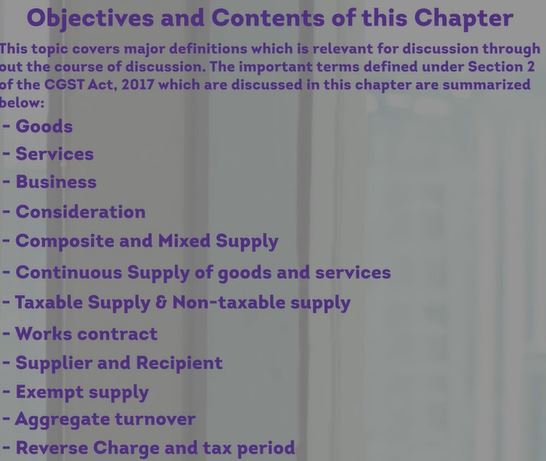
Module 2: Important Definitions. 11 Pages. 

1. Understand some definitions:


  1. 2(52) Goods cover all (1) movable property (2)  but not money and securities (3) include actionable claims like crops attached to land not severed (GST will be applicable - you might have exemption)
  2. 2(102) Services (1) anything other than goods (2) exchange of money (3) facilitating or arranging transaction in securities. 
  3. 2(31) Consideration - (1) Payment made or to be made by money or otherwise even grants (2) Advance deposit only if there is a consideration
  4. 2(17) Business (1) any trade, commerce, manufacture (2)  provision by club, association, society  (3) admission to premises
  5. Composite supply - Bundled. One principle umbrella and multiple others. 
  6. Mixed supply 2(74) - Single price - different products with different GST rate - whatever the highest rate that would be applicable on other supplies. Example: Mobile with charger, earphone and other accessories (BOGIF - Buy one get one free will not fall in either 5 or 6)
  7. Continuous supply of Goods and another for Continuous supply of Services.
  8. Taxable and Non Taxable supply 2(18) and 2(78) Not covered example petroleum, liquor, Schedule 3. 
  9. Works contract - Immovable property
  10. Recipient 2(39) - making payment, if not taking delivery or service
  11. Supplier 2(105) - supplying goods/services or agent
  12. Exempt Supplier 2(47) - Supply of any goods or services or both which attracts nil rate of tax, Wholly exempt from tax under section 11, or under section 6 of the IGST Act, Includes non-taxable supply
  13. Reverse Charge Section 2{98}: Liability of tax payable by recipient of notified goods or services
  14. Aggregate Turnover Section 2{6}: Very important definition - as based on it it would depend if you need to take registration? 
    1.  Aggregate value of all taxable supplies (excluding reverse charge)
    2.  Exempt supplies
    3. Exports of goods/ services
    4. Inter-state supplies for same PAN 
  15. Tax Period Section 2{106}: Period for which the return is required to be furnished; Monthly, quarterly, annual returns are to be files. 
Module 3: Concept of supply under GST. 7 Pages.


Pre GST event: Exercise - taxable event was manufacture; VAT - Sale; Service - Event
All these events combined and is called Supply. 

8 limbs and 2 provisio. 

  1. Sale - ownership change
  2. Transfer  - no change in ownership; goods moving from one branch to other
  3. Barter 
  4. Exchange
  5. License
  6. Rental
  7. Lease
  8. Disposal - Depreciated assets
For consideration, in the course of business. 

Proviso:

  1. Import of service
  2. Schedule 1 items - supply without consideration. 
Supply is an inclusive definition. 

Supply - Schedule 1


Supply - Schedule 11

Goods:

Activities to be treated as supply of goods
  • Transfer of title in goods
  • Transfer of title where property will pass at future date
  • Goods cease to form part of business assets
  • Transfer of assets where person ceases to be a taxable person
  • (except where as a going concern or by a personal representative)
  • Supply of goods by unincorporated association to its member

Supply of Services:


Supply- Schedule III: Supply of neither goods nor services

Sec. 7(2)(b) Such activities or transactions undertaken by

• Central government

• State government

• Any local authority

where they are engaged as public authorities. (as may be notified)


Module 4: Registration under GST 14 pages

Registration is the prerequisite for doing a business, but not all need to. Section 22 to Section 30 discuss registration. 

If business in 15 states - need registration in all the states

Turnover:  

Supplier of Goods

  • Aggregate turnover > 40 lakhs (intra state turnover)
  • Aggregate turnover >10 lakhs (intra state turnover for suppliers located in special category states*) 

Supplier of services

  • Aggregate turnover > 20 lakhs (inter or intra state turnover)
  • Aggregate turnover >10 lakhs (turnover for suppliers located in special category states*) 

Not liable for registration

1. Exclusive exempt supplier of goods or service

2. Where recipient is liable to pay tax under RCM

3. Certain taxpayers who are making supplies through e-commerce operator.

“Aggregate Turnover" means aggregate value of all taxable supplies (excluding value of inward supplies on which tax is

payable on reverse charge mechanism, exempt supplies, export of goods or services or both Inter-state supplies of

persons having the same PAN (to be computed on all India basis) but excludes central tax, state tax, union territory tax,

integrated tax and cess and includes all supplies made by the taxable person, whether on own account or made on behalf of all his principals

Voluntary registration

A person who is not liable for registration may still choose to obtain voluntary registration, all provisions of the Act as are applicable to a registered person, shall apply to such voluntary registered person. Benefits of Voluntary registration:

  • Availing and passing on Input tax credit
  • Good Rating under GST may help in increasing the scale of operations and adding more customers
  • Renting premises, availing loans from banks and other such business requirements will become easier for businesses that are registered

Compulsory registration


Point 8 certain people might get exemption. 

Time limit and Process of Registration

Time limit for registration

• Within 30 days from the date on which the person becomes liable

• A casual taxable person or a non-resident taxable person shall apply for registration at least 5 days prior to the commencement of business

Process of registration

• Application of registration filed by the taxable person along with Aadhar authentication

• Proper officer on receipt of application shall examine the details and if details are found in order, approve the same within seven working days

• If the application submitted is found to be deficient, communication must be made in Form REG-03 within 7 working days from date of submission of application

• Reply to the said notice shall be made in Form REG-04 within a period of 7 days from date of receipt of notice

• Where application is not approved by the officer within the due time limit, application for registration shall be deemed to have been approved.

Composition Scheme

  • Composition dealer is not allowed to collect outward tax from customers 
  • Not allowed to avail Input tax credit
  • Required to pay tax through GST CMP-08 quarterly and furnish GSTR-4 and GSTR-9A annually
  • Required to issue Bill of Supply instead of Tax Invoice

Composition scheme – Sec. 10

10(1) r/w 10(2)
Composition scheme - I
• Aggregate Turnover in preceding financial year ≤150lacs (75 lacs for specified states)
• Services along with goods can be supplied up to 10% of turnover in state (preceding financial year) or 5 lakh rupees, whichever is higher.
• Tax rate – Refer Annexure A
• Liable to pay tax under
reverse charge u/s 9(3) and
9(4) at applicable rates

10(2A)
Composition scheme - II
• Applicable for suppliers not eligible to pay tax under 10(1) r/w 10(2)
• Aggregate Turnover (preceding financial year) not exceeding 50 lacs
• Tax rate – 6% for suppliers opting or said scheme
• Liable to pay tax under reverse charge u/s 9(3) and 9(4) at applicable rates

Eligibility
• Not engaged in making any supply of goods or services which are not leviable to GST
• Not engaged in making any interState outward supplies
• Not engaged in making any supply through an electronic commerce operator required to comply with sec 52
• Not a manufacturer as may be notified by the Government
• Neither a casual taxable person nor a non-resident taxable person

10(1) r/w 10(2)
Composition scheme - I
• Aggregate Turnover in preceding financial year ≤150 lacs (75 lacs for specified states)
• Services along with goods can be supplied up to 10% of turnover in state (preceding financial year) or 5 lakh rupees, whichever is higher.
• Tax rate – Refer Annexure A
• Liable to pay tax under reverse charge u/s 9(3) and 9(4) at applicable rates

10(2A)
Composition scheme - II
• Applicable for suppliers not eligible to pay tax under 10(1) r/w 10(2)
• Aggregate Turnover (preceding financial year) not exceeding 50 lacs
• Tax rate – 6% for suppliers opting for said scheme
• Liable to pay tax under reverse charge u/s 9(3) and 9(4) at applicable rates

Eligibility
• Not engaged in making any supply of goods or services which are not leviable to GST
• Not engaged in making any interState outward supplies
• Not engaged in making any supply of services through an electronic commerce operator required to comply with sec 52
• Not a manufacturer as may be notified by the Government
• Neither a casual taxable person nor a non-resident taxable person


Documents needed:


Cancellation of registration


Revocation of cancellation of registration

• Application for revocation: Any registered person whose registration is cancelled by the
proper officer on his own motion, may apply to such officer for revocation of cancellation of
registration in such manner, within such time and subject to such conditions and
restrictions, as may be prescribed.
• Acceptance or Rejection of application by proper officer: The proper officer may in
such manner and such period as may prescribed, by order, either revoke cancellation of
registration or reject the application
Provided that application for revocation of cancellation of registration shall not be rejected
unless the applicant has been given an opportunity of being heard.

Module 5 PPT 35 Concept of Place of Supply under GST. 

Place and location determine nature of supply i.e. interstate or intra state. 

Any interstate supply IGST will be applicable and intra state it will be, CGST or SGST or UTGST depeding on the location.

Relevance of Place of Supply (POS)
• POS has been defined under IGST Act
• POS along with location of supplier determines nature of supply i.e. whether supply is inter-state or intra state

Location of recipient and supplier has been defined under GST basis place of business .

• Specific cases have been provided in law wherein levy of GST has been pre-determined. In case of supply from DTA to SEZ, IGST would be levied and same is always treated as an inter-state transaction. Similarly, imports of goods and services are inter-state supplies.


Place of Supply (POS) of goods in other miscellaneous cases:

“export of goods” with its grammatical variations and cognate expressions, means taking goods out of India to a place outside India [Section 2(5) of the IGST Act,2017]
Nature of Transaction Place of Supply
Goods supplied on board a conveyance [Sec. 10(1)(e)] Location where goods are taken on board
Import into India [Sec. 11(1)] Location of importer
Export from India [Sec. 11(2)] Location outside India

Place of Supply (POS) of goods: Bill to – Ship to (Out of India)
Nature of Transaction Understanding Place of Supply
Bill to in India –Ship to out of India
[Sec. 10(1)(b)]
• Direction given by Indian (Bill to) party
• Movement of goods outside India results transaction
into Export for the bill to party
• Principal place of business of person
giving the direction
Bill to out of India – Ship to in
India
[Sec. 10(1)(b)]
• Movement is within India, thus not export of goods
• Shipped to location not relevant for determining
place of supply
• Location outside India since the
person giving the instruction is
outside India. In such a case IGST
would be charged

Place of Supply of Services

Place of Supply (POS) of services where both supplier and recipient are located in India
POS of services shall be guided by general rule [Sec. 12(1)] as mentioned below (except in case of specific services):


Transaction: Supply of restaurant and catering services, personal grooming, fitness, beauty treatment, health service including cosmetic and plastic surgery [Sec. 12(4)]

Place of supply: Location where services are actually performed


(Not all data included)

Module 6: Time and Value of Supply PPT: 12

Time is relevant, because Tax is applicable from the time of supply on the value of supply. 


Module 7: Input Tax Credit: PPT 12

Very important topic = Cash. 
It can be utilised against output tax credit. 

Input Tax under GST

Definition Sec. 2(62) - • CGST/ SGST/ IGST/ UTGST charged on supply of goods or
services

Inclusion Sec. 2(62)

• IGST on imports
• CGST/ IGST/ SGST/ UTGST paid under reverse-charge

Exclusion • Tax paid under composition levy

Time-limit Sec. 16(4): • Earliest of filing return for September* following end of the financial year or annual return

**Under finance bill 2022, an amendment has been proposed to substitute ‘due date of filing return for September’ with ’30 November’
following end of the FY. This amendment will be applicable from such date as may be appointed by a notification

First and formost condition is that the invoice has to be raised. 


Other Conditions:

  • Invoice, debit note, self invoice, ISD invoice/credit note and bill of entry or other document prescribed in Custom Act,1962 can be used.
  • Receiver of ITC can avail credit in respect of invoices and debit notes which have been furnished by supplier in GSTR-1/ IFF and appearing in GSTR-2B
  • Banking company have an option to comply with sec. 17(2) i.e. either to reverse the credit pertains to exempt supply for example interest received or may claim 50% of ITC eligible.
  • Rule 41 of CGST Rules, 2017 have also provided provision for transfer of credit in case of sale, merger, de-merger, amalgamation, lease or transfer of business.

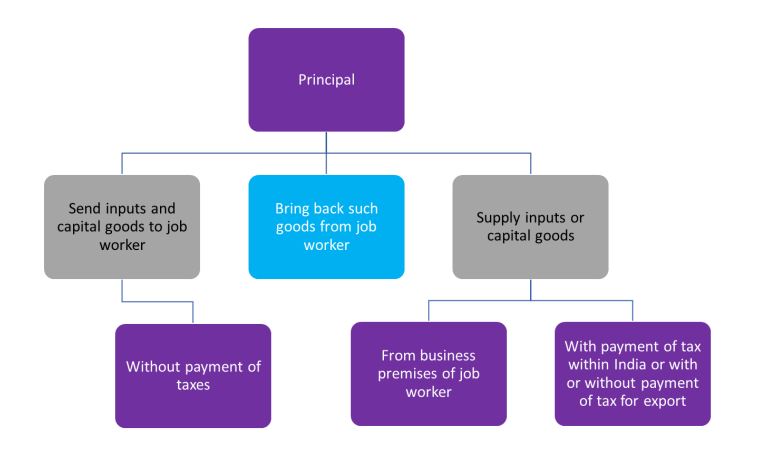
ITC – Goods sent for Job work

Job worker is not the principal, he is just doing on behalf of principle. 

Note: - Above conditions does not applies to moulds and dies, jigs and fixtures, or tools sent out to a job worker for job work.

Input: has to be return within one year. Maintain books of accounts. 
Capital Goods: Return period of capital goods is 3 years. 


This is not applicable for liquor and petroleum  and its products as they are covered separately by state. 


Formula to be applied on a monthly and yearly basis, 


keep knocking of the credit in this order. 

Mechanism to utilise to knock of the credits. 

Thumb rule - IGST must be fully utilised before utilising the other. 

Module 8: Input Service Distributor: PPT 8

Input Service Distributor means an office of a supplier which receives tax invoices towards the receipt of input services and distributes credit of GST paid to its branch offices.


Points for Consideration:

Invoice should contain:
  • Name, address, GSTIN of ISD and recepient
  • A consecutive serial number
  • Date of issue
  • Amount of credit distributed
  • Signature authorised representative
ISD shall only deal with input services. It cannot keep credits in its own books. 


Module 9:  Job Work and TDS/TCS - Page 10

Job work is supply of service. 

• Ownership of goods belongs to Principal andtreatment or process on such goods are undertaken by job worker.
• As per Schedule II of CGST Act, “Any treatment or process which is applied to another person's goods is a supply of services.” Hence, Job work is a supply of Service.
• The principal is allowed to avail credit on the goods directly sent to the job worker.

Job work - Procedure:

Inputs or capital goods can be sent by a principal to job worker without payment of tax under a Delivery Challan along with e-way bill, if applicable.
• Inputs or capital goods can be supplied from business premises of unregistered job worker if principal has added it as additional place of business.


Job Work – Other Provisions
• Principal may on intimation, send and bring back goods from “Job Worker” to any of his place of business without payment of tax provided the goods are returned within the prescribed time limit as summarized below:
• Type                                                                                    me Limit

  1. Inputs (whether completed or otherwise) - 1 year
  2. Capital Goods (other than moulds and dies, jigs and fixtures, or tools) - 3 Year
• If Inputs or Capital Goods (other than other than moulds and dies, jigs and fixtures, or tools) are not returned
within prescribed time limit, it shall be considered as deemed supply on the date when such goods were
received by the job worker.
• Waste and scrap generated during job work may be supplied on payment of tax by job worker, if job worker is
registered or by principal, if job worker is unregistered.

Tax Deducted at Source (TDS)

Person required to deduct TDS
• Department / Establishment of Central Government /State Government
• Local Authority
• Government Agencies
• Other person notified by the government
Transaction Value • Where total value of such supply of goods and / or services under acontract exceeds INR 2.5 lakhs.
• Taxable value of supply excluding GST indicated in invoice needs to be
considered for deduction.
Rate • 1% CGST + 1% SGST [2% in case of IGST] of payment made or credited
to the supplier
Non-Applicability of TDS
• If location of supplier and place of supply is in a state different from the
state of registration of the recipient
Time Limit of Payment • 10th day of the succeeding month in which deduction has been made
Interest for delayed
payment
• Interest at the rate notified, not exceeding 18% to be paid

Certificate • Certificate in Form GSTR-7A will be made available in GST portal once
return is filed
Excess / Erroneous Deposit
• Refund shall be according to Section 54
• No refund to deductor if the amount has been credited to electronic cash ledger of the deductee
Claim in Electronic Cash Ledger by Deductee
• Deductee shall claim the credit in his electronic cash ledger of the amount of deduction made by the deductor

Tax Collected at Source (TCS)

Person required to
collect TCS
• E-commerce operator (not agent) shall collect TCS on taxable supplies made
through it by other supplier, where consideration with respect to such
supplies is to be collected by the operator
Rate • 0.5% CGST + 0.5% SGST [1% IGST] of net value of taxable supplies made
through it
Net Value of Taxable
Supplies
• Aggregate value of taxable supplies of goods and/or services made through
e-commerce operator excluding supplies notified under Section 9(5) of CGST
Act and value of taxable supplies returned
Time Limit of Payment • 10th day of the succeeding month in which collection has been made
Interest for delayed
payment
• Interest at the rate notified, not exceeding 18% to be paid

Furnishing of Statement • Monthly- on or before 10th of succeeding month in Form GSTR-8
• Annually- on or before 31st December following the end of the financial year
• Rectification- before due date of filing of return for the month of September
following the end of the financial year or actual date for furnishing of the
relevant annual statement, whichever is earlier
Claim in Electronic
Cash Ledger
• Collectee shall claim the credit in his electronic cash ledger of the amount
of tax collected by the collector

Module 10: Payment of Tax under the GST Law PPT 15 pages.

Introduction

Format of Liability Register, Electronic Credit Ledger and Electronic Cash Register
• Payment of tax is to be made on or before 20th of succeeding month.
• A unique identification number shall be generated for every debit/credit made in electronic liability register, electronic credit
register and electronic cash register.
• Every taxable person shall discharge his tax and other dues under this Act in the following order:
o Self-assessed tax and other dues related to previous tax periods
o Self-assessed tax and other dues related to current tax period
o Any other amount/demand payable under section 73 or section 74
• Mode of Payments are summarized below:

  1. Internet banking
  2. Credit Card or Debit card
  3. NEFT/RTGS
  4. Over the counter (OTC)
  5. OIDAR Services - international money transfer through Society for Worldwide Internet banking


Electronic Liability Register

Applicability • This register is applicable for every person liable to pay tax, interest, penalty, late fee or any other amount
Form • GST PMT-01
Items to be Debited
• Amount of tax, interest, late fees or any other amount payable as per return
• Amount of tax, interest or any other amount payable as determined by proper officer
• Amount of tax & interest payable due to mismatch under section 42 & section 43
• Amount of interest that may accrue from time to time
Payment made to be credited • Every payment has to be made either from electronic cash ledger or electronic credit ledger
Miscellaneous
• Amount of demand debited shall stand reduced to the extent relief given by proper officer or appellate tribunal or court by way of credit in register
• Amount of penalty imposed or liable to be imposed shall stand reduced to the extent of payment made of tax interest or penalty by way of credit in register
Discrepancy
• If the registered person notices any discrepancy in the register, communicate the same to the officer exercising jurisdiction in
Form GST PMT-04


Electronic Credit Register

Applicability • This register is applicable for every registered person eligible to take ITC
Form • GST PMT-02
Items to be Debited
• Amount of liability discharge through input tax credit
• Amount of refund claimed, if any
Items will be Credited • Eligible input tax credit
Miscellaneous • If the amount of refund claimed is rejected, amount debited earlier shall be re-credited to electronic credit ledger
Discrepancy
• If the registered person notices any discrepancy in the register, communicate the same to the officer exercising jurisdiction in
Form GST PMT-04

These registers are auto populated and no manual intervention is allowed. 


Electronic Cash Register

Applicability • This register is applicable for every person liable to pay tax, interest, penalty, late fee or any other amount
Form • GST PMT-05
Items to be Debited • Amount of liability discharged through this register
Items to be Credited • Deposit made through Internet banking, credit/debit card,
NEFT, RTGS & OTC
Miscellaneous
• Any payment made in this register shall be made after generating challan in Form GST PMT-06 and his challan will be valid for 15 days.
• Where payment is made by way of NEFT/RTGS, mandate form will be generated and that mandate form shall be submitted to the bank from where payment is made and this mandate form shall be valid for 15 days.
• On successful credit of the amount to the account of the Govt., CIN will be generated by collecting bank
• On receipt of CIN, amount deposited shall be reflected in the electronic cash ledger of the concerned person
• In case any refund is claimed from this register, refund amount shall be debited in this register. If the refund claim made is rejected by proper officer, amount to the extent of rejection shall be credited to this register

Discrepancy
• If the payment amount is debited but no CIN has been generated, registered person shall communicate in Form GST PMT – 07 through the common portal to the bank or electronic gateway through which deposit was initiated
• If the registered person notices any discrepancy in the register, registered person shall communicate the same to the officer exercising jurisdiction in Form GST PMT-04


Format of Challan


Format of GST PMT-09

With effect from 1st January 2020, CBIC has inserted section 49(10), as per which Tax Payers are eligible to transfer the fund available in cash ledger balance of any Tax Head such as CGST, SGST & IGST to other Head such as SGST or IGST, CGST or IGST and CGST or SGST via filing of GST PMT-09.


Module 11: Documents prescribed under the GST law 18 pages.


Tax Invoice

Section 31 of CGST Act
• Supply by a registered taxable person under GST is to be made under a cover of “Tax invoice”
• “Tax invoice” is to be issued before or at the time of removal of goods in case of supply of goods
whereas it can be issued within 30 days of completion of services in case of supply of services
• For supply of goods, “Tax invoice” is to be issued in triplicate
• For supply services, “Tax invoice” is to be issued in duplicate
In case of continuous supply of goods, where successive statements of accounts or successive payments are involved, the invoice shall be issued before or at the time each such statement is issued or, as the case may be, each such payment is received.
In case of continuous supply of services, where the due date of payment is ascertainable, the invoice shall be issued on or before the due date of payment otherwise receipt of payment. In case, payment is linked to the completion of an event, the invoice shall be issued on or before the date of completion of that event.

E-invoicing - Overview

To automatically create invoice and curb tax evasion. 


Bill of Supply

• A registered person supplying exempted goods/services or
• Paying tax under composition scheme

Payment voucher, Receipt voucher, Refund voucher

Payment voucher : A registered person liable to pay tax in cases of supplies from unregistered vendor/ supplies that attract tax liability on RCM basis and At the time of making payment to supplier

Reciept voucher : A registered person receiving advance payment with respect to any supply of goods/services

Refund voucher :  A registered person received payment in advance, but no subsequent supply made, and no tax invoice issued.

Credit Notes and Debit Notes/Supplementary Invoices - Section 34 of CGST act.

ISD Invoices: • An input service distributor issues ISD invoices to distribute the GST ITC that pertains to different GSTIN having the same

PAN

Delivery Challan: Supply of liquid gas where the quantity at the time of removal is
not known
• Transportation of goods for job work
• Transportation of goods for reasons other than by way of supply

Tax Invoice in special cases are:

Supplier/Supply Document Requirement 

Insurer or a banking company or a financial institution, including a non-banking
financial company
Consolidated tax invoice for supply made during themonth /any other document in lieu thereof
• Serial no. is not mandatory
• Address of the recipient not mandatory
• Signature of supplier is not mandatory
• Can be issued physically or electronically
• Other information as mentioned under rule 46 is required
Goods transport agency (GTA) Tax invoice or any other document in lieu thereof
• Gross weight of the consignment
• Name of the consigner and the consignee
• Registration number of goods carriage
• Details of goods transported
• Details of place of origin and destination
• GSTIN of the person liable for paying tax whether as consigner, consignee or goods transport agency, and
• Other information as mentioned under rule 46.
Passenger transportation service
Tax invoice • Ticket in any form, by whatever name called
• Serially number is not mandatory
• Address of the recipient of service is not mandatory
• Signature of supplier is not mandatory
• Containing other information as mentioned under rule 46.
Admission to exhibition of cinematograph films in multiplex screens
An electronic ticket • Details of the recipient of service is not mandatory
• Other information as mentioned under rule 46.

Module 12: Accounts and Records Page 7

Manner, period and place to be maintained. 

Accounts and records to be maintained by every registered person

• production or manufacture of goods;
• inward and outward supply of goods or services or both;
• stock of goods;
• input tax credit availed/claimed;
• output tax payable and paid;
• goods or services imported or exported
• payment of tax on reverse charge along with the relevant documents
• advances received, paid and adjustments made thereto
• names and complete addresses of suppliers/recipients and
• such other particulars as may be prescribed

Records prescribed for Specified Cases

Supplier other than composition tax payer
• Accounts of stock in respect of goods received and supplied by him, and such accounts shall contain particulars of
opening balance , receipt, supply, goods lost, stolen, destroyed and balance of stock
• Account of tax payable, paid , input tax credit claimed
Agent
• Particulars of authorization received from principal for supply of goods on behalf of such principal
• Particulars including description, value and quantity of goods or services supplied and received on behalf of principal
• Details of accounts furnished to every principal and tax paid on receipts or supply.
Manufacturer Monthly production accounts showing quantitative details of raw materials or services used in the manufacture and quantitative
details of goods so manufactured including waste thereof.
Service provider Maintain accounts showing quantitative details of goods used in the provision of services, details of input service utilized and
services supplied.
Person executing works contract
• The names and addresses of the persons on whose behalf the works contract is executed.
• Description, value and quantity of goods or services received and utilized for execution.
• Details of payment received
• The names and addresses of the suppliers from whom he received goods or services.


Module 13 E-Way Bill PPT: 10 

01 What is the E-Way Bill?

01 What is an Electronic Way Bill?
• An electronic document that is required for movement of goods.
• It has to be generated on e-way bill portal
• A movement of goods for more than INR 50,000/- in value cannot be made by a registered person without an e-way bill

02 When E-way bill has to be generated?
When there is movement of goods:
• In relation to supply
• For reasons other than a supply
• Due to inward supply from an unregistered person

03 Objective and benefits of E-Way Bills


04 Who can generate an E-Way Bill


05 Exceptions of generation of E-Way Bill


06 Consequences of not carrying E-Way Bill


07 Validity and Cancellation of E-Way Bill


Module 14: Refund of GST: Page 25

Refunds under GST

Refund – Explanation 1 to sec. 54 – Inclusive definition
➢ Refund of tax paid on zero-rated supplies of goods or services or both
➢ Refund of inputs or input services used in making such zero-rated supplies
➢ Refund of tax on the supply of goods regarded as deemed exports
➢ Refund of unutilized input tax credit due to a higher tax rate on the input than tax rate on outward supplies 

Relevant provisions regarding Refunds

➢ CGSTAct – Sec. 54 to 58
➢ CGST Rules – Rule 89 to 97A


Cases where no refund shall be allowed

Cases where refund of unutilized ITC shall not be allowed
•In the cases other than:
oZero rated supply without payment of tax;
oAccumulation of ITC on account of inverted duty structure;
• Goods subject to export duty;
• If the supplier has availed drawback in respect of central tax or claims refund of the integrated tax paid on such supplies

Unjust Enrichment
• Every person who has paid tax to Govt. is assumed to have passed on the burden of tax, unless contrary is proved;
• As per principal of unjust enrichment, refund shall be given to person who has actually borne the burden of tax;
• Otherwise, refund is transferred to consumer welfare fund.

Non Payment of refund:
• No refund shall be paid if the amount of refund is less than ₹1,000 in each tax head separately.


Other relevant forms:

RFD-01W The applicant can withdraw the refund application during anytime before order of sanctioning of refund using RFD-01W

PMT-03 Where any amount claimed as refund is rejected, either fully or partly, the amount debited, to the extent of rejection, shall be re-credited to the electronic credit ledger under FORM PMT-03


Procedure for filing refund application on the portal
1. Under ‘Refunds’ select the tab ‘Application for refund’, select the category of refund from the following which you require to file.
2. Select the period for which you require to file refund application and click on create application. Select the refund type
3. Download the offline tool from the ‘Download offline utility’ option as available 
4. Proceed to fill in details in relation to outward supplies for which refund is to be filed. Once all the details have been filled, proceed to create file to upload the same on the link mentioned in the previous slide.
5. Proceed to upload the file generated in the previous slide to the ‘Click to upload the details of exports of goods and/ or services’ section mentioned in the below image and validate the same.
6. Proceed to fill the turnover as computed and input tax credit availed for the relevant period. Maximum amount of refund eligible will get auto-populated.
7. Amount of refund claimed should be in compliance with the latest circulars issued by government. Further, amount eligible should be punched in the‘Refund to be claimed’ tab
8. Select the bank account in which you want the refund to be received.
9. Upload the documents in supporting of the refund claim to be made.
10. Click on the mandatory undertakings and proceed to provide LUT number (in case of exports without payment of tax) and proceed to save the return.
11. Review the entire application and proceed to submit the application.
12. Post submission, affix DSC to the application, Application will be re-directed to the concerned officer for processing.


Checklist – Refund of tax paid on export of services

S.no Refund Document Checklist
1 Declaration under second and third proviso to section 54(3)
2 Undertaking in relation to sections 16(2)(c) and section 42(2)
3 Statement 2 under rule 89(2)(c)
4 BRC/FIRC /any other document indicating the receipt of sale proceeds of services
5 Copy of GSTR-2A of the relevant period
6 Statement of invoices (Annexure-B)
7Self-certified copies of invoices entered in Annexure-A whose details are not found in GSTR2A of the relevant period
8Self-declaration regarding non-prosecution under sub-rule (1) of rule 91 of the CGST Rules
for availing provisional refund

Checklist – Accumulated ITC Refund

S.no Refund Document Checklist
1 Declaration under second and third proviso to section 54(3)
2 Undertaking in relation to sections 16(2)(c) and section 42(2)
3 Statement 3 under rule 89(2)(b) and rule 89(2)(c)
4 Statement 3A under rule 89(4)
5 Copy of GSTR-2A of the relevant period
6 Statement of invoices (Annexure-B)
7 BRC/FIRC in case of export of services and shipping bill (only in case of exports made
through non-EDI ports) in case of goods

Checklist – Inverted Tax Structure

S.no Refund Document Checklist
1 Declaration under second and third proviso to section 54(3)
2 Declaration under section 54(3)(ii)
3 Undertaking in relation to sections 16(2)(c) and section 42(2)
4 Statement 1 under rule 89(5)
5 Statement 1A under rule 89(2)(h)
6Self-declaration under rule 89(2)(l) if amount claimed does not exceed two lakh rupees, certification under rule 89(2)(m) otherwise
7 Copy of GSTR-2A of the relevant period
8 Statement of invoices (Annexure-B)


Module 15: Returns: Page 62

01 Returns under GST


02 Types of returns


IFF - Invoice Furnishing Facility - small tax payers - can give invoice details on a monthly basis


03 Filing of GSTR-1
04 Filing of GSTR-3B
05 GSTR-09
06 GSTR-09C

GSTR-9: Annual Return

GSTR 9 is an annual return to be filed once in a year by the registered taxpayers under GST including
those registered under composition levy scheme but excluding Casual Taxable person, Input Service
Distributors, Non-resident taxable persons and person paying TDS under section 51 of CGST Act.
GSTR-9 consists of details regarding the supplies made and received during the year under CGST,SGST
and IGST. It consolidates the information furnished in the monthly/
quarterly returns filed during the year
GSTR-9 shall be filed on or before 31st December of the subsequent
financial year.
For instance for FY 2020-21, the due date for filing GSTR 9 is
31st December 2021

A registered person shall not be allowed to furnish an annual return for a financial year after the expiry of
a period of three years from the due date of furnishing the said annual return- Inserted vide THE
FINANCE ACT, 2023 dated 31-03-2023 w.e.f. 01-10-2023

GSTR-9 – Details to be Provided
PART I Basic details of the taxpayer. This will be auto-populated.
PART II Details of outward and inward supplies declared during the financial year.
PART III Details of ITC for the financial year
PART IV Details of tax paid as declared in returns filed during the F.Y.
PART VI Other Information comprising of GST Demands and Refunds, HSN wise summary and
Late fee payable and paid details

GSTR-9C: Reconciliation statement

GSTR 9C is a statement of reconciliation between GSTR-9 filed and the amount as per the audited
financial statement of the taxpayers. As per Sec. 44 read with Rule 80, every registered person (whose
whose aggregate turnover during a financial year exceeds five crore rupees), other than Input Service
Distributor, a person paying tax under Sec. 51 or 52, a casual taxable person and a non-resident taxable
need to furnish this statement on self certification basis.
GSTR-9C shall be filed on or before 31st December of the subsequent
financial year.
For instance, FY 2020-21 due date for filing GSTR 9C is
31st December 2021

GSTR-9C – Details to be Provided
PART I Basic details of the taxpayer. This will be auto-populated.
PART II Reconciliation of turnover declared in audited Annual Financial Statement with turnover
declared in Annual Return (GSTR9)
PART III Reconciliation of Tax paid.
PART IV Reconciliation of Input Tax Credit.
PART V Additional Liability due to non reconciliation

Module 16:   Assessment and Audit: Page 12

01 What is Assessment

Assessment under GST laws has been defined to mean determination of tax liability under GST Acts and it includes self-assessment, re-assessment, provisional assessment, summary assessment and best judgment assessment- Section 2(11) of CGST Act


02 Types of Assessment


03 Process of provisional Assessment


04 General understanding of Audit

• GST is a trust-based taxation regime wherein the assesse is required to self-assess and discharge his tax liability
• Audit in tax law is an important tool for the tax authorities to scrutinize the self-assessed liability determined by the assesse, Compliances undertaken etc to check and ensure compliance of law and prevent any revenue leakage.
• Thus, Audit brings accountability on the part of Taxpayer to properly assess and pay taxes as per the provisions of law and hence makes the tax system more effective
• Under GST Laws, Audit has been defined under Section 2(13) of CGSTAct to mean examination of records, returns and other documents maintained or furnished by the registered person under GST laws, to :
➢ verify the correctness of turnover declared, taxes paid, refund claimed, and input tax credit availed, and
➢ assess his compliance with the provisions of the GSTActs or the rules made thereunder

05 Type of Audit under GST

Audit by Tax Authorities : Audit conducted on order by Commissioner
Special Audit: Audit conducted by a CA/CMAnominated by Commissioner

06 Audit by Tax authorities & 07 Process of Audit by tax authorities


08 Special audit


09 Process of special audit


Entire system is based on trust based assessment and hence the need of audit. 


Module 17: Demands and Recovery: Page 18

01 Hierarchy of Officers and monetary limit


02 Time limit for issue of SCN


03 Adjudication order and Time-limits

Demand only against proper notice


04 Summary of Timelines


05 General Provision relating to Determination of Tax


06 Tax collected but not deposited


07 Tax wrongfully collected and paid


08 Recovery Proceedings


09 Modes of Recovery


10 Garnishee Proceedings


Module 18: Appeals and Advance Ruling: Page 22

01 Understanding of Appeal

General understanding of Appeal

• Dispute arises whenever there is differences in view between the tax-payer and tax officer.
• However, if a taxable person is not satisfied by the decision or order passed by the Adjudicating Authority, then he can appeal to a higher court. The following are the 4 levels of the appeal procedure in GST.
• Now, since India follows a dual GST structure, a natural question which arises is – should an appeal need to be made to both CGST as well as SGST / UTGST authorities?
• As per the provisions of CGST appeals and revisions, both CGST as well as SGST / UTGST officers are empowered to pass orders, and an order passed under CGST will also be deemed to be applied to SGST / UTGST.
• However if an officer under CGST has passed any order, any GST appeal and revisions against that order, will lie only with the officers of CGST. The same will apply in the case or orders passed under SGST / UTGST


02 Hierarchy of Appeal


03 Litigation under GST & Recourse


04 Appeal to appellate authority


05 Revisional authority


06 Appeal to appellate tribunal


07 Appeals to High court


08 Appeals to Supreme Court


09 Authorized representative


10 List of forms for filling appeal

List of forms for filling appeal

Sl. No. Form No. Content
1 GST APL-01 Appeal to AA(Aggrieved person)
2 GST APL-02 Acknowledgement of submission of appeal
3 GST APL-03 Appeal to AA(Authorized officer)
4 GST APL-04 Summary of order indicating final demand
5 GST APL-05 Appeal to the AT(Aggrieved person)
6 GST APL-06 Cross-objections before AT
7 GST APL-07 Appeal to AT(Authorized officer)
8 GST APL-08 Appeal to HC
9 GST RVN-01 Notice by the RA

11 Advance ruling


AAR Miscellaneous provisions
Rectification of Mistakes
• Authority may amend their order to rectify any mistake apparent on the face of the record within a period of six months from the date of the order. (u/s 102 of the CGST Act, 2017)
• However, if such rectification enhances the tax liability or reduces the quantum of input tax credit, the applicant must be heard before the order is passed.
Applicability of Advance Ruling
• An advance ruling pronounced by AAR or AAAR shall be binding only on the applicant and on the concerned officer or the jurisdictional officer in respect of the applicant. (u/s 103 of the CGST Act, 2017)
Time period for applicability
• No specific time period
• Advance ruling shall apply till the period when the law, facts or circumstances supporting original advance ruling have not changed
• Advance ruling shall be held to be ab initio void if obtained by fraud or suppression of material facts or misrepresentation of facts


Module 19 Interest and Penalty Provision: PPT 14

01 Interest on delayed payment of tax

Interest on delayed payment of tax & undue claim of ITC

As per Section 50 of CGST Act, 2017, if GST is not paid within the due dates prescribed for filing of return, then, interest at rates prescribed under GST law must be paid on net tax liability. The same is summarized below:

The interest must be paid by every taxpayer who:

  • Delay in payment of GST attracts interest @18% during delay period
  • Excess availment and utilization of ITC for payment of GST attracts interest @24% during delay period

02 Interest on undue claim of ITC

03 Late Fee for delayed filling of return

Late Fee for delayed filling of return
As per Section 47 of CGST Act, 2017, late fee is payable when there is delay in filing the GST return. A prescribed late fees will
be charged for each day of delay. The maximum limit of late fee per return for Form GSTR-1 and Form GSTR-3B is
summarized below:
Late Fee for delayed filling of return
Particulars Maximum limit for Late Fees (equally divided into CGST & SGST)
Annual Turnover in last year upto 1.5 cr. 1.5 cr. To 5 cr. Above 5 cr.
Form GSTR-1 2,000 per return 5,000 per return 10,000 per return
Form GSTR-3B 2,000 per return 5,000 per return 10,000 per return

04 Offence and understanding of penalty - 21 offences listed segregated into 3 buckets as below:


05 Personal Penalty


Personal Penalty u/s 122 (3)
Any person who aids or abets any of the offences under Section 122(1) where he acquires possession of, or transports, removes, deposits, keeps, conceals, supplies or purchases or in any other manner deals with any goods which are liable to confiscation under the Act where he receives or is in any way concerned with the supply of services which are in contravention of the Act
Fails to appear before the officer of Central tax, when issued with a summon for appearance to give evidence or produce a document in an inquiry or fails to issue invoice or fails to account for an invoice in his books of accountPenalty to the extent of INR 25,000 (each under CGST and SGST) may be imposed.


06 General Penalty u/s 125

Imposition of penalty upon Any person,
1. who contravenes any provisions the act or rules
2. No penalty is separately provided for in this act

Penalty
1. Maximum INR 25,000 (each in CGST and SGST)

07 General disciplines w.r.t. penalty u/s 126

General disciplines w.r.t. Penalty u/s 126
❖ No officer shall impose penalty for
✓ Minor breaches of tax regulation – tax amount involved is less than INR 5,000
✓ Procedural requirements –
• rectifiable omission or mistake in documentation
• not involving fraud intend
• Error is apparent on the face of record
❖ Penalty to be imposed depending upon facts and circumstances considering degree and severity
❖ Opportunity of being heard
❖ Specify nature of breach and applicable law which imposing penalty in an order
❖ Voluntary disclosure of breach of tax/law etc. prior to discovery – may consider as mitigating factor during
quantification of penalty
❖ The above principle do not apply where penalty is specified in act as fixed sum or fixed %

08 Power to impose and waive off penalty

❖ S. 127 - The officer may issue an order for levying penalty when he is of view that
✓ Person is liable to penalty
✓ The same is not covered under any proceedings u/s 62, 63, 64, 73 or 74 or 129 or 130
✓ After reasonable opportunity of being heard
❖ S. 128 - On recommendation of the Council, the government, by notification:
✓ Waive in part or full,
✓ Penalty u/s 122 (specified offences), 123 (information return) or 125(General penalty) or late fees
✓ For specified taxpayers under mitigating circumstances.
E.g. late fees waived off during covid-19

Module 20 Inspection, Seizure and Arrest PPT7

Provision with higher authority. 

01 Inspection
The Joint Commissioner of SGST/CGST (or a higher officer) may have reasons to believe that

a) a taxable person has suppressed any transaction or claimed excess ITC
b) Transporter or own has kept goods which escaped tax;

he can authorize any other officer of CGST/SGST (in FORM GST INS-01) to inspect places of business of the suspected evader.

Inspection of Goods in movement
The Government may intercept and inspect the goods in movement and require the person in charge of a conveyance to produce e-way bill, tax invoice / delivery challan, etc. and devices for verification of the officer.

02 Search and seizure


03 Power to arrest

Power to arrest –Where the Commissioner has reasons to believe that a person has committed any offence specified in
Section 132 (1) (a) or (b) or (c) or (d) which is punishable under clause (i) or (ii) of sub-section (1), or sub-section (2) of the said section, he may, by order, authorize any officer of central tax to arrest such person.
Cognizable offense
• Police can arrest a person without an arrest warrant.
• The arrested person will be informed of the grounds for his arrest.
• Serious crimes like murder, robbery, counterfeiting.
• Appearance before the magistrate within 24 hours
Non-cognizable offence
• Police can not arrest a person without an arrest warrant.
• Shall be admitted to bail or in default of bail, forwarded to the custody of the Magistrate
• The Deputy Commissioner or the Assistant Commissioner shall, for the purpose of releasing an arrested person on bail or otherwise, have the same powers and be subject to the same provisions as an officer-in-charge of a police station.

03Misc. Provisions


The proper office has power to summon persons to give evidence and produce documents.
The proper office shall have access to any place of business of a registered person to inspect books of
account, documents, computers, computer programs etc.
All officers of Police, Railways, Customs, and those officers engaged in the collection of land revenue,
including village officers, officers of State tax and officers of Union territory tax shall assist the proper
officers.

Module 21 Anti-Profiteering PPT7

01 Anti Profiteering - Concept

Anti Profiteering = Anti: opposed to/ against + Profiteering: make or seek to make excessive or unfair profit, often through manipulation of prices or by exploiting a bad or unusual situation

Factors leading to Anti-Profiteering Measure
▪ It has been the experience of many countries that when GST was introduced there has been a marked increase in inflation and the prices of the commodities
▪ In many countries like Australia and Singapore, the inflationary effect has largely been attributed to fact that the benefit accruing due to GST was not passed to the ultimate consumer.
▪ To curb undue profiteering and ensure that the benefit accruing due to implementation of GST is passed on to the consumer, Antiprofiteering provisions have been enacted under GST.

02 Provisions under GST Law


03 Legislative Process

Anti Profiteering: Legislative Process
State level Screening Committee
•To be constituted by respective State Government
•Applications forwarded by interested parties on local issues or application forwarded by Standing Committee is first examined within 2 months from date of receipt
•Relevant cases are forwarded with recommendations to Standing Committee Standing Committee
•Constituted by GST Council by nominating State and Central Government officers.
•Examine the written application within 2 months from the date of receipt from interested party or Commissioner for adequacy and accuracy of the evidence in the application
•If there is prima facie evidence, matter is referred to DG DG of Anti Profiteering
•Before initiating investigation, DG issues notice to interested parties for fair enquiry
•Detailed investigation is conducted by DG, and evidence is collected
•Complete investigation within 6 months from date of receipt from Standing Committee
•Furnish report with its finding to NAA
NAA
•Determination within 6 months from date of receipt of report from DG
•Recommend further investigation or inquiry to DG, if required
•Power to order for reduction of prices, return amount to recipient along with interest, impose penalty or cancel registration