Showing posts with label Politics. Show all posts

Friday, June 12, 2026

Nehru Vs. Modi


 We often see debates comparing Prime Minister Nehru and Prime Minister Modi. But such comparisons miss the bigger picture. Leadership is not about who served longer—it’s about the context they inherited and the output they delivered.


Nehru stepped into history at a time when India was fragile—scarred by partition, millions displaced, institutions nonexistent, and the economy barely breathing. His task was not just governance; it was nation-building from scratch. He had to lay the foundations of democracy, secularism, industry, science, and education while holding together a country of immense diversity. Every decision was about survival and stability.


Modi’s era, decades later, is one of transformation in a globalized, digital economy. His focus has been on scaling infrastructure, driving economic growth, and positioning India as a global power. These are significant contributions—but they build upon the foundations painstakingly laid by Nehru and others.


Comparing them is like comparing the architect who built the house with the renovator who expanded it. Both roles matter, but the difficulty of Nehru’s task was unparalleled.


In the end, it’s not tenure that defines greatness—it’s the legacy of impact.


Why can we not respect both and work together bridging gaps cause to quote Nehru's favourate lines “Without peace, all other dreams vanish and are reduced to ashes.”


Jawaharlal Nehru is often associated with Robert Frost’s famous line “Miles to go before I sleep,” but this was not his personal motto. It was often quoted in connection with his sense of unfinished duty and responsibility, which hold true even today. I can sense it both in my personal life and in my India and this world. From Robert Frost’s poem Stopping by Woods on a Snowy Evening:


“The woods are lovely, dark and deep,

But I have promises to keep,

And miles to go before I sleep,

And miles to go before I sleep.”

Sunday, May 10, 2026

Blockbuster hero to Chief Minister

From blockbuster hero to Chief Minister - today, Vijay completed one of the most dramatic transitions in Tamil Nadu politics and everything looked like a movie script. 

Years of fan clubs became political groundwork, cinema dialogues turned into campaign speeches, crowds that once gathered for first-day-first-show slowly became political cadres.

His journey was not smooth. Critics mocked him, he faced questions about political experience, media scrutiny, alliance pressures, family feud and the enormous challenge of breaking the decades-long dominance of the DMK–AIADMK era. Even after the election verdict, government formation saw tense negotiations and majority-proof battles before he finally crossed the magic number.

And today, history unfolded. A BJP-appointed Governor administered oath to a coalition-backed new-generation Chief Minister, while Rahul Gandhi from the Congress sat in attendance, a reminder of how unpredictable and layered Indian democracy can be. 


National Song, National Anthem, and Tamil Song being sung. 

Whether this becomes a political blockbuster or a difficult second half, only time will tell. But today belongs to the man once called “Thalapathy,” now officially the Chief Minister of Tamil Nadu. Be confident. Be peaceful. Love that script repeating. 

पिक्चर अभी बाकी है।

Monday, May 04, 2026

May Assembly Elections

Kudos to the BJP. Kudos to UDF. Kudos to Vijay. 

And a special mention to Prashant Kishore.

West Bengal has indeed turned, it marks a serious milestone in the Modi Shah political journey. It reinforces Narendra Modi’s enduring grip over national sentiment and underlines Amit Shah’s electoral machinery.

At the same time, United Democratic Front’s comfortable victory in Kerala should not go unnoticed. 99 seats is a solid, decisive mandate.

And then there is Vijay.

No traditional political structure. No visible institutional backing. No central levers of power.

Just raw, unfiltered public traction.

Call it a wave, call it a surge, call it instinctive public alignment. Whatever the label, it is hard to ignore. In a system where victories are often attributed to strategy, alliances, or state power, this stands out for its simplicity.

More significantly, this election has delivered outcomes that would have seemed improbable not too long ago. 

Mamata Banerjee lost to BJP’s Suvendu Adhikari in Bhabanipur constituency. M. K. Stalin lost to TVK’s VS Babu in Kolathur constituency. Gaurav Gogoi lost in Jorhat constituency to BJP’s Hitendranath Goswami. 

That is not just a result. That is a pattern shift.

“Vijay tsunami” will be studied, debated, and perhaps even respected in hindsight.


Is the history repeating?


Tamil Nadu gone case.. people r all still sleeping..an IAS officer fails but an actor wins in politics even in 2026..glad  atleast  west bengal has woken up..So people in TN are choosing this guy that until a few days ago was being mocked by the people for cheating on his wife with his co-actor. So people think he will be loyal to them 😂


Wednesday, September 11, 2024

US Presidential Election Debate


 https://www.youtube.com/watch?v=kRh6598RmHM

Hand shake, hand of help; how she began was a matter of discussion. 

Microphone was muted when other candidate was speaking, but Harris had her way of looking at him smiling, but intimidating him, she looked like she belonged to the stage. 

She spoke to voters, took notes. Trump was clear, and did not have anything to write. 

With less than two months until Election Day and just hours before Alabama starts mailing early ballots on Wednesday, according to an AP report, the debate provided a revealing glimpse into the tumultuous presidential race.

In their first and possibly only debate before the election, Kamala Harris made a vigorous case against Donald Trump, challenging him on abortion, immigration, Israel-Gaza and Russia-Ukraine wars, and American democracy, indicating their sharply contrasting visions for the country. 

The Diplomatic Editor of the Indian Express writes about the five key takeaways from the Harris-Trump Presidential Debate.

1. The style and atmospherics: Smiling Harris, angry Trump

Harris was calm and assertive, bringing out her natural prosecutorial skills to charge at Trump’s past — his criminal convictions, the January 6 Capitol Hill attack under his watch, and the fact that world leaders laugh at him. Trump was provoked, and he was angry, almost yelling, trying to counter them.

2. The domestic economy and politics debate: ‘Marxist’; ‘tired old lies’

The economy, abortion, immigration, and health care were among the top issues that were discussed during the debate. Harris criticized Trump’s past actions and policies, while Trump dismissed her arguments as 'Marxist' and 'tired old lies.'

3. The foreign policy debate: Russia, Gaza, Afghanistan

The candidates sparred on the Russia-Ukraine war, the Israel-Hamas war, and the withdrawal of US troops from Afghanistan.

On the Russia-Ukraine war, Harris sought to paint Trump in Putin’s corner. Trump said he would talk to both Russian President Vladimir Putin and Ukrainian President Volodymyr Zelenskyy, but refused to say that he would back Ukraine’s victory in the war.

On the Israel-Hamas war, Harris said she backed Israel’s right to defend itself, but also committed to a two-state solution and referred to the plight of the Palestinians — trying to walk a delicate balance in the diplomatic minefield. She reiterated that all need security and dignity. 

China was mentioned a few times — Harris accused Trump of being a sell-out, while Trump said that China, Russia, and North Korea were scared of him. Trump skilfully brought up Biden’s disastrous troop withdrawal from Afghanistan. 

4. Strategic messaging: Harris backs Biden, but says she isn’t him

Harris tried to distance herself from the unpopularity of Biden, and instead stuck to the fact that she was different from not just Trump, but from Biden as well. Her messaging was sharp and clear: she is not Trump, she is not Biden either. 'Let's turn the page', she kept saying repetedly. 

5. For India-watchers: silences that brought relief

There was no mention of India during the debate — either in the positive way or in a negative way. That was a relief to many in South Block who were tracking the debate early on Wednesday morning.

The fact that China was part of the discussion — mostly in a negative tone while talking about the chips industry or that China was scared of Trump — is an important takeaway for many in the Indian foreign policy establishment. That the political debate between candidates viewed Beijing as a rival and a threat clearly came out during the debate by both candidates.

There was no mention of high tariffs on goods and services from India, or a potential clampdown on legal and skilled immigration.This also reflected the innate domestic focus of the debate — primarily about America alone.

Few key points are:

We stand out for our rights. 

Border Czar - People comming all around the world. People are getting prosecuted. Sign a Bill to close the border. Horrible negotiator. 

Dictator - Trump is and like only dictators. They can manipulate Trump with flattery and favour. 

We have a nation in decline. 

Trump still feels he did not lose his last election. 

Will he win the upcoming election? What do you think?


Saturday, August 10, 2024

Bangladesh Unrest

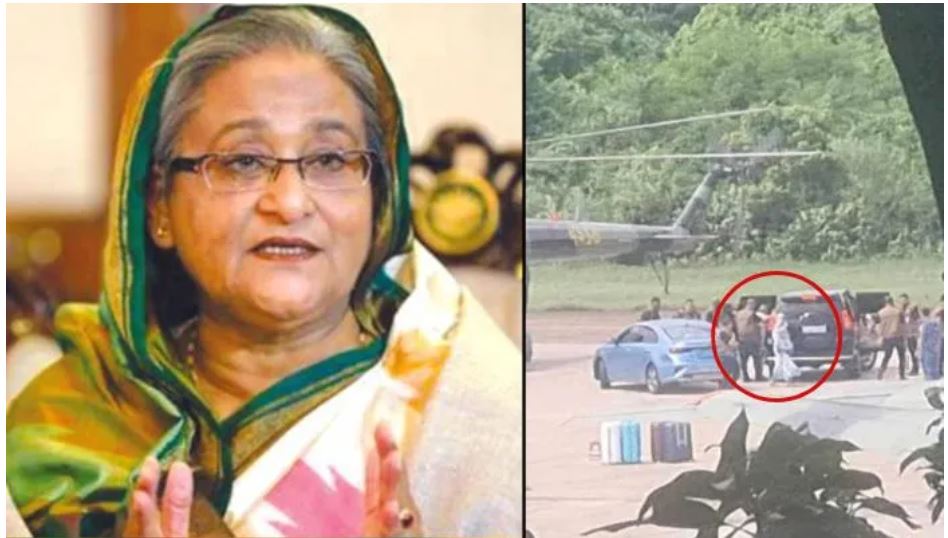
 Having served for a combined total of over 20 years, Sheikh Hasina the longest serving prime minister in the history of Bangladesh was asked to live the country within 45 minutes on Monday 5th August 2024.  Her premiership ended in self-imposed exile following a series of violent protests in 2024 following weeks of deadly protests that began as demonstrations by students against government job quotas but surged into a movement demanding her resignation. She was flown into India in a Bangladesh Military Helicopter. 


India called for an all-party meeting on Bangladesh issue. EAM S Jaishankar addressed Parliament on Bangladesh issue and said continuous contact has been maintained with the Indian community and border forces have been vigilant. IMF said it is 'fully committed' to Bangladesh after protests oust PM

Top army brass reshuffled amidst political unrest, pm resignation, and military takeover. Bangladesh former IT minister Zunaid Ahmed Palak detained while trying to flee to India and Bangladesh parliament dissolved amid warnings. Bangladesh president ordered the release of jailed ex-PM Khaleda Zia. Bangladesh President and chiefs of staff met key members of student protests. Nobel laureate Muhammad Yunus was appointed head of Bangladesh's interim government, said President's Press Secretary

Sheikh Hasina looked to Belarus, Finland, and Russia among others for political asylum. Sheikh Hasina remained at the Hindon airbase, where is expected to stay over the next couple of days as the UK rejected her political asylum.

Her Son Sajeeb Wazed said Sheikh Hasina will return to Bangladesh soon, has sought no asylum, plans to return to her country and revive her party, the Awami League. But earlier, he had said that his mother is old now and will give up politics and he too is not interested. 

On behalf of Naya Bangladesh, Bangladesh' Supreme Court Bar Association (SCBA) President AM Mahbub Uddin Khokon called on India to arrest former prime minister Sheikh Hasina and her sister Sheikh Rehana, and send them back to Bangladesh, Daily Star reported. In a statement, he said, "We want to maintain a good relationship with the people of India. Please, arrest Sheikh Hasina and Sheikh Rehana, who fled the country, and send them back to Bangladesh. Sheikh Hasina has killed many people in Bangladesh." 

What would happen, we need to wait and see. 

Some metrics from the years of her prime ministership: 

GDP in 2009 was USD 102 BILLION 

GDP in 2024 is 455 Billion

A 317% growth in 15 years. 

Per capita income  in 2024 is USD 2646

It was USD 698 in 2009

A 279% growth in per capita income 

Exports in 2009 was 17.36 Billion

Exports in 2024 are USD 50 Billion 

A 3X growth in exports 

Population in 2024 is 17.47 Crores

Population in 2009 was 14.67 Crores. 

A limited 19% growth in 15 Years. 

The economy of Bangladesh recorded an average growth rate of 6.5% in the decade to 2023, above the 4.3% average for the Asia-Pacific region.

Her fall is a great loss to Bangladesh

Bangladesh is now India’s potentially no more a friend,  Pakistan had not been ever, China has been expanding its borders,  Nepal is brooding, Maldives not close anymore, Sri Lanka is swimming out of the inner turmoil. Unfortunately, looks like India do not have even a single country in her neighbourhood as a friend, and she has been giving asylum to many .

If not managed well, this would not only effect Bangladesh, but the geopolitical situation of this subcontinent. 

So many are being killed on the borders, trying to get into India, and killed in Bangladesh. Count yet to be confirmed. 

Where is all this leading too? 

Rich can get better refuge - can move out in an aircraft, but the poor suffer. 


Wednesday, June 05, 2024

The Super Over after the Verdict - Loksabha Elections

A victory like a defeat, a defeat like a victory. Who wins?  Who loses? 

"Democracy wins. People have chosen a leader but the opposition is string enough to remind him that he is not the supremo. And so today every Indian celebrates."  ~ Payal responded. 


"India Witnessing World Cup Super Over":  So said @ShashiTharoor on Election Result 2024, which was as true for him, as to the party and the overall scenario. 

BJP is now hovering around the 240 mark, uncomfortably away from the halfway mark of 272 seats. NDA combined has 293 seats, INDIA has 234 and Others 16. The leaders of the Indian National Developmental Inclusive Alliance (I.N.D.I.A) deliberated on how to strengthen the alliance and chalked out a strategy for seat-sharing for the 2024 Lok Sabha elections.  INDIA bloc's combined strength plays spoilsport for BJP in 2 biggest states - UP and Maharashtra. BJP won ten seats in the 2009 Lok Sabha elections but managed to increase it to 71 in 2014 and 62 in 2019.


"Amidst all the noise, two less talked about results that stand out. 

1) Congress wins BOTH seats in Manipur 

2) Samajwadi party wins Faizabad/Ayodhya. 

Uparwala sab dekh raha hai! 

Public sab jaanti hai!🙏"

~Rajdeep Sardesi

This is the defining movement, in the election of India. If the Centre thinks it can run a government on its free will without taking into consideration the state and federation, it is the end of their era. 

TINA - There is No Alternative has turned into TIFA - There is a Federal Alternative. 

3N's - Narendra Modi, Naidu and Naveen Patnaik, So basically it is not 3.0 but 3.3.


This has been the most unequal election in the history of our country. Nobody had anything, Modi had everything. Election Commission, ED, CBI, Tax Authorities all had become his agents. Law's were passed as Money bill. In Rajya Sabha without votes bills were passed. Misuse of Schedule 10. 


Two Chief Ministers where in jail in between the election, and send notice to many others. 

People have given their verdict. 

INDIA Congress Leader Mallikarjun Kharge has been named INDIA bloc chief. This came after the INDIA alliance of the 28 opposition parties held discussions in a virtual meeting today.


Reminded of past collation government fun times and days.  Hope and wish we would not need another election before the end of the next five years. 

We definitely do not want another election. 

INDIA bl9ck decided against staking claim.


Congress says they will provide external support and would not be part of governance


Mathematics say:

Simple Arithmetic  ;

BJP 240 seats 

NDA 291 seats 

JDU 12 seats 

TDP 16 seats 

If Nitish join I.N.D.I.A alliance then also 

NDA 291 - 12 = 279 seats 

7 seats more than majority, 

If Chandrababu join I.N.D.I.A alliance then also 

NDA 291-16 = 275 seats 

3 seats more than Majority, 

If Nitish and Chandrababu both  join I.N.D.I.A alliance then

I.N.D.I.A  233 seats 

JDU 12 seats 

TDP  16 seats 

233 +12+16 = 261 

I.N.D.I.A alliance still short of 

11 seats for Majority, 

If JDU and TDP leave NDA Then

NDA 291 Seats 

JDU  12 seats 

TDP  16 seats 

291 -12-16 = 263 seats 

NDA short of 9 seats 

Then NDA may look for 

Others 18 seats ,

If TDP join I.N.D.I.A alliance then YSRCP will  join NDA 

263+ 4 = 267

5 seats short of Majority, 

There are others also who can join NDA and Vice Versa.

All said and done the key is with N.


Jai Hind! 

Jai Bharat!

Monday, September 05, 2022

Almost There and Being There


 Almost There and Being There - Makes so much of a difference. We were at a point where it was expected that two Indian's would lead two strong and sort after nations of the world. 

Though opinion polls said the final results would be otherwise, and we did expect it to be as per the exit polls, there was a ray of hope and a desire to see Indian's leading and being in top posts across the globe. 

Even when there was all the noise regarding US top post, I did wonder if it would be so - but hope remain. Who better would know the pain of being almost there and how different it is from being there. Wish the family is strong enough to support. At then end of the day, all we have is family. 

Wednesday, March 16, 2022

Assembly Election Results - Crisis of Social Democracy

 There is a worldwide crises in social democracy, but it is arguable more profound in India.  


 He also said," Democracy is the  worst form of government except for all the others".  Among different democratic systems, India had chosen "first past the post system" 

The common thread in the recent election narrative was "Change vs. Continuity". BJP was the protagonist of continuity, and Congress and AAP of change. Continuity trumped over change. There was a desire for change, with no change, why? The Upma story, the reality of democracy.  BJP won 4/5 and AAP one. 


Congress was a freedom movement as much in India as in Africa, then it became a liberal, nationalist -minded forces. Now it has been tarnished by corruption scandals and nepotism and undermined by a lack of ideology. Out of the embers of a non-dynastic Congress, an effective centre -left party could still be reborn.  Marxist was the hard left.  

Though many today, just say right and left, Left is not just one, and not all are left. But now it looks like nothing is left of congress. 

Wondering what Prashanth Kishore is thinking, and what would be his next move. 

Monday, February 14, 2022

Schoolies - Friendship

We have consciously started reducing  interactions with those that no longer serve our purpose . True our mission needs  focus - not the drama some people bring 😉😉😉May god bless them too.  We make your own list - and act accordingly 🌻🌻🌻 


Was lucky enough to get such amazing friends around, during school, college, office days… In fact, they were (some of them still are) one of my pillars of strength…….  Whenever I went low, they saved me…….in every possible way!!!❤️

But now, there are times where I could sense change in some of their thoughts, approach, talk……And YES, it’s definitely shattering me into pieces………!💔

 Do you remember the days back in school where we would queue up in temples for food, empty Eid's biryani from friends tiffin and share

Christmas cakes to the whole class. While doing all this we never thought about which religion we all belonged to. Life was good back then, isn't it?

Yes we did have sisters telling us not to wear nail polish or mehndi, and some raised voice against it, but eventually a common agreement was arrived it within the classroom or school. 

The purpose of education is lost if you do this. Unity in diversity is the beauty of our country. Let us see each others as human beings and not as religious symbols.


The social media will very soon pick its next hot topic, the politicians will get busy with their parties and the society at large will move on like it has always done.

But, friends who have now turned into hijabs, saffron shawls and blue shawls won't go back to who they were after all the damage we humans have done, in the past and now.

Situation have killed friendship bonds! 

Tuesday, February 08, 2022

Silicon to Saffron of India - Karnataka

Silicon valley of India is  turning into Saffron valley of India. Will not be surprised if soon we have dress code, like Yogi. Will there be a mandate all should wear only Saffron clothes? Will they prohibit Sikh from wearing turban?


Karnataka Govt invokes state law to back hijab ban: ‘Don’t wear clothes that disturb law & order’. The ban on wearing the hijab to classrooms, according to the state government, is not a violation of the fundamental right to religious freedom guaranteed by the Constitution.

The ‘hijab-saffron shawl’ controversy created confusion in some colleges in north Karnataka districts as students came to attend classes wearing ‘hijab’ and ‘saffron shawls’, forcing the college administrations to suspend classes for the day in a few institutions.

Protests in favour of and against hijab were staged in various districts, with Hindu outfits staging protests opposing students wearing hijab, while Muslim and progressive organisations staging protests condemning what they termed as divisive politics by the ruling party. 

Last week, B C Nagesh, minister for school education, announced plans for a uniform policy: “What if tomorrow someone comes to the college in shorts saying it is hot? We cannot allow it. Colleges had set their own rules and it was being followed. There are Christian missionary-run colleges and a few of them do not allow Hindu students to wear bangles or bindis. Nobody has questioned it because it was the college’s decision.”

Two questions to be asked

1. Does the institute have a dress code Y/ N

2. Did the Children violate that code Y/ N

If Y for both, the Children/ Parents need to step back, apologise and follow the code.

If N for both, the institute needs to step back and apologise

There is a Kerala High Court judgement on this. If there is a dress code, students need to follow it. It is not their personal choice

A video of a boy putting up a saffron flag went viral on social media. In the video, the majority of the students that were filmed were waving saffron flags and stoles. Times Now’s Special Correspondent Imran Khan shared the video with a misleading caption. He claimed, “Karnataka Congress president DK Shivakumar has tweeted saying replacing National flag with Saffron flag at #Shimoga is a breakdown of law and order. And the college should be closed for a week.” and now this tweet is going internationally viral. 

As I discuss with my cousin, he says, people in Karnataka do not know what bribe or corruption is, it is a custom there. At least in India, news erupt and then it goes silent. Karnataka, everything happens, but nobody will know. 

If we compare today's govt....central or state what ever...he thinks ...old Rajas,  the British admin, or the period soon after Independence were far more better. All Kallanmar, they were Vella Kallanmar, who did somethings in return. Now people are not afraid. They know if they support the ruling party, they will be safeguarded. Because of loop holes and vote bank system, people can do anything here. In Arab countries, people are so obedient. But in India as long as there is minority/majority and vote banks, the color of the flag will keep changing and so that of people. 

On 75th Anniversary - First 25 years - Mukund Mavlankar

 PM’s comments made at the IIT Kanpur convocation on Dec 28th has not gone unnoticed this time. Whether students heard him or not, alumni did. Modi deplored the “fact” that little was done in the first 25 years after independence to make India self-reliant. 

https://twitter.com/RajeevMatta/status/1480106570906103809

“25 years after Independence, we should have done a lot more to stand on our feet. There has been further great delay from then till now. The country has lost a lot of time. In between, two generations have passed. Now we can’t afford the loss of even two moments”.

However, is it a “fact” little was done in the first 25 years to make India self-reliant? Mukund Mavlankar, an illustrious alumnus of IIT Kanpur thinks it is not. 

He says of himself, “education in IIT Kanpur gave me a solid, scientific and technological foundation and helped me build a 43 year strong manufacturing career”, has written to PM to explain why. 

He mentions 12 key achievements of the first quarter century that India should not only never forget, but always be proud of. In the year we celebrate the 75th anniversary of Independence, these are the landmarks that are worth reminding ourselves of. 

First the political ones. India gave itself a Constitution to eternally boast of. It enshrines the values we cherish. That happened less than 3 years after Independence. 

Two years after that, the country held its first national election. Every adult, rich or poor, man or woman, had the right to vote. We take that for granted today, but it simply wasn’t at the time.

Next, come the educational institutions we built in those years. Between 1950 and 1964, five IITs were set up. Before 25 years were over, three Institutes of Management (IIMs) were also established. And let’s not forget prestigious research laboratories such as Indian Institute of Science, the Defence Research and Development Organisation.

The Bhabha Atomic Research Centre and the Indian Space Research Organisation. They are world-class and the envy of our peers. 

Mavlankar’s letter mentions a lot more – Bhakra Nangal Dam, Hindustan Aeronautics, the Oil and Natural Gas Commission, Bharat Heavy Electronics, and an assortment of steel plants. And in this time of Covid-19, how can anyone forget the Indian Council of Medical Research and the All India Institute of Medical Sciences (AIIMS)? The first was established in 1948. The second, in 1956.

The hundred acres on which AIIMS stands was donated by the then health minister Rajkumari Amrit Kaur. 

Mavlankar’s parting words: “Sir, the list could go on and on.Our democracy invested its energy, blood sweat and toll in the first 25 years to lay the foundation of this country which we are so proud of. All this was done in spite of poverty, great natural disasters, epidemics and four wars with our neighbours”

He adds: “I agree with you a hundred percent that the work of building the country is not over as yet.” 

The intent of his letter is to ask the PM not to forget or undervalue what politicians of the past have done. We need to add to their efforts, but that won’t happen by denigrating them. 

We collectively have been responsible for utter degradation of the environment we live in. CO2 level has been increasing relentlessly and in geometric progression since 1763.

Tuesday, February 01, 2022

1984 - George Orewell


11th of 2022, was the much talked about 1984  by Eric Arthur Blair, known by his pen name,  George Orewell. Eric Arthur Blair was born on 25 June 1903 in Motihari, Bengal Presidency, British India. His mother took him to UK for his schooling, he could not get scholorship for his college, as he was not brilliant academically, and so he joined, the family decided that Blair should join the Imperial Police, the precursor of the Indian Police Service.  Blair's maternal grandmother lived at Moulmein, so he chose a posting in Burma, then still a province of British India. Working as an imperial police officer gave him considerable responsibility while most of his contemporaries were still at university in England. When ill and on holiday in London, he resigned from the Indian Imperial Police to become a writer, with effect from 12 March 1928 after five-and-a-half years of service. In early 1935 Blair met his future wife Eileen O'Shaughnessy, when his landlady, Rosalind Obermeyer, who was studying for a master's degree in psychology at University College London, invited some of her fellow students to a party. Orwell's health continued to decline after the diagnosis of tuberculosis in December 1947. In mid-1949, he courted Sonia Brownell, and they announced their engagement in September, shortly before he was removed to University College Hospital in London. Sonia took charge of Orwell's affairs and attended him diligently in the hospital. On the morning of 21 January, an artery burst in Orwell's lungs, killing him at age 46.Orwell's adopted son, Richard Horatio Blair, was brought up by Orwell's sister Avril. He is patron of The Orwell Society.

Read the kindle book, had paperback, saw the movie, and listened to the audio book as well. 

'1984' George Orwell Audiobook (Full version) - Bing video


“It was a bright cold day in April, and the clocks were striking thirteen.” This by itself kept me hooked.

This is the story of the immediate future.  - Oceania, Eurasia and East Asia, the powerful countries controlling or wanting to control others. The war is not fought in Oceanian, Eurasian or Eastasian territory but in the Arctic wastes and a disputed zone comprising the sea and land from Tangiers (Northern Africa) to Darwin (Australia).  At the start, Oceania and Eastasia are allies fighting Eurasia in northern Africa and the Malabar Coast. In Nineteen Eighty-Four a war is raging on the "Malabar front" in "South India", but India does not figure at all.


We are introduced to terms like "doublethink", "Thought Police", "thoughtcrime", "Newspeak", and "2 + 2 = 5" and in 1948 the year he wrote the book, he envisioned the world in 1984 modelled after Stallins Russia and Nazi Germany. The three slogan of the Party is 'War is Peace', 'Freedom is slavery', 'Ignorance is Strength'. With the ministries, deliberately named after the opposite (doublethink) of their true functions: "The Ministry of Peace concerns itself with war, the Ministry of Truth with lies, the Ministry of Love with torture and the Ministry of Plenty with starvation." The book is a warning against totalitarianism. There is hate that is spread around. The celebrate hate week, and ask people to hate everyone who hate the party. It was always at night - the arrest invariably happened. There was no place where there was no darkness. They were afraid of love, they were afraid of loosing control. Even in sleep Big Brother was watching all. Thoughtcrime, did not entail death, it was death. 

The hero, Winston Smith, lives in Oceania, one of the three super states, the capital of which is London, and which is ruled by English socialism, an Orwellian substitute for Stalinist communism. The language of Oceania is Newspeak. It has been devised to meet the requirements of "Engsoc" or "English Socialism". Newspeak consists either of newly coined words or words stripped of their old meaning. Newspeak generates and thrives on thought-cum-language mechanisms called Doublethink and Doublespeak. Doublethink means thinking simultaneously on contradictory tracks. Doublespeak allows you to make your words mean what you want them to mean and not what they actually mean.

This is the story of Winston and Julia's , Winston started being scared of Julia, hating Big Brother, but gradually they fall in love and dream of a free life. Winston had written that there is hope and it lies in the proles. Though Julia advise other wise, Winston, took faith in  O'Brian but was tortured, who wants Winston to believe 2+2 is 5. Winston was scared and could not stand rats, he was put in a room with rats in room 101.  Acts by the Ministry of Love, who do not believe in killing the people, but changing the hearts of people, by their will, by making their existing mind hollow and fill it with their love. There were three stages in reintegration, that of learning, understanding and acceptance. It ends by Winston loving Big Brother, both feeling having betrayed to each other, departing, saying we must meet again. 

1984 George Orwell Full Movie ORIGINAL and Best version - Bing video

By 2050 - earlier, probably - all real knowledge of oldspeak will have disappeared. There is often mention of south Indian Malabar war.   There has been a lot of '1984' in the western countries, and some in India by 1984.  80 per cent of Orwell's predictions about a frightening, centralised all-seeing bureaucracy has already come to exist in America by 1984. The Indian bureaucracy is indeed a leviathan. But in character and attire, in outlook and behaviour, it is more Kafkaesque than Orwellian. However, many Indians feel that there is a Big Brother watching them all the time, looking down on them as they go about their daily chores. There is in India, as in all other countries, a Ministry of Truth doling out huge helpings daily of the truth as seen by the establishment, authorised, sanitised versions of events and non-events. People with a sense of humour, a somewhat scarce commodity in a nation of 700 million, call it the Ministry of Ifs and Buts (I&B). Ifs and Buts are also built into the style of Indian thinking. Social media is a cage full of starved rats and all of us have our heads stuck in there now, like it or not. The Machine has reduced man both in size and spirit. But recently we can see this being implemented in India as well. At times we are left to wonder, if the present government is taking it's lessons from this book. 

“Now I will tell you the answer to my question. It is this. The Party seeks power entirely for its own sake. We are not interested in the good of others; we are interested solely in power, pure power. What pure power means you will understand presently. We are different from the oligarchies of the past in that we know what we are doing. All the others, even those who resembled ourselves, were cowards and hypocrites. The German Nazis and the Russian Communists came very close to us in their methods, but they never had the courage to recognize their own motives. They pretended, perhaps they even believed, that they had seized power unwillingly and for a limited time, and that just around the corner there lay a paradise where human beings would be free and equal. We are not like that. We know that no one ever seizes power with the intention of relinquishing it. Power is not a means; it is an end. One does not establish a dictatorship in order to safeguard a revolution; one makes the revolution in order to establish the dictatorship. The object of persecution is persecution. The object of torture is torture. The object of power is power. Now you begin to understand me.”

In India 1984 is much more around 2020, Big Brother is watching us, Child Spy is everywhere, Thought Police, Ministry of hate/love, double thinking, and by controlling men's mind, its possible to dehumanise people and life can go on. So many people keep changing ideologies and parties on a daily basis. 

If we fail to preserve the heritage of the freedom, this would be the story of the future.

Thursday, January 20, 2022

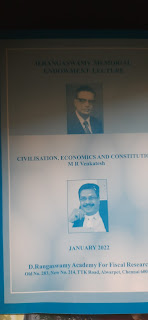
Civilisations, Economics and the Constitution - Dr M R Venkatesh


Anusha Srinivasan Senior Partner and daughter of D Rangaswamy,  in the Memorial Lecture, it made her feels taller and emotional lecture. A person with lot of wit, wisdom, there is a book on him called a compassionate accountant. 

Dr M R Venkatesh, CA in 1992, 2018 awarded doctorate by Shastra University, practising advocate. Authored and published several book. He speaks on 'civilisation, economics and constitution'. He said he was humbled and privileged to address the audience from where he had listened to so many people. 


Now to the subject proper,  'civilisation, economics and constitution', fascinating that debates are held without ill will. Fascinating, illuminating people from diverse walk of life wrote the constitution. It is concerning that aspect of public life, that all are passionately involved. At the time of Independence, Nehru a known agnostic, who never spoke about soul of people, used the phrase soul of nation. 

14th of 2022 as I got the book only on 4th of Feb.


"Long years ago we made a tryst with destiny, and now the time comes when we shall redeem our pledge, not wholly or in full measure, but very substantially. At the stroke of the midnight hour, when the world sleeps, India will awake to life and freedom. A moment comes, which comes but rarely in history, when we step out from the old to new, when an age ends, and when the soul of a nation, long suppressed, finds utterance...

...The ambition of the greatest man of our generation has been to wipe every tear from every eye. That may be beyond us, but so long as there are tears and suffering, so long our work will not be over. And so we have to labour and to work, and work hard, to give reality to our dreams. Those dreams are for India, but they are also for the world."

An excerpt from Jawaharlal Nehru's Tryst of Destiny speech, August 15, 1947

What is the soul of nation? Bushido : Bu-Shi-Do : The soul of Japan. There are different civilisations in the world driven since 1776 and 1789 resolution of America and France - and there would be clash of civilisation - would there be clash of the souls as well? West is a compass driven civilisation, others are determined by geography. Nations wanted sovereignty and freedom. American's civilisation, wanted absolute freedom. French wanted equality, liberty and fraternity. Freedom and Equality are antithesis. America today, is following more of French ideologies. 

Core of our issues and how we have created our Macro Economics. - 5th Dec. 1947, based on Nandini Sarkar report, tax structure was decided and implemented based on 1935 Govt. of India act. We cannot fix an economic policy for future generation to follow - Ambedkar said. The term Welfare state, which is not in the constitution, crept into the judgment. London School of Economics have a secret document by Labour party, for development of London, found in Hitler's bunker. First we became socialist country, we became obsessed with tax, and felt all the rich are villains. This socialism did not find a great landing, and Animal Farm movement was started. 1990's we had our liberalisation and we started progressing. World Economic Forum - WEF wants to bring back, Wealth tax, inheritance tax, if we go by history, taxes have created broken democracy. Roman emperor fall, was because of the inefficient democracy. Taxes have never helped any country to prosper. 

People always thought of duties and not rights. People happily went to the gallows. We are a nation, where the state have always been residual. Privacy is the fundamental right, but you want things delivered to your bedroom free of cost. Unfortunately this part - 'what is the duty of the state?' Article 12 only say what is a state, but don't define the duties. Then what you do? You tax people to a limit beyond which you cannot. Then you keep borrowing. If you have equal assets, it's fine, but when liabilities are not represented by assets, its risky. We do not know what is the exact position of each states. Single largest expenditure is salary, wages and pension - around 40%, 12% is interest. We should not pass on the liability to the next generation, irrespective of we giving asset or not. Miniscule Govt employees are sucking up huge percentage of the state revenue , disproportionate to their duties and responsibilities,  in the name of welfare state leaving very little for the development , resulting in large percentage of the population remaining poor despite their long years of hard work.

Robust individualism for the poor , and socialism for the rich is where we are. We have to see if the core mechanism of rights given, is workable from economic perspective. Article 292 - There must be a sealing for debts. Most abused act is the budget. We have always exceeded the fiscal deficit, revenue deficit is far more dangerous year of year since 1980. Socialism has failed India. Recklessness has paved way into lives. We cant bear this in silence. We need to proactively educate govt. Rajaji said it is easy to govern India, if we make people understand the duties. We have to go back, and make amends. We are oblivious to the effect this is having on economy. 

We have to draw from spirituality. When we look inward, we will derive strength. We have been looking out for strength. We should take best practises from everywhere in the world. We were prosperous civilisation upto 18th century. India was a sustainable prosperous civilisation. Spirituality was the soul of civilisation, with rule of Dharma.  We should not be carbon copy of the west. There should be a positive list and negative list for the states on what that can be done and not. Politicians promise, money to be paid - from our money. 

Solutions has to come from all of us, these are the thoughts. 

MRV's speech was shining light on certain dark spaces in our economy which was not seen hitherto and given its due attention.. Memorable, memorial lecture. Confessed, the thoughts expressed, were not learned in the classroom. It is way above. 

Huge topics, how are these going to be connected? Fundamental thing - 

  • Dimension to look at taxation , public policy and nation by looking at the souls. 
  • Civilisation of duties - is a timely call, and we need to participate in the nation's growth. Research should touch the soul of the nation. 

This was followed by unveiling of Flying High - 2 in the next post.  

Wednesday, December 15, 2021

A Sad Day in our History

The position CDS Bipin Rawat was in and the kind of death by the person responsible for the safety of the country is disturbing. CDS Bipin Rawat, died in a "helicopter crash" on 8 Dec 2021 (1 year after Galwan Valley clash & 2 days after Putin visit) at the age of  63. A new post of CDS was created and he was leading it only since 1st Jan. 2020.

Crashes have been common within the defence and outside. Film stars, politicians, scientists and armed force personnel's have died in crashes. It's sad and shocking but what is more scary is the highest official being in it, though equally or a greater loss is for the other families involved.

Rawat was being accompanied by his defence assistant, security commandos and Air Force personnel. The passengers included his wife, whom he would not have let join him, if he had even an iota of doubt, of any danger. Lt Col Harjinder Singh, Brig LS Lidder, NK Jitendra Kr, NK Gursewak Singh, L/Naik Vivek Kumar, L/Naik B Sai Teja and Hav Satpal where others with him.

What caused the Mi-17 crash? How many really know? Will we common Indians ever know what led to the end?

The Russian built Mi-17 is one of the world's most survivable helicopters. It has a heavily armoured skin which makes it highly resistant to sniper rifle fire and shoulder-fired heat seeking missiles – the favourite weapons of terrorists.

 There can only be 4 possibilities: maintenance failure, sabotage, overloading, accident. Let's do this.

1. Maintenance: CAG has criticised IAF's maintenance record. Fleet availability of IAF's Russian aircraft is well below American or French analogues. Plus, Russians have a poor record of supplying spares. This has forced IAF to buy low quality grey market spares from E.Europe.

2. Sabotage 1: Did the maintenance crews include Corrupt, anti-nationalist or Harmfuls? 

3. Sabotage 2: As first Chief of Defence Staff, General Rawat was doing overhauling India's fighting forces in preparation for a collusive two front war by Pak and China. India has given a bloody nose to both. Maybe they were feeling the pressure and decided to eliminate him. Few more thought below:

  • First doubt is he is killed as a conspiracy by America
  • Second china 
  • third internal arms lobby
  • forth sinowahabi alliance
  • fifth Domestic Sabotage
  • Sixth It was flying 1000km below where it should have flown - could have become uncontrolled. When the flight comes below standard limit, there is an alarm bell that rings, would it not have rang?
  • Seventh In case of conspiracy whoever has done is an Indian

4. Overloading: In the Soviet Union, many tragic air crashes happened because the generals overloaded Air Force planes with personal goods. Pilots knew it was dangerous but they also knew it was dangerous to protest. Did something similar happen on General Rawat's trip?

5. Accident: Once you remove all the improbable scenarios, what remains, however strange, is the truth. A freak accident may well have crashed the Mi-17. There is SOP for flight operations and technician who has overlooked and manipulated can manipulate black box too with no evidence coming out. Failure due to Technical error is next to impossible,  (unless corrupt people  giving incorrect information),  human error could be possible, Explosion, ridge, deliberate malfunction, anything could be the reason.

More the tragedy, more the conspiracy theory. 

All doubts are reasonable but with no conclusive evidence. They say all these are credible  hypotheses.

Don't want to rush into conclusions but there is a genuine concern, why does IAF flights keep crashing? Inside blast or missile could be the reason. Even before MI17V5 had a crash before in 2017, in Arunachal Pradesh.

Here the pilot was experienced he was Wing Commanding officer, P.S Chauhan, he had two choices IFR Vs. VFR. 

IFR - Instrument Flying rule and VFR - Visual Flight rules - 1.5 kms, horizontal visibility is needed. 

The Leans. When the surrounding is not clear, the flight tend to not fly straight and bend. 

Pilots disorientation, Self induced pressure, Plan continuation was the reason for Kobe Bryant's death.

Black Box = Flight Data Recorder + Cockpit voice recorder, has been recovered, which will help disclose the truth. 

Micro wave,  laser wave weapons could be used to hit fuel tank

80% of our defence equipment are imported which is an unfortunate  situation

Many of our nuclear scientists  committed suicide  just like that, Punjab is now fully drug addicted, smuggling by china on northern borders are all time high.

While the Mi-17 V-5 is among the most sophisticated military transport helicopters, India's ageing air force fleet is often blamed for the high number of air crashes there.

More than 170 helicopter and plane pilots have died over three decades, AFP reports.

The air force is investing billions of dollars to replace older aircraft, but the procurement process has suffered delays and corruption. Hight time these are manufactured in India.  

On 11 Jan 1966, PM Shastri "died mysteriously" in Tashkent, two weeks later Bhabha died in a plane crash. Vikram Sarabhai succeeded Homi Bhabha & look after India's Nuclear progress & NPT negotiations. This was between Subhash Chandra Bose and Sanjay Gandhi's death. 

When India was making a move in Nuclear Power - Homi Bhabha died in a "plane crash" on 24 Jan 1966 (1.4 year after China tested 1st N-bomb & NPT negotiations begun), aged 56. Earlier, in Feb 1965, Bhabha had visited US to convince them for "peaceful nuclear deal" but US refused.

Both Bhabha & Sarabhai used to say that "Americans, Russians, British, Chinese & Pakistanis all were keeping an eye on us & tracking all our moves" - India had expected their 'assasination' & that's why provided them top notch security, but still couldn't save them.

Group Captain Varun Singh could well turn out to be the IAF's Tukaram Omble, although unlike Omble he may live. Our hope that the lone survivor recovers and is able to reveal the truth is also shattered now. He wrote To Students Of His School In September:

You may be mediocre in school but it is by no means a measure of things to come in life," he said. "Find your calling, it could be art, music, graphic design. literature etc. Whatever you work towards, be dedicated, do your best. Never go to bed thinking I could have put in more effort," he added.

The air warrior said he was an average student and barely scored first division in class 12, but had a passion for airplanes and aviation. "I write to you filled with a sense of pride and humility. On August 15 this year, I was awarded Shaurya Chakra by the President of India in recognition of an act of gallantry on October 12, 2020," he said.

"I credit this prestigious award to all those I have been associated with over the years in school, NDA and thereafter the Air Force, as I firmly believe that my actions that day were a result of the grooming and mentoring by my teachers. instructors and peers over the years," Group Captain Singh wrote in the letter dated September 18.

There are stories for each who died. What they have meant to the family and the loss. 

The helicopter crash, may be conspiracy, may be genuine. Indian army plane has history of dropping. Can only pray, God Save Humanity. 

Tuesday, August 31, 2021

Afghanistan and Taliban

How could this month end, without thoughts and prayers for the most happening event of the month? 

Afgan - Gravyard of Empires. Land - Filled with minerals - Lithum. 

Afghan is now added to the lists of Uyghurs and Rohingya. 

Uyghurs alternatively spelled Uighurs, Uygurs or Uigurs, are a Turkic ethnic group originating from and culturally affiliated with the general region of Central and East Asia. The Uyghurs are recognized as native to the Xinjiang Uyghur Autonomous Region in Northwest China.

Rohingya people are a stateless Indo-Aryan ethnic group who predominantly follow Islam and reside in Rakhine State, Myanmar. Before the displacement crisis in 2017, when over 740,000 fled to Bangladesh, an estimated 1.4 million Rohingya lived in Myanmar

The Taliban, or "students" in the Pashto language, emerged in the early 1990s in northern Pakistan following the withdrawal of Soviet troops from Afghanistan. It is believed that the predominantly Pashtun movement first appeared in religious seminaries - mostly paid for by money from Saudi Arabia - which preached a hardline form of Sunni Islam.

The promise made by the Taliban - in Pashtun areas straddling Pakistan and Afghanistan - was to restore peace and security and enforce their own austere version of Sharia, or Islamic law, once in power.

Taliban Has "Broken Shackles Of Slavery", Says Pak PM Imran Khan

If the Taliban succeeds in toppling the Western-backed government in Kabul, China is prepared to recognize the group as the LEGITIMATE ruling power of Afghanistan, US News reports, citing multiple intelligence sources.

Beijing has publicly pressed the Taliban to continue working towards a peace agreement with Ashraf Ghani’s government, but reportedly sees any sort of stability in the country as beneficial to China’s prior economic investments in the region, including mineral rights in Afghanistan.

For revenge against 9/11 US went after Osama, Al Qaeda, Taliban and Mullah Omar. It didn’t get happy that MOHD Atta is no more as they knew he was just a last mile Pawn. 

We need to strike at roots which nurture this evil poisonous tree.

As on 31st July 2021 MASSIVE LINES as Afghans queue at passport office in Kabul amid Taliban offensive.

Over 10,000 Afghan citizens were reportedly turning to the passport office DAILY in the hope of getting documents to leave the country in July.

The security situation in Afghanistan was uncertain after the Biden admin. and US allies withdrew combat troops.

The Taliban has been gaining territory taking control of regions in all parts of the country.

About 200 Afghan interpreters and their families arrived in the US  - with thousands more set to be evacuated to escape Taliban revenge

MASSIVE LINES as Afghans queue at passport office in Kabul amid Taliban offensive.

The Taliban's senior leadership includes many Mujahideen fighters who were once trained by the U.S. during the Cold War to battle against the invading Soviet Union forces in the 1980s. The Sunni group's membership is drawn largely from the majority ethnic Pashtun population most dominant in the southern part of the country. 

Taliban do not want any foreign dignitaries or reporters stuck in the country so that they have more control over what the world knows. The escorting is also not because they want to make sure the foreigners reach home safe it is to identify the big shots of Afghanistan and making sure they do not flee. Especially the land owners of the opium farms. The chaos of the common people is because they understand the talibanian strategy and can foresee the future based on earlier experiences. It is not because Taliban has done anything yet. It also means that Taliban has bigger plans this time. So nobody is nice here… it is all about power, control and money

Extremist always create havoc. While the Righ wing try to propogae that if they are not active, they would attack and wipe us out, others call the right wing equivalent to Taliban.

All said and done, hate never destroys hate, it would only create more hate.

Peace, Peace, Peace. May there be Peace and Happiness Around!


Wednesday, August 11, 2021

Animal Farm - George Orwell

George Orwell's Animal Farm is undeniably one of the best short novels ever written in the English language. It is a deceptively simple tale, which even older children could read. Written in the style of a fable, and yet it can be read on so many levels. It is clearly both a satire and an allegory, a dystopian tale.


77th of 2021 was Animal Farm a satirical allegorical novella by George Orwell, first published in England on 17 August 1945. The poorly-run Manor Farm near Willingdon, England, is ripened for rebellion from its animal populace by neglect at the hands of the irresponsible and alcoholic farmer, Mr. Jones. One night, the exalted boar, Old Major, holds a conference, at which he calls for the overthrow of humans and teaches the animals a revolutionary song called "Beasts of England". 

Beasts of England, Beasts of Ireland,
Beasts of every land and clime,
Hearken to my joyful tidings
Of the Golden future time.
Soon or late the day is coming,
Tyrant Man shall be o'erthrown,
And the fruitful fields of England
Shall be trod by beasts alone.
Rings shall vanish from our noses,
And the harness from our back,
Bit and spur shall rust forever,
Cruel whips no more shall crack.
Riches more than mind can picture,
Wheat and barley, oats and hay,
Clover, beans, and mangel-wurzels
Shall be ours upon that day.
Bright will shine the fields of England,
Purer shall its waters be,
Sweeter yet shall blow its breezes
On the day that sets us free.
For that day we all must labour,
Though we die before it break;
Cows and horses, geese and turkeys,
All must toil for freedom's sake.
Beasts of England, Beasts of Ireland,
Beasts of every land and clime,
Hearken well, and spread my tidings
Of the Golden future time.

When Old Major dies, two young pigs, Snowball and Napoleon, assume command and stage a revolt, driving Mr. Jones off the farm and renaming the property "Animal Farm". They adopt the Seven Commandments of Animalism, the most important of which is, "All animals are equal". The decree is painted in large letters on one side of the barn. 

“The Seven Commandments:
Whatever goes upon two legs is an enemy.
Whatever goes upon four legs, or has wings, is a friend.
No animal shall wear clothes.
No animal shall sleep in a bed.
No animal shall drink alcohol.
No animal shall kill any other animal.
All animals are equal.”

Snowball teaches the animals to read and write, while Napoleon educates young puppies on the principles of Animalism. To commemorate the start of Animal Farm, Snowball raises a green flag with a white hoof and horn. Food is plentiful, and the farm runs smoothly. The pigs elevate themselves to positions of leadership and set aside special food items, ostensibly for their personal health. Following an unsuccessful attempt by Mr. Jones and his associates to retake the farm (later dubbed the "Battle of the Cowshed"), Snowball announces his plans to modernise the farm by building a windmill. Napoleon disputes this idea, and matters come to head, which culminate in Napoleon's dogs chasing Snowball away and Napoleon declaring himself supreme commander.

Inspirational quote:

“Man is the only creature that consumes without producing. He does not give milk, he does not lay eggs, he is too weak to pull the plough, he cannot run fast enough to catch rabbits. Yet he is lord of all the animals. He sets them to work, he gives back to them the bare minimum that will prevent them from starving, and the rest he keeps for himself.”

Napoleon enacts changes to the governance structure of the farm, replacing meetings with a committee of pigs who will run the farm. Through a young porker named Squealer, Napoleon claims credit for the windmill idea, claiming that Snowball was only trying to win animals to his side. The animals work harder with the promise of easier lives with the windmill. When the animals find the windmill collapsed after a violent storm, Napoleon and Squealer persuade the animals that Snowball is trying to sabotage their project and begin to purge the farm of animals Napoleon accuses of consorting with his old rival. When some animals recall the Battle of the Cowshed, Napoleon (who was nowhere to be found during the battle) gradually smears Snowball to the point of saying he is a collaborator of Mr. Jones, even dismissing the fact that Snowball was given an award of courage while falsely representing himself as the main hero of the battle. "Beasts of England" is replaced with "Animal Farm", while an anthem glorifying Napoleon, who appears to be adopting the lifestyle of a man ("Comrade Napoleon"), is composed and sung. 

“This work was strictly voluntary, but any animal who absented himself from it would have his rations reduced by half.”

“It had become usual to give Napoleon the Credit for every Successful achievement and every stroke of good fortune. You would often hear one hen remark to another, “Under the guidance of our leader, Comrade Napoleon, I have laid five eggs in six days” or two cows, enjoying a drink at the pool, would exclaim,

“thanks to the leadership of Comrade Napoleon, how excellent this water tastes!”...”

― George Orwell, Animal Farm


Napoleon then conducts a second purge, during which many animals who are alleged to be helping Snowball in plots are executed by Napoleon's dogs, which troubles the rest of the animals. Despite their hardships, the animals are easily placated by Napoleon's retort that they are better off than they were under Mr. Jones, as well as by the sheep's continual bleating of “four legs good, two legs bad”.

Mr. Frederick, a neighboring farmer, attacks the farm, using blasting powder to blow up the restored windmill. Although the animals win the battle, they do so at great cost, as many, including Boxer the workhorse, are wounded. Although he recovers from this, Boxer eventually collapses while working on the windmill (being almost 12 years old at that point). He is taken away in a knacker's van, and a donkey called Benjamin alerts the animals of this, but Squealer quickly waves off their alarm by persuading the animals that the van had been purchased from the knacker by an animal hospital and that the previous owner's signboard had not been repainted. Squealer subsequently reports Boxer's death and honours him with a festival the following day. (However, Napoleon had in fact engineered the sale of Boxer to the knacker, allowing him and his inner circle to acquire money to buy whisky for themselves.)

Years pass, the windmill is rebuilt, and another windmill is constructed, which makes the farm a good amount of income. However, the ideals that Snowball discussed, including stalls with electric lighting, heating, and running water, are forgotten, with Napoleon advocating that the happiest animals live simple lives. Snowball has been forgotten, alongside Boxer, with "the exception of the few who knew him". Many of the animals who participated in the rebellion are dead or old. Mr. Jones is also dead, saying he "died in an inebriates' home in another part of the country". The pigs start to resemble humans, as they walk upright, carry whips, drink alcohol, and wear clothes. The Seven Commandments are abridged to just one phrase: "All animals are equal, but some animals are more equal than others." The maxim "Four legs good, two legs bad" is similarly changed to "Four legs good, two legs better." Other changes include the Hoof and Horn flag being replaced with a plain green banner and Old Major's skull, which was previously put on display, being reburied.

Napoleon holds a dinner party for the pigs and local farmers, with whom he celebrates a new alliance. He abolishes the practice of the revolutionary traditions and restores the name "The Manor Farm". The men and pigs start playing cards, flattering and praising each other while cheating at the game. Both Napoleon and Mr. Pilkington, one of the farmers, play the Ace of Spades at the same time and both sides begin fighting loudly over who cheated first. When the animals outside look at the pigs and men, they can no longer distinguish between the two.

Few more quotes:

“The only good human being is a dead one.”

“Man is the only real enemy we have. Remove Man from the scene, and the root cause of hunger and overwork is abolished forever.”

“Four legs good, two legs better! All Animals Are Equal. But Some Animals Are More Equal Than Others.”

― George Orwell, Animal Farm


Monday, June 07, 2021

Vaccination no more a state subject - देर आये, दुरुस्त आये !

Supreme Court order and The Attorney Journal was grilled every day before they ordered the government, as summarized by Peri Maheshwer:

1. The SC settles that #vaccination is a central government responsibility: "Thus, the management of the pandemic, control  of  the  spread  of  COVID-19,  vaccination  policy  and  pricing,  are  the responsibility of the Central Government," which must work with State Govts

2. The quota of 25% to States, the SC says, "is extremely disproportionate and not in touch with societal realities". So the "quota available to the private hospitals must be reduced"

3. SC on critical issue around differential pricing: "The only room for negotiation with the manufacturers was on price and quantity, both of which have been pre-fixed. This  casts  serious  doubts on UoI's  justification  for enabling   higher   prices as a competitive measure."

4. "Furthermore,   the   Central Government justifying  its  lower  prices  on  account  of  its  ability  to  place  large purchase  orders  for  vaccines, raises  the  issue  as  to  why this  rationale  is  not  being employed  for  acquiring  100%  of  the monthly  CDL  doses."

5. "The  Union  Budget  for Financial Year 2021-2022  earmarked Rs 35000 crores for procuring vaccines...the  Central  Government  is directed to clarify  how  these funds  have  been  spent  so far  and  why  they  cannot  be utilized for vaccinating persons aged 18-44 years." 

6. And here is the nub as the SC cites Article 14 of the Constitution. What Article 14 says: "“The State shall not deny to any person equality before the law or the equal protection of the laws within the territory of India.”

7. Therefore, SC says: "it  is important  for  us  to  examine  the  rationality  of  the  existing Liberalized Vaccination Policy  against  Article  14  of  the  Constitution,  since  it could place  severe  burdens, particularly on States suffering from financial distress." 

8. On the use of CoWin App, SC cites various reports on internet availability. Here is one stat in the order: " approximately  13,000  Gram Panchayats in India do not have a Common Service Centres".


He took credit of states successes. He blamed states for his failure. He made an SC order look like govt. policy. He was in hiding when people were dying, And emerged once the pandemic abated.


Saturday, May 29, 2021

New world Changes - Clash of Civilizations By Samuel Phillips Huntington


Samuel Phillips Huntington (April 18, 1927 – December 24, 2008) was an American political scientist, adviser and academic. He spent more than half a century at Harvard University, where he was director of Harvard's Center for International Affairs and the Albert J. Weatherhead III University Professor. According to the Open Syllabus Project, Huntington is the second most frequently cited author on college syllabi for political science courses. 45th of 2021


He is best known for his 1993 theory, the "Clash of Civilizations", of a post–Cold War new world order. He argued that future wars would be fought not between countries, but between cultures. He argued that in a post-Cold War world, violent conflict would come not from ideological friction between nation states, but from cultural and religious differences among the world’s major civilizations. It  relates peoples to predominant cultures and groups all cultures into 8 major civilizations (Western, Islamic, Sinic (influenced by Chinese culture), Japanese, Orthodox, Hindu, Latin American and African).

According to him Islamic extremism would become the biggest threat to Western domination of the world. Huntington is credited with helping to shape U.S. views on civilian–military relations, political development, and comparative government.

Don't we see this happening now? Was wondering how this would take place and happen to read:

*Zohnerism* -  is all about twisting of simple facts to confuse people! "The use of a true fact to lead a scientifically and mathematically ignorant public to a false conclusion".

To know more about it, please read this:

In 1997, 14 year old Nathan Zohner presented his science fair project to his classmates, seeking to ban a highly toxic chemical from its everyday use.

The chemical in question? Dihydrogen monoxide.

Throughout his presentation, Zohner provided his audience scientifically correct evidence as to why this chemical should be banned.

He explained that dihydrogen monoxide:

-----Causes severe burns while it’s in gas form.

-----Corrodes and rusts metal.

-----Kills countless amounts of people annually.

-----Is commonly found in tumors, acid rain etc.

-----Causes excessive urination and bloating if consumed.

-----Zohner also noted that the chemical is able to kill you if you depend on it and then experience an extended withdrawal.

He then asked his classmates if they actually wanted to ban dihydrogen monoxide.

And so, 43 out of the 50 children present voted to ban this clearly toxic chemical.

However… this chemical isn’t typically considered toxic at all.

In fact, dihydrogen monoxide is simply H2O, which is nothing but water. 

Nathan Zohner’s experiment wasn’t a legitimate attempt to ban water, but instead an experiment to get a representation of how gullible people can really be.

Also, all of the points that Zohner used to convey his point were 100% factually correct; he just skewed all of the information in his favour by omitting certain facts.

In recognition of his experiment, journalist James K. Glassman coined the term "Zohnerism" to refer to "the use of a true fact to lead a scientifically and mathematically ignorant public to a false conclusion".

And this occurs a lot more often than you think, especially when politicians, conspiracy theorists, etc., use proven facts to persuade people into believing false claims.

The fact that educated people can mislead, and be misled so easily, is highly unsettling.

----

Back to the book: THE NEXT PATTERN OF CONFLICT

World politics is entering a new phase, and intellectuals have not hesitated to proliferate visions of what it will be—the end of history, the return of traditional rivalries between nation states, and the decline of the nation state from the conflicting pulls of tribalism and globalism, among others. Each of these visions catches aspects of the emerging reality. Yet they all miss a crucial, indeed a central, aspect of what global politics is likely to be in the coming years.

Nation states will remain the most powerful actors in world affairs, but the principal conflicts of global politics will occur between nations and groups of different civilizations. The clash of civilizations will dominate global politics. The fault lines between civilizations will be the battle lines of the future.

Conflict between civilizations will be the latest phase in the evolution of conflict in the modern world. For a century and a half after the emergence of the modern international system with the Peace of Westphalia, the conflicts of the Western world were largely among princes—emperors, absolute monarchs and constitutional monarchs attempting to expand their bureaucracies, their armies, their mercantilist economic strength and, most important, the territory they ruled. In the process they created nation states, and beginning with the French Revolution the principal lines of conflict were between nations rather than princes. In 1793, as R. R. Palmer put it, “The wars of kings were over; the wars of peoples had begun.” This nineteenth-century pattern lasted until the end of World War I. Then, as a result of the Russian Revolution and the reaction against it, the conflict of nations yielded to the conflict of ideologies, first among communism, fascism—Nazism and liberal democracy, and then between communism and liberal democracy. During the Cold War, this latter conflict became embodied in the struggle between the two superpowers, neither of which was a nation state in the classical European sense and each of which defined its identity in terms of its ideology.

These conflicts between princes, nation states and ideologies primarily conflicts within Western civilization, “Western civil wars,” as William Lind has labeled them. This was as true of the Cold War as it was of the world wars and the earlier wars of the seventeenth, eighteenth and nineteenth centuries. With the end of the Cold War, international politics moves out of its Western phase, and its centerpiece becomes the interaction between the West and non-Western civilizations and among non-Western civilizations. In the politics of civilizations, the peoples and governments of non Western civilizations no longer remain the objects of history as targets of Western colonialism but join the West as movers and shapers of history.

THE NATURE OF CIVILIZATIONS

During the cold war the world was divided into the First, Second and Third Worlds. Those divisions are no longer relevant. It is far more meaningful now to group countries not in terms of their political or economic systems or in terms of their level of economic development but rather in terms of their culture and civilization. What do we mean when we talk of a civilization? A civilization is a cultural entity. Villages, regions, ethnic groups, nationalities, religious groups, all have distinct cultures at different levels of cultural heterogeneity. The culture of a village in southern Italy may be different from that of a village in northern Italy, but both will share in a common Italian culture that distinguishes them from German villages.

European communities, in turn, will share cultural features that distinguish them from Arab or Chinese communities. Arabs, Chinese and Westerners, however, are not part of any broader cultural entity. They constitute civilizations. A civilization is thus the highest cultural grouping of people and the broadest level of cultural identity people have short of that which distinguishes humans from other species. It is defined both by common objective elements, such as language, history, religion, customs, institutions, and by the subjective self-identification of people. People have levels of identity: a resident of Rome may define himself with varying degrees of intensity as a Roman, an Italian, a Catholic, a Christian, a European, a Westerner. The civilization to which he belongs is the broadest level of identification withwhich he intensely identifies. People can and do redefine their identities and, as a result, the composition and boundaries of civilizations change.

Civilizations may involve a large number of people, as with China (“a civilization pretending to be a state,” as Lucian Pye put it), or a very small number of people, such as the Anglophone Caribbean. A civilization may include several nation states, as is the case with Western, Latin American and Arab civilizations, or only one, as is the case with Japanese civilization. Civilizations obviously blend and overlap, and may include subcivilizations. Western civilization has two major variants, European and North American, and Islam has its Arab, Turkic and Malay subdivisions. Civilizations are nonetheless meaningful entities, and while the lines between them are seldom sharp, they are real. Civilizations are dynamic; they rise and fall; they divide and merge. And, as any student of history knows, civilizations disappear and are buried in the sands of time. Westerners tend to think of nation states as the principal actors in global affairs. They have been that, however, for only a few centuries. The broader reaches of human history have been the history of civilizations. In A Study of History, Arnold Toynbee identified 21 major civilizations; only six of them exist in the contemporary world.

WHY CIVILIZATIONS WILL CLASH

Civilization identity will be increasingly important in the future, and the world will be shaped in large measure by the interactions among seven or eight major civilizations. These include Western, Confucian, Japanese, Islamic, Hindu, Slavic-Orthodox, Latin American and possibly African civilization. The most important conflicts of the future will occur along the cultural fault lines separating these civilizations from one another.

Why will this be the case?

First, differences among civilizations are not only real; they are basic. Civilizations are differentiated from each other by history, language, culture, tradition and, most important, religion. The people of different civilizations have different views on the relations between God and man, the individual and the group, the citizen and the state, parents and children, husband and wife, as well as differing views of the relative importance of rights and responsibilities, liberty and authority, equality and hierarchy. These differences are the product of centuries. They will not soon disappear. They are far more fundamental than differences among political ideologies and political regimes. Differences do not necessarily mean conflict, and conflict does not necessarily mean violence.Over the centuries, however, differences among civilizations have generated the most prolonged and the most violent conflicts. 

Second, the world is becoming a smaller place. The interactions between peoples of different civilizations are increasing; these increasing interactions intensify civilization consciousness and awareness of differences between civilizations and commonalities within civilizations. North African immigration to France generates hostility among Frenchmen and at the same time increased receptivity to immigration by “good’’ European Catholic Poles. Americans react far more negatively to Japanese investment than to larger investments from Canada and European countries. Similarly, asDonald Horowitz has pointed out, “An Ibo may be ... an Owerri Ibo or an Onitsha Ibo in what was the Eastern region of Nigeria. In Lagos, he is simply an Ibo. In London, he is a Nigerian. In NewYork, he is an African.” The interactions among peoples of different civilizations enhance the civilization-consciousness of people that, in turn, invigorates differences and animosities stretching or thought to stretch back deep into history. 

Third, the processes of economic modernization and social change throughout the world are separating people from longstanding local identities. They also weaken the nation state as a source of identity. In much of the world religion has moved in to fill this gap, often in the form of movements that are labeled “fundamentalist.” Such movements are found in Western Christianity, Judaism, Buddhism and Hinduism, as well as in Islam. In most countries and most religions the people active in fundamentalist movements are  young, college-educated, middle-class technicians, professionals and business persons. The “unsecularization of the world,” George Weigel has remarked, “is one of the dominant social facts of life in the late twentieth century.” The revival of religion, “la revanche de Dieu,” as Gilles Kepel labeled it, provides a basis for identity and commitment that transcends national boundaries and unites civilizations.

Fourth, the growth of civilization-consciousness is enhanced by the dual role of the West. On the one hand, the West is at a peak of power. At the same time, however, and perhaps as a result, a return to the roots phenomenon is occurring among non-Western civilizations. Increasingly one hears references to trends toward a turning inward and “Asianization” in Japan, the end of the Nehru legacy and the “Hinduization” of India, the failure of Western ideas of socialism and nationalism and hence “re-Islamization” of the Middle East, and now a debate over Westernization versus Russianization in Boris Yeltsin’s country. A West at the peak of its power confronts non-Wests that increasingly have the desire, the will and the resources to shape the world in non-Western ways. In the past, the elites of non-Western societies were usually the people who were most involved with the West, had been educated at Oxford, the Sorbonne or Sandhurst, and had absorbed Western attitudes and values. At the same time, the populace in non-Western countries often remained deeply imbued with the indigenous culture. Now, however, these relationships are being reversed. A deWesternization and indigenization of elites is occurring in many non-Western countries at the same time that Western, usually American, cultures, styles and habits become more popular among the mass of the people.

Fifth, cultural characteristics and differences are less mutable and hence less easily compromised and resolved than political and economic ones. In the former Soviet Union, communists can become democrats, the rich can become poor and the poor rich, but Russians cannot become Estonians and Azeris cannot become Armenians. In class and ideological conflicts, the key question was “Which side are you on?” and people could and did choose sides and change sides. In conflicts between civilizations, the question is “What are you?” That is a given that cannot be changed. And as we know, from Bosnia to the Caucasus to the Sudan, the wrong answer to that question can mean a bullet in the head. Even more than ethnicity, religion discriminates sharply and exclusively among people. A person can be half-French and half-Arab and simultaneously even a citizen of two countries. It is more difficult to be half-Catholic and half-Muslim.

Finally, economic regionalism is increasing. The proportions of total trade that were intraregional rose between 1980 and 1989 from 51 percent to 59 percent in Europe, 33 percent to 37 percent in East Asia, and 32 percent to 36 percent in North America. The importance of regional economic blocs is likely to continue to increase in the future. On the one hand, successful economic regionalism will reinforce civilization-consciousness. On the other hand, economic regionalism may succeed only when it is rooted in a common civilization. The European Community rests on the shared foundation of European culture and Western Christianity. The success of the North American Free Trade Area depends on the convergence now underway of Mexican, Canadian and American cultures. Japan, in contrast, faces difficulties in creating a comparable economic entity in East Asia because Japan is a society and civilization unique to itself. However strong the trade and investment links Japan may develop with other East Asian countries, its cultural differences with those countries inhibit and perhaps preclude its promotingregional economic integration like that in Europe and North America. Common culture, in contrast, is clearly facilitating the rapid expansion of the economic relations between the People’s Republic of China and Hong Kong, Taiwan, Singapore and the overseas Chinese communities in other Asian countries. With the Cold War over, cultural commonalities increasingly overcome ideological differences, and mainland China and Taiwan move closer together. If cultural commonality is a prerequisite for economic integration, the principal East Asian economic bloc of the future is likely to be centered on China. This bloc is, in fact, already coming into existence. As Murray Weidenbaum has observed, Despite the current Japanese dominance of the region, the Chinese based economy of Asia is rapidly emerging as a new epicenter for industry, commerce and finance. This strategic area contains sub-stantial amounts of technology and manufacturing capability (Taiwan), outstanding entrepreneurial, marketing and services acumen (Hong Kong), a fine communications network (Singapore), a tremendous pool of financial capital (all three), and very large endowments of land, resources and labor (mainland China).... From Guangzhou to Singapore, from Kuala Lumpur to Manila, this influential network—often based on extensions of the traditional clans—has been described as the backbone of the East Asian economy.

Culture and religion also form the basis of the Economic Cooperation Organization, which brings together ten non-Arab Muslim countries: Iran, Pakistan, Turkey, Azerbaijan, Kazakhstan, Kyrgyzstan, Turkmenistan, Tadjikistan, Uzbekistan and Afghanistan. One impetus to the revival and expansion of this organization, founded originally in the 1960s by Turkey, Pakistan and Iran, is the realization by the leaders of several of these countries that they had no chance of admission to the European Community. Similarly, Caricom, the Central American Common Market and Mercosur rest on common cultural foundations. Efforts to build a broader CaribbeanCentral American economic entity bridging the Anglo-Latin divide, however, have to date failed.

As people define their identity in ethnic and religious terms, they are likely to see an “us” versus “them” relation existing between themselves and people of different ethnicity or religion. The end of ideologically defined states in Eastern Europe and the former Soviet Union permits traditional ethnic identities and animosities to come to the fore. Differences in culture and religion create differences over policy issues, ranging from human rights to immigration to trade and commerce to the environment. Geographical propinquity gives rise to conflicting territorial claims from Bosnia to Mindanao. Most important, the efforts of the West to promote its values of democracy and liberalism as universal values, to maintain its military predominance and to advance its economic interests engender countering responses from other civilizations. Decreasingly able to mobilize support and form coalitions on the basis of ideology, governments and groups will increasingly attempt to mobilize support by appealing to common religion and civilization identity.

The clash of civilizations thus occurs at two levels. At the microlevel, adjacent groups along the fault lines between civilizations struggle, often violently, over the control of territory and each other. At the macro-level, states from different civilizations compete for relative military and economic power, struggle over the control of international institutions and third parties, and competitively promote their particular political and religious values.

THE FAULT LINES BETWEEN CIVILIZATIONS

The fault lines between civilizations are replacing the political and ideological boundaries of the Cold War as the flash points for crisis and bloodshed. The Cold War began when the Iron Curtain divided Europe politically and ideologically. The Cold War ended with the end of the Iron Curtain. As the ideological division of Europe has disappeared, the cultural division of Europe between Western Christianity, on the one hand, and Orthodox Christianity and Islam, on the other, has reemerged. The most significant dividing line in Europe, as William Wallace has suggested, may well be the eastern boundary of Western Christianity in the year 1500. This line runs along what are now the boundaries between Finland and Russia and between the Baltic states and Russia, cuts through Belarus and Ukraine separating the more Catholic western Ukraine from Orthodox eastern Ukraine, swings westward separating Transylvania from the rest of Romania, and then goes through Yugoslavia almost exactly along the line now separating Croatia and Slovenia from the rest of Yugoslavia. In the Balkans this line, of course, coincides with the historic boundary between the Hapsburg and Ottoman empires. The peoples to the north and west of this line are Protestant or Catholic; they shared the common experiences of European history—feudalism, the Renaissance, the Reformation, the Enlightenment, the French Revolution, the Industrial Revolution; they are generally economically better off than the peoples to the east; and they may now look forward to increasing involvement in a common European economy and to the consolidation of democratic political systems. The peoples to the east and south of this line are Orthodox or Muslim; they historically belonged to the Ottoman or Tsarist empires and were only lightly touched by shaping events in the rest of Europe; they are generally less advanced economically; they seem much less likely to develop stable democratic political systems. The Velvet Curtain of culture has replaced the Iron Curtain of ideology as the most significant dividing line in Europe. As the events in Yugoslavia show, it is not only a line of difference; it is also at times a line of bloody conflict. Conflict along the fault line between Western and Islamic civilizations has been going on for 1,300 years. After the founding of Islam, the Arab and Moorish surge west and north only ended at Tours in 732. From the eleventh to the thirteenth century the Crusaders attempted with temporary success to bring Christianity and Christian rule to the Holy Land. From the fourteenth to the seventeenth century, the Ottoman Turks reversed the balance, extended their sway over the Middle East and the Balkans, captured Constantinople, and twice laid siege to Vienna. In the nineteenth and early twentieth centuries as Ottoman power declined Britain, France, and Italy established Western control over most of North Africa and the Middle East.

After World War II, the West, in turn, began to retreat; the colonial empires disappeared; first Arab nationalism and then Islamic fundamentalism manifested themselves; the West became heavily dependent on the Persian Gulf countries for its energy; the oil-rich Muslim countries became money-rich and, when they wished to, weapons-rich. Several wars occurred between Arabs and Israel (created by the West). France fought a bloody and ruthless war in Algeria for most of the 1950s; British and French forces invaded Egypt in 1956; American forces went into Lebanon in 1958; subsequently American forces returned to Lebanon, attacked Libya, and engaged in various military encounters with Iran; Arab and Islamic terrorists, supported by at least three Middle Eastern governments, employed the weapon of the weak and bombed Western planes and installations and seized Western hostages. This warfare between Arabs and the West culminated in 1990, when the United States sent a massive army to the Persian Gulf to defend some Arab countries against aggression by another. In its aftermath NATO planning is increasingly directed to potential threats and instability along its “southern tier.”

This centuries-old military interaction between the West and Islam is unlikely to decline. It could become more virulent. The Gulf War left some Arabs feeling proud that Saddam Hussein had attacked Israel and stood up to the West. It also left many feeling humiliated and resentful of the West’s military presence in the Persian Gulf, the West’s overwhelming military dominance, and their apparent inability to shape their own destiny. Many Arab countries, in addition to the oil exporters, are reaching levels of economic and social development where autocratic forms of government become inappropriate and efforts to introduce democracy become stronger. Some openings in Arab political systems have already occurred. The principal beneficiaries of these openings have been Islamist movements. In the Arab world, in short, Western democracy strengthens anti-Western political forces. This may be a passing phenomenon, but it surely complicates relations between Islamic countries and the West. Those relations are also complicated by demography. The spectacular population growth in Arab countries, particularly in North Africa, has led to increased migration to Western Europe. The movement within Western Europe toward minimizing internal boundaries has sharpened political sensitivities with respect to this development. In Italy, France and Germany, racism is increasingly open, and political reactions and violence against Arab and Turkish migrants have become more intense and more widespread since 1990. On both sides the interaction between Islam and the West is seen as a clash of civilizations. The West’s “next confrontation,” observes M. J. Akbar, an Indian Muslim author, “is definitely going to come from the Muslim world. It is in the sweep of the Islamic nations from the Maghreb to Pakistan that the struggle for a new world order will begin.” Bernard Lewis comes to a similar conclusion: We are facing a mood and a movement far transcending the level of issues and policies and the governments that pursue them. This is no less than a clash of civilizations—the perhaps irrational but surely historic reaction of an ancient rival against our Judeo-Christian heritage, our secular present, and the worldwide expansion of both. Historically, the other great antagonistic interaction of Arab Islamic civilization has been with the pagan, animist, and now increasingly Christian black peoples to the south. In the past, this antagonism was epitomized in the image of Arab slave dealers and black slaves. It has been reflected in the on-going civil war in the Sudan between Arabs and blacks, the fighting in Chad between Libyan-supported insurgents and the government, the tensions between Orthodox Christians and Muslims in the Horn of Africa, and the political conflicts, recurring riots and communal violence between Muslims and Christians in Nigeria. The modernization of Africa and the spread of Christianity are likely to enhance the probability of violence along this fault line. Symptomatic of the intensification of this conflict was the Pope John Paul II’s speech in Khartoum in February 1993 attacking the actions of the Sudan’s Islamist government against the Christian minority there. On the northern border of Islam, conflict has increasingly erupted between Orthodox and Muslim peoples, including the carnage of Bosnia and Sarajevo, the simmering violence between Serb and Albanian, the tenuous relations between Bulgarians and their Turkish minority, the violence between Ossetians and Ingush, the unremitting slaughter of each other by Armenians and Azeris, the tense relations between Russians and Muslims in Central Asia, and the deployment of Russian troops to protect Russian interests in the Caucasus and Central Asia. Religion reinforces the revival of ethnic identities and restimulates Russian fears about the security of their southern borders. This concern is well captured by Archie Roosevelt:

Much of Russian history concerns the struggle between the Slavs and the Turkic peoples on their borders, which dates back to the foundation of the Russian state more than a thousand years ago. In the Slavs’ millennium-long confrontation with their eastern neighbors lies the key to an understanding not only of Russian history, but Russian character. To understand Russian realities today one has to have a concept of the great Turkic ethnic group that has preoccupied Russians through the centuries. The conflict of civilizations is deeply rooted elsewhere in Asia. The historic clash between Muslim and Hindu in the subcontinent manifests itself now not only in the rivalry between Pakistan and India but also in intensifying religious strife within India between increasingly militant Hindu groups and India’s substantial Muslim minority. The destruction of the Ayodhya mosque in December 1992 brought to the fore the issue of whether India will remain a secular democratic state or become a Hindu one. In East Asia, China has outstanding territorial disputes with most of its neighbors. It has pursued a ruthless policy toward the Buddhist people of Tibet, and it is pursuing an increasingly ruthless policy toward its Turkic-Muslim minority. With the Cold War over, the underlying differences between China and the United States have reasserted themselves in areas such as human rights, trade and weapons proliferation. These differences are unlikely to moderate. A “new cold war,” Deng Xaioping reportedly asserted in 1991, is under way between China and America. The same phrase has been applied to the increasingly difficult relations between Japan and the United States. Here cultural difference exacerbates economic conflict. People on each side allege racism on the other, but at least on the American side the antipathies are not racial but cultural. The basic values, attitudes, behavioral patterns of the two societies could hardly be more different.

The economic issues between the United States and Europe are no less serious than those between the United States and Japan, but they do not have the same political salience and emotional intensity because the differences between American culture and European culture are so much less than those between American civilization and Japanese civilization. The interactions between civilizations vary greatly in the extent to which they are likely to be characterized by violence. Economic competition clearly predominates between the American and European subcivilizations of the West and between both of them and Japan. On the Eurasian continent, however, the proliferation of ethnic conflict, epitomized at the extreme in “ethnic cleansing,” has not been totally random. It has been most frequent and most violent between groups belonging to different civilizations. In Eurasia the great historic fault lines between civilizations are once more aflame. This is particularly true along the boundaries of the crescent-shaped Islamic bloc of nations from the bulge of Africa to central Asia. Violence also occurs between Muslims, on the one hand, and Orthodox Serbs in the Balkans, Jews in Israel, Hindus in India, Buddhists in Burma and Catholics in the Philippines. Islam has bloody borders.

CIVILIZATION RALLYING: THE KIN-COUNTRY SYNDROME

Groups or states belonging to one civilization that become involved in war with people from a different civilization naturally try to rally support from other members of their own civilization. As the post–Cold War world evolves, civilization commonality, what H. D. S. Greenway has termed the “kin-country” syndrome, is replacing political ideology and traditional balance of power considerations as the principal basis for cooperation and coalitions. It can be seen gradually emerging in the post–Cold War conflicts in the Persian Gulf, the Caucasus and Bosnia. None of these was a full-scale war between civilizations, but each involved some elements of civilizational rallying, which seemed to become more important as the conflict continued and which may provide a foretaste of the future.

First, in the Gulf War one Arab state invaded another and then fought a coalition of Arab, Western and other states. While only a few Muslim governments overtly supported Saddam Hussein, many Arab elites privately cheered him on, and he was highly popular among large sections of the Arab publics. Islamic fundamentalist movements universally supported Iraq rather than the Western-backed governments of Kuwait and Saudi Arabia. Forswearing Arab nationalism, Saddam Hussein explicitly invoked an Islamic appeal. He and his supporters attempted to define the war as a war between civilizations. “It is not the world against Iraq,” as Safar Al-Hawali, dean of Islamic Studies at the Umm Al-Qura University in Mecca, put it in a widely circulated tape. “It is the West against Islam.” Ignoring the rivalry between Iran and Iraq, the chief Iranian religious leader, Ayatollah Ali Khamenei, called for a holy war against the West: “The struggle against American aggression, greed, plans and policies will be counted as a jihad, and anybody who is killed on that path is a martyr.” “This is a war,” King Hussein of Jordan argued, “against all Arabs and all Muslims and not against Iraq alone.” The rallying of substantial sections of Arab elites and publics behind Saddam Hussein caused those Arab governments in the anti-Iraq coalition to moderate their activities and temper their public statements. Arab governments opposed or distanced themselves from subsequent Western efforts to apply pressure on Iraq, including enforcement of a no-fly zone in the summer of 1992 and the bombing of Iraq in January 1993. The Western-Soviet-TurkishArab anti-Iraq coalition of 1990 had by 1993 become a coalition of almost only the West and Kuwait against Iraq. Muslims contrasted Western actions against Iraq with the West’s failure to protect Bosnians against Serbs and to impose sanctions on Israel for violating U.N. resolutions. The West, they alleged, was using a double standard. A world of clashing civilizations, however, is inevitably a world of double standards: people apply one standard to their kin-countries and a different standard to others.

Second, the kin-country syndrome also appeared in conflicts in the former Soviet Union. Armenian military successes in 1992 and 1993 stimulated Turkey to become increasingly supportive of its religious, ethnic and linguistic brethren in Azerbaijan. “We have a Turkish nation feeling the same sentiments as the Azerbaijanis,” said one Turkish official in 1992. “We are under pressure. Our newspapers are full of the photos of atrocities and are asking us if we are still serious about pursuing our neutral policy. Maybe we should show Armenia that there’s a big Turkey in the region.” President Turgut Özal agreed, remarking that Turkey should at least “scare the Armenians a little bit.” Turkey, Özal threatened again in 1993, would “show its fangs.” Turkish Air Force jets flew reconnaissance flights along the Armenian border; Turkey suspended food shipments and air flights to Armenia; and Turkey and Iran announced they would not accept dismemberment of Azerbaijan. In the last years of its existence, the Soviet government supported Azerbaijan because its government was dominated by former communists. With the end of the Soviet Union, however, political considerations gave way to religious ones. Russian troops fought on the side of the Armenians, and Azerbaijan accused the “Russian government of turning 180 degrees” toward support for Christian Armenia.

Third, with respect to the fighting in the former Yugoslavia, Western publics manifested sympathy and support for the Bosnian Muslims and the horrors they suffered at the hands of the Serbs. Relatively little concern was expressed, however, over Croatian attacks on Muslims and participation in the dismemberment of Bosnia-Herzegovina. In the early stages of the Yugoslav breakup, Germany, in an unusual display of diplomatic initiative and muscle, induced the other 11 members of the European Community to follow its lead in recognizing Slovenia and Croatia. As a result of the pope’s determination to provide strong backing to the two Catholic countries, the Vatican extended recognition even before the Community did. The United States followed the European lead. Thus the leading actors in Western civilization rallied behind their core-ligionists. Subsequently Croatia was reported to be receiving substantial quantities of arms from Central European and other Western countries. Boris Yeltsin’s government, on the other hand, attempted to pursue a middle course that would be sympathetic to the Orthodox Serbs but not alienate Russia from the West. Russian conservative and nationalist groups, however, including many legislators, attacked the government for not being more forthcomingin its support for the Serbs. By early 1993 several hundred Russians apparently were serving with the Serbian forces, and reports circulated of Russian arms being supplied to Serbia.

Islamic governments and groups, on the other hand, castigated the West for not coming to the defense of the Bosnians. Iranian leaders urged Muslims from all countries to provide help to Bosnia; in violation of the U.N. arms embargo, Iran supplied weapons and men for the Bosnians; Iranian-supported Lebanese groups sent guerrillas to train and organize the Bosnian forces. In 1993 up to 4,000 Muslims from over two dozen Islamic countries were reported to be fighting in Bosnia. The governments of Saudi Arabia and other countries felt under increasing pressure from fundamentalist groups in their own societies to provide more vigorous support for the Bosnians. By the end of 1992, Saudi Arabia had reportedly supplied substantial funding for weapons and supplies for the Bosnians, which significantly increased their military capabilities vis-à-vis the Serbs. In the 1930s the Spanish Civil War provoked intervention from countries that politically were fascist, communist and democratic. In the 1990s the Yugoslav conflict is provoking intervention from countries that are Muslim, Orthodox and Western Christian. The parallel has not gone unnoticed. “The war in Bosnia-Herzegovina has become the emotional equivalent of the fight against fascism inthe Spanish Civil War,” one Saudi editor observed. “Those who died there are regarded as martyrs who tried to save their fellow Muslims.”

Conflicts and violence will also occur between states and groups within the same civilization. Such conflicts, however, are likely to be less intense and less likely to expand than conflicts between civilizations. Common membership in a civilization reduces the probability of violence in situations where it might otherwise occur. In 1991 and 1992 many people were alarmed by the possibility of violent conflict between Russia and Ukraine over territory, particularly Crimea, the Black Sea fleet, nuclear weapons and economic issues. If civilization is what counts, however, the likelihood of violence between Ukrainians and Russians should be low. They are two Slavic, primarily Orthodox peoples who have had close relationships with each other for centuries. As of early 1993, despite all the reasons for conflict, the leaders of the two countries were effectively negotiating and defusing the issues between the two countries. While there has been serious fighting between Muslims and Christians elsewhere in the former Soviet Union and much tension and some fighting between Western and Orthodox Christians in the Baltic states, there has been virtually no violence between Russians and Ukrainians.

Civilization rallying to date has been limited, but it has been growing, and it clearly has the potential to spread much further. As the conflicts in the Persian Gulf, the Caucasus and Bosnia continued, the positions of nations and the cleavages between them increasingly were along civilizational lines. Populist politicians, religious leaders and the media have found it a potent means of arousing mass support and of pressuring hesitant governments. In the coming years, the local conflicts most likely to escalate into major wars will be those, as in Bosnia and the Caucasus, along the fault lines between civilizations. The next world war, if there is one, will be a war between civilizations.

THE WEST VERSUS THE REST

The West is now at an extraordinary peak of power in relation to other civilizations. Its superpower opponent has disappeared from the map. Military conflict among Western states is unthinkable, and Western military power is unrivaled. Apart from Japan, the West faces no economic challenge. It dominates international political and security institutions and with Japan international economic institutions.

Global political and security issues are effectively settled by a directorate of the United States, Britain and France, world economic issues by a directorate of the United States, Germany and Japan, all of which maintain extraordinarily close relations with each other to the exclusion of lesser and largely non-Western countries. Decisions made at the U.N. Security Council or in the International Monetary Fund that reflect the interests of the West are presented to the world as reflecting the desires of the world community. The very phrase “the world community” has become the euphemistic collective noun (replacing “the Free World”) to give global legitimacy to actions reflecting the interests of the United States and other Western powers.

Through the IMF and other international economic institutions, the west promotes its economic interests and imposes on other nations the economic policies it thinks appropriate. In any poll of non-Western peoples, the IMF undoubtedly would win the support of finance ministers and a few others, but get an overwhelmingly unfavorable rating from just about everyone else, who would agree with Georgy Arbatov’s characterization of IMF officials as “neo-Bolsheviks who love expropriating other people’s money, imposing undemocratic and alien rules of economic and political conduct and stifling economic freedom.” Western domination of the U.N. Security Council and its decisions, tempered only by occasional abstention by China, produced U.N. legitimation of the West’s use of force to drive Iraq out of Kuwait and its elimination of Iraq’s sophisticated weapons and capacity to produce such weapons. It also produced the quite unprecedented action by the United States, Britain and France in getting the Security Council to demand that Libya hand over the Pan Am 103 bombing suspects and then to impose sanctions when Libya refused. After defeating the largest Arab army, the West did not hesitate to throw its weight around in the Arab world. The West in effect is using international institutions, military power and economic resources to run the world in ways that will maintain Western predominance, protect Western interests and promote Western political and economic values. That at least is the way in which non-Westerners see the new world, and there is a significant element of truth in their view.

Differences in power and struggles for military, economic and institutional power are thus one source of conflict between the West and other civilizations. Differences in culture, that is basic values and beliefs, are a second source of conflict. V. S. Naipaul has argued that Western civilization is the “universal civilization” that “fits all men.” At a superficial level much of Western culture has indeed permeated the rest of the world. At a more basic level, however, Western concepts differ fundamentally from those prevalent inother civilizations. Western ideas of individualism, liberalism, constitutionalism, human rights, equality, liberty, the rule of law, democracy, free markets, the separation of church and state, often have little resonance in Islamic, Confucian, Japanese, Hindu, Buddhist or Orthodox cultures. Western efforts to propagate such ideas produce instead a reaction against “human rights imperialism” and a reaffirmation of indigenous values, as can be seen in the support for religious fundamentalism by the younger generation in nonWestern cultures. The very notion that there could be a “universal civilization” is a Western idea, directly at odds with the particularism of most Asian societies and their emphasis on what distinguishes one people from another. Indeed, the author of a review of 100 comparative studies of values in different societies concluded that “the values that are most important in the West are least important worldwide.” In the political realm, of course, these differences are most manifest in the efforts of the United States and other Western powers to induce other peoples to adopt Western ideas concerning democracy and human rights. Modern democratic government originated in the West. When it has developed in non Western societies it has usually been the product of Western colonialism or imposition.

The central axis of world politics in the future is likely to be, in Kishore Mahbubani’s phrase, the conflict between “the West and the Rest” and the responses of non-Western civilizations to Western power and values. Those responses generally take one or a combination of three forms. At one extreme, non-Western states can, like Burma and North Korea, attempt to pursue a course of isolation, to insulate their societies from penetration or “corruption” by the West, and, in effect, to opt out of participation in the Western-dominated global community. The costs of this course, however, are high, and few states have pursued it exclusively. A second alternative, the equivalent of “band-wagoning” in international relations theory, is to attempt to join the West and accept its values and institutions. The third alternative is to attempt to “balance” the West by developing economic and military power and cooperating with other non-Western societies against the West, while preserving indigenous values and institutions; in short, to modernize but not to Westernize.

THE TORN COUNTRIES

In the future, as people differentiate themselves by civilization, countries with large numbers of peoples of different civilizations, such as the Soviet Union and Yugoslavia, are candidates for dismemberment. Some other countries have a fair degree of cultural homogeneity butare divided over whether their society belongs to one civilization or  another. These are torn countries. Their leaders typically wish to pursue a band wagoning strategy and to make their countries members of the West, but the history, culture and traditions of their countries are non-Western. The most obvious and prototypical torn country is Turkey. The late twentieth-century leaders of Turkey have followed in the Attatürk tradition and defined Turkey as a modern, secular, Western nation state. They allied Turkey with the West in NATO and in the Gulf War; they applied for membership in the European Community. At the same time, however, elements in Turkish society have supported an Islamic revival and have argued that Turkey is basically a Middle Eastern Muslim society. In addition, while the elite of Turkey has defined Turkey as a Western society, the elite of the West refuses to accept Turkey as such. Turkey will not become a member of the European Community, and the real reason, as President Özal said, “is that we are Muslim and they are Christian and they don’t say that.” Having rejected Mecca, and then being rejected by Brussels, where does Turkey look? Tashkent may be the answer. The end of the Soviet Union gives Turkey the opportunity to become the leader of a revived Turkic civilization involving seven countries from the borders of Greece to those of China. Encouraged by the West, Turkey is making strenuous efforts to carve out this new identity for itself. During the past decade Mexico has assumed a position somewhat similar to that of Turkey. Just as Turkey abandoned its historic opposition to Europe and attempted to join Europe, Mexico has stopped defining itself by its opposition to the United States and is instead attempting to imitate the United States and to join it in the North American Free Trade Area. Mexican leaders are engaged in the great task of redefining Mexican identity and have introduced fundamental economic reforms that eventually will lead to fundamental political change. In 1991 a top adviser to President Carlos Salinas de Gortari described at length  all the changes the Salinas government was making. When he finished, author remarked: “That’s most impressive. It seems to me that basically you want to change Mexico from a Latin American country into a North American country.” He looked at me with surprise and exclaimed: “Exactly! That’s precisely what we are trying to do, but of course we could never say so publicly.” As his remark indicates, in Mexico as in Turkey, significant elements in society resist the redefinition of their country’s identity. In Turkey, European oriented leaders have to make gestures to Islam (Özal’s pilgrimage to Mecca); so also Mexico’s North American–oriented leaders have to make gestures to those who hold Mexico to be a Latin American country (Salinas’ Ibero-American Guadalajara summit).

Historically Turkey has been the most profoundly torn country. For the United States, Mexico is the most immediate torn country. Globally the most important torn country is Russia. The questionof whether Russia is part of the West or the leader of a distinct Slavic-Orthodox civilization has been a recurring one in Russian history. That issue was obscured by the communist victory in Russia, which imported a Western ideology, adapted it to Russian conditions and then challenged the West in the name of that ideology.

The dominance of communism shut off the historic debate over Westernization versus Russification. With communism discredited Russians once again face that question. President Yeltsin is adopting Western principles and goals and seeking to make Russia a “normal” country and a part of the West.Yet both the Russian elite and the Russian public are divided on this issue. Among the more moderate dissenters, Sergei Stankevich argues that Russia should reject the “Atlanticist” course, which would lead it “to become European, to become a part of the world economy in rapid and organized fashion, to become the eighth member of the Seven, and to put particular emphasis on Germany and the United States as the two dominant members of the Atlantic alliance.” While also rejecting an exclusively Eurasian policy, Stankevich nonetheless argues that Russia should give priority to the protection of Russians in other countries, emphasize its Turkic and Muslim connections, and promote “an appreciable redistribution of our resources, our options, our ties, and our interests in favor of Asia, of the eastern direction.” People of this persuasion criticize Yeltsin for subordinating Russia’s interests to those of the West, for reducing Russian military strength, for failing to support traditional friends such as Serbia, and for pushing economic and political reform in ways injurious to the Russian people. Indicative  of this trend is the new popularity of the ideas of Petr Savitsky, who in the 1920s argued that Russia was a unique Eurasian civilization. More extreme dissidents voice much more blatantly nationalist, anti-Western and anti-Semitic views, and urge Russia to redevelop its military strength and to establish closer ties with China and Muslim countries. The people of Russia are as divided as the elite. An opinion survey in European Russia in the spring of 1992 revealed that 40 percent of the public had positive attitudes towards the West and 36 percent had negative attitudes. As it has been for much of its history, Russia in the early 1990s is truly a torn country. To redefine its civilization identity, a torn country must meet three requirements. First, its political and economic elite has to be generally supportive of and enthusiastic about this move. Second, its public has to be willing to acquiesce in the redefinition. Third, the dominant groups in the recipient civilization have to be willing to embrace the convert. All three requirements in large part exist with respect to Mexico. The first two in large part exist with respect to Turkey. It is not clear that any of them exist with respect to Russia’s joining the West. The conflict between liberal democracy and Marxism-Leninism was between ideologies which, despite their major differences, ostensibly shared ultimate goals of freedom, equality and prosperity. A traditional, authoritarian, nationalist Russia could have quite different goals. A Western democrat could carry on an intellectual debate with a Soviet Marxist. It would be virtually impossible for him to do that with a Russian traditionalist. If, as the Russians stop behaving like Marxists, they reject liberal democracy and begin behaving like Russians but not like Westerners, the relations between Russia and the West could again become distant and conflictual.

THE CONFUCIAN-ISLAMIC CONNECTION

The obstacles to non-Western countries joining the West vary considerably. They are least for Latin American and East European countries. They are greater for the Orthodox countries of the former Soviet Union. They are still greater for Muslim, Confucian, Hindu and Buddhist societies. Japan has established a unique position for itself as an associate member of the West: it is in the West in some respects but clearly not of the West in important dimensions. Those countries that  for reason of culture and power do not wish to, or cannot, join the West compete with the West by developing their own economic, military and political power. They do this by promoting their internal development and by cooperating with other non-Western countries. The most prominent form of this cooperation is the Confucian-Islamic connection that has emerged to challenge Western interests, values and power. Almost without exception, Western countries are reducing their  military power; under Yeltsin’s leadership so also is Russia. China, North Korea and several Middle Eastern states, however, are significantly expanding their military capabilities. They are doing this by the import of arms from Western and non-Western sources and by the development of indigenous arms industries. One result is the emergence of what Charles Krauthammer has called “Weapon States,” and the Weapon States are not Western states. Another result is the redefinition of arms control, which is a Western concept and a Western goal. During the Cold War the primary purpose of arms control was to establish a stable military balance between the United States and its allies and the Soviet Union and its allies. In the post–Cold War world the primary objective of arms control is to prevent the development by non-Western societies of military capabilities that could threaten Western interests. The West attempts to do this through international agreements, economic pressure and controls on the transfer of arms and weapons technologies.

The conflict between the West and the Confucian-Islamic states focuses largely, although not exclusively, on nuclear, chemical and biological weapons, ballistic missiles and other sophisticated means for delivering them, and the guidance, intelligence and other electronic capabilities for achieving that goal. The West promotes nonproliferation as a universal norm and nonproliferation treaties and inspections as means of realizing that norm. It also threatens a variety of sanctions against those who promote the spread of sophisticated weapons and proposes some benefits for those who do not.

The attention of the West focuses, naturally, on nations that are actually or potentially hostile to the West. The non-Western nations, on the other hand, assert their right to acquire and to deploy whatever weapons they think necessary for their security. They also have absorbed, to the full, the truth of the response of the Indian defense minister when asked what lesson he  learned from the Gulf War: “Don’t fight the United States unless you have nuclear weapons.” Nuclear weapons, chemical weapons and missiles are viewed, probably erroneously, as the potential equalizer of superior Western conventional power. China, of course, already has nuclear weapons; Pakistan and India have the capability to deploy them. North Korea, Iran, Iraq, Libya and Algeria appear to be attempting to acquire them. A top Iranian official has declared that all Muslim states should acquire nuclear weapons, and in 1988 the president of Iran reportedly issued a directive calling for development of “offensive and defensive chemical, biological and radiological weapons.”

Centrally important to the development of counter-West military capabilities is the sustained expansion of China’s military power and its means to create military power. Buoyed by spectacular economic development, China is rapidly increasing its military spending and vigorously moving forward with the modernization of its armed forces. It is purchasing weapons from the former Soviet states; it is developing long-range missiles; in 1992 it tested a one-megaton nuclear device. It is developing power-projection capabilities, acquiring aerial refueling technology, and trying to purchase an aircraft carrier. Its military buildup and assertion of sovereignty over the South China Sea are provoking a multilateral regional arms race in East Asia. China is also a major exporter of arms and weapons technology. It has exported materials to Libya and Iraq that could be used to manufacture nuclear weapons and nerve gas. It has helped Algeria build a reactor suitable for nuclear weapons research and production. China has sold to Iran nuclear technology that American officials believe could only be used to create weapons and apparently has shipped components of 300-mile-range missiles to Pakistan. North Korea has had a nuclearweapons program under way for some while and has sold advanced missiles and missile technology to Syria and Iran. The flow ofweapons and weapons technology is generally from East Asia to the Middle East. There is, however, some movement in the reverse direction; China has received Stinger missiles from Pakistan.

A Confucian-Islamic military connection has thus come into being, designed to promote acquisition by its members of the weapons and weapons technologies needed to counter the military power of the West. It may or may not last. At present, however, it is, as Dave  McCurdy has said, “a renegades’ mutual support pact, run by the proliferators and their backers.” A new form of arms competition is thus occurring between Islamic-Confucian states and the West. In an old-fashioned arms race, each side developed its own arms to balance or to achieve superiority against the other side. In this new form of arms competition, one side is developing its arms and the other side is attempting not to balance but to limit and prevent that arms build-up while at the same time reducing its own military capabilities.

IMPLICATIONS FOR THE WEST

The civilization identities will replace all other identities, that nation states will disappear, that each civilization will become a single coherent political entity, that groups within a civilization will not conflict with and even fight each other. This paper does set forth the hypotheses that differences between civilizations are real and important; civilization-consciousness is increasing; conflict between civilizations will supplant ideological and other forms of conflict as the dominant global form of conflict; international relations, historically a game played out within Western civilization, will increasingly be de-Westernized and become a game in which non Western civilizations are actors and not simply objects; successful political, security and economic international institutions are more likely to develop within civilizations than across civilizations; conflicts between groups in different civilizations will be more frequent, more sustained and more violent than conflicts between groups in the same civilization; violent conflicts between groups in different civilizations are the most likely and most dangerous source of escalation that could lead to global wars; the paramount axis of world politics will be the relations between “the West and the Rest”; the elites in some torn non-Western countries will try to make their countries part of the West, but in most cases face major obstacles to accomplishing this; a central focus of conflict for the immediate future will be between the West and several Islamic-Confucian states.

Then read the book on fiction " Around the World in 2153 – The Plausible Mind" - Have written the book review of this https://sudeepanair.wordpress.com/2021/05/15/around-the-world-in-2153/

Isn't it interesting and surprising, how things fall in place? Time has come for us to recall Napoleon Bonaparte's words, "A leader is a dealer in hope". Heard in another video - "Hope is the soap we need to use daily".