Showing posts with label Religion. Show all posts

Monday, December 23, 2024

Sermons of the Dead ~ Narendra Murthy (119 of 2024)


"Sermons of the Dead" by Narendra Murty is a book in three parts. Part one cover a brief sketch of six historical martyrs: Socrates, Jesus, Joan of Arc, Galileo, Gandhi, and Mansur al-Hallaj  and interviews with them. Was there anything drastically new you learn from this book? Nope if you have followed the lives of these six martyrs, believe in them and follow what the world is going through today. But the catch is there is lot to ponder and implement. 

What is commendable is the thought process, the way author has brought all the characters  to the present and tried to address most of the pressing problems faced by humanity and the need of the hour. Yes when asked there could be varying views on what the pressing problem are now, but most of them could be related or linked to one of the subject covered in the book. Values, Morals, Love, Peace, Hope, Freedom.

Am sure, the six historical martyrs need no introduction,  in the book they are are interviewed by Bertrand Russell a quintessential modern man born on 18th may 1872 in UK. His contributions to logic, epistemology, and the philosophy of mathematics established him as one of the foremost philosophers of the 20th century. To the general public, however, he was best known as a campaigner for peace and as a popular writer on social, political, and moral subjects.

Part 2 covers three eternal debate,  one on Mind Vs. Matter by Joan of Arc, Mansur and Russell; 2nd on Authoritarianism Vs. Democracy by Socrates, Gandhi and Russell and 3rd on Science Vs. Religion by Jesus, Galileo and Russell. These debates are age-old in which neither side has ever won a conclusive victory, may be so called the 'eternal debates'. 

Mind Vs. Matter: For the modern man what he can see and touch is real, but even matter is made up of minute particles that cannot be seen. Because matter is a form of energy, so is consciousness that give rise to mind. The objective world, a world 'out there' independent of the observer, simply does not exist when we delve into the atomic world. We can only perceive and cannot know what is out there. The same apply to all senses. What we perceive is our own invention. World out there is a work of art and not a scientific fact. We are creating this reality. We can know things only as they present themselves to us, and not 'as they are'. External world is Mind plus matter. Neither objective or pure matter or subjective or pure mind. So can we say 'Omnijective'? We see 'what we are' at different stages of life, and not 'what it is'. Mind evolves out of matter because it is already involved in matter. 

Matter = Expression of energy

Mind = Expression of Consciousness. 

Consciousness sleeps in the rock, awakens in the plant, moves and feels in the animal and thinks and imagines in the man. 

Matter is involved mind and mind is evolved matter. 

 Authoritarianism vs. Democracy

Democracy is not just the right to vote, citizens should be involved. The belief that human beings, societies and the environment should be ruled by the demands of the market place is diabolic and suicidal.  Only when poor are happy with neither ignorance or distress, there are no prisoners or beggars, taxes are not oppressive and aged are not in want only then we can say the democracy is successful. If we have to protect democracy, at some point we have to confront the violence of authoritarianism. 

Dysfunctional democracies with their bankrupt economic policies that exist only to serve the power elite, would respond with violence once the people rise in protest when it all becomes to unbearable. 

Democracy is controlled by the rich, which can lead to his failure. 

Science  Vs. Religion 

Our science is not an illusion, but it would be an illusion to suppose that what science cannot give us, we can get elsewhere. Science refuse to acknowledge God as God cannot be caught in laboratory experiment. God is a higher dimension and a state of being which simply cannot fit into a laboratory experiment. God is the whole, the totality of existence and science can never grasp God because its vision is fragmentary, because it deals with fragments. And even though science deals with the fragments when the fragments are integrated, we find that we are moving closer to a Unity, the Whole. Science has discovered that matter and energy are one. Time and space are one - time being the fourth dimension of space. 

Consciousness is an obvious, glaring fact of the universe and science is incapable of coming to terms with it. It happens to be the field of religion. Religion is all about illusion, revelation, inspiration, insight and vision. 

Science cannot run away from the sphere of Value judgement. There is science for knowledge and science for power. They are inextricably linked in the modern world. Power can never be free of value judgement. We are in the middle of a race between human skill as to means and human folly as to ends. The human race has survived hitherto owing to ignorance and incompetence; but given knowledge and competence combined with folly, there can be no certainty of survival. 

We are seeing the coexistence of the marvels of science on the physical plane but on the mental plane, we find an attempt to escape into irrationality and a regress into a Utopia where all our wishes come true if only we follow a prescribed formula.  We believe in Vastu, Feng Shui, and intense form of narcissism driven by the advertisement industry which place importance to physical body. 

Cults are mushrooming and they provide a refugee, by giving a sense of belonging and brotherhood. Religion has two aspects, the inner and the outer. Science see religion as a set of outdated morals. Nobody today is interested in salvation and heaven for virtuous behaviour. 

Science should not in arrogance provide blanket judgement, its best representatives - Einstein, John Wheeler - where all religious and mystics in the highest form.  The longing in man's soul can only be satisfied by a true and authentic religion. We need science to make the world a better place. 'For what would it profit a man if he gains the entire world but loses his soul?

and in Part 3 each of them give their final message, the need of the hour for humanity.

Socrates speaks on why do we live? Our souls long for things of a higher order: Love, truth, justice, peace and beauty though we are behind material things. Science lead to Truth, religion to goodness and art to beauty. Happiness would elude us in spite of possession of all the material luxuries if the higher motives or meta motives don't guide our lives. 

Joan of Arc ask us to strive for and work towards peace. 

Galileo to enhance our quest for knowledge, and not power and wealth. Though it is wisdom we should ultimately strive for. 

Gandhiji ask us to stop pretending that economics is a science. We have moved out of agricultural, industrial economics and have made finance a gamble, making money not out of goods or services but out of money. An unemployed man is a hungry man and a angry man. 

Mansur says that religious law/theocracy and freedom cannot coexist. The five pillars are enough for a good Moslem. Now we have 'clash of civilisation' because religion involves very strong emotions and it is coming out in the public space. Bertrand Russell had wisely remarked 'Religion is a department of Politics'. Beware, look where you are going. 

Jesus says, he had not asked for churches, blessed are the pure in the heart for they shall see God. Need of the hour is great LOVE. Love with tears of devotion can conquer the fear of death. 

Through these conversations, the book delves into enduring issues such as war, religious conflict, social inequality, and the essence of a virtuous life. This kind of writing do need a soaring, lofty flight of imagination that seeks to visit the realm of the departed to win the treasures of wisdom from the noble dead, making it difficult to categorise it under either non-fiction or fiction. 

 "Sermons of the Dead" is recommended for readers interested in philosophy, history, and the application of historical wisdom to modern societal challenges. Its imaginative premise and engaging prose offer a unique opportunity to reflect on the insights of some of history's most influential martyrs.


Tuesday, July 16, 2024

Indian Philosophies

 Philosophy arose in India as an enquiry into the mystery of life and existence.

Indian Philosophy refers to several traditions of philosophical thought that originated in the Indian subcontinent.

Over centuries, India’s intellectual exploration of truth has come to be represented by six systems of philosophy. These are known as Vaishesika, Nyaya, Samkhya, Yoga, Purva Mimansa and Vedanta or Uttara Mimansa.

These six systems of philosophy are said to have been founded by sages Konada, Gotama, Kapila, Patanjali, Jaimini and Vyasa, respectively. These philosophies still guide scholarly discourse in the country.

The six systems of philosophy were developed over many generations with contributions made by individual thinkers. However, today, we find an underlying harmony in their understanding of truth, although they seem distinct from each other.

Orthodox Schools of Indian Philosophy

Orthodox (astika) schools, originally called sanatana dharma, are collectively referred to as Hinduism in modern times. The ancient Vedas are their source and scriptural authority. Hinduism consists of six systems of philosophy & theology.

Samkhya (Kapila): Samkhya is the oldest of the orthodox philosophical systems, and it postulates that everything in reality stems from purusha (self, soul or mind) and prakriti (matter, creative agency, energy).

Purush cannot be modified or changed while prakriti brings change in all objects.

Yoga (Patanjali): Yoga literally means the union of two principal entities. Yogic techniques control body, mind & sense organs, thus considered as a means of achieving freedom or mukti.

This freedom could be attained by practising self-control (yama), observation of rules (niyama), fixed postures (asana), breath control (pranayama), choosing an object (pratyahara) and fixing the mind (dharna), concentrating on the chosen object (dhyana) and complete dissolution of self, merging the mind and the object (Samadhi).

Yoga admits the existence of God as a teacher and guide.

Nyaya (Gautama Muni): Nyaya Philosophy states that nothing is acceptable unless it is in accordance with reason and experience (scientific approach). Nyaya is considered as a technique of logical thinking.

Nyaya Sutras say that there are four means of attaining valid knowledge: perception, inference, comparison, and verbal testimony.

Vaisheshika (Kanada): The basis of the school's philosophy is that all objects in the physical universe are reducible to a finite number of atoms and Brahman is regarded as the fundamental force that causes consciousness in these atoms.

Vaisheshika system is considered as the realistic and objective philosophy of universe.

The reality according to this philosophy has many bases or categories which are substance, attribute, action, genus, distinct quality and inherence.

Vaisheshika thinkers believe that all objects of the universe are composed of five elements–earth, water, air, fire and ether.

They believe that God is the guiding principle. The living beings were rewarded or punished according to the law of karma, based on actions of merit and demerit.

The Vaisheshika and Nyaya schools eventually merged because of their closely related metaphysical theories (Vaisheshika only accepted perception and inference as sources of valid knowledge).

Purva Mimamsa (Jaimini): This philosophy encompasses the Nyaya-vaisheshika systems and emphasises the concept of valid knowledge. According to Purva Mimamsa, Vedas are eternal and possess all knowledge.

According to Mimamsa philosophy Vedas are eternal and possess all knowledge, and religion means the fulfilment of duties prescribed by the Vedas.

It says that the essence of the Vedas is dharma. By the execution of dharma one earns merit which leads one to heaven after death.

Vedanta: The Vedanta, or Uttara Mimamsa, school concentrates on the philosophical teachings of the Upanishads (mystic or spiritual contemplations within the Vedas), rather than the Brahmanas (instructions for ritual and sacrifice). The school separated into six sub-schools, each interpreting the texts in its own way and producing its own series of sub-commentaries:

Advaita (Adi Shankara): It states that both the individual self (Atman) and Brahman are the same, and knowing this difference causes liberation.

Visishtadvaita (Ramanuja): It believes that all diversity is subsumed to a unified whole.

Dvaita (Madhvacharya): It considers Brahman and Atman as two different entities, and Bhakti as the route to eternal salvation.

Dvaitadvaita (Nimbarka): It states that the Brahman is the highest reality, the controller of all.

Shuddhadvaita (Vallabhacharya): It states that both God and the individual self are the same, and not different.

Achintya Bheda Abheda (Chaitanya Mahaprabhu): It emphasizes that the individual self (Jīvatman) is both different and not different from Brahman.

Unorthodox Schools of Indian Philosophy

Schools that do not accept the authority of Vedas are by definition unorthodox (nastika) systems. The following schools belong to heterodox schools of Indian Philosophy.

Charvaka (Brihaspati): Charvaka is a materialistic, sceptical and atheistic school of thought.

According to Charvaka there is no other world. Hence, death is the end of humans & pleasure is the ultimate object in life.

It is also known as the Lokayata Philosophy-the philosophy of masses.

Buddhist philosophy (Siddhartha Gautama): Buddhism is a non-theistic philosophy whose tenets are not especially concerned with the existence or nonexistence of God. Buddha considered the world as full of misery and considered a man’s duty to seek liberation from this painful world. He strongly criticized blind faith in the traditional scriptures like the Vedas

Jain philosophy (Mahavira): A basic principle is anekantavada, the idea that reality is perceived differently from different points of view, and that no single point of view is completely true.

According to Jainism, only the Kevalins, those who have infinite knowledge, can know the true answer, and that all others would only know a part of the answer.

Thursday, May 30, 2024

Ramakrishna Math & Mission (38 of 2024)


If your wish to be a true reformer, three things are necessary, first is to feel, you must think next if you have found any remedy. Have you discovered means by which to keep that without any dross. What is your motive? It should not be greed of gold, or thirst for fame or power. Can you stand to your ideals and work on, even if the whole world wants to crash you down? 


It was while reforms of various kinds were being inaugurated in India that a child was born of poor Brahmin parents on the eighteenth of February 1836 in one of the remote villages of Bengal. The father and mother were very orthodox people. The life of a really orthodox Brahmin is one of continuous renunciation. Very few things can be do, and over and beyond them the orthodox Brahmin must not occupy himself with any secular business. At the same time, he must not receive gifts from everybody. Even in this poverty a Brahmin's wife will never allow a poor man to pass through the village without giving him something to eat. She is served the last. 

A Brahmin's boy must go to school, the caste restricts him to a learned profession only. Sannyasins education was different from others. No fees as knowledge is sacred and not to be sold. Students were taken without charge and given food and clothing too. They do this from the donations given by wealthy.  This boy did not like people fighting and therefore went to become a temple priest. He too is not allowed to take gifts. 

Like every book on religion breaths, he do swam in the idea of realisation - he realized God, felt God, Saw God, talked to God, but it was not easy. First  in the temple of Blissful mother he kept wondering why the God was not speaking to him, if God existed. At last it became impossible for him to serve in the temple so he left it and entered into a little wood that was near and lived The idea of sex and the idea of money were the two things, he thought, that prevented him from seeing the mother. The boy began to see visions, Mother herself became the teacher and initiated the boy into the truths he sought. An Sannyasini was surprised to see his devotion remained near the boy for years, taught him the forms of the religions of India, initiated him in the different practices of Yoga and guided and brought into harmony tremendous river of spirituality.  Then came to the grove a sannyasin, who began to teach the boy the philosophy of the Vedas; spend several months with him and initiated him into the order of Sannyasins and took his departure. 

When he was had left temple worship, his relatives had got him married as a Child, he unaware, but he had left to the grove soon after. The young girl to whom he was wedded to went in search of him, she was a maiden and pure soul, able to understand her husband's aspiration and sympathize with him. Se became one of his most devoted disciples, always revering him as a divine being.  After learning about his own religion, he set out to learn from Mohammedan saint and sects following Jesus the Christ. He then set to learn humility, because he had found that the one idea in all religions is, 'not me, but Thou'. He had the most wonderful faculty of carrying everything into practice which he thought was right. He went and worked in the house of Pariah (who works for others), stopped distinction between male and female.


His hard earned jewels of spirituality for which he had given three-quarters of his life were now ready to be given to humanity and then began his mission. He thought that it was Mother who was doing everything and not he. His favourite illustration was, "When the lotus opens, the bees come of their own accord to seek the honey; so let the lotus of your character be full-blown and the results will follow.' - A great lesson to learn. 

Be in no hurry to give your thoughts to others. First have something to give, he alone teaches who has something give, for teaching is not talking, teaching is not imparting doctrines, it is communicating. Spirituality can be communicated just as really as one can be given a flower. This teacher, was intellectual, devotional, mystic and active. Condemned no one, but saw good in all. He moved to Calcutta to impart his teachings. 

Vivekananda, asked him the question, he has been asking others "Do you believe in God, Sir?' 'Yes' he replied, 'Can you prove it, Sir? 'Yes', 'How', 'Because I see Him just as I see you here, only in a much intenser sense.' That impressed Vivekananda, as here was a man who dared to say he had seen God. That religion was a reality to be felt, to be sensed in an infinitely more intense way than we can sense the world. Master used to say 'Religion can be given and taken more tangibly, more really than anything else in the world." Be therefore spiritual first, have something to give and then stand before the world and give it. Religion is not talk, or doctrine or theories, nor is it sectarianism. Religion cannot live in sects and societies, it is the relation between the soul and God; how can it be made into a society? It would then become a business, Only our realisation will satisfy us.  

First we must give up everything for the sake of God. The religions of the world are not contradictory or antagonistic. They are various phases of one eternal religion. Applied to different planes of existence, to the opinions of various minds and various races. Religion manifest themselves not only according to  race and geographical position but also according to individual powers. For one it could be work, for other devotion, for yet another mysticism, philosophy and so on.

Truth can be one and many at the same time. So all are right. Microcosm is but the miniature repetition of the macrocosm. Welcome to India! All sects of religion so we have so many. Religion is realization. Only true teacher is who can convert himself, as it were, into a thousand persons at a moment's notice. Who can come down to the level of student and transfer his soul to students, see through students eyes, and hear through his ears and understand through his mind. 

Religion is like different river going and meeting the same ocean. Renunciation is the background of all religion. Whatever any man wants and appreciates, that he will get and it is the same with nation. He died spreading the gospel - speaking for 20 hours a day, without rest. One day he said he would lay down the body that day, and entered Samadhi. 

This is the message of Shri Ramakrishna to the modern world. 'Do not care for doctrines, do not care for dogmas, or sects or churches or temples, they count for little compared with the essence of existence in each man, which is spirituality; and the more that this is developed in a man, the more powerful is he for good. Earn that first, acquire that and criticize no one, for all doctrines and creeds have some good in them. Show by your lives that religion does not mean words, or names or sects but that it means spiritual realisation. Only those can understand who have felt. Only those that have attained to spirituality can communicate it to others, can be great teachers of mankind. They alone are the powers of light. '

'Be spiritual and realize truth for yourself.' To proclaim and make clear the fundamental unity underlying all religions was the mission of Ramakrishna. He left every religion undisturbed because he had realized that in reality they are all part and parcel of one eternal religion. 


Ramakrishan Math is a monastic order for men brought into existence by Sri Ramakrishna (1836-1886) the great 19th century saint of Bengal who is regarded as the Prophet of the Modern Age. Ramakrishna Mission is a registered society in which monks of the Ramakrishna Math and lay devotees cooperate in conducting various types of social service mainly in India. It was founded by Sri Ramakrishna's Chief disciple and religious leader, Swami Vivekananda (1863-1902). These twin organization have set in motion a non-sectarian, universal spiritual movement which has been silently working for more than a 100 years to catalyse the spiritual regeneration of humanity. The chief catalyst in this ongoing transformation is India's ancient religious philosophy known as Vedanta. Although several other systems of philosophy arose in India at different times, they were confined to small groups. Vedanta alone has remained the dominant philosophy of India's religious tradition from Vedic times to the present day. In modern times this ancient system of thought has been purified, unified and energized by Sri Ramakrishna and expounded in the modern idiom by Swami Vivekananda. 


Under the leadership of Swami Vivekananda whose original name was Narendra Nath Dutta, monastic brother hood known as Ramakrishna Math (order) was set in force at a dilapidated building in Baranagar, in North Kolkata in 1886. It was later moved to a better building in Alambazer, later with the funds provided by the western followers of Swami Vivekananada, a big plot of land was acquired on the western bank of the Ganga at a place called Belur, and the monastery was finally shifted there on 2nd Jan 1899. Branches of Ramakrishna Math soon came to be founded in different parts of the country. Although rooted in the 3000 year old monastic tradition of India, and forming a part of the Ten orders (dashanami) established by Shankaracharya in the 8th Century A.D., the Ramakrishan Order represents a new pattern of monastic life which combines some of the best elements of the monastic traditions of the East and the West.  Main emphasis is service, with modern outlook, governed by definite rules and regulations originally framed by Swami Vivekananda. 

It's ideology has three characteristic - It is modern in the sense that the ancient principles of Vedanta have been expressed in the modern idiom; it is universal, that is it is meant for the whole humanity, it is practical in the sense that its principles can be applied in day-to-day life to solve the problems of life.  The basic principles of ideology are:

  1. God realization is the ultimate goal of life
  2. Potential divinity of soul - Brahman - Atman Source of all happiness. Body, mind all one. 
  3. Synthesis of the Yogas - Jnan Yoga (Knowledge), Karma (Work), Bhakti (Devotion) and Raja (Meditation)
  4. Morality based on strength - Weakness is the main cause of immorality, evil and suffering. 
  5. Harmony of religion
  6. Avatarhood of Sri Ramakrishna
  7. A New Philosophy of Work:
    1. All work is sacred
    2. Work as workship (Gita 18.46 and 9.24)
    3. Service to man is service to God
    4. Focus on service to the poor and the downtrodden
    5. Work is a spiritual discipline
Motto: 'Atmano Mokshartham Jagad Hitaya Cha' - For ones own salvation and for the welfare of the world. 

Service as way of life have certain distinct features like:
  1. Selflessness, Sacrifice, Love
  2. Liberty, Equality, Fraternity
  3. Excellence, Efficiency, Teamwork
  4. Truthfulness, Honesty, Transparency
  5. Social commitment without politics
The emblem:

In the emblem the wavy water represents Karma Yoga, the lotus flower represents Bhakti Yoga, the rising sun represents Jnana Yoga, the coiled serpent represents Raja Yoga, the Swan represents the Supreme Self. The meaning of the ensemble is : by the combined practice of all the four Yogas the Supreme Self is realized. 


Places in Kolkota


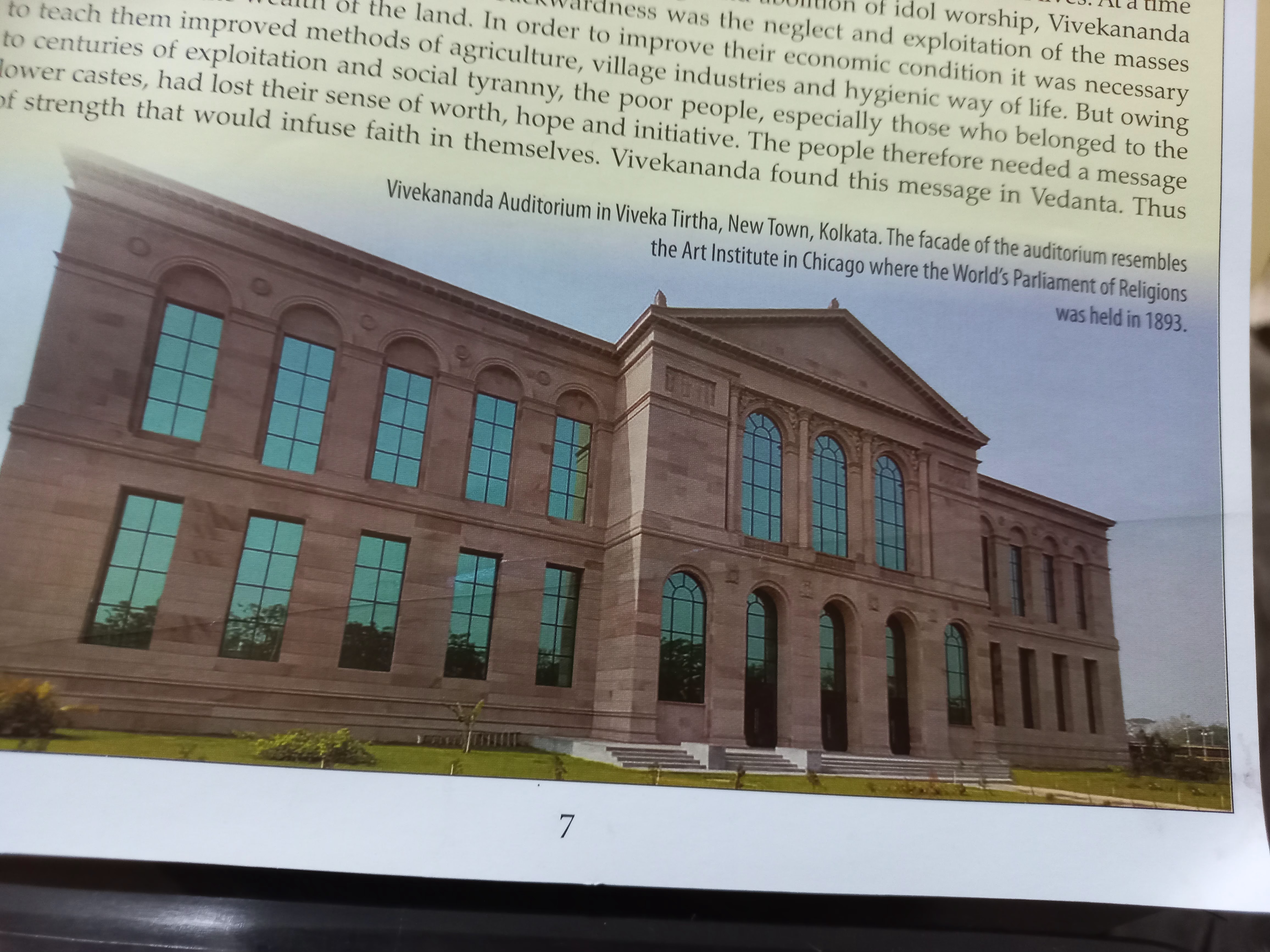
Was fortunate to set my foot on the soil of Swami Vivekananda on 13th May 2024


Friday, December 08, 2023

The Seven Spiritual Laws of Success ~ Deepak Chopra


1. The Law of Pure Potentiality: Take time to be silent, to just BE. Meditate for 30 minutes twice a day. Silently witness the intelligence within every living thing. Practice non-judgment. Mantra - Om Bhavam Namah

2. The Law of Giving: Today, bring whoever you encounter a gift, a compliment, or a flower. Gratefully receive gifts. Keep wealth circulating by giving and receiving care, affection, appreciation and love. Mantra - Om Vardhanam Namah

3. The Law of Karma: Every action generates a force of energy that returns to us in like kind. Choosing actions that bring happiness and success to others ensures the flow of happiness and success to you. Mantra - Om Kriyam Namah

4. The Law of Least Effort: Accept people, situations, and events as they occur. Take responsibility for your situation and for all events seen as problems. Relinquish the need to defend your point of view. Mantra - Om Daksham Namah

5. The Law of Intention and Desire: Inherent in every intention and desire is the mechanics for its fulfillment. Make a list of desires. Trust that when things don’t seem to go your way, there is a reason. Mantra - Om Ritam Namah

6. The Law of Detachment: Allow yourself and others the freedom to be who they are. Do not force solutions—allow solutions to spontaneously emerge. Uncertainty is essential, and your path to freedom. Mantra - Om Anandham Namah

7. The Law of Dharma: We have taken manifestation in physical form to fulfill a purpose. Mantra - Om Varunam Namah

Thursday, December 07, 2023

Religion - Time -

 The mind of the man is the man, and everything out there in life is a manifestation of the flow of thoughts. But human beings we are, we may not be able to think right all the time.

Religion gives a solution by stipulating auspicious and inauspicious time in a day allure people towards positive thinking en masse and hence aids in the manifestation of collective positivity.

Trains leave at Rahu Kalam everyday. They do not meet with accident. 

“The psychological impact religion has on a human being is fascinating!”, Mahatria exclaims he explains why religion created auspicious and inauspicious time in a day.

Religion - Mass hypnotise, Ritualistically things can be accomplished. Mind is programmed, to ensure things are going to go right. 

Religion has psychological impact on human being. It is an advanced science. 

Lucky shirt is a lucky shirt as you belive it is lucky, as the mind is filled with positivitiy. Rationality. 

We need external help at times and that is what religion provides

It was needed, idea .


Monday, November 20, 2023

Theo's Odyssey ~ Catherine Clement


In 'Theo's Odyssey', ~ Catherine Clement  takes us through an amazing journey around the world with Theo and his wealthy aunt Martha crisscrossing various countries in search of a spiritual solution to the ailment, introducing Theo to the religions of the world in the process.

Theo has a mysterious illness and though no one knows what it is, the prognosis is not good, so his rich  aunt decides to take him on a world tour, as a last fling before he dies, or a special treat in case he lives. It begins from his home town in Paris. 

In the first chapter we are introduced to his family, and then begin the journey, from the oldest. It is said that , this book does for religion and spirituality what Sophie's World did for philosophy. Theo is fourteen, Parisian, and slow to get up in the mornings. His parents love him, and want him to choose his own life, his own faith, so they have deliberately avoided giving him a religious education. Theo is very clever, reads a lot, loves computer games and the Greek myths. But then, suddenly, he falls ill. His rich aunt Martha decides that they must roam the world to find a cure for his malaise. 

The sceptical, quizzical Theo being shown the varieties and depths of faith that exist in other places, other cultures. All this is handled with real style, pace, wit and clarity. The book is a thoroughly enjoyable introduction to why and how people believe in their God.

The journey begins with Jerusalem - A wall and a Tomb introducing Theo to Jews, Christians and Islam;  Then to Seen Hills, One Rock. Egypt, and Rome. Then to India covering 10 religions, Hindus, Islam, Buddhist, Sikhs, Christians, Jainism, Jews, Parsi's, Bahais; Mao and Tao in China; Shinto in Japan; Muslims, Hindus and Christians in Indonesia; Christianity and communisam from Russia; Islam from Istanbul; African traditional religion, Brazilian syncretism and even Mormons in New York, and back to Jews in Greece and return to the source. 

It covers a fair variety of religions, and most of the way through it seems to lead one down the path of syncretism, showing how each religion incorporates elements of other religions, or has points of resemblance to other religions.

Theo is half-Greek and so has an Orthodox grandmother (well, half-Orthodox, because she is syncretistic too, mixing Orthodoxy with faith in the Olympian gods). And the treatment of Orthodoxy is pretty skimpy, saying it is all about sorrow and suffering. There are detailed descriptions of rituals for some religions, at least three different rituals for the African traditional religions, but there is no comparable description of the rituals of Orthodox Christianity, not even a memorial service.  It says, Jainisam and Buddhism started around the same time, while Jainisam like Hinduism is old, and Mahavir is the 12th Thirthankara who was born during the time of Buddha. In the story of Ramayana, Rama has two mothers, when we know she has three. Nothing much is mentioned about Bahi religion. 

How is the aunt so rich? Investing and trading in stock market. Theo needs to solve a series of riddles which take him around the world to different cultures and different religions; it's hopefully not his final journey but an insightful adventure. His eccentric, atheist aunt hopes that one if all or any of the gods could heal him from his implied incurable disease.

'Faiths of many lands', is another interesting and better covered book on this subject. So does Kim by Rudyard Kipling. And Of course, my very own Swami Vivekananda and his Chicago Address. 

Tuesday, December 20, 2022

Mantras

 🙏 ये 16 मंत्र  जो सीखना और बच्चों को सिखाना चाहिए,


1. Mahadev

          ॐ त्र्यम्बकं यजामहे, 

           सुगन्धिं पुष्टिवर्धनम् ,

           उर्वारुकमिव बन्धनान्,

           मृत्योर्मुक्षीय मामृतात् !!


2. Shri Ganesha

              वक्रतुंड महाकाय, 

              सूर्य कोटि समप्रभ 

              निर्विघ्नम कुरू मे देव,

              सर्वकार्येषु सर्वदा !!


3. Shri hari Vishnu

           मङ्गलम् भगवान विष्णुः,

           मङ्गलम् गरुणध्वजः।

           मङ्गलम् पुण्डरी काक्षः,

           मङ्गलाय तनो हरिः॥


4. Shri Brahma ji

             ॐ नमस्ते परमं ब्रह्मा,

              नमस्ते परमात्ने ।

              निर्गुणाय नमस्तुभ्यं,

              सदुयाय नमो नम:।।


5. Shri Krishna

               वसुदेवसुतं देवं,

               कंसचाणूरमर्दनम्।

               देवकी परमानन्दं,

               कृष्णं वन्दे जगद्गुरुम।


6. Shri Ram

              श्री रामाय रामभद्राय,

               रामचन्द्राय वेधसे ।

               रघुनाथाय नाथाय,

               सीताया पतये नमः !


7. Maa Durga

            ॐ जयंती मंगला काली,

            भद्रकाली कपालिनी ।

            दुर्गा क्षमा शिवा धात्री,

            स्वाहा स्वधा नमोऽस्तु‍ते।।


8. Maa Mahalakshmi

            ॐ सर्वाबाधा विनिर्मुक्तो,

            धन धान्यः सुतान्वितः ।

            मनुष्यो मत्प्रसादेन,

            भविष्यति न संशयःॐ ।


9. Maa Saraswathi

            ॐ सरस्वति नमस्तुभ्यं,

             वरदे कामरूपिणि।

             विद्यारम्भं करिष्यामि,

             सिद्धिर्भवतु मे सदा ।।


10. Maa Mahakali

             ॐ क्रीं क्रीं क्रीं,

             हलीं ह्रीं खं स्फोटय,

             क्रीं क्रीं क्रीं फट !!


11. Hanuman ji

          मनोजवं मारुततुल्यवेगं,

          जितेन्द्रियं बुद्धिमतां वरिष्ठं।

          वातात्मजं वानरयूथमुख्यं,

          श्रीरामदूतं शरणं प्रपद्ये॥


12. Shri Shanidev

             ॐ नीलांजनसमाभासं,

              रविपुत्रं यमाग्रजम ।

              छायामार्तण्डसम्भूतं, 

              तं नमामि शनैश्चरम् ||


13. Shri Kartikeya

        ॐ शारवाना-भावाया नम:,

         ज्ञानशक्तिधरा स्कंदा ,

         वल्लीईकल्याणा सुंदरा।

          देवसेना मन: कांता,

          कार्तिकेया नामोस्तुते ।


14. Kaal Bhairav ji

          ॐ ह्रीं वां बटुकाये,

          क्षौं क्षौं आपदुद्धाराणाये,

          कुरु कुरु बटुकाये,

          ह्रीं बटुकाये स्वाहा।


15. Gayatri Mantra

            ॐ भूर्भुवः स्वः,

            तत्सवितुर्वरेण्यम् 

            भर्गो देवस्य धीमहि 

            धियो यो नः प्रचोदयात् ॥

16. Truth/Sun Mantra

hiraṇmayena pātreṇa

satyasyāpihitaṁ mukham

tat tvaṁ pūṣann apāvṛṇu

satya-dharmāya dṛṣṭaye


 🙏🙏🏻

Friday, August 26, 2022

Inner Sound

The inner sound has also been developed as a spiritual path or reference point in almost all the religions, traditions and philosophies worldwide. It has been said that it goes by the following names in these various scriptures and philosophical works:

  • AUM, Naad, Akash Bani and Sruti in the Vedas
  • Nada and Udgit in the Upanishads
  • Akshar in the Bhagavad Gita
  • The music of the spheres taught by Pythagoras
  • Sraosha by Zoroaster
  • Kalma and Kalam-i-Qadim in the Qur’an
  • Word and Water of Life in the Bible
  • The Divine Wine and HU by the Sufis
  • Hari Ras and Amrit by Saints and Mystics
  • Naam, Akhand Kirtan and Sacha Shabd in the Guru Granth Sahib
  • Logos in Greek and Hebrew metaphysics, the unifying principle of the world.

It is called variously as Sruti or Shruti (that which is heard), Shabd (word) or Akash bani (voice from the heaven), Sraosha (music of the beyond), Harmony, Logos, Kalma or Bang-i-Ilahi (call from God) or Nida-i-Asmani (heavenly sound).  

Aum is the universal sound, and is not religious in nature. Armaic used by Jews including Christianity they close it with Amen said as Aaammeeennnn (take off n and say), in US it's said A-Man and Islam says Ameen.

When Ram came to South, people called him Rama, Raman. Krishn became Krishna and Krishnan. Infliction of  'N'

A , U , Mm - Do not need the use of the tongue.  Just like in clour television there are only three basic colours - Red, blue and Green. Tongue is helping to mix these sounds in different ways. 

Om is basically a monosyllabic word, as compared to Aum, which is tri-syllabic. Om is simply pronounced the way it is written as opposed to Aum, which is pronounced aa-uu-eemm. In Sanskrit, 'O' is a diphthong sound. This means that it is formed by combining the two sounds 'A' and 'U'.

Daily utterance of AUM will have a phenomenal difference in your existence. 

Monday, November 22, 2021

Tat Tvam Asi

 The phrase was given its most literal interpretation by the 8th–9th-century thinker Shankara of the Advaita (Nondualist) school, for whom the statement was one of the great assertions fundamental to his doctrine.

Tat Tvam Asi (Sanskrit: तत् त्वम् असि or तत्त्वमसि) is a Sanskrit mantra from the Advaita tradition, typically translated as “I am that” or “Thou Art That”. It is one of the four principle Mahavakyas, or "Great Sayings" from the ancient Hindu text, The Upanishads.

Tat Tvam Asi (तत् त्वम् असि) - "That essence (tat, referring to sat, "the Existent") are you" (Chandogya Upanishad 6.8.7 of the Sama Veda)


This is something I have been thinking of in similar lines. In religion we call it spirits. In science we call it energy. In the streets we call it vibes. Whatever we call it, what is important is that we trust it. 

And so much of it has been flowing in during the past few days. 


Sunday, July 18, 2021

Six Stages of a Seeker

Self realization is the foundation on which God realization happen.  As long as Self realization don't happen, you keep coming back to lack of trust. You will be stuck in the suffering states of anger, disappointment, hurt. 

You will wonder if your partner loves you or the divine loves you. You feel disappointed in your family members and divine. You live in the fear of tomorrow, loose trust in life and the divne.

You cant have one heart for the universal intelligence and another for self. 

Journey of spiritual awakening called Manifest. Walking a mystic's path. Journey into the transcendence. 

For the universal intelligence to act as the great protector of life. There are six stages as a seeker:

  • Balya Avasta or the stage of childhood: Most dominant nature, wanting - constant craving. When they are met you are happy. You have faith. When your wants are not met with - emotional or material, you move deeper and deeper in suffering and lose faith. There is anger and dissatisfaction. There is no spiritual wisdom in Balyaavasta. You have wants and desires. There are constant swings.
  • Warthika  Avasta or the stage of trading:  Your connection with the universal intelligence is in giving and taking. You become calculative, you doubt and mistrust. There is no generosity, because your heart is closed. You think like a trader. 
  • Adharsha or the idealist: At this stage you strive hard to be good, because you believe you will come close to God and will be in his grace, receiving spiritual reward. You are engrossed with your self only. You strive to be good and patient, self disciplined, generous. You try to appease universal intelligence. You have experienced immense struggle against yourself. Who you are and what you try to do, are totally in misalignment and hence there is conflict within you. You may move into disappointment and disconnection, you blame, and become stuck with five questions: why is this happening to me? 
These three stages are immersed in ignorance, a consciousness that is not awakened. Self realization don't happen when you judge yourself, when you are self -righteous. It happens in non judgmental awareness and passion arise from it. 

  • Premi or the lover of universal intelligence. Love is an immensely fulfilling experience. You feel complete in the experience, that there is nothing to ask. Love is a reward in itself. When you awake in love you are in the heart of universal intelligence. 

5th and 6th  - Enlightened stage

  • Janani  or the wise men You see the creator and creation as inseparable. Your eyes of wisdom open, and you have to understand the nature of reality itself. You are attached to certain events happening. You are averse to certain events happening. Janani pulls downward pull, witnesses everything as a flow of situation. Life is a flow.  Not attached to outcome. Reality is a vast field of possibilities. Anything arise and anything can go out of existence. To a jani universe is a leela or play of intelligence. 
  • Muktha or the one who is liberated. Everything is Universal intelligence. No moment when it is absent. It happens only in Ekam Tapas. 
As your consciousness move from one stage to another, it is on an evolutionary trajectory.  This is a journey ahead for the seeker. 


Tuesday, January 05, 2021

Sraddha - An Always within a never

8 years, and have been doing this; especially because he was keen and particular and always did for his parents. For him it was the day, when parents want all children to come together and remember the time they spend together, and have that food.


With changing time, we continue doing that, it do give quality time for reflection, and as we do that also ponder:

Do we really need to dip in a Canal/Pond/river and perform Sraddha with wet cloths on or was this done because there were no pipes in the earlier days?


Do we really need to burn the wood and cook over the wood fire, with vessel kept on three stones? Was it something that was done during the earlier times as gas stove were not there and are we continuing to follow the rituals blindly? There was another Sraddham earlier last year, and the rice ball offering/Pinda was cooked in the cooker. 

It is the mantras that are powerful, but the instructor, gives us only instructions, he do not recite any mantras, so is that the right thing to do?


Thankfully we live in a place where there are crows, what if there were no crows around? Remember Raghu Chetan telling about the story, on how an IT employee quit his job, and started domesticating crows, to take the crows to houses where Sraddha was being performed, and how finally one day the forest authorities came and took the Crow away. 

Sraddha is a Sanskrit word which literally means anything or any act that is performed with all sincerity and absolute faith in it. In the Hindu religion, it is the ritual that one performs to pay homage to one's 'ancestors' (Pitṛs), especially to one's dead parents.  Conceptually, it is a way for people to express heartfelt gratitude and thanks towards their parents and ancestors, for having helped them to be what they are and praying for their peace. It also can be thought of as a "day of remembrance".


In practice, the karta (normally male member) (1) invites Brahmanas (priests) that day, invokes in them the divinity of his/her parent, worships and feeds them (2) performs a homa (fire ritual), appeasing Agni and Soma - the deities who transmit the offerings to the ancestors, nourish and protect them and (3) offers balls of rice to the departed souls ("pinda pradaana", offered to the Pitṛs, the ancestral spirits). The karta extends hospitality to the priest and concludes the ceremony by giving "dakshina" (fees) to the Brahmanas. Crows are also revered in Hinduism and during Śrāddha the practice of offering food or pinda to crows is still in vogue.


The important and requisite components for the shraddha ritual are Darbha, Tulasi, black sesame, white rice, ghee, sandlewood, water.

1. Darba:

Darbha is a very important component in the shraddha ritual. Darbha generates radiance (Tej). When Darbha is used in the shraddha ritual, by the influence of the frequencies of Tej emitted by Darbha, the interference of raja-tama particles in each ritual of the shraddha is reduced. The deceased ancestors (Pitars) absorb the energy of a specific level from the ritual.

Darbha represents all the components of inferior or superior level. Hence, in the absence of any specific component, Darbha can be installed at that place. The inherent Tej particles in the Darbha attract the superior frequencies of the Deities and the inferior frequencies of the Pitars as per requirement and invite them at the venue of the shraddha. The inherent air associated with the Tej Principle in the Darbha is activated by the : with-resolve recitation of mantras of the shraddha. This activated Tej Principle is emitted by the Darbha. The negative energies are prohibited by the emitted Tej          

Due to the ability of the Darbha to attract the Principles of superior Deities, it is used as the smallest particles of Divine Consciousness (pavitrak) in each ritual of worship.

2. Black sesame seeds

Using black sesame seeds in the shraddha means invoking the deceased ancestors (Pitars) trapped in the Martyaloka with the help of the raja-tama frequencies emitted from the black sesame seeds. The recitation of mantras in the shraddha has an effect on the black sesame seeds. The dormant raja-tama energy in black sesame seeds is awakened as a result of the sound energy generated by the recitation of mantra. This energy is emitted into the environment in the spiral form of raja-tama vibrations.

At that time, according to the invocation made in the shraddha, subtle bodies of particular Pitars are attracted towards these vibrations and enter Earth's environment. In this process, with help of the raja-tama frequencies emitted from the black sesame seeds, reaching the place of shraddha ritual becomes easier for the subtle bodies of Pitars.

Black sesame seeds are showered at the place of the shraddha. Due to the frequencies of Pitars getting attracted towards the black sesame seeds, the place of the shraddha becomes charged with the Pitar frequencies.

The Desire sheath present around the subtle bodies gets activated due to the frequencies emitted from the black sesame seeds and the Pitars get satiated by partaking their portion of shraddha in air form. In shraddha, water containing black sesame seeds charged with mantras (Tilodaka) has special spiritual importance.

3. The copper platter contains charged Tilodaka. 

Money to be offered to the Brahmin (dakshina), leaf of Bhrungaraj, Sandalwood, flower and beetle nut are placed in it. The momentum of subtle Pitar frequencies increases due to the black sesame seeds in the Tilodaka. As a result, a whirlpool with attraction energy is generated. The subtle body is attracted towards this whirlpool. Thus, the subtle body attracted towards the whirlpool with attraction energy formed from the Pitar frequencies having momentum enters the Earth region. The change occurring at spiritual level during performance of ritual is a feature of spiritual practice of rites, rituals and observances performed at the physical level (Karmakand) prescribed by Hindu Dharma.

4. Akshat

After the host pays obeisance to the Dev-brahman and Pitru-brahman, the brahmins bless the host by showering unbroken rice (akshat) on him. Unbroken rice should be used as akshat. In the shraddha ritual barley is also used. White unbroken rice is used if barley is not available.

 5. Maka (leaf of Bhrungaraj and Tulasi)

At the time of shraddha some of the Pitars coming to Earth are not satiated. Due to the unsatisfied desires of these Pitars, polluted air or speed of emission of subtle frequencies generated from tamasic object increases. Due to the speed of these frequencies, tamasic energy is generated. Movement of raja-tama particles gains momentum. To restrain this momentum, these two substances, maka, that is, leaf of Bhrungaraj and Tulasi are used.

6. Sandlewood

Sandalwood has a meaning and properties of making your mind calm. It is a sacred item that has been used in temples and shrines. This item can make you relax deeply and balance your feelings. By purifying your negative energy and make you feel more positive. It is good to use when you want a hope for the future.

We also apply ash and kajol after the Sraddha. Whatever be the reason, it is indeed worth to spend quality time at least yearly walking around and thinking of them , with our siblings. 


Thursday, December 31, 2020

The complete Works of Swami Vivekananda

Swami Vivekananda famous for his Chicago address, was born on 12 January 1863 and left his earthly abode on  4 July 1902. He has been a great inspiration, and I have always loved reading him and his books. But this is the first time, I read his Complete 9 volumes of work, each around 600 pages. So can we call these 89 to 97 of 2020?


Bliss!

"We have what is not only a gospel to the world at large, but also to its own children, the Charter of the Hindu Faith. What Hinduism needed, amidst the general disintegration of the modern era, was a rock where she could lie at anchor, an authoritative utterance in which she might recognise her self. And this was given to her, in these words and writings of the Swami Vivekananda."

In his Master, Ramakrishna Paramahamsa, living and teaching in the temple-garden at Dakshineshwar, the Swami Vivekananda — "Naren" as he then was — found that verification of the ancient texts which his heart and his reason had demanded. Here was the reality which the books only brokenly described. Here was one to whom Samâdhi was a constant mode of knowledge. Every hour saw the swing of the mind from the many to the One. Every moment heard the utterance of wisdom gathered superconsciously. Everyone about him caught the vision of the divine. Upon the disciple came the desire for supreme knowledge "as if it had been a fever". Yet he who was thus the living embodiment of the books was so unconsciously, for he had read none of them! In his Guru, Ramakrishna Paramahamsa, Vivekananda found the key to life.


Volume I

Addresses at The Parliament of Religions

Response to Welcome, Why We Disagree, Paper on Hinduism, Religion not the Crying Need of India, Buddhism, the Fulfilment of Hinduism, Address at the Final Session

Karma-Yoga

Karma in its Effect on Character, Each is great in his own place, The Secret of Work, What is Duty?, We help ourselves, not the world, Non-attachment is complete self-abnegation, Freedom, The Ideal of Karma-Yoga

Raja-Yoga

Preface, Introductory, The First Steps, Prana, The Psychic Prana, The Control of Psychic Prana, Pratyahara and Dharana, Dhyana and Samadhi, Raja-Yoga in brief

Patanjali's Yoga Aphorisms: Introduction, Concentration: Its spiritual uses, Concentration: Its practice, Powers, Independence, Appendix

Lectures and Discourses

Soul, God and Religion, The Hindu Religion, What is Religion?, Vedic Religious Ideals, The Vedanta Philosophy, Reason and Religion, Vedanta as a Factor in Civilisation, The Spirit and Influence of Vedanta, Steps of Hindu Philosophic Thought, Steps to Realisation, Vedanta and Privilege, Privilege, Krishna, Gita I, Gita II, Gita III, Mohammed, Vilvamangala, The Soul and God, Breathing, Practical Religion: Breathing and Meditation

Volume 2

Work and its Secret

The Powers of the Mind

Hints on Practical Spirituality

Bhakti or Devotion

Jnana-Yoga

The Necesssity of Religion, The Real Nature of Man, Maya and Illusion, Maya and the Evolution of the Conception of God, Maya and Freedom, The Absolute and Manifestation, God in Everything, Realisation, Unity in Diversity, The Freedom of the Soul, The Cosmos: The Macrocosm, The Cosmos: The Microcosm, Immortality, The Atman, The Atman: Its Bondage and Freedom, The Real and the Apparent Man

Practical Vedanta and other lectures

Practical Vedanta: Part I to IV, The Way to the Realisation of a Universal Religion, The Ideal of a Universal Religion, The Open Secret, The Way to Blessedness, Yajnavalkya and Maitreyi, Soul, Nature and God, Cosmology, A study of the Sankhya philosophy, Sankhya and Vedanta, The Goal

Reports in American Newspapers

Note, Divinity of Man, Swami Vivekananda on India, Religious Harmony, From far off India, An Evening with our Hindu Cousins, The Manners and Customs of India, The Religions of India, Sects and Doctrines in India, Less Doctrine and more Bread, The Religion of Buddha, All Religions are Good, The Hindu way of life, Ideals of Womanhood, True Buddhism, India's Gift to the World, Child Widows of India, Some Customs of the Hindus

Volume 3

Lectures and Discourses

Unity, the Goal of Religion, The Free Soul, One Existence Appearing as Many

Bhakti-Yoga

Definition of Bhakti, The Philosophy of Ishvara, Spiritual Realisation, the aim of Bhakti-Yoga, The Need of Guru, Qualifications of the Aspirant and the Teacher, Incarnate Teachers and Incarnation, The Mantra: Om: Word and Wisdom, Worship of Substitutes and Images, The Chosen Ideal, The Method and the Means

Para-Bhakti or Supreme Devotion

The Preparatory Renunciation, The Bhakta's Renunciation Results from Love, The Forms of Love — Manifestation, Universal Love and How it Leads to Self Surrender, The Higher Knowledge and the Higher Love are One to the True Lover, The Triangle of Love, The God of Love is His Own Proof, Human Representations of the Divine Ideal of Love, Conclusion

Lectures from Colombo to Almora

First Public Lecture in the East (Colombo), Vedantism, Reply to the Address of Welcome at Pamban, Address at the Rameswaram Temple on Real Worship, Reply to the Address of Welcome at Ramnad, Reply to the Address of Welcome at Paramakudi, Reply to the Address of Welcome at Shivaganga and Manamadura, Reply to the Address of Welcome at Madura, The Mission of the Vedanta, Reply to the Address of Welcome at Madras, My Plan of Campaign, Vedanta in its Application to Indian Life, The Sages of India, The Work before us, The Future of India, On Charity, Address of Welcome Presented at Calcutta and Reply, The Vedanta in all its phases, Address of Welcome at Almora and Reply, Vedic Teaching in Theory and Practice, Bhakti, The Common Bases of Hinduism, Bhakti, The Vedanta, Vedantism, The Influence of Indian Spiritual Thought in England, Sannyasa: Its Ideal and Practice, What have I learnt?, The Religion we are born in

Reports in American Newspapers

India: Her Religion and Customs, Hindus at the Fair, At the Parliament of Religions, Personal Traits, Reincarnation, Hindu Civilisation, An Interesting Lecture, The Hindoo Religion, The Hindoo Monk, Plea for Tolerance, Manners and Customs in India, Hindoo Philosophy, Miracles, The Divinity of Man, The Love of God, The Women of India

Buddhistic India

Volume 4

Addresses on Bhakti-Yoga

The Preparation, The First Steps, The Teacher of Spirituality, The Need of Symbols, The Chief Symbols, The Ishta

Lectures and Discourses

The Ramayana, The Mahabharata, Thoughts on the Gita, The Story of Jada Bharata, The Story of Prahlada, The Great Teachers of the World, On Lord Buddha, Christ, the Messenger, My Master, Indian Religious Thought, The Basis for Psychic or Spiritual Research, On Art in India, Is India a Benighted Country?, The Claims of Religion, Concentration, Meditation, The Practice of Religion

Writings: Prose

Is the Soul Immortal?, Reincarnation, On Dr. Paul Deussen, On Professor Max Müller, Sketch of the Life of Pavhari Baba, Aryans and Tamilians, The Social Conference Address, India's Message to the World, Stray Remarks on Theosophy, Reply to the Address of the Maharaja of Khetri, Reply to the Madras address, A Message of Sympathy to a Friend, What we Believe in, Our Duty to the Masses, Reply to the Calcutta Address, To my Brave Boys, A Plan of Work for India, Fundamentals of Religion

Writings: Poems

Kali the Mother, Angels Unawares I-III, To the Awakened India, Requiescat in Pace, Hold on Yet a While, Brave Heart, Nirvanashatkam, or Six Stanzas on Nirvana, The Song of The Sannyasin, Peace

Translations: Prose

The Problem of Modern India and its Solution, Ramakrishna, his Life and Sayings, The Paris Congress of the History of Religions, Knowledge: Its Source and Acquirement, Modern India, The Education that India needs, Our Present Social Problems

Translations: Poems

To a Friend, The Hymn of Creation, The Hymn of Samadhi, A Hymn to the Divine Mother, A Hymn to Shiva, A Hymn to the Divinity of Shri Ramakrishna, "And let Shyama Dance there", A Song I Sing to Thee

Volume 5

Epistles - First Series

Note, I Fakir, II Panditji Maharaj, III to V Alasinga, VI Haripada, VII Friends, VIII Alasinga, ..........CXXIII Dhira Mata

Interviews

Miracles, An Indian Yogi in London, India's Mission, India and England, Indian Missionary's Mission to England, With the Swami Vivekananda at Madura, The Abroad and The Problems at Home, The Missionary Work of The First Hindu Sannyasin to The West, Reawakening of Hinduism on a National Basis, On Indian Women — Their Past, Present and Future, On The Bounds of Hinduism

Notes from Lectures and Discourses

On Karma-Yoga, On Fanaticism, Work is Worship, Work Without Motive, Sadhanas or Preparations for Higher Life, The Cosmos and The Self, Who is A Real Guru?, On Art, On Language, The Sannyasin, The Sannyasin and The Householder, The Evils of Adhikarivada, On Bhakti-Yoga, Ishvara and Brahman, On Jnana-Yoga, The Cause of Illusion, Evolution, Buddhism and Vedanta, On The Vedanta Philosophy, Law and Freedom, The Goal and Methods of Realisation, World-Wide Unity, The aim of Raja-Yoga

Questions and Answers

I Discussion at The Graduate Philosophical Society of Harvard University, II At The Twentieth Century Club of Boston, III At The Brooklyn Ethical Society, Brooklyn, IV Selections from The Math Diary, V Yoga, Vairagya, Tapasya, Love, VI In Answer to Nivedita, VII Guru, Avatara, Yoga, Japa, Seva

Conversations and Dialogues (Recorded by Disciples - Translated)

I Shri Surendra Nath Das Gupta, II - V Shri Surendra Nath Sen, VI - X Shri Priya Nath Sinha, XI - XV From the Diary of a Disciple, Shri Sarat Chandra Chakravarty

Sayings and Utterances

Writings: Prose and Poems - Original and Translated

Reason, Faith and Love, Six Sanskrit Mottoes, The Message of Divine Wisdom, The Belur Math: An Appeal, The Advaita Ashrama, Himalayas, The Ramakrishna Home of Service, Varanasi: An appeal, Who Knows how Mother Plays!, To The Fourth of July, The East and The West

Volume 6

Lectures and Discourses

The Methods and Purpose of Religion, The Nature of the Soul and its Goal, The Importance of Psychology, Nature and Man, Concentration and Breathing, Introduction to Jnana-Yoga, The Vedanta Philosophy and Christianity, Worshipper and Worshipped, Formal Worship, Divine Love

Notes of Class Talks and Lectures

Religion and Science, Religion is Realisation, Religion is Self-abnegation, Unselfish Work is True Renunciation, Freedom of the Self, Notes on Vedanta, Hindu and Greek, Thoughts on the Vedas and Upanishads, On Raja-Yoga, On Bhakti-Yoga, On Jnana-Yoga, The Reality and Shadow, How to Become Free, Soul and God, The Goal, On Proof of Religion, The Design Theory, Spirit and Nature, The Practice of Religion, Fragmentary Notes on the Ramayana, Notes taken down in Madras, 1892-93, Concentration, The Power of the Mind, Lessons on Raja-Yoga, Lessons on Bhakti-Yoga, Mother-worship, Narada-Bhakti-Sutras

Writings: Prose and Poems - Original and Translated

Historical Evolution of India, The Story of the Boy Gopala, My Play is Done, The Cup, A Benediction, The Hymn of Creation, On the Sea's Bosom, Hinduism and Shri Ramakrishna, The Bengali Language, Matter for Serious Thought, Shiva's Demon

Epistles - Second Series

I Sir, ................ CLXVII Joe, CLXVIII Nivedita

Conversations and Dialogues (From the Diary of a Disciple)

 Volume 7

Inspired Talks (1895)

Date wise. 

Conversations and Dialogues

From the Dairy of a Disciple (Shri Sharat Chandra Chakravarty)

Shri Priya Nath Sinha

Mrs. Wright XXXII, The Appeal-Avalanche XXXIII, The Detroit Free Press XXXIV, The Detroit Tribune XXXV

Translation of Writings

Note, Memoirs of European Travel I, Memoirs of European Travel II, Addenda

Notes of Class Talks and Lectures

Notes of Class Talks

On Art, On Music, On Mantra and Mantra-Chaitanya, On Conceptions of Godhead, On Food, On Sanyasa and Family Life, On questioning the Competency of the Guru, Shri Ramakrishna: The significance of His Life and Teachings, On Shri Ramakrishna and His Views, Shri Ramakrishna: The Nation's Ideal

Notes of Lectures

Mercenaries in Religion, The Destiny of Man, Reincarnation, Comparative Theology, Buddhism, The Religion of the Light of Asia, The Science of Yoga

Epistles - Third Series

Note, I Sir,  L Mother, LI Mr. Leggett, LII Aunt Roxy, LIII Alberta

Volume 8

Lectures and Discourses

Discourses on Jnana-Yoga

I, to IX

Six Lessons on Raja-Yoga

Women of India, My Life and Mission, Buddha's Message to the World, Discipleship, Is Vedanta the Future Religion?

Writings: Prose

Struggle for Expansion, The Birth of Religion, Four Paths of Yoga, Cyclic Rest and Change, A Preface to the Imitation of Christ

Writings: Poems

An Interesting Correspondence, Thou Blessed Dream, Light, The Living God, To an Early Violet, To My Own Soul, The Dance of Shiva, Shiva in Ecstasy, To Shri Khrishna, A Hymn to Shri Ramakrishna, A Hymn to Shri Ramakrishna, No One to Blame

Notes of Class Talks and Lectures

Notes of Class Talks, Man the Maker of His Destiny, God: Personal and Impersonal, The Divine Incarnation or Avatara, Pranayama, Women of the East, Congress of Religious Unity, The Love of God I, The Love of God II, India, Hindus and Christians, Christianity in India, The Religion of Love, Jnana and Karma, The Claims of Vedanta on the Modern World, The Laws of Life and Death, The Reality and the Shadow, Way to Salvation, The People of India, I am That I am, Unity, The Worship of the Divine Mother, The Essence of Religion

Sayings and Utterances

Epistles - Fourth Series

Volume 9

Letters (Fifth Series)

Lectures and Discourses

The Women of India, The First Step towards Jnana, Bhakti-Yoga, The Mundaka Upanishad, History of the Aryan Race

Notes of Lectures and Classes

Note, The Religion of India, Christ's Message to the World, Mohammed's Message to the World, Class Lessons in Meditation, The Gita, The Gita — I, The Gita — III, Gita Class, Remarks from Various Lectures

Writings: Prose and Poems (Original and Translated)

The Ether, Notes, Lecture Notes, Macrocosm and Microcosm, Footnotes to The Imitation of Christ, The Plague Manifesto, One Circle More, Facsimile of One Circle More, An Untitled Poem on Shri Ramakrishna, An Unfinished Poem, Bhartrihari's Verses on Renunciation

Conversations and Interviews

Excerpts from Sister Nivedita's Book

Note, Foreword, I The Home On The Ganges, II At Naini Tal And Almora, III Morning Talks At Almora, IV On The Way To Kathgodam, V On The Way To Baramulla, VI The Vale Of Kashmir, VII Life At Srinagar, VIII The Temple Of Pandrenthan, IX Walks And Talks Beside The Jhelum, X The Shrine Of Amarnath, XI At Srinagar On The Return Journey, XII The Camp Under The Chennaars, Concluding Words Of The Editor

Sayings and Utterances

Newspaper Reports

Part I: American Newspaper Reports

Note, Chicago Newspapers, September 11, 1893, Chicago Record, September 11, 1893, Chicago Inter Ocean, September 21, 1893, New York Critic, November 11, 1893, Daily Cardinal, November 21, 1893, Daily Iowa Capitol, November 28, 1893, Iowa State Register, November 28, 1893, Daily Iowa Capitol, November 29, 1893, Iowa State Register, November 30, 1893, Des Moines Daily News, November 30, 1893, Daily Iowa Capitol, November 30, 1893, Iowa State Register, December 1, 1893, Minneapolis Journal, December 15, 1893, Minneapolis Tribune, December 15, 1893, Detroit Tribune, February 18, 1894, Detroit Tribune, February 19, 1894, Detroit Journal, February 23, 1894, Detroit Evening News, February 25, 1894, Detroit Tribune, March 11, 1894, Detroit Tribune, March 20, 1894, Detroit Evening News, March 21, 1894, Bay City Times Press, March 21, 1894, Saginaw Evening News, March 21, 1894, The Lynn Daily Evening Item, (Date?), New York Daily Tribune, April 25, 1894, Smith College Monthly, May 1894, New York Daily Tribune, May 3, 1894, Evening Tribune, May 16, 1894, Lawrence American and Andover Advertiser, May 18, 1894, Boston Evening Transcript, August 11, 1894, Greenacre Voice, 1894, Boston Evening Transcript, August 15, 1894, Baltimore American, October 13, 1894, Baltimore News, October 13, 1894, Baltimore Sunday Herald, October 14, 1894, Washington Times, October 29, 1894, Washington Times, November 2, 1894, Baltimore News, November 3, 1894, Daily Eagle, April 8, 1895, New York World, December 8, 1895, New York Herald, January 19, 1896, Hartford Daily Times, February 1, 1896, Tribune, March 5, 1896, News Tribune, March 16, 1896, Boston Evening Transcript, March 21, 1896, Boston Daily Globe, March 24, 1896, Boston Evening Transcript, March 27, 1896, Boston Evening Transcript, March 30, 1896, Los Angeles Times, December 9, 1899, Los Angeles Times, December 13, 1899, Los Angeles Herald, December 13, 1899, Los Angeles Herald, January 3, 1900, Los Angeles Times, January 17, 1900, Los Angeles Herald, January 26, 1900, Unity, February (?) 1900, San Francisco Chronicle, February 24, 1900, Oakland Tribune, February 26, 1900, The Alameda Encinal, April 5, 1900

Part II: European Newspaper Reports

Maidenhead Adviser, October 23, 1895, Standard, October 23, 1895, London Morning Post, October 23, 1895, Christian Commonwealth, November 14, 1895, The Queen, November 23, 1895, Daily Chronicle, May 14, 1896, Light, July 4, 1896, Light, October  28, 1896

Part III: Indian Newspaper Reports

Madura Mail, January 28, 1893, The Indian Mirror, November 28, 1893, The Indian Mirror, December 7, 1893, The Indian Mirror, June 14, 1894, The Indian Mirror, July 20, 1894, The Bengalee, May 18, 1895, The Indian Mirror, June 29, 1895, The Indian Mirror, December 1, 1895, The Indian Mirror, March 25, 1896, The Indian Mirror, June 19, 1896, The Brahmavadin, July 18, 1896, The Indian Mirror, September 22, 1896, The Journal of the Maha-Bodhi Society, November, 1896, The Indian Mirror, December 16, 1896, The Amrita Bazar Patrika, January 8, 1897, The Amrita Bazar Patrika, January 20, 1897, The Indian Mirror, February 24, 1898, The Indian Mirror, April 24, 1898, The Indian Mirror, February 15, 1901, The Indian Social Reformer, June 16, 1901

There is so much in here, that I would like to keep revisiting, a treasure house indeed. Would want to remember the lines below:

My whole ambition in life is to set in motion a machinery which will bring noble ideas to the door of everybody, and then let men and women settle their own fate. Let them know what our forefathers as well as other nations have thought on the most momentous questions of life. Let them see specially what others are doing now, and then decide. We are to put the chemicals together, the crystallization will be done by nature according to her laws. Work hard, be steady, and have faith in the Lord. Set to work, I am coming sooner or later. Keep the motto before you — "Elevation of the masses without injuring their religion".