Showing posts with label Temples. Show all posts

Tuesday, June 10, 2025

Ancient Churches from Kochi ~ John Alexander

 There are 8 churches in Kerala which tradition says, were built by Apostle St Thomas between 52 ( he landed in Muziris) and 63 AD, before he left for Madras ..taking the land route via Keezhadi, near Madurai. He was killed in 73 AD on St Thomas Mount and buried I'm San Thome church.

After Vasco da Gama landed at Calicut in 1498, the Portuguese etc established themselves at Cochin, Goa (They gave Bombay to England's Charles II, as dowry for Catherine of Braganza) Though they lost control.of Cochin to the Dutch in 1663, they retained Goa, Daman, Diu.


Church built by Apostle Thomas, 60 AD.


Basilica at Valarpadam (1524)


St Francis Church, Fort Cochin and (below) tomb of Vasco da Gama


Bom Jesus Basilica, Goa, consecrated 1605, contains body of St Francis Xavier.


Monday, January 20, 2025

Chola Temples


The iconic Chola temples ..Thanjavur, Gangaikondacholapuram and Darasuram .. are among the most amazing structures in India. I have visited all three, and used to drive  down to Thanjavur from Trichy many an evening, when I was FACT's Regional Manager in the late 1960s. The first two Brihadeswara temples were built by Rajaraja I in 1010, and son Rajendra in 1040, while Darasuram's Airavateshwara was built 100 years later by Rajaraja II.
Apart from their sheer architectural beauty, as a civil engineer, I was struck by the technology used which was far in advance of the times. Even today, we are left awestruck by the feat of rolling the huge 85 tonne sikara up a 6.5 km long ramp!
The earliest known Chola was Karikala ( burnt leg) of the Sangam period who built the Grand Anicut on the Kaveri later in 10 AD. However, it was only centuries later (circa 850), that Vijalaya established a small kingdom in Thanjavur, which grew into a mighty empire. What a wonderful history Tamilnadu has!
But I am reserving the feats of the Cholas as grand builders and mighty conquerors for another day.
JPA


Sunday, November 10, 2024

Thandika Varavu


*Irinjalakuda Kudalmanikum Temple: 'Thandika Varavu' – A Devotional Journey*


The 'Thandu Varavu' is an event filled with deep devotion, observed at the Kudalmanikum Temple in Irinjalakuda. During the Malayalam month of Thulam (which falls at the end of October or beginning of November), devotees embark on a 15-kilometer journey from Potta in Chalakudy to the Kudalmanikum Temple. This journey is undertaken on the day of Utradam.

Devotees leave Potta in the afternoon, carrying eight bamboo poles laden with eight full bunches (kulla) of Nendra Pazham (big yellow bananas) and two poles (Thandu) of Kadli Pazham (a variety of small yellow bananas), along with rice, oil, sandalwood, cloth, and ornaments for the idol. This procession is called Thandiga Varavu and starts with the auspicious 'Arpu Villi'.


തണ്à´Ÿിà´• വരവു à´šാലക്à´•ുà´Ÿി à´…à´Ÿുà´¤്à´¤ുà´³്à´³ potta à´¯ിൽ à´¨ിà´¨്à´¨് Inrajalakuda kudalmanika Temple à´²േà´•്à´•്....à´•ാà´´്à´š്à´š à´•ുà´² കൾ സമ്്à´ªിà´•്à´•ുà´•..

Carrying agricultural produce and other offerings to the temple is an annual ritual and a way for devotees to express gratitude for the blessings they received in the past, a practice known as 'Kshetram Vaga Pravarthi Kacheri'. In the days before motor vehicles, devotees had to walk the entire distance, and the tradition continues to this day.

After walking for 3 to 4 hours, they reach Althara, near Danav, where they take a brief rest before proceeding to the temple for the evening pooja. Temple members welcome with traditional Panchavadyam and Nathaswara. Local devotees donate offerings to prepare a Sadhya (feast) for the next three days, with devotees from Potta given first preference in receiving the meal.


Saturday, October 05, 2024

Statue Of Equality (105 of 2024)

 'To alleviate the misery of others,

I don't mind facing the throes of Hell.

All are eligible to enter a temple.

The Creator showed no partiality, nor should we.

All are equally qualified to chant the name of God.

All are equal in the eyes of God.

Shed your ego. Serve all beings as service to God.

Serve society which is the universal form of God.

Nobody is infallible.

Do not humiliate anyone.

What is of supreme importance is purity of mind and deed'

~ Sri Ramanujacharya Swami


On rare occasions, heavenly stars miraculously descend on earth.  Sri Ramanuja  was one such miracle - a human manifesting who lit the path of equality  and Bhakti across the universe. Born in Sriperumbudur, Tamil Nadu in 1017 AD. He dedicated his entire life for social reform,  leaving no stone unturned in dispelling darkness. As an unparalleled spiritual master, he delivered the treasure of the true spirit of Vedic literature to the doorsteps of the common person - regardless of caste, creed or gender. He propounded the philosophy of qualified monism, which enables us to understand reality as it is, and the relationship among all of us. He brought people from all walks of life together. Ramanuja made 18 journey's to get the sacred mantra from Goshtipurna the acharya, 100kms away from Sri Rangam.  17 times he was he was told 'the time is not right, come back later'. Ramanuja, provided the secret to everyone with a desire to know. 

The core philosophy of Equality - all beings have the same eternal relationship with the supreme being. All things and beings are simply different limbs of the same Universal Body that is God. 

It's been a thousand years since this divine personality sanctified the earth by his presence. The world is advocating his ideology without truly knowing much about him. His name remains in the shadows. This, the powerful essence of his teachings and the core roots of the values he advocated are amiss. 

Today inevitable, yet seemingly invincible walls have been built, dividing our society. The world is fraught with divisiveness and populism. People are pitted against each other over conflicts of religion, economics, culture and background. The world 'Equality' has become just a slogan. 

The need of the hour is Sri Ramanuja's ideology. His form and his words have the power to uplift society in all aspects. What better time than now to experience this inspiration than the millennium anniversary of his birth. The core vision of His Holiness Chinna Jeeyar Swami is to inspire society to inculcate equal opportunity throughout all aspects of life, breaking down the barriers of culture, economics and socio-economic status. He aims to empower everyone of us with the message of Sri Ramanuja. Let's imbibe this message of equality and practice it daily in our lives. 

Vedic seers envision the world living in harmony at the individual, family, societal, nature and spiritual levels. Given such a magnificent vision, imagine the personality that spread it to the world. Bhagavad Ramanujacharya is awe inspiring beyond comprehension. The Statue excudes his personality, bringing him to life in a magnificent, tangible form for all of us. By having such a monumental place of inspiration, it is expected that millions of people will be inspired by this Universal Message. 

It enables us to rise above the difficulties we face in life, to ultimately understand the true concept of Equality. It unites and accepts all of us with our unique characteristics, to help each other, to love each other, and to in turn make the world a better place. 


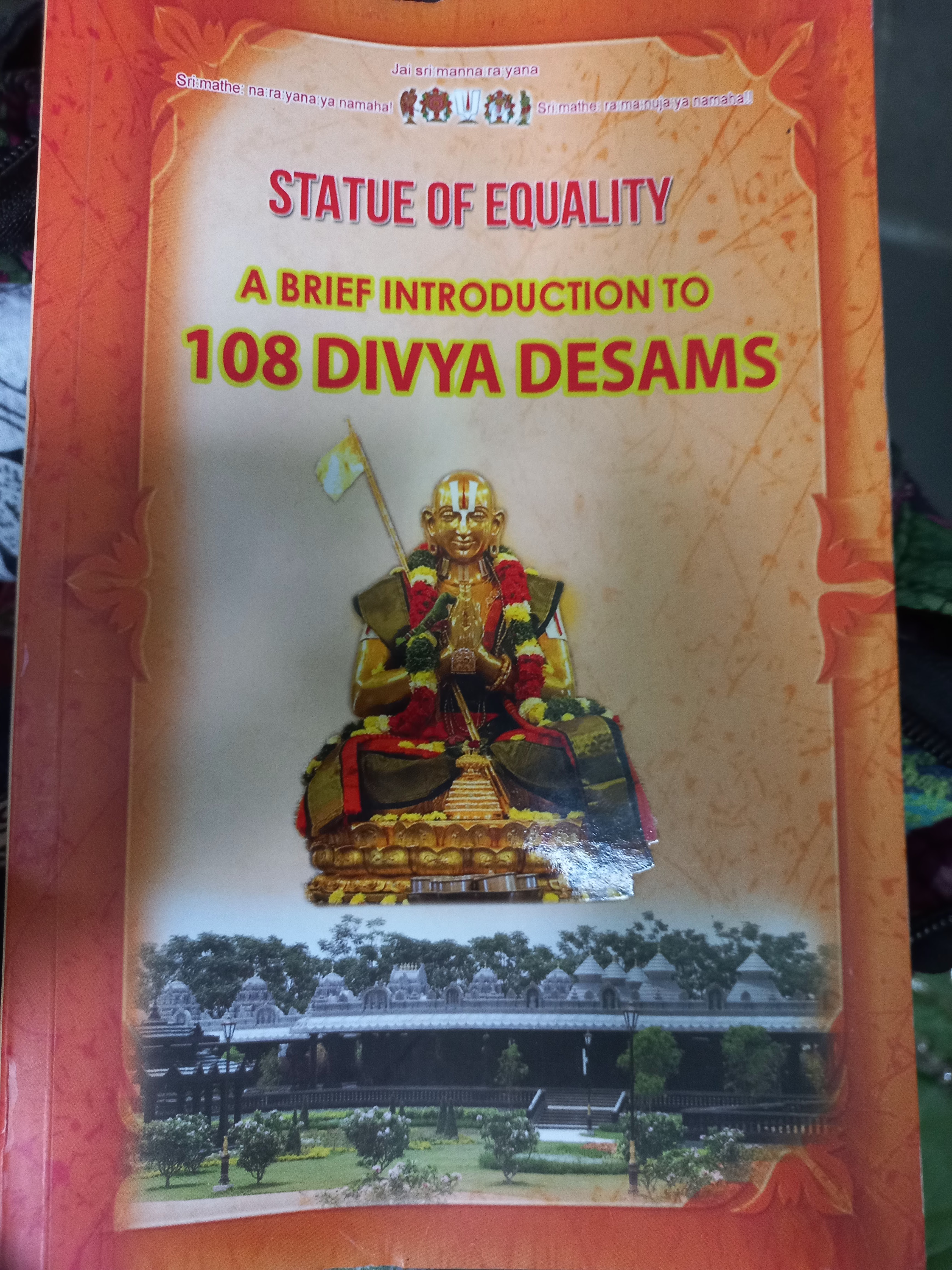
The Statue of Equality is a statue of the 11th-century Indian philosopher Ramanuja, located on the premises of the Chinna Jeeyar Trust at Muchintal, Ranga Reddy district in the outskirts of Hyderabad. It is the second tallest sitting statue in the world. The tallest sitting statue being that of Bhudda in Thailand. Inside you are not allowed footwears or mobiles. So better to leave them in your care. There is a place where they collect it, and return it at the exit gate which was gate number 8 for us. Also this being on the other side of airport and not in the direction of Hyderabad or Secandrabad, where most of the tourist attraction and Hi-Tech city is, better to visit during arrival or departure, in case you are short of time. 


The base building under the statue named Bhadravedi is 16 metres (54 ft) tall and three-stories high. Atop the building lies a lotus of 8.2 metres (27 ft) in diameter,and is carried by 36 elephants, over which the statue sits. The diameter of the lotus represents 24 tattvas, as well as soul, god and the guru. The statue has a concrete core which is surrounded by a panchaloha sheet with a thickness varying between 10 mm and 20 mm.The base building has a meditation hall where a 54 inches (1.4 m) statue of Ramunuja made of 120 kg of gold, representing the years he lived, is installed. 108 divyadesams (model temples), built in stone, surround the statue.

These are the sacred temples of Lord Vishnu revered in the Divya Prabandham, a collection of 4,000 Tamil verses written by the Azhwar saints. The arrangement of the 108 Divya Deshams around the Statue of Equality is done to honor these sacred temples.


While the Statue of Equality doesn't arrange the Divya Deshams based on any specific geographic or scriptural order (since these temples are geographically spread across India and beyond), they are categorized as per tradition into clusters. Here's an outline of how the Divya Deshams are traditionally classified:

Tamil Nadu Divya Deshams (Alvars sung about these Vishnu temples)

  1. Thiruparkadal (Milky Ocean - Symbolic Divya Desham)
  2. Thiruvahindrapuram (Thiruvahindrapuram Temple, Tamil Nadu)
  3. Thiruvarangam (Srirangam)
  4. Thirukoshtiyur
  5. Thiruvallur
  6. Kanchipuram
  7. Tirupati (Tirumala)
  8. Thiruvananthapuram (Sri Padmanabhaswamy Temple)

And many others scattered in Kanchipuram, Srirangam, and Madurai, as well as temples along the Cauvery and Tamirabarani rivers.

North Indian Divya Deshams

  1. Badrinath
  2. Dwarka
  3. Mathura
  4. Ayodhya

Kerala and Andhra Pradesh Divya Deshams

  1. Thiruvananthapuram
  2. Naimisharanya

At the Statue of Equality, each of these Divya Deshams is represented by a smaller replica of the original temples, arranged in a circular fashion around the central statue. Though the specific order may not be universally prescribed or defined in a sequence, they are generally categorized based on geography or historical significance.

The statue was inaugurated by Indian Prime Minister Narendra Modi on 5 February 2022. The smaller golden statue inside the base building was inaugurated by President Ram Nath Kovind on 13 February 2022.

Divya Desham's are 108 Vishnu and Lakshmi temples that is mentioned in the works of the Alvars, the poet-saints of the Sri Vaishnava tradition. The word Alvar has traditionally been etymologized as from Tamil Al (ஆழ்), 'to immerse oneself' as 'one who dives deep into the ocean of the countless attributes of god'. The 106 earthly Divya Desam temples are spread over the Indian states of Tamil Nadu (84), Kerala (11), Uttar Pradesh (4), Uttarakhand (3), Andhra Pradesh (2) and Gujarat (1), and the country of Nepal (1) (Muktinath). The last two are believed to be in in Tirupparkatal and Vaikuntham.

The Divya Desams are classified into six regions:

  • Chera Nadu (western)
  • Chola Nadu (central)
  • Pandya Nadu (south)
  • Pallava Nadu (north)
  • Vada Nadu (northern India)
  • Vinnulaga Divya Desams (celestial)


In Hindu texts, these temples are often referred to as Bhuloka Vaikuntham, which in Tamil means heavens on earth. Each of the Divya Desam has its own significance related to Sri Vaishnava legend. Almost all of these temples have separate shrines for Vishnu and Lakshmi.

Srirangm (near Thiruchi in Tamil Nadu) is considered the first, foremost and the most important of all the 106 Divya Desams in this world, and hence praised as Bhoologa Vaikundam. The presiding deity of this temple is Sri Ranganathar.  Srirangam temple is considered the largest functioning Hindu temple in the world as it is spread across 156 acres of land in an islet formed by River Cauvery and its tributary Kollidam.

Other's are:


Let the Statue reverberate within you with the echoes of Equality. Let these echoes become a yearning for improvement and upliftment. Let this feeling be translated into actions improving the wold at large throughout our lives. 

How can we imbibe the ideals of Ramanuja?

Equality is a universal concept, there are infinite ways in which it can be practiced by each of us in our daily lives. Here are some examples:

  1. Remember the body -soul relationship at all times. Inside every soul is a God. That supreme being is the same one inside of all of us. We should treat that being with respect and care. 
  2. If any other being, animal, tree, insect or person needs help, respond appropriately. Do your best to alleviate that pain in any way possible. 
  3. When irritated by another person or animal, bird etc. try to remember that they are essentially, at the core, the same as us - a soul with God inside of that soul. This will help us moderate our irritation towards the person and enable us to focus on the circumstances that caused the irritation, rather than the person. 
  4. When for any reason, we feel superior to anyone else, remember, everyone is equal in the eyes of great people and supreme being, regardless of their achievements. 
  5. When we see diversity in people, try to see the commonness, among all of us. This will reduce feelings of hatred and domination towards the other person. 
  6. When we see nature around us - the earth, trees, water, mountains, air etc. remember Nature is also a manifestation of the Supreme Being, and do our best to protect and nurture nature. 
  7. At home keep a deity form of the Supreme Being, have faith, have trust and have confidence in the deity form of the Lord. 

Equality Starts with us. 

Live Better. Inspire Others. 

Courtesy 


Monday, January 22, 2024

Faith, Religion, Ram temple


The way forward for the planet, is the recognition that authority is not truth; truth is the only authority.  In the quest for truth, we have iconic inspirations. One among them Ram/Rama/Raman has left an indelible mark on the collective consciousness. We do not have to be religious to appreciate this. 

Ram embodied love, patience, integrity, gentleness and fortitude under incredibly challenging circumstances, who fought for his wife without hatred, resentment or negativity and repented for slaying his adversary, because he recognised that his enemy was a noble human being in his own right. 

He placed the well-being of his citizens above personal interest. 

Heroism is not the conquest of the external but the internal. Remaining unruffled and equanimous through various disasters in life makes him exceptional. He was not a super human, but a man who with examples proved being human is super. An ideal man, who rose to be divine, with triumph of responsibility. 


Anniruddha Acharya clearly states why Hindu's have not just one God. Just as I am one, but different for different people - like a mother, sister, daughter, aunth, friend etc. we have one God in different forms, and different religion. 


Kaun Hindu, kaun Musalman… Thappa kidhar hai dikha… Ye farak bhagwan nahi tum log banaya hai… Aur yahi is gola ka sabse danger wrong number hai...

Who is Hindu, who is Muslim… where is the stamp visible… this difference is not made by God but you people… and this is the most dangerous wrong number of this globe…

A man of principle, who voluntarily gave up his kingdom and went to exile, and came back, fulfilled his responsibility and again returned. 

Would he be happy or sad to see the splendid marvel created in his name today? 

One of the 10 avtara's of Lord Vishnu


Shri Ram as a 5-year old boy is the main Murti in the Mandir in Ayodhya.

Some Facts about the temple construction:

Chief Architects - Chandrakant Sompura, Nikhil Sompura and Ashish Sompura.

Design Advisors - IIT Guwahati, IIT Chennai, IIT Bombay, NIT Surat, Central Building Research Institute Roorkee, National Geo Research Institute Hyderabad, and the National Institute of Rock Mechanics.

Construction Company - Larsen and Toubro (L&T)Project

Management Company - Tata Consulting Engineers Limited ( TCEL)

Sculptors - Arun Yogiraaj (Mysore), Ganesh Bhatt and Satyanarayan Pandey

Total Area - 70 Acre (70% green Area)

Temple Area - 2.77 Acre

Temple Dimensions - Length – 380 Ft.

Width – 250 Ft. Height – 161 Ft.

Architectural Style - Indian Nagar Style

Architectural Highlights - 3 storeys (floors), 392 pillars, 44 doors

Now let's see how the temple will be a modern marvel:

The temple complex consists of several independent infrastructures of its own
which includes -
1. Sewage treatment plant
2. water treatment plant
3. fire service
4. independent power station.
5. Pilgrims Facility Centre of 25,000 capacity to provide medical facilities and locker facilities to the pilgrims.
6. Separate block with a bathing area, washrooms, washbasin, open taps, etc.
7. 200 KA light arresters have been installed over the temple structure to protect it from lightening.
8. Museum showcasing artifacts related to Lord Ram and the Ramayana. Thus. more than just a religious center, the Ram Mandir has been envisioned as a cultural and educational center as well.

Other Fascinating Things:
1. A time capsule has been placed approximately 2,000 feet below the ground, right underneath the temple. The capsule contains a copper plate inscribed with relevant information regarding the Ram Mandir, Lord Rama, and Ayodhya.
The purpose of this time capsule is to ensure that the identity of the temple remains intact over time so that it doesn’t get forgotten in the future.

2. The temple is an earthquake-resistant structure, with an estimated age of 2500 years.

3.The idols are made up of 60 million years old Shaligram Rocks, brought from the Gandaki River (Nepal)

4. The Bell is made of Ashtadhatu (Gold, Silver, Copper, Zinc, Lead, Tin, Iron, and Mercury)
The Bell weighs 2100 Kg
The sound of the bell can be heard up to a distance of 15 Km.

And in times to come, hope we will only be mesmerized to see it bring prosperity to the region.


AI's have their own way to showcase this. 


Is this true?

How do we know the path Ram travelled, where exactly he was born? 


Has'nt even the landscape of India changed? 


Sekharipuram Narayanan Subramanian, Managing Director,L &T , the brain behind the engineering Marvel at Ayodhya . There are people from Kanyakumari to all over India who have been involved in the construction of this temple. 

Hope the glory remain. 

Friday, December 08, 2023

Ashtavinayaka


https://en.wikipedia.org/wiki/Ashtavinayaka

 Ashtavinayaka is a Sanskrit term which means "eight Ganeshas". The Ashtavinayaka Yatra refers to a pilgrimage to the eight Hindu temples in the state of Maharashtra, India, centered around the city of Pune. The eight temples house eight distinct idols of Ganesha, the Hindu deity of unity, prosperity, learning, and removing obstacles. Each of these temples has its own individual legend and history, as distinct from each other as the murtis in each temple. The form of each murti of Ganesha and his trunk are distinct from one another. There are other temples of eight Ganesha in various other parts of Maharashtra; however, the ones around Pune are more well known and visited. To complete the Ashtavinayaka Yatra, one must revisit the first temple after visiting all the eight temples.

Out of these 8 Temples, 6 are in Pune and 2 are in Raigad District.

The pilgrimage takes 3 days to complete. As per scriptures travel starts from Moreswar in Moregaon then Siddhivinayak temple of Siddhtek, Pali, Mhad, Theur Chintamani Ganesh in Pune, Lenyandri, Ojar, Ranjangaon then back to Moregaon where pilgrimage had started.

Ashtavinayaka Temples
#TempleLocation
1Mayureshwar TempleMorgaon, Pune district
2Siddhivinayak TempleSiddhatekAhmednagar district
3Ballaleshwar TemplePaliRaigad district
4Varadavinayak Temple[4]Mahad, Raigad district
5Chintamani TempleTheur, Pune district
6Girijatmaj TempleLenyadriPune district
7Vighneshwar TempleOzar, Pune district
8Mahaganapati TempleRanjangaonPune district

Traditionally, Moreshwar of Moregaon is the first temple visited by the pilgrims. The temples should be visited in this order Moregaon, Siddhatek, Pali, Mahad, Theur, Lenyandri, Ozar, Ranjangaon. The pilgrimage is concluded with a second visit to Moregaon.

All these murtis are called svayambhu idols in Sanskrit (self-originating/self-existent images, and not carved images).

Monday, October 31, 2022

Chardam

 The Char Dham, is the four most famous Hindu pilgrimage circuit in India which are believed to be the abodes of Hindu gods. Located in the four directions of India, the circuit consists of four sites - to the north is Badrinath, to the west is Dwarka, to the south is Rameshwaram and to the east is Puri. 


At Badrinath the famous temple is Badrinath Temple and the presiding deity is Shri Badrinath (Vishnu).


 At Rameshwaram the famous temple is Rameshwaram Temple and the presiding deity here is in the form of a Linga with the name Sri Ramanatha Swamy. 


At Puri the temple is known as Lord Jagannath Temple and the presiding deity is Lord Jagannath. He is present together with His elder brother Balabhadra and His sister Subhadra. 


At Dwarka the main temple is The temple of Dwarkadheesh (Lord Krishna), also known as Jagat Mandir.


There are Matt's associated with each of these temples and each of these maths was assigned the task of maintaining and preserving for posterity, one of the four Vedas (the main scriptures of Hinduism). They are:

1. Sharada Math - Sama Veda -  West - Dwaraka

2. Shringeri Math - Yajur Veda - South - Rameshwaram

3. Jyotir Math - Atharva Veda - North - Bhadrinath

4. Govardhan Math - Rig Veda - East - Puri

All the Four Dhamas located at cardinal points of the Indian sub-continent are believed to have been liked by Lord Vishnu intimately. It is said and believed that He takes His bath at Rameswaram, meditates at Badrinath, dines at Puri and retires at Dwarika.

Popular writings of many cites that for National Integrity, Adi Shankaracharya had agreed and insisted that Joshis from Kashi, Kashmir, Nepal or Maharashtra should be the poojaris at Rameshwaram; the Chowbey Brahmins from Orissa should be the Poojaris at Dwaraka and the Poojaris at Jagannath Puri should be the Pandits from Gujarat. Adi Shankaracharya  arranged that the idol at Badrinath be offered chandan {sandalwood}  and silk from the south India also the head priest comes from south India  {namboodiri brahmin from kerala} and the Shivling at rameshwaram be offered Ganga water from north and the priest comes from north India {gharwal brahmin or from Varanasi in north}

The reason why Adi Shankaracharya started the tradition of the char dham yatra and the religious gathering of the Kumbh mela was that he wanted to integrate India spiritually. There was a north / south cultural divide and India was split up.

This was Adi Shankaracharya ‘s vision to have a flow of spiritual energy across India and as a direct result India was firmly integrated.

These yatras are only to connect to the Divine energy that prevails there and that Moksha only comes when one cleans oneself mentally, physically and spiritually....

This had become a big business, until the episode of the June disaster in 2013 which has slowed down people going there, but recently people again have started trickling in large number to seek their GODS for MOKSHA. Religion has become a money making business and the spiritual super market has a lot to offer and trap people

Rameshwaram has Tamil priest though, and Kedarnath has a Karnataka Priest and Pashupathinath has from Butt community of Tulu Nadu. 

Not sure if Shankaracharya did it during his time. 

Tantra over years dwindled in North India with the rise of Smarta tradition. and later for new Vedantha traditions which denounced the concepts of old Vedic rituals and initiated for philosophies mostly in monastic order intended for social spiritual connections. The key concepts of these traditions were to stop all sorts of rituals and complex knowledge-based procedures to connect to the god, rather simply link oneself to the supreme being.

Thus the traditions of Tantra slowly ended as large scale rituals for Yajnas, Homas etc as done in Vedic period started ending to much more simplified easy to link/understand traditions. The Bhakti movement took spiritualism to masses.

So essentially much of North India became a less ritualistic oriented style of worship unlike South where these older traditions continued, especially in Kerala and Tulu coast which still retains old Vedic era concepts without much dilution.

It is part of the recorded history that in the year 1776, Garhwal King sent invitations to priests from South to preside over the temples of Badrinath and Kedarnath.

Hoping, wishing and praying that I am blessed to cover all four this year. It is believed that every Hindu should visit the Char Dhams during one's lifetime, irrespective of the fact if visiting these sites helps achieve moksha (salvation) or not, it help us understand history, and has it's own advantages and should I say disadvantages as well? 

Friday, February 26, 2021

Iringole Kavu

Sacred groves, also called Kavu in Malayalam language, are rich abodes of biodiversity. They are often seen on the premises of Hindu ancestral homes (tharavaadu) in the villages. It was a common practice among the people to assign a portion of the land on which they built house to serpent god Naga or goddess Durga. While the state boasted of more than 10,000 groves at the time of its formation in 1956, only around 1,200 exist now, and among these many are under threat, the report prepared by the State Assembly Committee on Forest and Environment, chaired by forest minister Thiruvanchoor Radhakrishnan, reads. The biggest one now is the Iringlole Kavu in Perumbavoor, Ernakulam.  Though had been staying not very far from this place, this 14th Feb. was my first visit. 


Like most sacred groves, Iringole Kavu, too, has a temple which is dedicated to Mother Goddess. Considered as one of the largest sacred groves or kavus in Kerala, when you visit the place, you can hear the droplets of rain making its way down through the green canopy; all of this is accompanied by the chirping of birds and chattering of squirrels, which would give you an energetic experience of being in a tropical forest, although, this one is not legally considered as one.


The temple is said to be 2700 odd years old, but only 1200 odd years old since the rituals and festivals and the arrival of devotees began. Spread over 50 odd acres of land, it would take one an entire day to cover the entire sacred grove. Home To Nature The grove remains in the multiple hues of green with its many marshes and ponds in the vicinity, which form a mesh like appearance in the ground formed by the locks of roots which have aged up to thousands of years. The temple pond here is filled with water throughout the year, which means to say even during peak summers.

The grove is not only the holy abode of Mother Goddess but also to 49 odd different species of trees, 19 varieties of spiders, four species of amphibians and seven species of reptiles. While most of its residents are under the threat of extinction, it is also home to 42 different species of insects and 5 mammals. The green woods surrounding the temple exhibit a very rare combination of divinity and wilderness. 


As per one of the many stories, which are associated with the goddess here, the most popular one goes like this, the goddess is considered as the eighth born child of Devaki and Vasudeva who ever imprisoned by Kamsa. It is said that the newborn rose up to take the form of goddess Durga. Kamsa attempted to kill the infant and the goddess made her appearance with a lighting; the place where the lighting struck was called Irunnol, which later became Iringol. Another legend narrates that, a sage named Trinabindu had been meditating here. Once Hanuman is said to have watched him without his knowledge. Pretty soon the monkey god was chased away by the sage who failed to recognise him. Hanuman is believed to have returned with an elephant and a lion, which further enraged the sage who cursed Hanuman, who happened to be sitting atop a tree, that he would be unaware of his strength.


Hanuman's father, the wind god, is said to have searched the entire forest after learning about the curse and began to shake every single tree here. Except one, the rest trembled to the power of Vayu. The monkey god had been sitting on this tree which came to be known as Valiya llavu and is one of the most worshipped ones here. It is also said that Vayu bowed before the sage to apologies on behalf of his son, but he was stubborn. The sage reminded Vayu that Iringol is a sacred land; the wind which blows here must be soft and no one should cut the trees and that there will be no dangerous animals or venomous ones which would harm anyone.

The Goddess Who Accepts Non Fragrant Flowers Here, Mother Goddess is worshiped as Saraswathi, the goddess of learning, in the morning, Vanadurga in the afternoon and as Bhadrakali in the evening. Here only tulasi or the holy basil and non-fragrant flowers, such as the lotus, are used for the rituals, which makes it all the more unique. If you happen to carry any sort of plastic material, kindly refrain from dumping it into the groves in case you plan to visit this place and be watchful for snakes.