Monday, December 23, 2024

Malaysia Diaries

Malaysia is a vibrant, multicultural country located in Southeast Asia. It is known for its rich history, diverse cultures, modern cities, and beautiful natural landscapes. Gained independence from British rule on August 31, 1957, forming the Federation of Malaya, and later expanded to include Sabah, Sarawak, and Singapore in 1963. Singapore left in 1965 to become an independent nation.


National Flag of Malayasia - was first raised on 31st August, 1957 at 12:01 AM

Malaysia's Capital: Kuala Lumpur, with the administrative capital in Putrajaya. Malaysia is slightly larger than Norway or New Mexico (USA).It ranks 66th in the world by land area.


Malaysia consists of two main regions:

Peninsular Malaysia (West Malaysia): Shares borders with Thailand in the north and is connected to Singapore via a causeway in the south. Includes 11 states and two federal territories (Kuala Lumpur and Putrajaya).Features a central mountain range known as the Titiwangsa Range, surrounded by coastal plains.

East Malaysia (Borneo): Shares borders with Indonesia and Brunei and is separated from Peninsular Malaysia by the South China Sea. Located on the northern part of the island of Borneo. Comprises the states of Sabah and Sarawak and the federal territory of Labuan. Characterized by dense rainforests, mountain ranges (including Mount Kinabalu, the highest peak at 4,095 meters), and a rugged coastline.


So we have 13 states and three federal territories.


Light n fountain show

Ancient trade routes brought Hindu and Buddhist influences from India and China.Islam was introduced in the 13th century, becoming the dominant religion.Colonized by the Portuguese, Dutch, and British, Malaysia became a key trading hub. Islam is the official religion, but Buddhism, Christianity, Hinduism, and traditional beliefs are also practiced.

The population is a mix of: Malays (the largest ethnic group), Chinese, Indians, Indigenous groups (e.g., Orang Asli, Iban, Kadazan)

Official language is  Malay (Bahasa Malaysia) English is widely spoken, along with Tamil, Mandarin, and other regional languages.

Main festivals  here are  Hari Raya Aidilfitri (Eid), Chinese New Year, Deepavali (Diwali), Gawai Festival (Sarawak), Kaamatan Festival (Sabah)

It's Infrastructure is a mix of traditional villages (kampongs) and ultramodern urban centers.
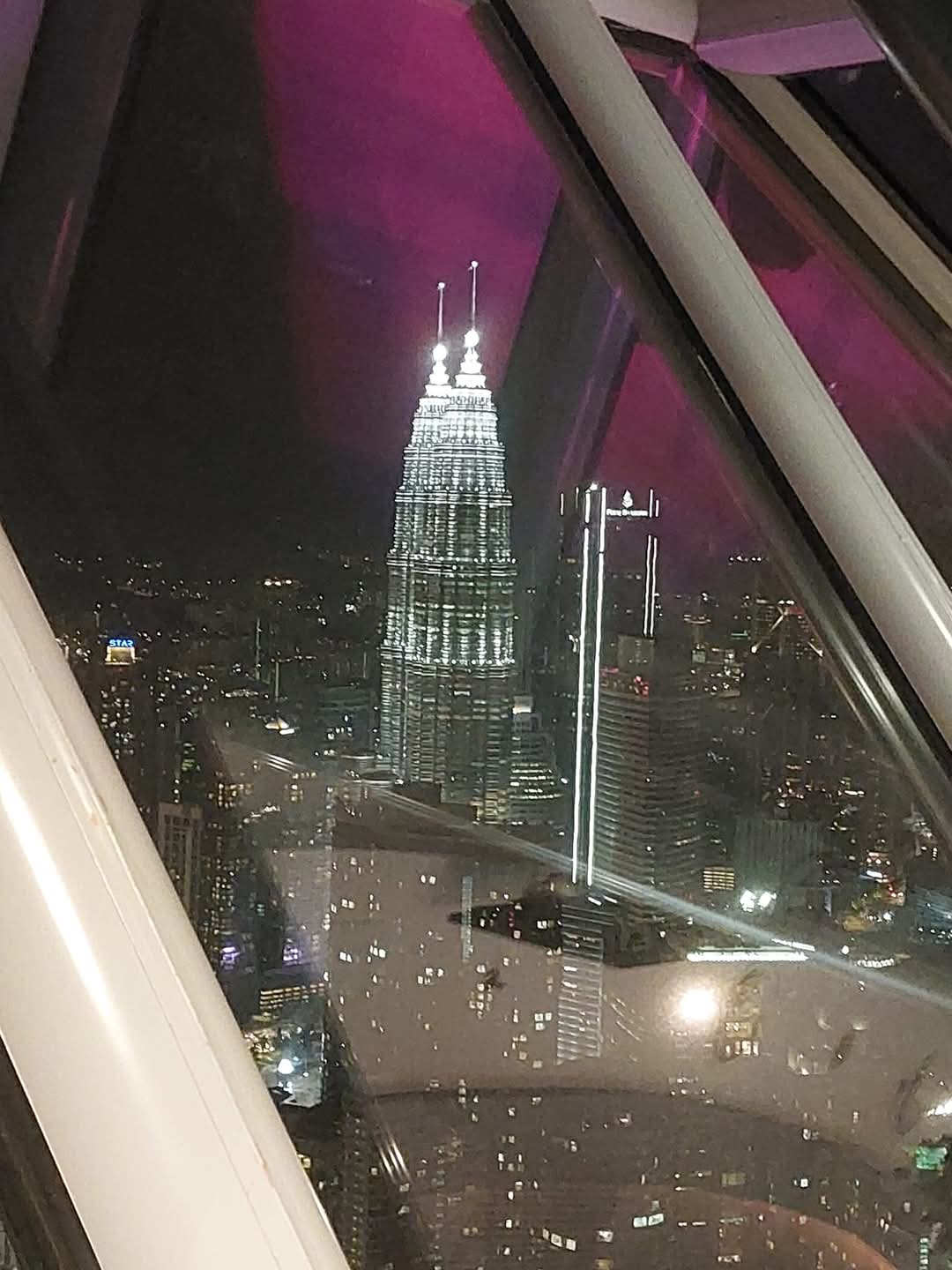


A view of The Petronas from 906ft @ KL Tower


Key Landmarks or tourist attractions here are: Petronas Twin Towers (Kuala Lumpur): Iconic skyscrapers and a symbol of modern Malaysia; Malacca: UNESCO World Heritage city with a rich colonial history.
George Town (Penang): Known for its colonial architecture and street food; Mount Kinabalu (Sabah): Popular for trekking. Rainforests: Home to diverse wildlife like orangutans and tigers. Beaches: Langkawi, Tioman Island, and the Perhentian Islands. National Parks: Taman Negara, Gunung Mulu.


@ the base of KL Tower


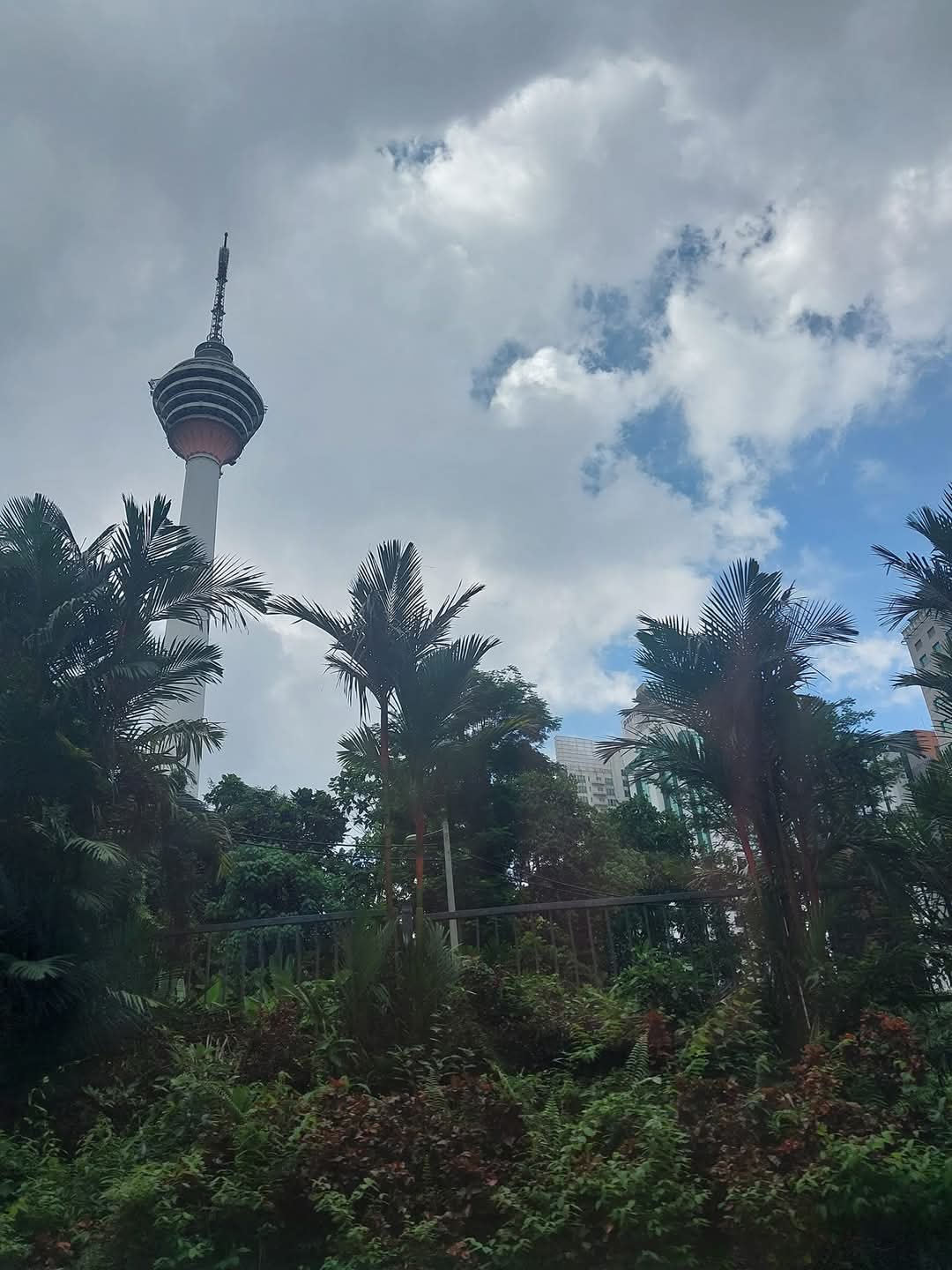
The KL Tower


Life by the river.... painted on the building.... there are many more buildings painted along the riverside


Sultan Abdul Samad Jamek Mosque.... oldest mosque in KL @ the confluence of River Klang & River Gombak


Sรนltan Abdul Samad Building.... British Govt. Office in its early years


World's tallest Flag Rising Pole 100m...@ Independence Square, KL, Malaysia


Miniatures of some important monuments of the world.... there were so many that all couldn't be captured...


Miniatures of some important monuments of the world.... there were so many that all couldn't be captured...


Smallest Quran with Magnifying Glass


Ivory carved Paduka


Mughal neck piece


Mughal neck piece


A beautiful art work on the ceiling


An ancient marble game - Mancala


Malay Jewelleries


Ancient Musical Instruments of Malaysia


Muzium Negara - The National Museum of Malayasia


Malaysian cuisine is a flavorful fusion influenced by Malay, Chinese, Indian, and indigenous cooking styles.

Popular dishes are Nasi Lemak: Coconut rice served with sambal, anchovies, and eggs.; Rendang: Spicy meat dish.; Laksa: Spicy noodle soup.; Char Kway Teow: Stir-fried flat noodles.
Roti Canai: Indian-style flatbread.
Beverages:Teh Tarik: Sweet, frothy tea. White Coffee: Originating from Ipoh.


@ base of ''The Petronas''..... beauty indeed


@ base of ''The Petronas''..... beauty indeed


@ Museum Of Illusions, Bukit Bintang, KL


Three towers in same frame


The Kek Lok Si Temple is a Buddhist temple within the city of George Town in the Malaysian state of Penang. Located at Ayer Itam, it is the largest Buddhist temple in Malaysia


The Batu Caves, located in Gombak, Selangor, just north of Kuala Lumpur.
The statue of Lord Murugan is a towering 42.7 meters (140 feet) tall, making it one of the tallest statues of Lord Murugan in the world.
It is painted in vibrant gold and stands at the base of the Batu Caves, welcoming visitors.
The Batu Caves is a limestone hill with a series of caves and cave temples, serving as a major Hindu pilgrimage site.


The caves are especially popular during the annual Thaipusam festival, which attracts devotees and tourists from around the world.


Malaysia has beautiful beaches too. One of the famous is Langkawi, including the Pretty Pregnant Maiden Island. There are many water sports activity like snorkelling and swimming. 


Government and Politics System is Constitutional monarchy with a parliamentary system.King: The Yang di-Pertuan Agong, elected from the nine Malay rulers on a rotational basis. Prime Minister: Head of government.

Malaysia is Celebrated for its coexistence of diverse ethnic groups.. Home to unique species like the Malayan tiger, orangutan, and Rafflesia (world’s largest flower).

Rafflesia, known locally as Bua Phut (wild lotus), is orange/red in appearance. It has no roots or leaves of its own; instead it lives parasitically inside the roots of the liana. It takes nine months to grow from the size of a small button to a giant football (some reach 80cm in diameter). The Rafflesia only blooms for a few days a year, usually during January and February.

Friday, December 20, 2024

Before We Forget Kindness by Toshikazu Kawaguchi (118 of 2024)

"With life come many regrettable actions that we can't undo. Most of these come down to things we do or say in the heat of the moment. Fallouts that occur in a family - between parent and child, or among siblings - can take a long time to resolve. No amount of regret over past words and actions can heal the emotional wounds inflicted on someone unless that person's feelings change."

Before We Forget Kindness by Toshikazu Kawaguchi is  the fifth book in the sensational Before the Coffee Gets Cold series, the mysterious cafe where customers arrive hoping to travel in time welcomes four new guests:

- A boy who wants to show his smile to his divorced parents chapter titled The Son

- A wife holding a child with no name . . .The Nameless Child

- The father who could not allow his daughter to get married chapter titled The father where talk about daughters favourite food Omurice (Omelette on rice) too. 

- A woman who couldn't give Valentine's Day chocolates to her loved one The Valentine. 

They must follow the cafe's strict rules, however, and come back to the present either from the past or the future before their coffee goes cold. 

Our new visitors wish to go back into their past to move on their present, finding closure and comfort so they can embark on a beautiful future.

"Even the pettiest of reasons can delay the mending of a relationship. Often neither side accepts the claims of the other and it can remain stained for many years. Human hearts are complicated and simple solutions often elude them. The more you believe in someone, the more unbearable the anger or sorrow becomes when you feel betrayed. "

To die without conveying our feelings is a great torment. 

The biggest obstacle to confessing your love is not knowing what your romantic interest is feeling - it would take some kind of superpower. And feelings are fickle, they change daily. If the timing of a confession is even slightly off, the opportunity may be missed. 

"Expressing your feelings honestly isn't wrong. It's rare for someone to take offence at being told they are liked - on the contrary, its a blessing. So why is it so hard to take that step? Saying 'I like you' should be simple, but around each person's heart there appears to be a massive wall. Not a physical barrier but an emotional one. When we interact with each other, we hold back because we don't know what's on the other side of the wall. As humans, we are wired to fear the unknown, and this causes many to falter. "

"Essentially, it is the fear of rejection that makes the wall, and heartbreaks only make it higher. "

Tuesday, December 17, 2024

100 years of Solitude & The legends of Khasak


Why is Gabriel Garcia Marquez so popular in Kerala?  This was the question asked in a book club meeting which I attended.

This set me thinking. Because it's not only Gaby, but Latin America as a whole which holds a fascination for this small state in South India. We have rabid fans of Argentina and Brazil football teams. Long after his death, Che Guavera holds demi-god status among the left-wing youth. And Latin American literature and movies always have an audience here.

I can only explain this using the word "ethos": the sum total of the culture of a people. Kerala shares with Latin America a curious mix of left-wing activism, rebellious individualism, deep religiosity and aggressive atheism. In fact, our state is a bunch of contradictions just as Latin America is - a land on the verge of collective schizophrenia.

Maybe, magical realism is the only way to map the mind of such a place. We had our first tryst with the genre much before Marquez, by the way: O. V. Vijayan's Khasak (a fictitious land from "Khasakkinte Ithihasam", a Malayalam novel published in 1968, and later translated by the author himself as "The Legends of Khasak") was here much before Macondo. And our writers continue to explore landscapes of the mind.


Monday, December 16, 2024

My Way ~ Paul Anka & Frank Sinatra


"My Way" is a song popularized in 1969 by Frank Sinatra set to the music of the French song "Comme d'habitude" composed by Jacques Revaux with lyrics by Gilles Thibaut and Claude Franรงois and first performed in 1967 by Claude Franรงois.

https://www.youtube.com/watch?v=-JODZ8AMkqo  ~  Frank Sinatra

https://www.youtube.com/watch?v=LX4EGvw5wP4 ~ Paul Anka

And nowwww the end is near

& So I face the final curtain

My friend, I'll say it clear

I'll state my case, of which I'm certain

I've lived, a life that's full

I've Traveled each and every highway

and More, much more than this

I did it, myyyy.... way

Regrets, I've had a few

But then again, too few to mention

I did,  what I had to do

And saw it through, without ex-emption

I planned each charted course

Each careful step, along the byway

And more, much more than this

I did it, myyyy way

Yes there were times, I'm sure you knew

When I bit off, moreeee than I could chew

But through it allllllll, when there was doubt

I ate it up, and spit it out

I faced it all, and I stood tall

And did it myyyyy way

I've loved,  I've laughed and cried

I've had my fill, my share of losing

And now, as tears subside

I find it all soooo amusing

To think, I did all that

And may I say, not in a shy way

Oh no, oh no not me

I did it myyy way

For what is a man, what has he got?

If not himself, then he has naught

To say the things, he truly feels

And not the words, of one who kneels

The record shows, I took the blows

And did it.. myyy way......................

Yes, it was my way...............

~ Sung by Frank Sinatra in 1969


Mind Master ~ Viswanathan Anand (117 of 2024)


Had  Mind Master by Viswanathan Anand with me for quite some time now. With all the news about his students creating history, and making India shine, could not resist myself from making it my next read. The book is  the journey of 'The Lightning Kid' becoming 'The Madras Tiger' . Co-authored with sports journalist Susan Ninan, the book combines personal anecdotes, insights into the world of competitive chess, and life lessons that extend far beyond the 64 squares of the chessboard. The book traces Anand’s journey from his childhood in Chennai, where his love for chess was nurtured, to his rise as a five-time World Chess Champion. Along with it the highlight of the book is:

  • Anand’s vivid description of his World Championship matches, particularly against Kramnik, Topalov, and Carlsen.
  • His reflections on the psychological warfare in chess, where preparation often extends beyond the board.
  • Life lessons that seamlessly intertwine with chess strategies, making the book relevant for professionals, students, and enthusiasts alike.

Anand dedicates his book to his mother by mentioning her at the beginning of the book - For my mother, who told me to always write down my thoughts, good or bad. She said, 'One day you will read them and realize how beautiful they are.' The legend starts his book by mentioning one of his favorite songs - 'Regrets, I've had a few...' by the legendary singer Frank Sinatra.

Regrets, I've had a few

But then again, too few to mention

I did what I had to do

And saw it through without exemption

I planned each charted course

Each careful step along the byway

And more, much more than this

I did it my way

~ Written by Paul Anka

The prologue of the book ends with "Que sera sera, I tell myself, as I sip my tea..."

Anand recounts his early days, from his mother teaching him chess to his meteoric rise in the global arena. His anecdotes about facing legends like Garry Kasparov and Magnus Carlsen offer a fascinating look into the psychological battles of top-level chess

Anand does not shy away from revealing his vulnerability. Yes even World Champions also go through a difficult time as we find Anand mentioning, 'I need to speak to Radek... I can't recall a thing.' So next time you forget a theory or a middle game plan, you are at your wits end, no need to get a cold feet because even the best of the best has also suffered a similar situation. What is the difference maker then? How they come out on top of it despite facing various adversity.

Anand doesn’t shy away from discussing his setbacks, including his loss to Carlsen in 2013. He reveals how he managed self-doubt, learned from failures, and came back stronger—lessons that resonate with anyone striving for success.

One of the most compelling aspects of the book is Anand’s discussion of how he reinvented his game to stay relevant in a constantly evolving chess landscape. He draws parallels to how adaptability is essential in any field.

Behind Anand’s individual brilliance is a story of teamwork. He highlights the crucial role his seconds (chess assistants), family, and friends played in his career. This underscores the importance of collaboration even in seemingly solitary pursuits.

Anand emphasizes the importance of focus, preparation, and maintaining calm under pressure. His methods for staying mentally sharp—be it through meditation, reading, or simple observation—are practical takeaways for readers.

While Mind Master is insightful, readers looking for a detailed breakdown of chess strategies might find it lacking in technical depth. The book focuses more on Anand’s personal journey and life lessons rather than intricate chess analysis. However, this broadens its appeal beyond chess aficionados to a wider audience.

Anand delves into the psychological aspects of chess, discussing how mental preparation and resilience play a critical role in competitive success. He also explores the intense psychological battles that occur off the board, especially during his high-stakes World Championship matches. Anand examines the emotional dynamics of victory, the importance of humility, and how Anand processed and celebrated his wins. When You Lose, Say Less, he says, but find other avenues to vent out. Anand discusses the evolving role of technology in chess, from the early days of computer-assisted training to the current era where artificial intelligence and engines dominate the scene. Anand highlights the importance of collaboration and the role his support system—family, trainers, and seconds—played in his success.

Mind Master is an inspiring read that goes beyond chess. Viswanathan Anand not only shares the highs and lows of his illustrious career but also offers practical wisdom for overcoming challenges, embracing change, and pursuing excellence. Whether you’re a chess enthusiast or simply someone looking for motivation, this book will leave you enriched.

Viswanathan Anand's Mind Master: Winning Lessons from a Champion’s Life is not just an autobiography; it’s a treasure trove of wisdom from one of the greatest chess minds of our time. 

Whether you are a player, coach, parent, chess enthusiast or even a sports fan, there is something for everyone. Anand discusses all his triumph and tragedy, every little and big obstacle he had to face, how he overcame them, what he did when some of them were surmountable, facing practical challenges and much more. This is a gateway to a journey of a prodigy who conquered the world and firmly planted India's flag all over the chess world. 

Here is the concluding message of the 12 chapters in Mind Master: Winning Lessons from a Champion’s Life by Viswanathan Anand:

  1. DITCHING THE LADDER - Of gut heart and a winning idea : As a long term strategy, being predictable is not of much advantage - for your career or business or even for yourself. Once in a while, you've got to take the counter-intuitive path, but not without owning responsibility for the consequences - and certainly not without preparation. In such situations, your attitude should trump the decision itself. When you focus on previously unconsidered solutions to reach your end goal, don't' let your mind wallow in indecision or imagined negative outcomes. Instead, push through with execution. 
  2. STICKY NOTES - Madras, Manila, Madrid and everything in between - Once you shut out the clamour of the result and simply persevere, success is bound to be yours. Keep making notes. 
  3. THE ART OF REMEMBERING - Hooks, Hacks and Serendipity. - Nothing you do however unconnected it is to your livelihood or your life's goal, goes waste. You never know when an idea that you've read about or heard of, or an activity you've dabbled in, will pay off. It's wise, then, to keep your interest and your learning as varied and broad as you can. 
  4. WIN SOME, LOSE SOME - Emotions and the power of objectivity - No matter what you may be feeling emotionally being inscrutable at the board is a vital skill. Organise your thoughts, dont make a move when your are in turmoil. 
  5. GATHERING THE TROOPS - How to make preparations count and tactics work. That is the key.  Strategy without tool is bound to fall. 
  6. NEW YORK, NEW YORK - The making of a champion. - Doing everything admirable well doesn't matter, when you cannot finish the job. Be flexible, unpredictable and stay unaffected by psychological duress. 
  7. THE GIFT AND THE GRIT - Making Talent work hard. Talent is like a plant, you need it to water with hard work, for it to grow into a tree. You also need luck for things to come together at the right time. 
  8. MINING THE MIND AND MACHINES - Decision-Making, Data and a New Giant on the Block. Be adaptable. Circumstances change and you cant be prepared for everything. Assess the resources at your disposal, weight what is feasible to what is risky. 
  9. BONN AGAIN - Finding Beauty in Risk -  A Volcanic Ash Cloud, a Road Trip and a Title - Don't relax when you have to be focused, or celebrate too soon. Having a lead is different from finishing. Be mindful, find calm and keep yourself grounded. Don't be too busy visualising the future success. In interview he said, actually playing is more important than analysing past or other's games. 
  10. THE ADVERSITY ADVANTAGE - Resilience is the only answer to adversity. When tough situations arise - and they sometimes arrive like a hailstorm - accept it, tackle it with practicality. Look deep for the resources that will pull you through. 
  11. TWO CITIES, ONE STATE - Battling Learned Helplessness -  Life does not raise red flags unprompted. Look for the cues - they will ask you to identify and work on your weaknesses, disallow passivity in your attitude, thought and preparation. It will help pave path to recovery. Success can often lull you into believing in what is non-existent. 
  12. STAYING ALIVE - On Today's wins and Tomorrow's Horizons. - Keep learning, new things and fresh ways. For growth and success, unlearning is necessary. 
Each chapter offers a mix of personal anecdotes, chess insights, and life lessons, making the book both an engaging memoir and a guide to achieving success in any field.


Sunday, December 15, 2024

Sookshmadarshini


The story revolves around the nosy Priyadarshini, played to perfection by Nazriya. She is sure that there is more to her neighbour Manuel (Basil Joseph excelling in the role of a despicable villain with his usual ease), and his mother who purportedly has Alzheimer's. Priya is sure she has nothing of the sort and there is foul play afoot; and we have "Rear Window" with all the neighborhood women joining in the action.

An enjoyable movie if you don't think about its plausibility!


Two people are travelling in a train. One person puts up a large package on the luggage rack. The other guy asks: "What's in the package?" The first guy replies:"That's a MacGuffin - a device used to catch lions in the Scottish highlands." The second person says: "But there are no lions in the Scottish highlands!" The first person replies: "Well, then there's no MacGuffin!"

This story is one of Alfred Hitchcock's favourites. He uses it to highlight the plot devices in his movies, which have no relevance to the tale other than to push the action forward: once the tale is up and running, the MacGuffin is forgotten. Hitchcock is a self-confessed fan of the device, and he has used it in many of his celebrated movies - 'The 39 Steps', 'Notorious', 'The Foreign Correspondent', etc. Such is his mastery of the medium that the audience don't care.

That the director of the Malayalam suspense movie "Sookshmadarshini" (Microscope) is a Hitchcock fan, I have no doubt. He has created a movie of nail-biting suspense - a literal edge-of-the-seat thriller - with a MacGuffin to end all MacGuffins. Once the movie is on track, the audience will scarce notice what the original premise was. I thoroughly enjoyed the movie, though its concept was so patently silly.

MC directs Nazriya - Basil starrer "Sookshmadarshini" that is the story of Priya (Nazriya), a smart and curious homemaker and her new neighbor, Manuel (Basil Joseph) who seems to have something to hide. Ever since Manuel and his ailing mother (Manohari Joy) come back to their old house in her neighborhood, Priya feels something is not right and with the help of her neighborhood friends - Sulu (Akhila Bhargavan) and Asma (Pooja Mohanraj) - tries to find out what is happening with Manuel's life as he takes more than a keen interest in Stephy (Merin Philip), a single mother in the same neighborhood. 


Is Manuel actually hiding something? Is Priya overcurious as blamed by her husband, Antony (Deepak Parambol)? Is everything normal with Manuel, Priya and their respective families? All of these are answered over a 147 minute narrative that keeps you invested throughout - thanks to MC's firm grip over the narrative and an engaging (though not fully logical) script by Athul Ramachandran and Libin T B. 


Hidden under all the jokes and entertainment is a very socially relevant point that exposes the patriarchal and regressive mindset of Malayalees and the honor killings that happen in families in this part of the world. The goriness of Dr John's (Sidharth Bharathan) actions are also skillfully camouflaged with comic dialogues and situations. While the scriptwriters should be appreciated for where they take the narrative, there is no denying logic issues in the script - why would Manuel serve the meat of monitor lizard to his friends, how did Diana (Manuel's sister) deliver that voice message to Priya? - these are questions that remain unanswered. 


Skillful editing by Chaman Chacko, good cinematography by Sharan Velayudhan Nair, engaging OST by Christo Xavier are other positives. The talented supporting cast delivers, Basil seems to be playing an extension of his character in "Jaya Jaya Jaya Jaya he" in terms of mannerisms but is good nevertheless. Nazriya makes a good comeback in a role that is tailor made for her though she looks a little jaded compared to Ohm Shanti Oshana, Bangalore days and Koode. 


To sum up, "Sookshmadarshini" engages and entertains you throughout and the moolah that it has raked in from theatres is proof enough. I go with 3.5 stars out of 5.

Saturday, December 14, 2024

Gukesh & Chess


Dreams come true, when it is backed with hard work, determination, and luck. 

'Gukesh won the world championship because of his attitude' said  Viswanathan Anand. 

D Gukesh’s rise as the youngest world championis a tale with two pieces — one of individual and family sacrifice, and the other of legend Viswanathan Anand’s payback to Indian sport.


It made me look out about him more. World Chess Champion today. He is the son of Dr. Rajinikanth ENT surgeon and Dr. Padma Kumari MD Microbiologist AP in Madras Medical College.

Gukesh’s father, Rajini Kanth, gave up his profession as an ENT surgeon in 2018 to accompany his son to tournaments around the world, and Gukesh’s mother, Padma, a microbiologist at the Madras Medical College, took on the mantle of sole breadwinner. Gukesh stopped going to school when he was in Class 7, turning up only to write exams. Instead of living like a normal teenager, he would be locked in his room for hours — either obsessively playing online or mastering the intricacies through books and historical boards that were memorised and internalised. As his skill grew, he lived out of a suitcase, travelling from one tournament to another while his family ensured they would cut whatever corners they had to so that he got every opportunity to pursue excellence.

A proud moment for them. Instead of running in routine layout, this couple identified the talent of their kid and he is world champion now. What else would a parent expect from his kid??

For Gukesh, it has always been about the process. Sample this from him. “For me, it is always about the process,” he said. “To be the best prepared that I can be. " “I like criticism,” he said when asked if he had seen what Magnus Carlsen had said about him. “It fires me up.” Ahead of the final, he had said to me, “I don't really think about predictions and stuff. I think my job is to go there and play good chess, and if I do that, I believe good things will happen. My focus is entirely on the job at hand and I know I will have to go there and play at my best.”

That’s exactly what he did. When the entire world had called it a draw, Gukesh did not. He kept at it. Having not expected Ding Liren to be a pushover, Viswanath Anand – India’s first chess world champion – said D Gukesh took the crown because of his refusal to accept a draw and keep pushing.Persistence was the key. And the self-belief. With time in hand, he was waiting for Ding Liren to make a mistake. As Anand said, “At times, you need to carry on even if there is not much of a chance.” Gukesh did so, and was rewarded.

He is Someone who could take time out and thank his opponent is good for the sport. In fact, great. That’s what sport is all about, and Gukesh will enrich it further going forward. Gukesh Dommaraju, all of 18 years and eight months old, winning the world championship has to be one of the greatest achievements in the history of Indian sport.

 https://www.facebook.com/share/15iMfF3qP1/

The final game


The WestBridge Anand Chess Academy, which was started in December 2020, is striving to fulfil Anand’s dream of converting GMs to Super GMs.Gukesh (Elo 2783, world No 5), India’s current highest-rated player Arjun Erigaisi (2801, world No 4), R Praggnanandhaa (2737, world No 17), and Nihal Sarin (2676, world No 49).


If ever an example was needed of someone giving back to Indian sport, it is Anand. 

He has enabled India to be the world’s powerhouse in chess — the open and women’s Olympiad champion, and now the home of the reigning world champion.


 He could not control his laugh in the last couple of minutes. He was so nice that he walked elsewhere to laugh and not on Ding's face..เดœเดฏിเดš്เดšเดค് เด‡เดจ്เดค്เดฏเด•്เด•ാเดฐเตป. เดคോเดฑ്เดฑเดค് เดšൈเดจเด•്เด•ാเดฐเตป. เด…เดตเตผเด•്เด•് เดฐเดฃ്เดŸുเดชേเตผเด•്เด•ും เดช്เดฐเดถ്เดจเดฎിเดฒ്เดฒ. เดช്เดฐเดถ്เดจം เดฑเดท്เดฏเด•്เด•ാเดฐเดจ്!


1. Steinitz 2. Lasker 3. Capablanca 4. Alekhine 5. Euwe 6. Botvinnik 7. Smyslov 8. Tal 9. Petrosian 10. Spassky 11. Fischer 12. Karpov 13. Kasparov 14. Kramnik 15. Anand 16. Magnus 17. Ding 18. Gukesh


Behind most great success, there is a team and here is his:


One of the intriguing things about the World Chess Championship match is always the seconds working for each player. After becoming the 18th World Champion, D Gukesh revealed his team of seconds! They are:


GM Grzegorz Gajewski (Poland)

GM Radoslaw Wojtaszek (Poland), 

GM  Pentala Harikrishna (India)

GM Vincent Keymer (Germany)

GM Jan-Krzysztof Duda (Poland)

GM Viswanathan Anand (India)

IM Jan Klimkowski (Poland)

Paddy Upton (Mental coach, South Africa)


During the Candidates, IM Jan Klimkowski was helping Gajewski. Vishy Anand was not officially part of the seconds team. However, Gukesh mentioned that he attended and helped remotely during one of the  training sessions!


A big congratulations to the whole team who ably supported Gukesh in his journey to becoming the World Champion!


The New Boss. Wins from a drawn position. Luck is when opportunity meets preparation. Enormous day.

He through Jisha introduced me to our female chess grandmasters.


Earlier Anish Sarkar was in limelight for his play as three year old, and seeing this picture,  took for granted that she was his mother. I was not aware, she was India's most notable female chess grandmaster is Koneru Humpy. She earned the Grandmaster title in 2002 at the age of 15, making her the youngest woman to achieve this distinction at the time.


Key Highlights of Koneru Humpy's Career:

World Rapid Chess Champion (2019): Humpy won the Women's World Rapid Chess Championship, showcasing her exceptional skill in faster time controls.

Multiple Gold Medals: She has represented India in numerous international tournaments, including the Chess Olympiad and the Asian Games, winning several medals.

FIDE Rating: Humpy consistently ranks among the top female players globally.

Pioneering Achievement: She broke barriers for Indian women in chess, inspiring a new generation of female players.

Other notable female chess players from India include Harika Dronavalli, a multiple-time Women's World Chess Championship medalist, and Tania Sachdev, an International Master and Woman Grandmaster known for her achievements and chess commentary.

Hope better years are ahead for Indian chess players.


Friday, December 13, 2024

Eating India ~ Chitrita Banerji (116 of 2024)

In Eating India, Chitrita Banerji takes us on a thrilling journey through a nation’s food formed by generations of arrivals, assimilations and conquests. In mouth-watering prose, she explores how each wave of newcomers brought innovative new ways to combine the subcontinent’s rich native spices with the vegetables, fish, grains and pulses that are the staples of the Indian kitchen. Along the way she visits traditional weddings, tiffin rooms, city markets, roadside cafes and tribal villages to find out how India’s turbulent history has shaped its people and its cuisine.


Eating India: An Odyssey into the Food and Culture of the Land of Spices by Chitrita Banerji is a captivating exploration of India’s culinary landscape, interwoven with its cultural, historical, and social fabric. Banerji’s work is more than just a chronicle of recipes and ingredients; it’s a heartfelt journey that delves into the soul of Indian cuisine.

A Journey Through Regions and Cultures

Banerji takes the reader across the length and breadth of India, from the bustling streets of Delhi to the serene landscapes of Kerala. Each chapter unfolds the unique culinary traditions of a region, influenced by its geography, history, and diverse communities. She expertly ties food to identity, whether it’s the distinct cuisines of the Parsi, Anglo-Indian, or Jewish communities, or the royal kitchens of Lucknow and Hyderabad.

History Served on a Platter

What sets Eating India apart is Banerji’s ability to weave historical narratives into her culinary exploration. She discusses the influence of colonizers like the British, Portuguese, and Mughals, as well as ancient trade links that brought spices to Indian shores. Her reflections on how these interactions shaped Indian cuisine offer a nuanced understanding of its evolution.

Personal Reflections and Sensory Descriptions

Banerji’s prose is both evocative and intimate. Her personal anecdotes, such as rediscovering childhood flavors or reflecting on her Bengali heritage, bring warmth and authenticity to the narrative. Her vivid descriptions make the flavors, aromas, and textures almost tangible, transporting readers into India’s vibrant kitchens and bustling markets.

A Celebration of Diversity

The book celebrates India’s diversity, not just in terms of food but also the stories of people who preserve culinary traditions. Banerji highlights the role of food in rituals, festivals, and daily life, emphasizing how it bridges gaps between communities and generations.

While the book is richly detailed, readers unfamiliar with Indian cuisine might find some references or regional specifics challenging to grasp without prior context. Additionally, the narrative occasionally meanders, which might feel digressive to some.

Whether you're a seasoned foodie or a curious traveler, Eating India offers a feast for the mind and soul, leaving you hungry for more—both on the plate and on the page.

The book covers:

  • Bengal: Land of a Thousand Rivers: Exploring the rich culinary heritage of Bengal, influenced by its rivers and abundant resources.
  • In Pursuit of the Portuguese: From Bengal to Goa: Tracing the Portuguese influence on Indian cuisine, particularly in Goa and Bengal.
  • Road Food on the Highway: Delving into the diverse street foods and roadside eateries across India.
  • A Southern Thali in Karnataka: Examining the traditional multi-course meals of Karnataka and their cultural significance.
  • The Anglo-Indian Table: Investigating the fusion cuisine that emerged during British colonial rule.
  • Pilgrimage and Pageantry in Amritsar: Highlighting the culinary traditions associated with religious practices in Amritsar.
  • Banquets of the Imperial Palace—Muslim Style: Discussing the opulent Mughal culinary traditions.
  • Benaras: Feasting and Fasting in Shiva’s City: Exploring the unique food customs in the holy city of Varanasi.
  • Art and Texture on the Gujarati Platter: Focusing on the vegetarian delicacies of Gujarat.
  • Bombay: City by the Sea: Looking into the cosmopolitan food culture of Mumbai.
  • Kerala: Rich Cuisines of the Pepper Kingdom: Delving into the spice-rich cuisine of Kerala.
  • The Vanishing Jews of India: Exploring the culinary contributions of India's Jewish communities.
  • The Indigenous Pot: Discussing traditional cooking methods and utensils.
  • Saffron Desires: Examining the use of saffron in Indian cuisine.

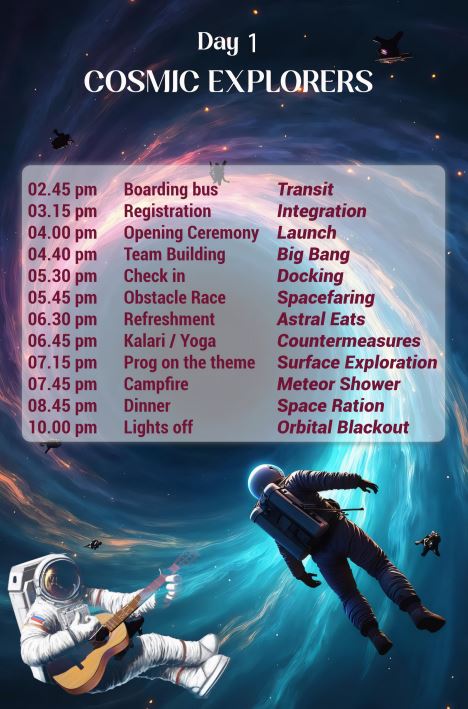
Cosmic Rendezvours


An amazing voyage to the end of infinity it was from 29th November to 1st December. 

The vast expanse of the universe encompasses countless galaxies, stars, planets, and cosmic phenomena, stretching beyond the limits of our observable horizon. The ever-growing stellar realm hasoften left one in wonder. Man's quest into the unknown frontiers has unravelled mysteries and opened the
doors to advancements and a better understanding ofthe cosmos. The future holds endless possibilities for young minds who are willing to learn, absorb and act.

Vidyodaya AnnualInterschool Camp2024 is dedicated to the vibrant and aspiring innovators of the future, aiming to foster the spirit of curiosity, creativity and exploration. This voyage into the edge of infinity shall endeavour to inspire and ignite
the passion and imagination of the tender minds. We welcome all to this cosmic journey where creativity and exploration willgo hand in hand and enable the erudite minds of the future to delve into the wonders of this marvellous universe.


Sparkling and stunning to our naked eyes, behold high above, the lofty and enchanting space, studded with dazzling celestial bodies. Infinity, thy glory lies unfathomed. Yet your depth we delve soaring on the wings of our imagination. Hand in hand we rejoice and revel in thy glory and mystery. 

Wednesday, December 11, 2024

Ending another year....


 We are coming to the end of another unique year.

You have a couple of weeks left,

to let it all go.


Let go of worry, what will be will be.

Let go of regret, what’s done is done.

Let go of anger, it’s prolonging your pain.


Let it all go and make way.


You cant reach for the new, if your arms are full of yesterday’s baggage.


We can’t go back, my friends, but we can move on, lightly, without that load.


So...

Let it all go, set it all down.

It’s dragging you back.

And you're not going back,

You’re going forward.


So go forward, with peace.


You did what you did,

life gave what it gave, 

and we are who we are.


March on… 


Love first.


~Donna Ashworth


Art by. ๐ŸŽจ _hilllo

Tuesday, December 10, 2024

Early Indians: The Story of Our Ancestors and Where We Came From ~ Tony Joseph (115 of 2024)


Early Indians: The Story of Our Ancestors and Where We Came From is a 2018 nonfiction book written by Indian journalist Tony Joseph. His question was how did Harappan vanish? This made him want to know who they were, which made him think when the agriculture started and when did people come to inhabit in India?  So he went back to 65 thousand years before. 

The book relies on research findings from six major disciplines: history, archaeology, linguistics, population genetics, philology, and epigraphy, and includes path-breaking ancient DNA research of recent years. Each of them having a different story, and different starting point, because of different starting point. Example archaeology look at tools, while genetics look at modern human. By then people living during the time we find archaeology would have been wiped out. 

The book discusses four prehistoric migrations in India. The first Indian's Out of Africa. the first farmers, the first urbanites - Harappa's and The last migrants The Arya's.

70000 years ago few hundred of Africa migrated out of Africa into the Arabian Peninsula, and they reached America around 16000 years ago defined by Climatic change. 

Then when people started experimenting with Agriculture, not all were successful, Egypt Mesopotamia, India and China were lucky as they have wide variety of cereals to domesticate and they became farmers from hunter gatherers. There is a population explosion leading to migration, that leads to population concentration changing the demographic of the world with mastery of nature. It happened from West Asia and East Asia. 

According to Joseph, Proto-Dravidian is related to the Elamitic language of Iran. Mastery of mobility with wheels, metals, from Central Asia moved to Europe and Asia, spreading Indo - European language. 


All existing population are a mixture of previous migrations,  which again is a mixture of previous migrations and so on. 

Colonial migration, when people started moving in large numbers. It has virtually no impact on India. It mentions that "Aryan" culture was most likely the result of interaction, adoption, and adaptation among those who brought Indo-European languages to India and those who were already well-settled inhabitants of the region, and that Sanskrit and the Vedas developed in the Indian subcontinent.

By integrating diverse strands of evidence, Joseph provides a nuanced understanding of the complex migrations and interactions that have shaped the genetic and cultural landscape of the Indian subcontinent. 2000 years ago, Endogamy was in place. We all have common ancestor, cast system came into place 2000 years ago. 

5th class of major migration today - difference in population growth and economic prosperity. This is related to climate as climate change can effect economic prosperity. We have to wait and see if it will change the world demographic. 

Where reason and logic can't reach art can. We are all Indian's and we are all migrant's. 

Monday, December 09, 2024

Ayyapan , Shastavu, Kuttichathan, Shabrimala


 8th year and what a connection to begin this day with the discussion. 


Valsa Kumar N Menon asks: เดถเดฌเดฐി เดฎเดฒเดฏിเดฒെ เดช്เดฐเดคിเดท്เด  เดงเตผเดฎ്เดฎ เดถാเดธ്เดคാเดตോ เด…เดฏ്เดฏเดช്เดชเดจോ? 


Who is worshipped at Shabrimala? Ayyapan or Dharma Shastav?


To which my response was Ayyapan, Dharma Shasta, Manikandan all are one. Dharma. Shasta means one who protects Dharma


Generally younger  is called Ayyapa and older is Dharma Shasta.


And then comes the detailed explanation from Sasidharan T 


The King of Pandalam found a baby in the forest with a 'mani' around his neck, adopted him as he was childless and called him 'Ayyapan' and 'Manikandan'. As the child grew up, the queen had her own child and with the intention of getting rid of Ayyapan asked him to bring tigers milk from forest. 


The kid fulfilling his duties enroute  returned sitting on a ๐Ÿ… tiger. Everybody in the court/palace was scared. Then he said it was time for him to return.  People became sad and pleaded that he stay back. He told them not to worry,  those interested can meet him where the temple of Dharma Shastav was. 


Ayyapa is believed to be the reincarnation of Dharma Shasta, the son of Shiva and Vishnu in   form of Mohini.  That is where Shabrimala is believed to be. 


And the book recommendation. Thank You Ajitha Ravindran Menon


Let me know your thoughts please.


#Ayyapan #Ayyapa #Shabrimala #shastav #Manikandan

Tuesday, December 03, 2024

Harassment

 Harassment is any:

~ uninvited, unwelcome behaviour

~ which has the purpose

~ Or unintentional effect

~ of violating someone's dignity

~ of creating an intimidating, hostile, degrading, humiliating or offensive environment

~ for anyone

Harassments is unlawful if it is linked to a protected characteristic. If not linked to a protected characteristic it is still bullying which is a serious breach of our policy and is unlawful. 

Protected Characteristics are:

  • Sex
  • Race (Rationality, Color, Origin)
  • Gender reassignment
  • Sexual Orientation
  • Age
  • Disability
  • Religion or belief (including philosophical belief)
  • Marriage or Civil Partnership
  • Pregnancy & maternity

There are many examples on what could constitute harrasments:

Misconception:

  • One of act may not be an issue - A single act may lead to liability to both
  • Incident outside workplace cannot be considered
  • Only employees can bring claims

Different people have different tolerance to acceptable behaviour. 

It need not be aimed to a particular person, anyone witnessing can also bring a claim. 

Dismissal without notice can be given. 

Career damage and criminal record can be filed. 

One persons banter can be considered as another persons discriminatory treatment. 

New legal duty to prevent sexual harassment.  26 oct. 24, new law, - Prevent. 

New duty manager need to take preventive measures. 

Code of conduct and Respect at work policy. 

If you find cases:

  • Report to line manager
  • Submit a grievance
  • Raise a speak up complain unanimously. 


Mere Dholna Sun 4.0 Full Version


https://www.youtube.com/watch?v=lsdF9BU6RFs

Nigam- Core of Pain

Ghoshal- Recovery of Pain

Singh- Not showing inside pain 

Sreekumar- Enjoying with everyone and not letting anyone know.

Adee S. KULKARNI Ji, great job. 


These are main 4 sources of expressing pain that most of the students have.... Still dealing forever....


Masterpiece. Perfectly synchronised and bliss to mind. Tribute to Indian classical music compositions.


Adee S. KULKARNI's answer to the people who say lyrics dont make any sense:


Shreya - Do Dilon Ki Ye Prem Kahani

Le Aayi Dekho Kahan


Sonu - Duniyadaari se hoshiyaari se

Main toh anjaan thaa

Lagi chot aisi mere bhole dil pe

Bikhar saa gaya toot ke


Shreya - Juda Ab Naa Hoge Karo Ham Se Wada

Mera Sathh Na Chhodna

Tumhe Aaj Payenge

Ya Maar Hi Jayenge

Ye Khwab Na Todna


Mere dholna Sun...


This story of love captures both innocence and deep commitment. Shreya’s lines, "Do Dilon Ki Ye Prem Kahani," hint at a love that has brought them to a powerful and unexpected moment. Sonu’s reflection, "Duniyadaari se hoshiyaari se, main toh anjaan tha," suggests he was untouched by worldly complexities, innocent in his ways, until love struck him so intensely, it left him "bikhar saa gaya toot ke," shattered and transformed.


In response, Shreya’s promise, "Juda ab naa hoge, karo ham se wada," reflects her unshakable loyalty. She asks him to vow that they’ll never part, saying, "Mera saath na chhodna," pledging a love that’s willing to either fulfill the dream—"ye khwab na todna"—or die trying.


The refrain, "Mere dholna sun," is a passionate call, asking him to hear the depth of her love, making this a timeless vow of devotion.


Sonu - Aadha adhura tha badan ye mera

Ek gark thaaa

Jo ghar thaa meri jannat

Ek nark thaaa


Shreya - Tu Jo Nhi To Mera Yeh Man Hai

Banjar Zameen

Sookhi Ret Jaisi Hoon Main

Tu Hai Nami


Sonu - Ye takht-o-taaj sb tereMain toh jala ke chhodungaZinda bachega naa koiSabko mitaa ke chhodunga

Ye jism khatm hota haiYe rooh toh nahi martiChahein koi sitamgar hoYe rooh toh nahi darti


These lyrics dive into love that brings both deep yearning and fierce intensity. Sonu’s part expresses the feeling of being incomplete—"Aadha adhura tha badan ye mera" (my body was half-empty) and trapped in a life that felt like "nark" (hell) despite being once considered his "jannat" (paradise). His pain transforms into an almost destructive resolve: "Main toh jala ke chhodunga...sabko mitaa ke chhodunga," willing to burn away everything in his path, showing the fierce strength love can unleash.


Shreya’s part reflects how hollow her life feels without him, as though her heart has become a "banjar zameen" (barren land). She compares herself to "sookhi ret" (dry sand) without him, while he is the "nami" (moisture) that brings life. Her love for him is essential, like water in the desert.


Finally, Sonu’s closing lines, "Ye jism khatm hota hai, ye rooh toh nahi marti," bring a powerful sense of resilience, suggesting that while the body is mortal, the soul and its courage are eternal and undying. Even if faced with suffering ("sitamgar ho"), the soul remains fearless, making their love feel immortal and unbreakable.


Amazing, touching, divine.