Tuesday, July 09, 2024

Kalki 2898


 "Kalki 2898" is not just a movie; it's an experience that redefines the boundaries of science fiction and epic storytelling. Directed by the visionary filmmaker Nag Ashwin, this film is a tour de force that combines a compelling narrative, breathtaking visuals, and stellar performances, setting a new benchmark for Indian cinema.

Plot and Storyline: Set in a dystopian future, "Kalki 2898" explores themes of hope, survival, and the eternal battle between good and evil. The plot intricately weaves together elements of mythology and futuristic science, creating a tapestry that is both thought-provoking and emotionally resonant. The story follows Kalki, a hero prophesied to restore balance in a world teetering on the brink of chaos. The narrative is gripping, with each scene meticulously crafted to keep the audience on the edge of their seats.

Visuals and Special Effects: The visual effects in "Kalki 2898" are nothing short of spectacular. The futuristic landscapes are rendered with a level of detail that is awe-inspiring, transporting viewers to another world. The use of CGI is seamless, enhancing the storytelling without overwhelming it. The film's cinematography is equally impressive, with each frame composed like a work of art. The use of color, lighting, and innovative camera angles adds depth and dimension to the viewing experience.

Performances: The cast of "Kalki 2898" delivers performances that are powerful and nuanced. Prabhas, in the titular role, brings a perfect blend of intensity and vulnerability, making Kalki a hero that audiences can root for. Deepika Padukone, as the enigmatic and strong-willed heroine, adds a layer of complexity to the narrative. Amitabh Bachchan, in a pivotal role, delivers a performance that is both commanding and emotionally charged. The supporting cast, including Disha Patani, brings depth and authenticity to their characters, enhancing the overall impact of the film. Sir Amitabh Bachchan outweighs every other character and is the heart of the whole movie. His stature, voice, caring attitude & protective nature, and breathtaking action scenes will be remembered by all ages.AmitabhBachchan as Ashwatthama is the highlight of Kalki. He has a roaring screen presence and excels. DeepikaPadukone gets a meaty part and is the soul of the film. She delivers a fabulous performance, lending the right emotions. Prabhas does well in his part though his character warranted a better arc. I feel, the maker has saved the best of #Prabhas for the sequel. He gets his share of elevation moments and emerges a winner in there.KamalHaasan is terrific in his cameo and spikes excitement for the next installment. SawataChatterjee is solid as the villain. Some of the cameos are exciting and come across as a pleasant surprise in the narrative. characters like Ram Gopal Varma, Rajamouli, Vijay Devarakonda, Mrinal Thakur, Dulquer Salmaan and others gives a goosebumps moments that makes you love the flick. I loved Shobhana as Mariam. Wondering why that name?

Direction and Screenplay: Nag Ashwin's direction is masterful, showcasing his ability to blend genres and create a cohesive and compelling story. His vision for "Kalki 2898" is ambitious, and he executes it with precision and flair. The screenplay is tight, with a perfect balance of action, drama, and philosophical musings. The dialogues are poignant, often leaving a lasting impact long after the credits roll.

Music and Sound Design: The music by Santhosh Narayananelevates "Kalki 2898" to another level. The score is hauntingly beautiful, perfectly complementing the film's tone and themes. The sound design is meticulous, creating an immersive audio experience that draws viewers deeper into the story.

Conclusion: "Kalki 2898" is a cinematic triumph that stands out in every aspect. It is a film that challenges, inspires, and entertains, leaving a profound impact on its audience. This movie is a must-watch for anyone who appreciates the art of filmmaking and storytelling. Nag Ashwin has crafted a masterpiece that will be remembered as a landmark in Indian cinema. "Kalki 2898" is not just a film; it is a journey that stays with you long after you leave the theater. 

Cons : 1. Music, background score is unique but doesn't give the much needed grandeur to the visuals and scenes, repeated use of same score, abruptly high background score during stunts 2. Editing especially first half. 3. I didn't personally like is the extremely repetitive and prolonged fights between Bhairava and Aswattama. It could've been way shorter.

Although the nature of the film are far from logical, the directors and the technical team have succeeded in creating a new world on the silver screen. It stands as a film that takes Indian cinema to another level...This is a film dedicated to the company's five-year journey of hardwork...

Monday, July 08, 2024

Rasathantram


Rasathanthram was released in theatres on 7 April 2006, did see it in the theather then, got an opportunity to watch it again with Amma, last saturday. The film starring Mohanlal and Meera Jasmine, with Bharath Gopi, Innocent, Oduvil Unnikrishnan, and Mamukkoya in prominent roles is an amazing family drama film written and directed by Sathyan Anthikkad . Story, emotions, fun, you name it, and it is in the movie. The best part and tons of applause to Meera Jasmine. 


Premachandran is a carpenter who lives along with his father, Balan Master, and works along with his friend, Manikandan. They are now working on a house near the house of a rich landlord. Kanmani, who was sold by her mother, works in that house as a servant and is ill-treated. Seethamma lives along with her daughter, Kumari, who has a liking towards Premachandran.


One night, Premachandran goes to his workplace to take his tools. He sees Kanmani leaving the house and is puzzled. He follows her. She was on the verge of committing suicide when Premachandran rescues her. He gives her shelter in one room in a building owned by Chettiyar, telling Chettiyar that his friend did not get the bus to go back home. Kanmani dresses up as a boy by the name of Velayuthan Kutty and soon starts working with Manikandan and Premachandran. Balan Master starts liking the disguised boy.


One day, Premachandran tells Kanmani that he has planned to rescue her by sending her to Tamil Nadu to work in a banyan company where Premachandran's friend is working. Kanmani refuses to go. Premachandran accidentally confesses to Manikandan that Velayuthan Kutty is actually the missing Kanmani. Manikandan has no peace and shouts out the truth in the middle of the night. Two policemen, accidentally hear this and take Premachandran and Kanmani into custody.


Kanmani tells the court that she and Premachandran are in love and intended to elope. She said this to avoid imprisonment. Soon, Kanmani develops an affection towards Premachandran. Premachandran tells her that she does not know anything about him and that he is an ex-convict in a murder case. Actually, Premachandran's friend Sivan murdered a hooligan who abused Premachandran's sister. Kanmani now agrees to go to Tamil Nadu, but Premachandran does not let her go, he admits her in a hostel.


Premachandran's brother, Ramachandran, comes to the fray and asks Balan Master to attend his daughter's marriage. He asks that Premachandran not come. Actually, Balan Master and Premachandran are living far away from home because of the bad nature shown by Premachandran's brother and sister. Balan Master is not willing to go without Premachandran. Premachandran who loves his niece as his daughter changes Balan Master's mind, by going with him without anybody knowing he is there. On returning, they see their rented house being destroyed. Balan Master takes shelter in an old age home headed by a retired Colonel until a new house can be rented.


Premachandran goes to Kochi to meet Sivan – who is now a business tycoon, but Sivan does not meet Premachandran's needs. On returning, Premachandran finds out that Balan Master is dead. He performs the ceremonial rites and goes to Kanmani. Meanwhile, Kanmani's so called uncle (Jagathty Sreekumar) – who wants to marry Kanmani – and his sister have court orders to take Kanmani back to Tamil Nadu. But, Premachandran grabs the "thali mala" from Sundara Pandian, ties the knot on Kanmani and subsequently marries her.

Dil Chahta Hai


 Dil Chahta Hai was based on Farhan Akhtar's diary he wrote during his trips to Goa and his month-and-a-half-long stay in New York City in 1996, and a story by a friend of his, Kassim Jagmagia. He originally conceived a story about the romance between Akash and Shalini. He later shared it with his parents, who immediately liked his idea but suggested several changes. However, he felt the story was not exciting and unusual enough for him and started to develop other characters, including Akash's friends, making his initial idea become the film's subplot.Farhan began writing the film's screenplay under the working title of Hum Teen in 1998.

 After principal photography commenced in 2000, the film was retitled Dil Chahta Hai. Farhan originally wrote the dialogue in English, and he translated it to Hindi in two months.This marked the cinematic debut of Akhtar and his friend Ritesh Sidhwani, who produced it under their banner of Excel Entertainment.Several elements of the film were inspired by the English playwright William Shakespeare's Much Ado About Nothing which looked at the conflict between romantic love and male bonding. The only clue for the unacknowledged remake was that in one shot there was a boat in a harbour that was clearly named Much Ado,"  Farhan's sister, Zoya, was in charge of the casting of the film.Filming started in 2000 and was completed in 108 days by Ravi K. Chandran, taking place in Mumbai, Goa, and Sydney.

Three close friends are separated after college due to their different approaches towards relationships. Akash goes to Australia, Sameer gets busy wooing a girl and Siddharth devotes himself to art.The film focuses on a significant transition period in the romantic lives of 3 college-graduate friends (Aamir Khan, Saif Ali Khan and Akshaye Khanna). It also stars Preity Zinta, Sonali Kulkarni and Dimple Kapadia.

The film starts with Siddharth "Sid" rushing a patient to the hospital. The patient is diagnosed with liver cirrhosis. Sid calls up his friend Sameer who calls up their friend Akash who refuses to come with him. Sameer and Sid meet at the waiting lounge and reminisce their life's events.

Akash does not believe in the concept of love and doesn't take anything seriously. Sameer is a very romantic but confused guy. Whenever he is attracted towards a girl, he thinks that he has found true love. Sid, an artist by profession and the most mature of the three, has no interest in romance and is very serious and dedicated towards his work. They spend all their time together, taking trips, playing pranks on each other and supporting the other when needed.


At their college leaving party, Akash jokingly professes love for a girl called Shalini, earning him a punch from her hot-tempered, possessive fiancée Rohit. Upon graduating from college, they are forced to decide on what to do with their lives ahead. Sameer's parents want to arrange his marriage with their friends' daughter, Pooja while Akash's parents ask him to manage the family business in Sydney. Sid is busy trying to become a painter and works to develop his skill.


One day, Sid runs into his new neighbour, Tara Jaiswal, who is a divorcee and an alcoholic. She takes an interest in his art and the two become friends. Despite her older age, Sid finds himself attracted to her. After a night out, Sid confesses to Sameer and Akash that he loves Tara. In typical fashion, the friends refuse to take him seriously. Sameer realizes that Sid is not joking but Akash continues to mock him, leading Sid to slap him. Infuriated, Akash leaves the scene, refusing to reconcile with Sid despite Sameer's attempts to mediate. Soon, Akash leaves for Sydney to work on the family business and Sid temporarily moves away to Kasauli to attend a painting workshop, leaving Sameer to his own means.


Sid eventually returns and he meets Sameer who tells him that he is attracted to Pooja at first-sight. However, Pooja has a boyfriend but it seems their relationship is not going strong hence they inevitably break up. With the help of Sid, Sameer asks her out and Pooja accepts.


In Sydney, Akash meets Shalini who shows him around the new city. The two soon fall in love, but she has to return to India to marry Rohit. It is revealed that Shalini does not love Rohit, and is only marrying him to please his parents, who have raised her. Determined not to lose Shalini, Akash shows up at her wedding. He proposes to her in front of all the guests, Rohit and his family. Rohit is enraged but decides to yield on being told by Shalini that she loves Akash too much to the approval of Rohit's parents who accept Shalini's love for Akash enraging Rohit more who gets slapped by Akash.


Back to the present, Sameer lies to Sid about being unable to contact Akash. The next morning, however, Akash arrives at the hospital to bury the hatchet with Sid. He apologizes to him, and the two hug.


Meanwhile, Tara who is revealed as the patient is about to die from liver cirrhosis due to her alcoholism. The hospital staff approach Sid to inform him, and he speaks with Tara for the last time in her hospital room. She thanks him for being there for her in her final moments and passes away, leaving Sid's love for her unrequited. Six months later, the friends again visit Goa for a trip, now accompanied by Shalini and Pooja. Sid sees a woman who resembles Tara, and approaches to talk to her. It is implied that she and Sid get together, as the three friends are shown enjoying dinner with their respective partners.

Friday, July 05, 2024

Global Forgiveness Day ~ 7th July


 Life involves interacting with people around us, and sometimes they can hurt us. It's natural to hold grudges, but that anger can burden us. 

 Forgiveness is a great way to let go and move on. Remember, forgiveness doesn't mean forgetting, but it allows you to heal from within and avoid similar situations in the future.

It can be difficult, but the comic strip below is an example of how we can tackle such situations. 

Global Forgiveness Day ~ 7th July. 

Few of my Favourite Reads

 Not an easy task, am sure the list will be different, if you ask me at some other time, but in No Particular Order

Fiction

Alice in wonderland

Wuthering Heights

The Palace of Illusion 

Once there were wolves

The Secret garden

The Shell Seekers

What you are looking for is in the library

Fresh water for flowers

One Hundred Years of solitude

The Moor’s Last Sigh


Non Fiction

The Chicago Address by Swami Vivekananda

Vesper Flights by Helen Macdonald

Mirrors stories of almost everything

The complete works of Kahlil Gibran

In Search of Your true self

The Magic of Thinking Big

The success Principle

The Boy, the Mole, the Fox and the Horse'

Future Shocks

Man’s search for meaning

And yes the Great Indian Story by Shasi Tharoor

Thursday, July 04, 2024

T20 Cricket World Cup 2024

 India won the match and so many to take credit. 

There was a discussion going on about who could have a hand in India's victory in T-Twenty World Cup 2024.

One person said that BJP, VHP and RSS have a hand in this.

The rest of the people angrily asked that person, this cannot be possible, how did BJP, VHPand RSS come in between??, please explain to us.

The guy replied, 'Hey brothers, there is no politics in this victory, BJP means Bumrah, Jadeja, Patel. VHP means Virat, Hardik,Pant.

RSS means Rohit, Suryakumar, Shivam 

What an emotional farewell to Rahul Dravid. 

What a comeback from run a ball scenes.

Rahul Dravid, Rohit Sharma, Virat Kohli - all moving out of the T20 .

Jasprit Bumrah, Hardik Pandya rocking.

സ്വപ്നങ്ങൾ ഒന്നും അവശേഷിപ്പിച്ചു കൊണ്ടു ഭൂമിയിൽ നിന്നും മടങ്ങാൻ തയാറാല്ലാത്ത മനുഷ്യന്മാർക് ധൈര്യമായി ഈ മനുഷ്യനെ മാതൃകയാക്കാം...... ❤️❤️

ഇന്ത്യ ലോകത്തിന്റെ നെറുകയിൽ.... ❤️❤️ 

എന്റെ രോഹിത്.... ❤️❤️❤️❤️

Looks like that is the determination of Rohit Sharma. 

 This is the day Rohit Sharma would cherish for ever and close to his heart ❤️

And well deserved victory for India the world champions - remarkable and incredible performance of bowlers and some top class fieldings (SKY). Bumrah is a gift to our country, he is the real 🐐 goat....what an inswinger to right handers...

Really sorry for Proteas again, unfortunate still...but reall well played Dekock and Miller and ofcourse klassen was real class. You lost the championship between the Cup and nip.

From WhatsApp 

1975 - No malayali

1979 - No malayali

1983 - Sunil Walson 🏆

1987 - No malayali

1992 - No malayali

1996 - No malayali

1999 - No malayali

2003 - No malayali

2007 - No malayali

2007 - S Sreeshanth 🏆

2009 - No malayali

2010 - No malayali

2011 - S Sreeshanth 🏆

2012 - No malayali

2014 - No malayali

2015 - No malayali

2016 - No malayali

2019 - No malayali

2021 - No malayali

2022 - No malayali

2023 - No malayali

2024 - Sanju Samson 🏆

Hence Proven - U need to have a Mallu on the team...

Wednesday, July 03, 2024

Great Indian Cricket Circus (63 of 2024)

 Mukherjee, who won the Anandji Dossa Award for the Cricket Statistician of the Year in 2019/20, is the content head at Wisden India. Bhattacharjya, who was ESPN Star Sports’ first Indian head of production, and has been the team director for the Kolkata Knight Riders, is a cricket analyst with the online platform Cricbuzz. They have combined their experiences and networks to write a memorable book aptly named 'Great Indian Cricket Circus'.


A book that promises to be “an unabashed celebration of this incredible sport” is a smart idea because success in cricket as well as publishing often depends on good timing. It has 52 short, crisp chapters. Each one can be read in a few minutes. The emphasis here is on supplying readers with trivia that is humorous, astonishing, and sometimes even bizarre.

Did you know that ...

Chandu Sarwate, Indian Test cricketer, was also a fingerprint expert?

Sania Mirza is related to four Test captains, two of them Indian.

In addition to roads and neighbourhoods, Sachin Tendulkar also has a racehorse, a variety of mango and a species of spider named after him?

The Great Indian Cricket Circus takes a rollicking journey through more than a century of Indian cricketing history. It tells the stories of not just the matches and the players, but also of crazy fans, mind-boggling endorsements, memorable scores, eccentric commentators, iconic stadiums and much more.

Supremely entertaining, and full of bewildering events, surprising anecdotes and cool facts compiled together in wacky, interesting ways, this is the perfect book for fans of the sport, trivia lovers or anyone looking for entertainment!

Not simply a compendium of information, this is a chronicle of memories around the game that evokes joy, sadness, longing, anger, despair, and hope.

“Where does cricket end and the rest of life begin? In India, you never know,” writes Indian cricketer R Ashwin in his foreword to The Great Indian Cricket Circus. People who do not follow cricket might think that he is exaggerating but those who have been ardently following would fully agree. 

The book opens with a chapter that is ideal for people who are equally devoted to fiction and cricket. Following the format of a listicle, it spots references to real-life cricketers in book such as RK Narayan’s Swami and Friends (1935), Jeffrey Archer’s A Quiver Full of Arrows (1980), Ruskin Bond’s Cricket for the Crocodile (1986), Rohinton Mistry’s Tales from Firozsha Baag (1987), Salman Rushdie’s The Moor’s Last Sigh (1995), Chetan Bhagat’s The 3 Mistakes of My Life (2008) and Anuja Chauhan’s The Zoya Factor (2008), among others.

Another endearing chapter tracks down things and places named after Indian cricketers. Sachin Tendulkar has a hybrid mango variety – “a cross between gudshah and chausa” named after him thanks to horticulturist Haji Kaleemullah Khan of Malihabad in Uttar Pradesh. A cricket stadium in Zanzibar (Tanzania), a ground in Leicester (England), and a cricket field in Louisville (Kentucky, USA) are named after Sunil Gavaskar. The Tihar Jail in Delhi used to have a block named after Manoj Prabhakar but “the authorities changed the name of the block in 2001 after Prabhakar was named in the match-fixing scandals the year before”.

The writing seems effortless but it must have taken a lot of research and fact-checking. The chapter on religion and Indian cricket is a case in point. It throws light on the history of a less known interfaith cricket tournament called the Bombay Pentangular that was played between the Parsees-only Zoroastrian Gymkhana, the Europeans-only Bombay Gymkhana, the Hindu Gymkhana, the Mohammedan Gymkhana, and fifth team added later to include “Sikhs, Buddhists, Jains, Indian Christians, other Indian communities and even the Ceylonese”. Unfortunately, this tournament was discontinued in 1945/46 because of communal riots.

One of the chapters in the book focuses on cricketers who were forced to leave their birthplaces and ancestral homes at Partition or just before. The authors note, “Of the 31 Pakistan Test cricketers born in what became India after Partition, most were – not surprisingly – from Punjab, Rajasthan and Gujarat, all of which share borders with Pakistan.”

Selected Stories of Rabindranath Tagore (61 of 2024)


 Another buy from Calcutta - College Street. 

This covers 14 stories. 

  1. Kabuliwallah

In the story there are three examples of filial affection—the narrator and his daughter Mini; the Kabuliwala "Rahmat" and his own daughter in Afghanistan; and the Rahmat "Kabuliwala" and Mini. In this story Rahmat comes to India every year to sell dry-fruits and to meet this girl named Mini. He had a physical altercation with a person while collecting debts and was imprisoned. After several years, he was pardoned and was released from jail. He returned to meet Mini at her house on her wedding day, but she had grown up and did not recognize him. Her father, however, gave him some money so he could visit his own daughter. 
  1. Postmaster
For his first job, the Postmaster is assigned to work in the village of Ulapur, a quiet backwater with an indigo factory. He feels sorely out of place in the village, feeling both too sophisticated as a Calcutta man amongst uneducated villagers, and needlessly arrogant to the very people who he might turn to, hoping for friendship.

For lack of anything better to do, the Postmaster takes to writing poetry about his scenic surroundings, pontificating on rain-soaked leaves and the like as a way to express his deepest sorrows. Since he doesn’t make much money, the Postmaster cooks for himself and enlists a young orphan girl named Ratan to help him with housework in exchange for some food.

One night while Ratan is preparing his hookah, the Postmaster asks her to describe her family. This begins a relationship where the two share intimate details about their families, with the Postmaster divulging how much he misses his mother and sister back in Calcutta. The rapport develops to such an extent that Ratan starts to consider the Postmaster’s family her own.

One day while watching a bird in a tree, the Postmaster is taken by a desperate need for female companionship, for someone who he could share this sighting of a bird with. He calls Ratan into his office and informs her that he’s going to teach her how to read. These lessons continue until the Postmaster falls ill and he grows unable and unwilling to continue. Ratan, regardless, practices what he has taught her. Fed up with the village and his illness, the Postmaster applies for a transfer and is denied.

Nonetheless, he quits the job to return home, and tells Ratan as much. Ratan begs him to take her with him, but he smugly tells her that’s impossible. He promises her that the next Postmaster will take care of her, but that does nothing to comfort her. Upon leaving, he tries to give Ratan money, but she refuses.

As the Postmaster is leaving, he is struck by a feeling that he should go back and take Ratan, but concludes that life is full of separations and endings, so what’s the point? Ratan doesn’t have the same view though, and holds out, in anguish, for the possibility that the Postmaster will return to take her to Calcutta.
  1. Homecoming
The story is told from the perspective of a fourteen-year-old adolescent boy, describing the hardships he faces. The themes of strife and love in Phatik’s life are at the center of this tale. Minor themes also include a teenage boy’s feelings of isolation and responsibility.

Phatik, a naughty and fun-loving fourteen-year-old boy, has developed a reputation for it. His younger brother Makhan sat on the log in front of him when he was with other village lads to agitate him. Phatik warns that if he doesn’t go, he would shove him to the ground. However, this threat is ignored. Phatik pushes the log off while swallowing his fright because he couldn’t lose face in front of the other boys. Makhan beats Phatik out of hatred despite being hurt. When Makhan gets home, he instantly tells his mother the lies. His mother shares his convictions. Before a stranger who turns out to be the mother’s brother comes, Phatik punches his sibling out of rage. His mother gives her consent for his uncle, Bishmaber, to bring Phatik to Calcutta with him so that he can receive an education. His mother was only too willing to concur. His mother was troubled by his presence since she constantly feared that he might end up endangering Makhan. She becomes upset, though, because Phatik is just as eager to escape. Calcutta wasn’t any better, though. He wasn’t loved by his aunt. He was considered a bother by others. He was unhappy. He yearned to return home. Phatik had a terrible time in school as well. He was unable to fit in or win over the teachers. He finally finds the confidence, out of desperation, to ask his uncle when he could return home. The only response from his uncle was that he could come back during the holidays. He misplaces his book one day, and as a result, his aunt and fellow students scold him and correct him. The following day when he gets home, Phatik attempts to get away. He is however caught in a downpour and has a serious malarial cold. Unable to locate him, his uncle reported him to the police. He receives more criticism once the cops track him down and bring him home. He sobs, unable to take it any longer.

Phatik begs his mother not to beat him in a fever-induced hallucination, even as he longs to go back home. Tagore sharply criticizes society’s treatment of teens when he notes that not a single person made an effort to comprehend the emotional pain he was experiencing. Even if his mother seemed to regret her choices after the novel, it is too late to undo the suffering her son had to go through. Phatik’s mother forbids him from entering his early teens. Perhaps for this reason, she is happy to have Bishambar take him to Calcutta. It is clear to the reader that Phatik’s mother is powerless to control him. She is to blame for something, not Phatik.

The conclusion of the story is especially intriguing because it makes it plain to the reader that Phatik is insane as a result of his disease. He thinks that the holidays (October) have arrived when he sees his mother. However, everyone in the room is aware that Phatik is dying and is in critical condition. What was once a healthy youngster has in such a short time turned into a weak wreck. It’s possible that Tagore was implying that Phatik shouldn’t have been removed from his familiar village setting. Some kids will be successful in the city or at school. That kind of character was not Phatik. Despite being a lover of nature, he passed away in Calcutta’s walls. Bishambar cannot be held responsible for what occurred, though. He was merely attempting to assist Phatik. The two mothers that appear in the story cannot be claimed to be the same. Both Phatik’s mother, who was impatient and eager to get rid of Phatik, and Bishambar’s wife, who thought Phatik was just a clumsy small child. whom she truly wanted nothing to do with.
  1. Master Mashai
The father of the young man lives from the interest on money he inherited from his family. Until, somewhat late in life, his wife finally has a child, a son, he is very tight with his money. Gradually he gets used to spending money on his son. He hires a distinquished tutor but a riff develops between the tutor and his son.

One day the son of one of the families cooks brings her son to work. The father finds out young man is an accomplished scholar and he offers him a job as live in tutor. His son and tutor bond, the boy calls him “Master Mashai”.

A lot will happen, much of it very sad, as the plot advances and the boy ages.
  1. Once there was a King
When we were children there was no need to know who the king in the fairy story was. It didn't matter whether he was called Shiladitya or Shaliban, whether he lived at Kashi or Kanauj. The thing that made a seven-year-old boy's heart go thump, thump with delight was this one sovereign truth, this reality of all realities: "Once there was a king. The theme of innocence radiates through the delicate tapestry of the narrative. Recounted by an unnamed narrator reflecting upon his childhood, the story delves into the realm of innocence through the lens of storytelling, escapism, and respect.

  1. The Baby
Part One of My Lord The Baby begins with a twelve-year-old boy named Raicharan. He leaves his village and enters the home and service of a man who shares the same caste as Raicharan. Raicharan becomes the private servant of the man’s so, Anukul. From birth up until the day that the boy leaves for college, he is Anukul’s personal attendant.


After Anukul marries, he makes Raicharan the servant of his new son, who is called The Little Master in the story. Raicharan takes pride in his work and finds great pleasure in the child. The story contains several passages in which the reader sees Raicharan’s joy in reading to the boy.

When the child begins to walk, it is an “epoch in human history.” He plays with the child night and day. When it utters the words “Ba-ba,” “Ma-ma,” and “Chan-na” (this is what the baby calls Raicharan), “Raicharan’s ecstasy knew no bounds.”


Anukul buys a small go-cart for his son, and drapes him in silks and finery, including golden ornaments, bracelets, and more. When the rainy season approaches, the child is dreadfully bored while confined indoors. One day, on which the rain has lifted, Raicharan puts him in the cart and pulls him down to the riverbank.

The boy sees a lovely tree covered in flowers, and Raicharan can tell that he wants one. He tries to distract the boy by showing him birds and various other diversions, but the child is intractable. Finally, Raicharan asks him to stay in the cart, forbids him from going to the water, and wades in to get the flower. When he returns, the child is missing.

When evening comes and Raicharan has not returned with the child, Anukul and the mother go out searching. They find Raicharan running along the banks, calling out “Little Master!” over and over, heartbroken. Under questioning, he says that he knows nothing about what happened. They promise him anything if he will tell them, but he has no answers. He is sent from the house. The mother tells Anukul that she suspects that Raicharan had stolen the child, possibly to sell it to the gypsies, who were also rumored to be in the area at the same time. “The baby had gold ornaments on his body,” she says. It is enough to convince her.

In Part Two, Raicharan returns to his village. His wife bears him a son named Phailna and then dies. Raicharan initially feels an intense resentment of the child, feeling that it someone intends to replace the little master who was so recently lost. He feels extreme guilt at the prospect of being happy about his own child in the aftermath of such tragedy.

Soon he is as affectionate and loving with his own son as he ever was with the little master. However, there is an unsettling development. As the baby develops, begins to walk, and to do all of things that babies do, Raicharan is reminded of the little master. His son’s actions seem uncannily similar, and he manages to convince himself that it is the little master, reincarnated in his own home. He considers the following three facts “beyond dispute:”

I. The new baby was born soon after his little master’s death.

II. His wife could never have accumulated such merit as to give birth to a son in middle age.

III. The new baby walked with a toddle and called out Ba-ba and Ma-ma.

The logic is far from ironclad, but he remembers that the mother accused him of stealing her child. If this is truly the little master reincarnated, he feels that he deserves her accusation.

In the final sequence of the story, Raicharan begins spoiling Phailna just as Anukul did for the little master. He spends money he does not have to clothe him in satin, and send him to fine schools. When he visits Phailna, the other students are amused by his country manners and they wonder how the elegant Phailna could have such a bumpkin for a father.

Soon Phailna is asking for more money and there is nothing Raicharan can give him. He visits the city where Anukul is practicing as a magistrate and tells him that he lied about the little master. He had kept him all along and now wishes to make it right. Anukul is suspicious of the claim, as there is no proof that Phailna is the little master. However, his wife’s reaction makes it irrelevant. She accepts the child whole-heartedly, believing that he is hers, and they send Raicharan away.

The story ends with Anukul sending money to Raicharan’s village, but there is no longer anyone there with that name.

My Lord The Baby, and many of Tagore’s other short stories, is a precursor to sprawling stories of Indian families such as Rohinton Mistry’s A Fine Balance and many of the novels of Salman Rushdie. Its central themes are duty—particularly the duty to one’s master and one’s son and father—and sacrifice.
  1. Vision
It describes the situations where wife has to sacrifice her own desires for the husband's happiness. It comments on Indian customs and traditions. It studies the relations between husband and wife and the unsaid expectations of the husband from his wife.
  1. Living or dead?
‘The Living and the Dead’ is a focus on the theme of death. The story is based on Kadambini’s family with unfortunate set of incidents and circumstances. The friendship between Kadambini and Jogamaya make the story fresh in the minds of the readers. 

The story begins with the introduction of Sharadashankar Babu’s family, the Zamindar of Ranihat in which there is a young widow called Kadambini. She had no living relatives on her father’s side and even her in-laws family too. All of them have died one by one sooner or later. There was only a nephew – her brother-in-law Shardashanker’s son who was an apple of Kadambini’s eyes. Soon after the death of the child’s mother, Kadambini looked after the child as if it was her own son. All the affections were bestowed on the child until one were on the child until one monsoon night Kadambini died.

Without making undue ceremony to the departed soul, the dead body was sent straight away to the cremation ground by the employing four Brahmin labourers of Sharadashankar. Though the Ranihat cremation ground was far away from the town, it consisted of little hut beside a pond and a banyan tree. The four men assigned for the cremation work waited for the pyre wood to be brought. After too long waiting, two of them departed to see what the cause for the delay was. Only Bindu was left before the corpse when Banamali had gone to the town to fetch tobacco.

In the midst of the thick clouds and lightening and raining Bindu had experienced something unusual – the littar on which the dead body was placed began to move. In terror Bindu had run off to the village leaving the corpse in the hut itself. All the four employees came back to the cremation ground and found that the corpse was missing and the litter was empty. The four members have decided to report to the Zamindar that the body had indeed been cremated. Here Tagore asserts the truth that dead person revitalizing life again. The ghost of Kadambini was regaining conscious stage. Very often she constantly thinks about her affectionate child and was ready to go home. The next moment she considers that since she was no longer alive, her family members could not accepted her. Moreover, they would be surprised to see Kadambini’s ghost coming back. She recalled to her memory Sharadashanker’s brightly lit home and compared her present solitariness in this dark and dissolute place of death.

Kadambini started going on and on till her feet ached and body felt week and exhausted. She crossed field after field with the first loght of dawn. She reached a nearby village. Kadambini with her muddy clothes, rapt state and crazed sleepless appearance, faced man coming up to her and he enquired her and her family. Suddenly she thought about her childhood friend – jogmaya the best and the dearest friend. She told the stranger that she had to go to Shripati charman Babu’s house of Nischindipura. The gentleman agreed that anyhow on his way to Calcutta Nischindrapura was a shortdistance. So he decided to escort Kadambini to Shripati’s house.

Jogamaya was pleased to see her friend after a long gap. The two friends exchanged a few words and Kadambaini pleaded before Jogamaya to provide a place in a corner of her house and accept her as a maid. For a month’s stay in Jogamaya’s house, Shripati Charman – Jogamaya’s husband wanted to know all about the illtrated childless widow – Kadambini and her in-laws. So he decided to proceed to Ranihat and make personnal enquires about Kadambini. 

In the course of the two friends’ conversation, Jogamaya strongly announced that keeping custody of a married woman of another household doesn’t look nice. So Jogamaya had decided to send her out in the absence of her husband for which Kadambini though strongly refused to go, yet she simply moved away with a pensive expression. 

Shripati returned home late at night and narrated the whole story of a Kadambini that Jofgamaya old friend was dead. The husband and wife went on arguing for a long time unti they came to know that Kadambini was there in the next room. Shripati mentioned before his wife that the evening before Kadambini’s arrival to their house, the door swung open and the sudden gust of wind blew out the lamp. In the darkness Kadambini entered into the house of Jogmaya when there was continuous outpouring of rain. She addressed to Jogamaya that her friend Kadambini is no longer alive but she is dead. Having said this she left the house and proceeded to Ranihat. She hid all day in a ruined temple hungry alone. An untimely dusk spread over the monsoon sky and the villagers hurried home far the fear of approaching storm. She entered into her married home with fully veiled and the servants of the house let her pass. In the midst of heavy rains and buffeting wind Kadambini slipped past the women and entered the room where the sick boy, Sathish was fast asleep. The sick boy turned over and asked his Kakima for water for which Kadambini felt very happy to see that he child asking for the aunt. With great rejoice she hurriedly poured out a glass of water and helped him to drink. The child put his arms round her neck and asked ‘Kakima were you dead. Kakima go away”. He screamed.

Kadambini realized that she was not really dead. She pleaded before Didi (Shardashankar’s wife) why are all of you frightened to see me? “ I am what I always was” As a result the mistress of the house fell sown and fainted. At the moment Sharadashankar appeared and pleaded before Kadambini that why all this? Satish is the only son of ours why have you cast your evil eye on him? Kadambini made it clear that she was mot dead proving tae bell metal bowl as the evidence that she was alive. She struck it against her head repeatedly and as a result blood poured out. Kadambini only screaming that she was not dead. Not and not dead. She ran out of the room and down stairs and threw herself into the backyard pond. From upstairs room Sharadashankar heard the splash.
  1. The Skeleton
  2. The Trust Property
  3. Subha
  4. The river Stairs
  5. My Fair Neighbour
  6. The Kingdom of Cards

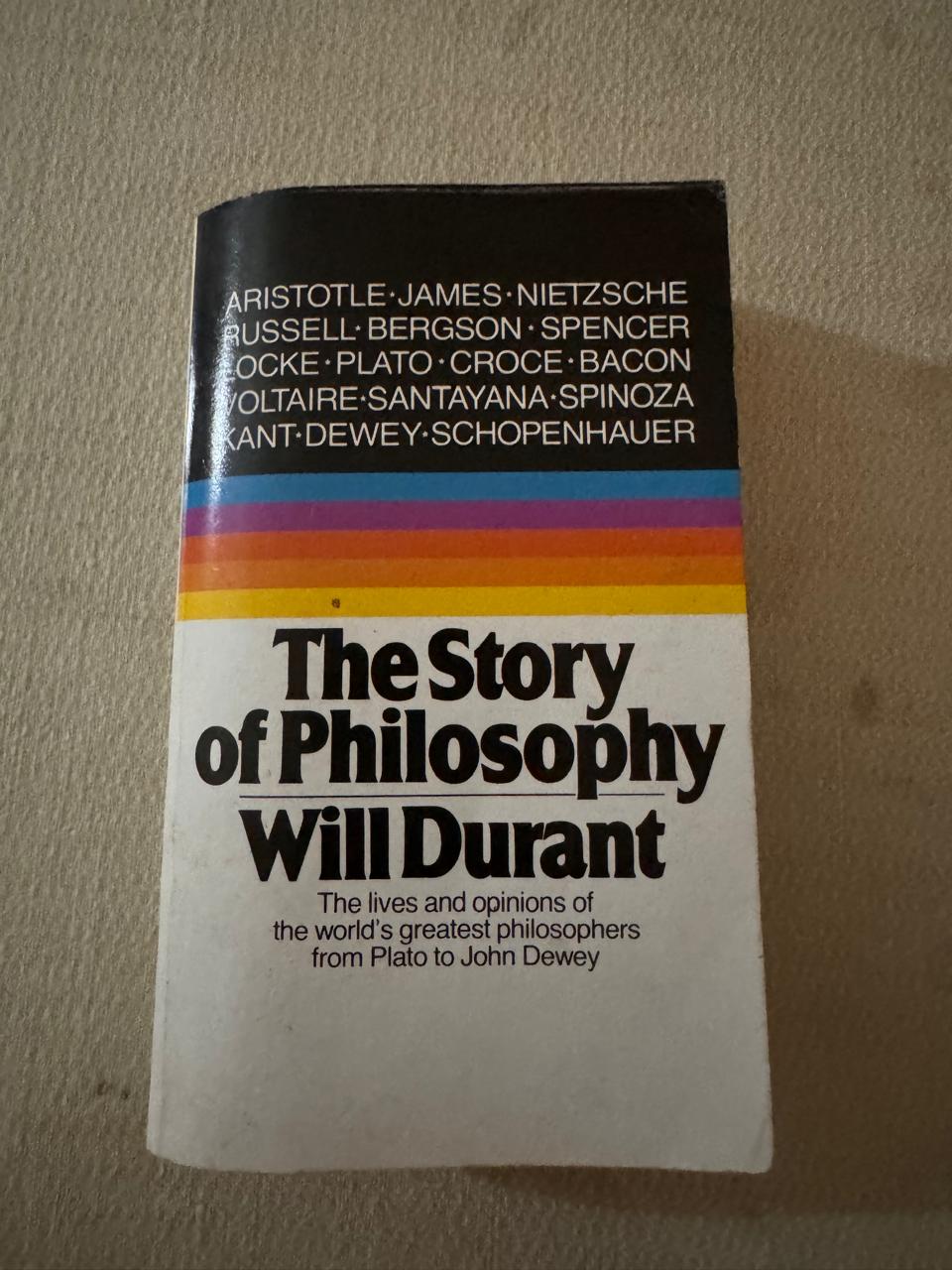
The Story of Philosophy ~ Will Durant (62 of 2024)

 If we closely look at Raphael’s painting ‘ School of Athens’ we can see the great philosophers Plato & Aristotle in the centre. And a real closer look helps us see Plato the idealist pointing his finger heavenward and Aristotle the realist having his palm facing downward. A very powerful depiction of their divergent yet rooted ideology.

https://en.wikipedia.org/wiki/The_School_of_Athens#:~:text=Additionally%2C%20Italian%20artists%20Leonardo%20da,the%20viewer%20in%20the%20artwork.


Durant's book is a good primer for Western philosophy. A stepping stone to modern theories . .

Was wanting to buy the below book but it being costly, decided to go with the one above for now.


‘Some books are to be tasted, others to be swallowed, and some to be chewed on and digested’ – so said Francis Bacon, a philosopher from 17th century Britain. This book of Will Durant, which carries a chapter about Bacon himself, deserves not just to be chewed and digested, but also to be brought out often as cud and ruminated upon. Such a brilliant work!


This book is about the famous philosophers, a brief glimpse into their lives and a detailed discussion on their philosophies. Will Durant takes enough time to also compare them all with one another and rate them on the touchstone of truth and relevance towards the daily lives of humans. Plato, Socrates, Aristotle, Francis Bacon, Benedict Spinoza, Friedrich Nietzsche, Arthur Schopenhauer, Immanuel Kant, Herbert Spencer, George Santayana, Bertrand Russell –these are all names that occupy the top echelons of the pantheon of Philosophy and Will Durant helps you have a clear and sufficient view into the world and works of them all.


While the book is equally well-written about all the philosophers, and I loved them all, some of them stood out for me. One is Voltaire. Having already read his classic ‘Candide’, I was curious to read more of Voltaire’s works. This book only added to that appetite. It is in the hands of an author to make a subject interesting or insipid. Some of them write so well that they can make even Economics sound interesting, while some of them can bungle up even a fun-filled subject like Astronomy. I am glad that I chose to read Will Durant. Reading his words on Voltaire, I felt a smile cross my face every now and then. Such an amazing sense of humour and grasp on the subject! Voltaire would have nodded his head in approval from inside his grave.


Next is Arthur Schopenhauer. You can either admire Schopenhauer OR unstintingly adore the women in your life. If you say that you do them both at once, you're a big LIAR. Such caustic views about the follies of women! Poor Schopenhauer, having got estranged from his mother in the young age, has poured out all that bitterness in his essays on women.


Then, Baruch Spinoza - the religious leader who expelled Spinoza from the congregation, cursing that Spinoza's name may be forgotten for all eternity, because of his 'heretic' thoughts, is now remembered only in a negative tinge. But Spinoza's name lives on. The woman who ignored his love, allegedly for a richer suitor, is cast into oblivion. But Spinoza is remembered as one of the greatest minds in the history of mankind. The god-believing ruffian, who attacked Spinoza with a knife because of Spinoza's rational views, well, nobody remembers that thug for anything else 'noteworthy'. Religion, riches, rage - a real quest for wisdom seems to withstand the attacks from all these unworthy pursuits – that is what I learnt from Spinoza’s life.


But, none of their stories touched my heart’s chords like Friedrich Nietzsche's did. Born into an influential family, brought up as a pious young man only to suffer a crisis of faith to become an apostate for life, having contempt for the 'masses', believing rather in the power of the evolved few and then that special person - 'superman', believing in the power of Germans to unite Europe culturally and politically, arguing more for the sake of war than for peace, correctly prophesying the occurrence of 'trade wars' across Europe during the early 20th century, not finding love and the warmth of a woman that could have helped heal the fissures in his heart and soul, finally ending up as a wreck both physically and mentally before passing away in peace, here is a man I would love to love and love to hate. Love to love - because his wisdom and seemingly caustic yet correctly derogatory views about the inept masses. Love to hate - because he seems to be the soil on which the thorny, poisonous plant called Hitler seems to have taken root. Love him or hate him, but you cannot ignore him. That's Friedrich Nietzsche for you.


All in all, this is a great book for any beginner looking to cut their teeth into philosophy. Of course, the book has many pages of deep discussions on Metaphysics that just went over my head and my eyes could only skim through. But as I already said, this is a book that deserves more than one reading to be enjoyed thoroughly. This book is a worthy gateway into the world of Philosophy!


Another one pending is:


Science first began as a branch of philosophy, but it has since grown up and moved out of the family home, and its successes have put its parent in the shade. Thanks to scientific knowledge we have walked on the Moon, cured once-fatal illnesses, and even identified the very building blocks of life and the universe. But it is these very successes that underline the need for philosophy.

How much should we trust the pronouncements of scientists that we read in the media? What are the ethical implications of our delving into the foundations of our DNA, reproductive treatments, or artificially prolonging life? And are there limits to what science can tell us about the world we think we know?

In straightforward and accessible terms, 50 Philosophy of Science Ideas You Really Need to Know explains the key philosophical questions that continue to lie at the heart of the nature and practice of science today.

The ideas explored include: Appearance and reality; Knowledge; Anti-realism; Metaphysics; Science and gender; Phenomenology and science.

The Tree Within ~ Ardra Manasi

 The Tree Within ~ Ardra Manasi

In Rajasthan, a woman and her daughters hug a Khejri tree,

before being axed to death together.

In Uttaranchal, an old woman hugs an Ash tree,

as loggers wait to cut it down.

In Kerala, a tribal woman hugs the last tree alive;

cries over a burning forest.

At home,

my aunt hugs a Muringa tree,

which still bears the weight of her childhood.

peace, resistance, and nostalgia

We are in a hurry to give names

to describe what women feel;

but sometimes, a woman comes to a tree

in a moment of loneliness,

away from thankless husbands,

children and rulers of the land,

who tell them their place is inside.

(painting - Under A Palm Tree by Winslow Homer)

CBC : 52.3: Exploring Romantic Fiction

 On June 30, 2024, the Cochin Book Club organised meetup 52.3, Exploring Romantic Fiction, at CCD, Kaloor. Ten members attended the event and participated in the discussion.  It was my first meeting. 


Attendees were:

Harris

Meenakshi

Konchitha

Ganesh

Rohit

Meera

Harshan

Shon

Rekha

Harish


We began by each of us sharing the romantic fiction books that we read. It was curious to note that there was no one amongst us who seriously read contemporary romance novels like those by Colleen Hoover or Ali Hazelwood. But it turned out that all of us have read many novels that belonged to romantic fiction, either classics or literary fiction, like that of Jane Austen or Paulo Coelho. 


Other than the regular romantic writers of different periods, like Colleen Hoover, Jane Austen, Nicholas Sparks, etc., books with strong romantic plots by writers like Murakami, Orhan Pamuk, Paulo Coelho, Basheer, etc. were also discussed. The discussions also branched out into several related topics, like differences in gender perceptions in different parts of the world, issues men and women face while entering a relationship, etc.


The following were the salient points that we covered in our discussion:

· Differentiation of romantic fiction and romance in fiction.

· The impact of an author's gender and sexual orientation on the portrayal of characters of different sexes.

· The role of social prejudices in the portrayal and the misogyny involved.

· The different tropes that are commonly found.

· How social media contributes to book sales.

· The role of publishers in pigeonholing romantic books based on tropes.

· The changing trends of romantic fiction.

· Queer romances and some common tropes.

· How cute covers are used to entice younger readers into consuming books with explicit content.

· The Instagram factor of covers.

· Romantic tragedies and comedies.

· Portrayal of relationships in generic romantic novels vs. in real life.

· Is smut necessary in romantic fiction, and to what extent is it healthy?


We began with the difference in Romantic fiction vs. Romance in fiction and how the romantic fiction by itself is so vast covering comedy, tragedy, contemporary, etc. 

One must read recommended was AS Biott - Possession - RH Hash - Booker. 

Vineeth Abraham not not present conveyed - Grand Sophie by Georgette Heyer. Book there was False colours 


By the time we all left after five hours, our TBR lists were filled with book recommendations shared with each other.

Franz Kafka

 "One morning, Gregor Samsa woke up to find himself transformed into a giant insect." Gabriel Garcia Marquez says it is the reading of this one sentence that gave him the confidence to be an author: because till then, he never thought that people had the freedom to write so outrageously!

How many more have you inspired like that, dear Franz Kafka, my favourite purveyor of nightmares?

And we overlook the black humor, thinking he is writing about profound things. I read about the humor in Kafka novels in an essay by Kundera. I reread and was amazed how easy it was to overlook the obvious hilarity.

Kafka is very easy to read if you don't try to understand what he "means". He doesn't "mean" anything . Kafka just tells you a story. Suspend all disbelief, go along with him, and you will understand that it was a ride worth taking!

With this message from Nandakumar Sir, we started our today, celebrating Franz Kafka's birthday, who was born on 3 July 1883 in Germany and left us too early on  3 June 1924 due to TB. 

Franz Kafka's work is characterized by anxiety and alienation, and his characters often face absurd situations. He is famous for his novels The Trial, in which a man is charged with a crime that is never named, and The Metamorphosis, in which the protagonist wakes to find himself transformed into an insect.

He was a German-language novelist and writer from Prague. He is widely regarded as one of the major figures of 20th-century literature. His work fuses elements of realism and the fantastic.

Great Works of Franz Kafka - Amercia, The Castle, The Trial – Is calling me. 

https://youtu.be/wkPR4Rcf4ww

What makes something kafkaesque? - anything that's made complicated 

Fludd ~ Hilary Mantel (60 of 2024)


In 'Fludd' Hilary Mantel  takes us to the fictitious village of Fetherhoughton, which is proudly Catholic and conservative. It is presided over by Father Angwin, an elderly alcoholic priest who has lost faith in God but believes that the devil exists (moreover, that he is physically present in the village). The convent and its attached school are ruled with an iron hand by Mother Perpetua (popularly known as Purpiture or simply, Purpit). There are a handful of protestants, as well as the sister village of Netherhoughton populated by atheists.

The plot centres on the Roman Catholic church and convent in the town and concerns the dramatic impact of the mysterious Fludd, who is apparently a curate sent by the bishop to assist Father Angwin, a priest who continues in his role despite privately having lost his faith.

The novel presents an uncompromisingly harsh view of the Roman Catholic Church, portraying a vividly cruel mother superior and a thoughtless, bullying bishop. The narrative flirts with the supernatural (for instance, a wart migrates miraculously from one person to another, a character bursts into flames, Fludd causes food to vanish without appearing to eat it). Fludd resembles the Devil in various ways (he instantly succeeds in learning people's innermost feelings and wishes, and he performs subtle profane miracles like maintaining an ever-full whiskey bottle). Yet Fludd's effect on both of the two main protagonists, Father Angwin and the young Sister Philomena, turns out to be very liberating, and the novel ends with some degree of new hope for both of them.

A few choice quotes:

The village:

    The village lay in moorland, which ringed it on three sides. The surrounding hills, from the village streets, looked like the hunched and bristling back of a sleeping dog. Let sleeping dogs lie, was the attitude of the people; for they hated nature. They turned their faces in the fourth direction, to the road and the railway that led them to the black heart of the industrial north: to Manchester, to Wigan, to Liverpool. They were not townspeople; they had none of their curiosity. They were not country people; they could tell a cow from a sheep, but it was not their business. Cotton was their business, and had been for nearly a century. There were three mills, but there were no clogs and shawls; there was nothing picturesque.

The language:

    The speech of the Fetherhoughtonians is not easy to reproduce. The endeavour is false and futile. One misses the solemnity, the archaic formality of the Fetherhoughtonian dialect. It was a mode of speech, Father Angwin believed, that had come adrift from the language around it. Some current had caught them unawares, and washed the Fetherhoughtonians far from the navigable reaches of plain English; and there they drifted and bobbed on waters of their own, up the creek without a paddle.

The women:

    Consider the women of Fetherhoughton, as a stranger might see them; a stranger might have the opportunity, because while the men were shut away in the mills the women liked to stand on their doorsteps. This standing was what they did. Recreational pursuits were for men: football, billiards, keeping hens. Treats were doled out to men, as a reward for good behaviour: cigarettes, beer at the Arundel Arms. Religion, and the public library, were for children. Women only talked. They analysed motive, discussed the serious business, carried life forward. Between the schoolroom and their present state came the weaving sheds; deafened by the noise of the machines, they spoke too loudly now, their voices scattering through the gritty streets like the cries of displaced gulls.

The Protestants:

    The Protestants were damned, of course, by reason of this culpable ignorance. They would roast in hell. A span of seventy years, to ride bicycles in the steep streets, to get married, to eat bread and dripping: then bronchitis, pneumonia, a broken hip: then the minister calls, and the florist does a wreath: then devils will tear their flesh with pincers.

The Bishop, a man of modern sensibilities, decides to reform Fetherhoughton and bring it out from the Middle Ages. As a beginning, he gets Father Angwin to get rid of most of the statuary from the church (the padre buries them!) and decides to appoint a curate to keep the old man in line.

Enter Fludd.

The curate is strange. He can penetrate the very souls of people (especially the fair sex), yet nobody can recall his features from memory. He eats and drinks without seeming to do so. His approach to religion is unorthodox, to say the least.

Soon, the influence of Fludd is felt everywhere. The padre's middle-aged housekeeper Agnes Dempsey and the young sister Philomena feel his magnetism. Mother Purpit is intimidated. Father Angwin is emboldened in his unorthodox views. The Fetherhoughtonian on the street becomes more pious, and even the atheists of Netherhoughton are affected.

Fludd, who talks in alchemical terms, effects his own alchemy on the sleepy village before leaving in the most unusual fashion.

The sense of being in perpetual sin, the need for redemption, and guilt about being human and having human emotions... these are highlighted, especially through the thoughts of Sister Philomena, who has the burden of being a nun in addition to being a Catholic. True, the church in Fetherhoughton does not bear much resemblance to the actual Roman Catholic Church of 1956 (when the events take place), but that creative exaggeration enables the writer to highlight some universal issues.

In one hundred and eighty-six pages, Hilary Mantel has managed to tell a thumping good story as well put a lot questions into the reader's mind. No mean feat!

PS: The author states at the beginning: "The real Fludd (1574-1637) was a physician, scholar and alchemist. In alchemy, everything has a literal and factual description, and in addition a description that is symbolic and fantastical ." (Emphasis mine). That could be said of this novel, too.

To say that Hilary Mantel writes beautifully would be a statement of the obvious. She has enormous control over the language; in addition, she can delineate characters so effectively with a few strokes of her pen, that they stand before you as living, breathing entities. And to top it all, her subject matter is always unique, so that the reader is hooked and pulled into the tale before she knows it. (I have faced some problem with her thicker books: but those were more to do with my powers of persistence than the quality of her writing.)

Thanks to Nandakishore sir for this. 

Tuesday, July 02, 2024

Abraham Verghese & Writing

 A doctor by profession working for HIV victims, wrote a scientific paper describing that, but then felt that the language of science didn’t begin to capture the heartache of the families, the tragedy of that whole journey. That was the moment he became a writer. (His first book―My Own Country: A Doctor’s Story―came out in 1994.) And then  just sort of have kept going,  have kept writing ever since then partly because he love to read. He came to medicine because of certain books, certain novels that inspired him. And so once he published that first book, he had this ambition to write the kind of novel that would inspire another generation of readers to go into medicine.


And he did at his own pace. He worry that when your attention span is confined to Instagram and short bursts like that, and when it is all visual and when you don’t have the experience of taking words and making pictures in your head, then a part of your brain just doesn’t get exercised and we lose something.

He had his medical education in two places―in Ethiopia to begin with and then when the civil war broke out there, eventually finished in India [Madras Medical College]. But in both cases, there was a British system of education that put great emphasis on learning to read the body as a text. It is an art that is dying, that is not done very well anymore. But he loved it. And he had the most wonderful teachers, unforgettable people who were incredibly skilled at reading the body. And so he sort of really fell in love with that. And it is ironic that his reputation in America in academic medicine has a lot to do with bedside medicine  yet it is not as though he learned some special skills in his postgraduate years. 

He is an outsider looking in, wherever he had lived his life. This is a great perspective to have as a writer.  Nonfiction, at least in America, outsells fiction five to one, ten to one. For some reason, if something really happened, readers are more interested in it than if you make it up. So in general, even though novels make a lot of splash, nonfiction makes money for publishers. So there was a lot of pressure for  to write another nonfiction story. And he had just lived through another experience with the death of a friend.

But he was really keen to write fiction because he think it is very liberating.  Fiction though it draws on things he know, it draws on  experience, he don’t think it is autobiographical in the sort of broadest sense. But he do write about what he know. So the first novel was set in Ethiopia and the character goes to medical school. But that’s about the only resemblance―he had a twin,  mother was  a nun.

According to him the most important decision is geography―where you locate the book. 

He is a  big believer in the quote “Geography is destiny.”  heard this as a medical school, and it was taught  as something that Freud said, speaking about the proximity of the birth canal to the interesting organs nearby. —he was paraphrasing Napoleon. Napoleon, in saying “Geography is destiny,”.

Every change of geography change destiny.

He has a whiteboard where he doodles, it is the  artefacts of the creative process. They weren’t the causative agents that made me write in a certain way. They were just part of the process.

To keep the readers engaged, You want them to forget all personal problems and enter this world in two or three pages. And then you have to work very, very hard to keep them in this fictional dream with their disbelief suspended. So he think it is much harder to write fiction than nonfiction because when something really happens, we have an inherent interest in it. But when you write fiction, I think you just have to work very hard.

There is a famous saying in writing that you have to kill your darlings. But when they say kill your darlings, it doesn’t mean killing your favourite characters, by the way. What it means is, as you know, if you think a piece of writing is very, very cute, you have written 10 pages, but you love this one paragraph, that’s the paragraph your editor and you, if you have some wisdom, are going to realise that it is just not working.

He think of myself as all-physician. And is looking out at the world through the lens of a physician. A very famous American physician who died in 1919 used to say, ‘It is much more important to know what patient has the disease than what disease the patient has.’ I think that remains true. I think it is much less about specific diagnosis than it is about getting to know this person in front of you and the illness that they have and sometimes the outcome depends much less on the nature of the illness than on the nature of the patient.

We raise our children with stories. We use stories from the very earliest stage. If you think about your own childhood, it is a succession of small stories that impacted you. And it is always puzzling to me why people stop reading fiction, to their great detriment. At least in America, the majority of readers are women. One could argue that they have perhaps more time. That’s not a really good argument, but it’s being made. Fiction, time and time again, has the ability to change societies. You think about Uncle Tom’s Cabin in America. That novel ended slavery in America. One book captured the public’s imagination and made slavery unpalatable. Similarly, in the UK, one book―The Citadel by A.J. Cronin―depicting medicine and health care in a small Welsh mining town created the National Health Service. It caused such a public sentiment.

When fiction sweeps through society, it has a particular role in shaping us. And, a part of the reason that to me medicine feels very unimaginative at times in terms of the way people seem to understand it is because we have become so left-brained in our orientation. And we are not tapping into the right brain and all its wonderful mystical associations. All the stuff that Freud and everyone else would tell us is terribly important in driving us.

One of the common things is that when you have done something, then it is assumed that you are going to keep doing it. You are going to create another one, another one. And with every book, you have always felt that you have nothing more to say, that you have put everything you know into it. When you do something that’s worked well, there is immediately the sense of, ‘Oh, what’s next? You’re gonna do this again. When will you do it again?’ He feel free of that pressure. So that’s probably why it took 14 years between the last book and this book.

It is not easy for him to do that. And he can’t just do it on demand. It has to sort of come organically, because he feel he has something to say, and there is a story that’s compelling. So he is not in any rush to write another one right away. He probably will write. He enjoy writing. But he don’t feel compelled to churn out another bestseller, first of all, because it is impossible to do. It is incredibly lucky to have had one novel do well, and then to have a second one do even better. There is no formula. With every book, you start from zero. And it is long, tortuous. 

Art gives meaning to our lives. If we were mechanical creatures, then we wouldn’t need art. But art is in a way tapping into our subconscious and tapping into our complex motivations. I mentioned Proust talking about novels being an optical instrument that allows you to look into yourself. Similarly, I like a lot of modern art, but it is very subjective. The artist presents you something and you bring your life history and your biography and your eyes and you look at this thing and you tell yourself a certain story. My belief is that we need art to make meaning of our lives. We need technology to boil our coffee and to allow us to talk on Zoom, but it doesn’t necessarily give us meaning.

AI is going to do a lot of things (laughs). But there is a big misconception about AI; it is neither artificial, nor is it intelligent. It is actually parasitising material already existing in the world by writers like me. In fact, there is a movement afoot to try and make sure that AI pays us for poring through our novels and coming up with ways to imitate us. So I think it is an interesting phenomenon, it will generate a lot of interesting quasi art. But ultimately, we respond to human beings, individuals making art. I am not sure whether we are moved by, except in the abstracts, technology creating art even if it has some similitude where it feels real. Even so, I don’t think it is quite the same thing.

----------

It was during her time as a nurse that she met Abraham Verghese, a young medical student whose passion for medicine matched her own dedication to patient care. Their shared values and love for their work brought them closer, and they soon realized that they were meant to be together. After a whirlwind romance, Sylvia and Abraham tied the knot and began their journey as a couple. Sylvia's unwavering support for Abraham throughout his career has been pivotal in his success. They had two children. 

Abraham Verghese and Cari Costanzo Kapur, Ph.D Anthropology work together now. 

The Covenant of Water ~ Abraham Verghese (59 of 2024)

 A book running into 796 pages, running across three generations with roots in Kerala India and spreading across, thought of grabbing this book on Doctors day, as I heard that it is by a doctor and related to them.  Final verdict after the read. 

This doctors day – the 1st of July, thought of reading a book related to Doctors, and lo and behold, here is ‘The Covenant of Water’ by Abraham Verghese a book by a doctor, about human condition(s) and doctor filled with reminiscences. Most nostalgic was big ammachi, her desire to read, wanting to have a doctor in the family and being the strong woman – a mother to so many. Reminding me of my ‘Ammuma’ in many possible ways.

Filled with wealth of details, over 700 pages, including beautiful imagery and spanning three generations from 1900 to 1977 this is a fictional story with real world events of that time period.

Excerpt from the book:

“Some books are lies from end to end,
And some great lies were never penn'd...”

But you have my word this book is true, and I know it through and through.

For Elsie, who helped me understand, that past and present go hand in hand.

With eternal gratitude,

Digby Kilgour,

1936 St. Bridget’s Leprosarium

Covenant of Water by Abraham Verghese. 


Early in The Covenant of Water, Big Ammachi’s granddaughter and namesake, Mariamma, “begs for a story about their ancestors.” This request, like much of the novel’s 715-page answer, was inspired by Verghese’s own mother. In 1998, Mariam Verghese was asked by her granddaughter (middle name: Mariam), “Ammachi, what was it like when you were a girl?” Verghese’s mother responded by filling 157 pages of a spiral notebook with intricate illustrations and written memories of her girlhood in Kerala. He used several of the stories from this notebook in the novel, but, he writes, “more precious to me were the mood and voice that came through in her words, which I supplemented with my own recollections of summer holidays with my grandparents in Kerala, and later visits when I was in medical school.” Here, Verghese shares his personal family photographs from those visits and explains how his own experience influenced his fictional world.

Verghese has given us Parambil, a water-filled, near-mythical dreamscape in Kerala. Verghese's story opens with a storytelling grandmother. Drawing on ancient Malayali Christian communal histories that reach back to 52 A.D. with St. Thomas' arrival in India, this story is about the ebbs and flows of lives across three generations from 1900 to the late-1970s. As various historical events of both British and then independent India unfold, we experience them through the loves and losses of a cast of characters that keeps growing like a nodal system with ever-multiplying branches and intersections.

Mariamma, a 12-year-old child bride, marries a 40-year-old widower and becomes the mistress of 500 acres of Parambil. Her husband's family has a secret medical "condition" where water is the cause of death for members in each generation. Big Ammachi, as she comes to be known, experiences many joys and sorrows from that early age until her passing. Though she remains in Parambil all her life, the human and spirit worlds forever intervene. Her wide-open heart takes in everything and everyone, no matter if they bring pain or comfort.

As I watched the unfolding of that relationship and family, I came to recognize how the world worked at that time. How he honored his wife until she came of age, how the relationship grew in love, and then what the story was truly meant to be about – this “condition” feared and how it would rock the family in such a devastating way.

Then another story emerge about a fellow named Digby. A new timeline then back in time to our original story of our young girl, now grown, widowed, managing. 

Would her story and Digby’s intersect? It ends in 1977, when that girl’s physician granddaughter arrives at a shocking discovery. Let’s just say that this family loves and suffers in a variety of ways.

That kind of capaciousness is also a notable stylistic quality of the novel. At times, we might wonder why almost every character has a backstory or why certain subplots exist. Ever the skillful surgeon, Verghese threads meaningful connections between macrocosmic and microcosmic details so elegantly that they are often barely noticeable at first. For example, the parallel narratives of the Parambil family, the Scottish doctor Digby Kilgour, and the Swedish doctor Rune Orquist seem like they could each be entire novels on their own. Instead, Verghese takes his time to reveal how everything, like the waterways there, is connected and eventually flows together.


"The best possible operation is not the same as the best operation possible".

"We don't have children to fulfill our dreams. Children allow us to let go of the dreams we were never meant to fulfill."