Tuesday, August 20, 2024

Charles Bukowski


 Charles Bukowski never liked movies. And Hollywood never knew what to do with his books. Yet, the life and work of Bukowski were always an inspiration for generations of filmmakers, and many dozens of movies were made during and after his lifetime, with only a very few of them being established Hollywood productions. Most of these movies were short films, a majority of them student films directed on shoestring budgets solely out of a passion for the author and his works.


Conscientious Reflection : Read in the Substack app Book Review- Bukowski: On Film by Marc Shapiro ~ HARISH P I ~ DEC 08, 2023


Charles Bukowski never liked movies. And Hollywood never knew what to do with his books. Yet, the life and work of Bukowski were always an inspiration for generations of filmmakers, and many dozens of movies were made during and after his lifetime, with only a very few of them being established Hollywood productions. Most of these movies were short films, a majority of them student films directed on shoestring budgets solely out of a passion for the author and his works.


Who was Bukowski? A rebellious poet and story writer, he wrote six novels and countless poems and short stories in many literary magazines, including some obscure ones, which are collected in over sixty books. Called by Time as 'the laureate of American lowlife', Bukowski wrote about the poor by living among them. He wrote about impoverished Americans, alcoholism, sex, and the drudgery of ordinary living. He lived in L.A. and based all his writing around the city. He wasn't noticed much in America at the time, but Europeans celebrated him. Today, he is very popular the world over, with a dedicated fanbase and numerous academic studies being made about his life and work.


Bukowski: On Film is a volume written by Marc Shapiro that tries to list out the movies that were about Bukowski, by Bukowski, or based on the work of Bukowski. This is a tough work because, like his scattered collection of numerous poems and stories, a lot of the movies based on his works are condemned to obscurity. Many of the first-time directors who created them changed their fields, and many others consider them too benign to revisit them. To his credit, the writer has painstakingly tried his best to find out the majority of them and include the details in this book.


Friday, August 16, 2024

Life: A User’s Manual ~ Georges Perec 83 of 2024

 Life: A User’s Manual, a novel by Georges Perec, was originally published in 1978 under the French title of La Vie mode d’emploi. This remarkable book presents a minutely detailed portrait of a fictional ten-story apartment building in Paris and its scores of inhabitants. A melting pot of classes, nationalities, and occupations, the population of this apartment block yields a bountiful harvest of fascinating narratives, each of which is worthy of a novel of its own. As an intertwined whole, they form a sort of Balzacian tapestry of twentieth century Paris.

Perec was one of the founders of the Oulipo movement in literature. 


Thanks to Nandakishore Sir for this recommendation. 

A melange of stories, with the common thread of a building: roughly one chapter per room, (room defined broadly to include common spaces such as stairs etc). Some of the stories additionally are related to the project of 'the eccentric English millionaire' .

Between World War I and II, a tremendously wealthy Englishman, Bartlebooth (whose name combines two literary characters, Herman Melville's Bartleby and Valery Larbaud's Barnabooth), devises a plan that will both occupy the remainder of his life and spend his entire fortune. First, he spends 10 years learning to paint watercolors under the tutelage of Valène, an artist who is a resident of 11 rue Simon-Crubellier, where Bartlebooth also purchases an apartment. Then, he embarks on a 20-year trip around the world with his loyal servant Smautf (also a resident of 11 rue Simon-Crubellier), painting a watercolor of a different port roughly every two weeks for a total of 500 watercolors.


Bartlebooth then sends each painting back to France, where the paper is glued to a support board, and a carefully selected craftsman named Gaspard Winckler (also a resident of 11 rue Simon-Crubellier) cuts it into a jigsaw puzzle. Upon his return, Bartlebooth spends his time solving each puzzle, re-creating the scene.


Each finished puzzle is treated to re-bind the paper with a special solution invented by Georges Morellet, another resident of 11 rue Simon-Crubellier. After the solution is applied, the wooden support is removed, and the painting is sent to the port where it was painted. Exactly 20 years to the day after it was painted, the painting is placed in a detergent solution until the colors dissolve, and the paper, blank except for the faint marks where it was cut and re-joined, is returned to Bartlebooth.


Ultimately, there would be nothing to show for 50 years of work: The project would leave absolutely no mark on the world. Unfortunately for Bartlebooth, Winckler's puzzles become increasingly difficult and Bartlebooth becomes blind. An art fanatic also intervenes in an attempt to stop Bartlebooth from destroying his art. Bartlebooth is forced to change his plans and have the watercolors burned in a furnace locally instead of couriered back to the sea, for fear of those involved in the task betraying him. By 1975, Bartlebooth is 16 months behind in his plans, and he dies while he is about to finish his 439th puzzle. The last hole in the puzzle is in the shape of the letter X while the piece that he is holding is in the shape of the letter W.


The entire block is primarily presented frozen in time, on 23 June, 1975, just before 8 pm, moments after the death of Bartlebooth. Nonetheless, the constraint system creates hundreds of separate stories concerning the inhabitants of the block, past and present, and the other people in their lives. The story of Bartlebooth is the principal thread, but it interlinks with many others.


Another key thread is the painter Serge Valène's final project. Bartlebooth hires him as a tutor before embarking on his tour of the world, and buys himself a flat in the same block where Valène lives. He is one of several painters who have lived in the block over the century. He plans to paint the entire apartment block, seen in elevation with the facade removed, showing all the occupants and the details of their lives: Valène, a character in the novel, seeks to create a representation of the novel as a painting. Chapter 51, falling in the middle of the book, lists all of Valène's ideas, and in the process picks out the key stories seen so far and yet to come.


Both Bartlebooth and Valène fail in their projects; failure is a recurring theme in many of the stories.


While Bartlebooth's puzzle narrative is the central story of the book, 11 rue Simon-Crubellier is the subject of the novel. 11 rue Simon-Crubellier has been frozen at the instant in time when Bartlebooth dies. People are frozen in different apartments, on the stairs, and in the cellars. Some rooms are vacant.


The narrative moves like a knight in a chess game, one chapter for each room (thus, the more rooms an apartment has the more chapters are devoted to it).


The entire block is primarily presented frozen in time, on 23 June, 1975, just before 8 pm, moments after the death of Bartlebooth.

As may be imagined, this is a giant sized work ith 600+ pages, not merely in the number of chapters or pages, but in the number of characters, which proved (for me) impossible to keep track off, even after regularly checking back to the index. (Yes! The book has an index.)

Agreed, that the work is supposed to be a set of (pen) pictures, there is, for my taste, too much description of the contents of the rooms, especially

of the art work (pictures again as well as other objects), (perhaps for someone interested in art this might not be a problem, in fact it might be a positive); not to mention too many lists of various types, (which I confess I skimmed or even skipped over).

Also, there are apparently a number of allusions to other people, or stories, or possibly real events, most of which I cannot claim to have understood.

Nevertheless, most, (practically all) of the stories or anecdotes are interesting and many have penetrating insights into society and human nature and behaviour (Without any spoilers, eg., chapters 27, 88, 96 & 98).

A sample:

"Sometimes Valène had the feeling that time had been stopped, suspended, frozen around he didn't know what expectation. The very idea of the picture he planned to do and whose laid-out, broken-up images had begun to haunt every second of his life, furnishing his dreams, squeezing his memories, the very idea of this shattered building laying bare the cracks of its past, the crumbling of its present, this unordered amassing of stories grandiose and trivial, frivolous and pathetic, gave him the impression of a grotesque mausoleum raised in the memory of companions petrified in terminal postures as insignificant in their solemnity as they were in their ordinariness, as if he had wanted both to warn of and to delay these slow or quick deaths which seemed to be engulfing the entire building storey by storey: Monsieur Marcia, Madame Moreau, Madame de Beaumont, Bartlebooth, Rorschach, Mademoiselle Crespi, Madame Albin, Smautf. And himself, of course, Valène himself, the longest inhabitant of the house."

"To begin with, the art of jigsaw puzzles seems of little substance, easily exhausted, wholly dealt with by a basic introduction to Gestalt: the perceived object - we may be dealing with a perceptual act, the acquisition of a skill, a physiological system, or, as in the present case, a wooden jigsaw puzzle - is not a sum of elements to be distinguished from each other and analysed discretely, but a pattern, that is to say a form, a structure: the element's existence does not precede the existence of the whole, it comes neither before nor after it, for the parts do not determine the pattern, but the pattern determines the parts: knowledge of the pattern and of its laws, of the set and its structure, could not possibly be derived from discrete knowledge of the elements that compose it. That means that you can look at a piece of a puzzle for three whole days, you can believe that you know all there is to know about its colouring and shape, and be no further on than when you started. The only thing that counts is the ability to link this piece to other pieces, and in that sense the art of the jigsaw puzzle has something in common with the art of go. The pieces are readable, take on a sense, only when assembled; in isolation, a puzzle piece means nothing - just an impossible question, an opaque challenge. But as soon as you have succeeded, after minutes of trial and error, or after a prodigious half-second flash of inspiration, in fitting it into one of its neighbours, the piece disappears, ceases to exist as a piece. The intense difficulty preceding this link-up - which the English word puzzle indicates so well - not only loses its raison d'être, it seems never to have had any reason, so obvious does the solution appear. The two pieces so miraculously conjoined are henceforth one, which in its turn will be a source of error, hesitation, dismay, and expectation."

What beautiful prose ❤️


Rather than a novel, Life: A User’s Manual almost resembles a scenario written for a role-playing game. A map of the imaginary building is provided. When one enters a room, all the various furnishings are described, right down to every last object on the tables, shelves, and walls. Rather than the treasure chests and magical trappings of Dungeons & Dragons, however, the rooms of Perec’s apartment building are furnished with books, postcards, objets d’art, decorative prints, occupational paraphernalia, and miscellaneous ephemera, all intricately described to the last detail. Like Umberto Eco, Perec has a penchant for extensive lists, whether it be the contents of a refrigerator, the items in a shop window, or the artifacts in an archives. Crafted in such exquisite verbal detail, the ten-story apartment building at 11 rue Simon-Crubellier becomes the ultimate life-sized dollhouse.

The building’s inhabitants are revealed in a similar level of elaborate detail. The people one meets in this building are defined by their pasts. Though the main narrative of the novel takes place in the present of 1975, all the action occurs in flashbacks, as if the building were now frozen in time. One meets not only the present occupants of the building’s many rooms but also its past denizens as well, as if the story of each room were more important than the lives that took place there. But oh, the lives! Perec comes up with incredibly inventive biographies for the dozens of characters in the book, each more fascinating than the next. The 99 brief and varied chapters amount to a sort of modern Canterbury Tales. The stories are even indexed in the back of the book, with such entries as “The Tale of the Acrobat who did not want to get off his trapeze ever again” or “The Tale of the Neurasthenic Lawyer who settled in Indonesia. If there is a main character in the building that is the whole universe of this novel, it is bartlebooth, a man so rich that he has devised a plan for his life so deviously futile that despite 50 years, a complete plethora of skills, workmen, travels, paint, glue, jigwaws and postage, he still cant complete, and is left with a jigsaw piece in his hand, that you might think that there is no reason for his life in the first place. but you would be wrong. there is a reason for the lives of every person in this book, in this building, if only to explain the reason for something else. It has no narrative, you do not connect with any of the residents, it is a jumble of stories and subterfuges. sometimes you find out why, sometimes you dont..it could be the diary of any building in the world. People come and go, have kids, plans, become rich, lose it all, get murderded, get happy, move away, come back, have another marriage, steal, buy, etc etc. 

The entire premise of this book is the exercise in futility that we call life. It is brilliantly written, so funny it makes you laugh out loud, and its just life in all its stupidity. 

Life: A User’s Manual is a masterpiece of 20th-century literature, celebrated for its innovative structure, depth of detail, and philosophical exploration of life. It is a novel that challenges conventional storytelling, offering readers a unique and intellectually stimulating experience. However, its complexity and non-linear narrative may not appeal to everyone. For those who enjoy literary puzzles and are willing to engage deeply with a text, it offers an incredibly rewarding reading experience.

This book is best suited for readers who appreciate literary experimentation and are intrigued by the idea of exploring life through the lens of an intricately crafted, multi-layered narrative.

Thursday, August 15, 2024

Pride and Prejudice Vs. Wuthering Heights

 The choice between Pride and Prejudice by Jane Austen and Wuthering Heights by Emily Brontë often depends on what you're looking for in a novel, as both are classics but very different in style, tone, and themes.

Pride and Prejudice:


Genre: Comedy of manners, romance.

Tone: Light, witty, and humorous with a focus on social satire.

Themes: Marriage, class, morality, and family.

Characters: The story centers on Elizabeth Bennet, a sharp and independent young woman, and Mr. Darcy, who undergoes significant character development.

Style: Known for its irony and sparkling dialogue, Pride and Prejudice offers a more optimistic and lively view of life.

Wuthering Heights:


Genre: Gothic fiction, tragedy.

Tone: Dark, intense, and brooding with elements of the supernatural.

Themes: Passion, revenge, the destructive nature of love, and the impact of childhood on adult life.

Characters: The novel features complex and often morally ambiguous characters like Heathcliff and Catherine, whose tumultuous relationship drives the story.

Style: The narrative is intense, with a focus on deep, often painful emotions, and is marked by its moody atmosphere and intricate structure.

Which is better?

If you prefer a lighter, more humorous read with keen social observations and a focus on character development, Pride and Prejudice might be the better choice.

If you're drawn to darker, more intense narratives with complex characters and emotional depth, Wuthering Heights could be more appealing.

Ultimately, it comes down to personal preference. Both are masterpieces in their own right.


Wednesday, August 14, 2024

Wuthering Heights 82 of 2024


One of the first book review I had written, but unfortunately I do not have that with me now. Have read this couple of times - again now - for writing the comparison with the books and authors. 

Wuthering Heights by Emily Brontë is a complex and intense novel that explores themes of love, revenge, and the destructive power of obsession. The story is told through multiple narrators, primarily Mr. Lockwood, a tenant at Thrushcross Grange, and Nelly Dean, the housekeeper who recounts the history of the Earnshaw and Linton families.

Part One: The Earnshaw Family:

The story begins in the late 18th century with Mr. Earnshaw, the owner of Wuthering Heights, who brings home an orphaned boy from Liverpool, named Heathcliff. Heathcliff is treated as a member of the family, much to the chagrin of Mr. Earnshaw’s son, Hindley, who grows to hate him.

Mr. Earnshaw’s daughter, Catherine (Cathy), forms a close bond with Heathcliff, and they become inseparable, sharing a wild, passionate nature. However, after Mr. Earnshaw's death, Hindley inherits Wuthering Heights and cruelly reduces Heathcliff to the status of a servant.

Heathcliff’s Revenge:

Despite his degraded position, Heathcliff’s love for Cathy remains intense. However, Cathy becomes torn between her love for Heathcliff and her attraction to the more refined Edgar Linton, a wealthy neighbor who lives at Thrushcross Grange.

Cathy ultimately chooses to marry Edgar, believing it would elevate her social status, though she admits to Nelly Dean that she loves Heathcliff with an almost supernatural passion. This betrayal devastates Heathcliff, and he leaves Wuthering Heights for three years.

Heathcliff’s Return:

When Heathcliff returns, he is now wealthy and vengeful. He begins to exact revenge on those who wronged him, particularly Hindley, who has become a drunkard after the death of his wife. Heathcliff manipulates Hindley into gambling away his ownership of Wuthering Heights and gains control of the estate.

Heathcliff also marries Edgar’s sister, Isabella, purely to spite Edgar and Cathy. However, he treats Isabella horribly, and she eventually flees to London, where she gives birth to Heathcliff's son, Linton Heathcliff.

Cathy’s Decline and Death:

Cathy’s health deteriorates due to the emotional strain of her conflicting feelings for Heathcliff and Edgar. She becomes gravely ill and, shortly after giving birth to her daughter, Catherine (Cathy), she dies, leaving both Heathcliff and Edgar devastated.

Part Two: The Next Generation:

The story then shifts focus to the next generation. Cathy, Edgar’s daughter, grows up at Thrushcross Grange. She is kind and spirited but sheltered.

Heathcliff, still obsessed with revenge, arranges for Cathy to meet and eventually marry his sickly son, Linton, whom he has brought to Wuthering Heights after Isabella’s death. Heathcliff's aim is to gain control of Thrushcross Grange through this marriage.

Heathcliff’s Revenge Fulfilled:

Linton Heathcliff dies shortly after marrying Cathy, and Heathcliff gains control of both Wuthering Heights and Thrushcross Grange. Cathy is left at Wuthering Heights, where she is treated cruelly by Heathcliff.

Heathcliff’s Downfall and Death:

As time passes, Heathcliff becomes increasingly haunted by memories of Cathy, whom he continues to obsess over even after her death. He begins to lose interest in his revenge, and his mental and physical health deteriorates.

Heathcliff dies in a state of despair, longing to be reunited with Cathy in death. He is buried next to her in the moors.

Resolution:

After Heathcliff's death, the gloom of Wuthering Heights begins to lift. Cathy and Hareton, Hindley’s son, who had been raised harshly by Heathcliff but softened by Cathy’s kindness, form a close bond. The novel ends on a hopeful note, with Cathy and Hareton planning to marry and move to Thrushcross Grange, leaving the haunted legacy of Wuthering Heights behind them.

Themes:

Love and Obsession: The novel explores the destructive nature of Heathcliff’s all-consuming love for Cathy and how it drives him to ruin both his life and the lives of those around him.

Revenge: Heathcliff’s pursuit of revenge is central to the plot, as he seeks to destroy those who wronged him, but it ultimately leads to his own downfall.

Social Class and Power: The novel examines the rigid class structures of the time and how they influence relationships and social mobility.

Nature vs. Civilization: The wild, untamed moors reflect the raw emotions and passions of the characters, particularly Cathy and Heathcliff, contrasting with the more refined, controlled environment of Thrushcross Grange.

Wuthering Heights is a powerful and emotionally intense novel, with its dark themes, complex characters, and gothic atmosphere contributing to its enduring status as a classic of English literature.

When Emily Brontë published Wuthering Heights in 1847 under the pseudonym Ellis Bell, outraged Victorian critics deemed it savage, indecent and immoral. One described it as “a compound of vulgar depravity and unnatural horrors”.

After Brontë’s death, when the novel began to find success, many were surprised to find that such a tempestuous gothic romance had been written by a quiet parson’s daughter. But did a real-life romance inspire Emily Brontë’s only novel? According to Frances O’Connor’s new film, Emily, the answer is yes. But the historical picture is far more murky.

The film presents a romantic origin story to account for Brontë’s iconic novel. While reclaiming Emily as a rebel, misfit and the weirdest of the “weird sisters”, as Ted Hughes memorably called them, the film departs knowingly from historical fact, mixing biography with Brontë mythology and dramatic invention to present a very different picture. Australian-British director O'Connor has described her film as putting Emily at the centre of her own story.

Jane Austen Vs. Emily Bronte Vs. Bronte Sisters

The question of who is the better writer between Emily Brontë and Jane Austen is subjective and depends on what qualities you value in literature. Both authors are celebrated for their unique contributions to English literature, but they have very different styles and themes.

Jane Austen was very much a regency woman, familiar with the values and traditions of the late eighteenth century, whereas the Brontës grew up at the start of Queen Victoria's reign, and witnessed the huge social impact brought by the industrial revolution in a way that Jane never did.

Jane Austen:

Style: Austen is renowned for her wit, irony, and social commentary. Her writing is precise, elegant, and often centers on the subtleties of human behavior and social interactions, particularly within the context of marriage and class.

Themes: Austen’s novels often explore themes like social mobility, morality, and the constraints placed on women in her time. Her works are known for their sharp observations on the society of the English landed gentry.

Legacy: Austen’s influence is immense, with her novels frequently adapted into films, TV shows, and other media. Her characters, like Elizabeth Bennet and Mr. Darcy, have become iconic figures in literature.

Emily Brontë:

Style: Brontë’s writing is more intense, poetic, and emotionally charged. Wuthering Heights is her only novel, but it's known for its dark, gothic atmosphere and complex narrative structure.

Themes: Brontë delves into themes of passion, revenge, and the supernatural, offering a more visceral exploration of human emotions and the darker aspects of love and obsession. Her work is often seen as more raw and haunting compared to Austen’s.

Legacy: Though Emily Brontë wrote only one novel, Wuthering Heights is considered a masterpiece of Gothic literature and has inspired countless adaptations and interpretations. Her novel is often praised for its originality and the depth of its characters.

Who is the Better Writer?

Austen is often praised for her wit, social critique, and the elegance of her prose. She is seen as a master of the novel of manners, with a sharp eye for detail and a sophisticated, often humorous portrayal of society.

Brontë is celebrated for her ability to evoke powerful emotions and create a dark, immersive atmosphere. Her writing is often more passionate and lyrical, appealing to those who enjoy intense, brooding narratives.

In summary:

Austen is better if you value subtlety, wit, and social insight.

Brontë is better if you prefer intensity, emotion, and a more gothic sensibility.

Both are exceptional writers, and their greatness lies in their ability to speak to different aspects of the human experience.

Here's a brief overview of where and when Jane Austen and the Brontë sisters were born:

Jane Austen:

Born: December 16, 1775

Place: Steventon, Hampshire, England

Jane Austen was born in Steventon, a small village in Hampshire, England. She spent much of her early life in Steventon, where her father was the rector of the local church.

The Brontë Sisters (Charlotte, Emily, and Anne Brontë):

Charlotte Brontë: Born: April 21, 1816

Emily Brontë: Born: July 30, 1818

Anne Brontë: Born: January 17, 1820

Place: Thornton, West Yorkshire, England

The Brontë sisters were born in Thornton, a village near Bradford in West Yorkshire, England. However, when they were young, the family moved to the village of Haworth in West Yorkshire, where their father, Patrick Brontë, became the rector. The sisters spent most of their lives in Haworth, which greatly influenced their writing.

When and how did they die?

Jane Austen: Died: July 18, 1817 Age: 41

Jane Austen died after a prolonged illness, the exact nature of which remains debated. Many scholars believe she suffered from Addison's disease, a disorder of the adrenal glands, though others suggest she may have had Hodgkin's lymphoma, a type of cancer. She spent her final days in Winchester, Hampshire, where she was seeking medical treatment, and was buried in Winchester Cathedral.

Charlotte Brontë: Died: March 31, 1855 Age: 38

Charlotte Brontë died while pregnant, possibly due to complications related to pregnancy such as hyperemesis gravidarum (severe morning sickness), which led to dehydration and malnutrition. There is also speculation that she may have succumbed to tuberculosis, a common illness at the time. She was buried in the family vault in the Church of St. Michael and All Angels in Haworth, West Yorkshire.

Emily Brontë: Died: December 19, 1848 Age: 30

Emily Brontë died of tuberculosis, which she likely contracted from her brother Branwell, who had died a few months earlier. She became ill in the autumn of 1848 but refused medical treatment until it was too late. Emily passed away at the Brontë family home in Haworth and was buried in the family vault at the Church of St. Michael and All Angels in Haworth.

Anne Brontë: Died: May 28, 1849 Age: 29

Anne Brontë also died of tuberculosis, just five months after Emily’s death. Hoping that the sea air might improve her condition, she traveled to Scarborough with her sister Charlotte. Unfortunately, her health deteriorated rapidly, and she passed away there. Anne was buried in St. Mary's Churchyard in Scarborough, making her the only Brontë not buried in the family vault in Haworth.

Who were their inspiration to write so well?

Jane Austen:

Jane Austen drew inspiration from various sources, both personal and literary:

Family and Social Life: Austen's immediate surroundings, including her family and the social milieu of the English gentry, heavily influenced her writing. Her keen observations of social interactions, family dynamics, and the limited roles available to women in her time are central themes in her novels. Her own experiences with love, marriage proposals, and the complexities of relationships also informed her work.

Literary Influences:

Samuel Richardson: Austen admired Richardson’s novels, particularly Pamela and Clarissa, which explore the intricacies of human behavior and social morality.

Fanny Burney: Burney’s novels, especially Evelina and Cecilia, are considered precursors to Austen’s works, featuring young heroines navigating the complexities of society and love.

Henry Fielding: The humor and satire in Fielding’s novels, like Tom Jones, influenced Austen’s own use of irony and social commentary.

Theater and Poetry: Austen was also influenced by the theater, enjoying plays that featured witty dialogue and social satire. The poetry of writers like William Cowper and the novels of Sir Walter Scott were also significant influences on her development as a writer.

The Brontë Sisters (Charlotte, Emily, and Anne Brontë):

The Brontë sisters were inspired by a combination of personal experiences, literary influences, and their shared imagination:

Family and Early Life: The Brontë family’s isolated life in Haworth and the early deaths of their mother and two older sisters profoundly affected the Brontë sisters. Their father, Patrick Brontë, encouraged their education and creativity, while their brother, Branwell, shared in their imaginative play. The sisters created intricate fantasy worlds (Angria and Gondal) in their youth, which honed their storytelling abilities.

Literary Influences:

Lord Byron: The Byronic hero, characterized by a brooding, passionate, and flawed nature, significantly influenced the Brontë sisters, particularly in Emily’s creation of Heathcliff in Wuthering Heights and Charlotte’s depiction of Mr. Rochester in Jane Eyre.

Walter Scott: Scott’s historical novels, with their romanticism and exploration of the past, influenced Charlotte and Emily, particularly in their use of gothic and romantic elements.

William Shakespeare: The Brontës admired Shakespeare for his exploration of complex human emotions and psychological depth, which they emulated in their own character-driven narratives.

Personal Experience and Imagination: The sisters’ own experiences with love, loss, and the harsh realities of life informed their writing. Emily’s solitary nature and connection with the moors around Haworth heavily influenced the setting and mood of Wuthering Heights. Charlotte’s time as a governess and her unrequited love for a married man in Brussels influenced Jane Eyre and Villette. Anne’s more practical and moralistic approach is reflected in her novels Agnes Grey and The Tenant of Wildfell Hall, which explore social issues like the treatment of governesses and the dangers of alcoholism.

In summary, both Jane Austen and the Brontë sisters were shaped by their personal experiences, literary influences, and the cultural environments in which they lived. While Austen’s inspirations led her to write about social norms and relationships with wit and irony, the Brontës were driven by deeper, often darker emotions, creating intense, character-driven stories with gothic elements.

Determining which Brontë sister was the "better" writer is highly subjective and depends on individual preferences regarding themes, style, and narrative approach. Each of the Brontë sisters—Charlotte, Emily, and Anne—brought unique strengths and perspectives to their writing.

Charlotte Brontë (1816–1855):

Notable Works: Jane Eyre, Villette, Shirley, The Professor

Strengths: Charlotte is often praised for her ability to create strong, independent female protagonists, like Jane Eyre, who navigate complex emotional and social landscapes. Her novels are known for their deep psychological insight, rich character development, and exploration of themes such as gender, class, and morality. Charlotte's writing combines elements of gothic fiction with realism, making her work accessible yet profound.

Impact: Jane Eyre is one of the most famous and enduring novels in English literature, celebrated for its strong narrative voice and feminist themes.

Emily Brontë (1818–1848):

Notable Work: Wuthering Heights

Strengths: Emily’s writing is characterized by its intense emotional depth, poetic language, and exploration of dark, often turbulent themes. Wuthering Heights is her only novel, but it stands out for its complex structure, gothic atmosphere, and the morally ambiguous, passionate characters of Heathcliff and Cathy. Emily’s work is often seen as more raw and powerful, delving into the darker aspects of human nature and the destructive power of love and revenge.

Impact: Wuthering Heights is considered a masterpiece of gothic literature and is admired for its originality and emotional intensity. It is a novel that has inspired countless adaptations and critical interpretations.

Anne Brontë (1820–1849):

Notable Works: Agnes Grey, The Tenant of Wildfell Hall

Strengths: Anne’s writing is often regarded as more socially conscious and morally driven than that of her sisters. She tackled issues such as the treatment of women, alcoholism, and the harsh realities of life as a governess with a straightforward, realistic approach. The Tenant of Wildfell Hall is particularly noted for its bold critique of Victorian gender roles and its portrayal of a woman leaving an abusive marriage, which was highly controversial at the time.

Impact: While less famous than Charlotte and Emily, Anne’s work is increasingly appreciated for its early feminist themes and its unflinching exploration of social issues.

Who Was the Better Writer?

Charlotte Brontë: If you value psychological depth, strong narrative voices, and the exploration of gender and social issues, you might consider Charlotte the better writer. Her ability to blend gothic elements with realism has made her work particularly enduring.

Emily Brontë: If you are drawn to intense emotions, complex characters, and the exploration of dark, existential themes, you might find Emily the most powerful writer among the sisters. Her singular novel, Wuthering Heights, is often regarded as a work of genius.

Anne Brontë: If you appreciate social realism, moral integrity, and early feminist perspectives, Anne’s work might resonate the most with you. Her novels are valued for their forthrightness and social critique.

In the end, each sister brought something unique to the literary world, and their different strengths make it difficult to declare one as definitively better than the others. Readers often choose a favorite based on which themes and styles resonate most with them.

Saturday, August 10, 2024

Triumph ~ Jeremy Schaap (81 of 2024)


This New York Times best-selling author’s account of the 1936 Olympics in Berlin offers a “vivid portrait not just of Owens but of ’30s Germany and America” (Sports Illustrated).

At the 1936 Olympics, against a backdrop of swastikas and goose-stepping storm troopers, an African American son of sharecroppers won a staggering four gold medals, single-handedly falsifying Hitler’s myth of Aryan supremacy.

The story of Jesse Owens at the Berlin games is that of an athletic performance that transcends sports. It is also the intimate and complex tale of one remarkable man’s courage. Drawing on unprecedented access to the Owens family, previously unpublished interviews, and archival research, Jeremy Schaap transports us to Germany and tells the dramatic tale of Owens and his fellow athletes at the contest dubbed the Nazi Olympics.

With incisive reporting and rich storytelling, Schaap reveals what really happened over those tense, exhilarating weeks in a “snappy and dramatic” work of sports history .


Prologue Just before 9:30 p.m. central time on September 23, 1955, in a handsome townhouse on Chicago’s South Side, James Cleveland Owens slipped into a tweed jacket and sat down in a straight-backed chair. As he smoothed out his pencil mustache and slicked back his hair — what little was left of it — a dozen technicians put the finishing touches on what had been an allday job, wiring and lighting the Owens home. In a few minutes, Owens would be talking live on national television with Edward R. Murrow of CBS, on his celebrity interview show Person to Person. More than 20 million Americans would watch as Murrow spoke from a studio in New York via satellite, first with Owens and his family, and then, in the second half of the show, with Leonard Bernstein and his.

A forty-two-year-old father of three, Jesse Owens weighed twenty- five pounds more than he had in Berlin in 1936, when he had turned in the most indelible performance ever at the Olympic games. In his conservative jacket, flannel slacks, white shirt, and dark tie, he could have passed for a fifty-year-old. Not that he wasn’t in superb shape. He was. In fact, just a few months earlier he had run 100 yards in 9.9 seconds, less than a second slower than his personal best. He still held the world record in both the broad jump (now called the long jump) and the 4 x 100-meter relay — though both records had been set in the mid-1930s.

For his part, Murrow was readying himself for another half-hour of banalities. No one confused Person to Person with See It Now, Murrow’s other show on CBS, the one on which eighteen months earlier he had neutered Senator Joseph McCarthy. Despite the fluff, Murrow was eager to speak with Owens, whose legend had grown significantly since 1936. Here, Murrow thought, was a legitimate American hero, the man who had humbled the Third Reich. For Owens, the appearance with Murrow was emblematic of his enhanced stature. In the first fifteen years after his athletic career ended, he had struggled to find his way, professionally and financially. He made more money than the vast majority of his fellow Americans — in the dry-cleaning business, at Ford Motors, working for the state of Illinois — but the windfall he expected in the aftermath of his Olympic heroics never materialized. Banned from amateur competition after an imbroglio with American track officials, he had raced against horses — most famously in Havana, in December 1936, defeating Julio McCaw, a five-year-old bay gelding, after the horse spotted him a 40-yard advantage. In 1938, on the occasion of the first night baseball game at Ebbets Field, he raced two speedy major-league outfielders, spotting them several yards. He barnstormed with a black baseball team and campaigned for the Republican presidential candidate Alf Landon. In countless ways, he sold himself — but he never had much to show for it. Until now.

By the time Owens sat down to speak with Murrow, he was well on his way to becoming an institution — the Jesse Owens who would spend the rest of his life telling his story to appreciative audiences around the world, the Jesse Owens who could have been a hero from Horatio Alger, if Alger’s heroes had not all been white. In the years after his Olympic victories, his achievements in Berlin had been overshadowed by World War II. But by 1955, at the end of the first decade of the cold war, he was finally getting his due. He was in demand as a banquet speaker and making good money because he had become useful — to industry and government — as a symbol of the opportunities America promised and sometimes delivered. To the delight of white America and most of black America, he disputed the sentiments of Paul Robeson, the All-American football player turned actor/ singer, who famously suggested that African-Americans would not and should not fight for the United States in the event of war with the Soviet Union. Owens, in contrast, held himself out as an example of what black Americans could achieve, despite the indignities and slights he had suffered his entire life. He agreed with Jackie Robinson, who in his 1949 testimony before the House Un-American Activities Committee had said that blacks had too much invested in the American experiment to support its enemies.

Just a few days after his appearance on Person to Person, Owens was to embark, at the behest of the State Department, on a goodwill tour of Singapore, Malaya, the Philippines, and India. As A. M. Rosenthal, then the New York Times correspondent in South Asia, put it, Owens’s mission was “to make friends for the United States.” Having fought the fascists with his fleetness of foot, he would now fight the Communists with his charm and rhetoric — even thhough some Indian writers, unversed in the annals of the Olympics, confused him with Sir Owen Dixon, an Australian judge and United NNNNNations mediator.

Before the long ride to the subcontinent, though, there was the interview with Murrow, whose fondness for bespoke tailoring matched his own. Finally, at 9:30, with a cigarette clenched in his left hand, Murrow began the interview.

“Jesse Owens,” he said, “is generally recognized as the greatest track star of the last half-century. His performance in Berlin stands unmatched in modern times. Statistics will never indicate Adolf Hitler’s reaction as he watched a twenty-three-year-old boy from Danville, Alabama, run the athletes of the master race right into the ground.” Owens, whose politeness was among his defining characteristics, declined to correct Murrow by pointing out that he had been twenty-two, not twenty-three, and was from Oakville, Alabama, not Danville. He simply smiled and waited for the questions he knew were coming, the questions that always came.

After several minutes of amiable chatter — “You look to be in almost good enough condition to get out your old track shoes again” — and the introduction of Owens’s wife and three pretty daughters, Murrow offered him the opportunity to talk about the games of the Eleventh Olympiad. “Jesse Owens,” he said, “what’s your warmest memory of that August of 1936?” Owens had been asked this question, or its variants, perhaps hundreds of times. He did not hesitate. “I remember a boy,” he said, his accent betraying no hint of his southern roots, “that I competed against in the broad jump — a boy with whom I built a friendship — and we corresponded for a number of years, and then the war broke out, and I didn’t hear any more from him at all.” Owens looked down and away from the camera. The boy he was referring to was Luz Long, the silver medalist, a pureblooded Aryan from Leipzig who had helped him reach the broad-jump finals when he had been on the verge of disqualifying. Composing himself, Owens talked about Long’s son Kai — Owens and Kai had met in 1951 — and then about winning the 100-meter dash. But he had not yet answered Murrow’s question.

“I think that the greatest moment that a person can have is to stand on a victory stand,” he said, “far away from home, and then, from the distance you can hear the strains of ‘The Star- Spangled Banner,’ and then suddenly you make a left turn and you see the Stars and Stripes rising higher and higher, and the higher the Stars and Stripes rose the louder the strains of the Star-Spangled Banner would be heard. I think that’s the greatest moment of my whole athletic career.” Finished, he smiled, looking slightly off-camera.

“Thank you very much, Jesse Owens,” Murrow said, taking a deep drag. “In just a moment, we’ll take you for a visit with Leonard Bernstein and his wife, Felicia Montealegre.” Now Owens rose from his chair and dug into his pants pockets. Unlike Murrow, he had not dared to smoke on camera. Acutely conscious of his image, it simply would not do for Jesse Owens, the great track champion, to be seen smoking on network television. Nor did he want any of the young people who idolized him to think that he condoned the use of tobacco. But now that the technicians were coiling their cables and packing their cases, he pulled out a cigarette, lit up, and inhaled. Eventually, this habit would kill him — as it killed Murrow. But he was hooked, of course, and he would just as soon have joined the Communist Party as quit his Camels.

As the crew finally moved his couch and coffee table back where they belonged — into the deep indentations in the carpet — Owens and his wife, Ruth, carefully returned his memorabilia to a display case. A few special items had been freed from the case temporarily, for Murrow and his audience to see clearly. There were the bronzed spikes. And the medals. The laurel wreaths. All the tokens of his youthful greatness. He had collected them nineteen years earlier, in Germany, with the eyes of the world fixed on him, in an atmosphere charged by an ascendant Third Reich, on a continent that would soon convulse in war and genocide.

Nothing Jesse Owens did at the Olympic stadium diminished the horrors to come. He saved no lives. However, for those paying close enough attention, Owens, in Berlin, revealed essential truths. While the western democracies were perfecting the art of appeasement, while much of the rest of the world kowtowed to the Nazis, Owens stood up to them at their own Olympics, refuting their venomous theories with his awesome deeds.

The accomplishments of Jesse Owens in the 1936 Summer Olympics is still revered and celebrated now, eighty years later. Not just for the athletic achievement of earning four gold medals, but also for dispelling the myth of Adolf Hitler’s notion of Aryan superiority is this feat remembered. In this excellent book by Jeremy Schapp, the reader will learn more about what made a humble black man from Ohio turn into the fastest man on Earth.


There are many aspects about Owen’s story that Schapp writes about beyond the wins on the track. From the coaching of Larry Snyder at Ohio State to the story about how Owens became one of the members of the 4 x 100-yard relay team to the alleged “snub” by Hitler after Owns won his first medal, there are many different subplots that are recalled in great detail. The story of the “snub” is very interesting in that the myth is dispelled by Owens himself by recalling that Hitler waved at him after his first medal. It was only later during the lecture circuit did the story of the snub become well known.


Not everything written is about Owens, either. Schapp wrote very good pieces about filmmaker Leni Reifenstahl, the American boycott of the games that almost happened and the controversy about leaving the two American Jewish runners off of the relay team in which Owens replaced one of them and won his fourth medal. Avery Brundage is also prominently portrayed in the book. These and other aspects of the 1936 Olympics make the book complete and an excellent source of information on this topic.


The only thing that could have made this better would have been a little more coverage of life after the Olympics for Owens as the book does not make it clear what really became of Owens after that historic event. But if the reader wants to learn about the Jesse Owens story of how he became a person who singlehandedly dispelled a dictator’s vision of domination through the simple acts of running and jumping, then this is the book to read.

But we know he moved around as a public speaker, Had a wife, who cared for him till his death, and three daughters. 

Bangladesh Unrest

 Having served for a combined total of over 20 years, Sheikh Hasina the longest serving prime minister in the history of Bangladesh was asked to live the country within 45 minutes on Monday 5th August 2024.  Her premiership ended in self-imposed exile following a series of violent protests in 2024 following weeks of deadly protests that began as demonstrations by students against government job quotas but surged into a movement demanding her resignation. She was flown into India in a Bangladesh Military Helicopter. 


India called for an all-party meeting on Bangladesh issue. EAM S Jaishankar addressed Parliament on Bangladesh issue and said continuous contact has been maintained with the Indian community and border forces have been vigilant. IMF said it is 'fully committed' to Bangladesh after protests oust PM

Top army brass reshuffled amidst political unrest, pm resignation, and military takeover. Bangladesh former IT minister Zunaid Ahmed Palak detained while trying to flee to India and Bangladesh parliament dissolved amid warnings. Bangladesh president ordered the release of jailed ex-PM Khaleda Zia. Bangladesh President and chiefs of staff met key members of student protests. Nobel laureate Muhammad Yunus was appointed head of Bangladesh's interim government, said President's Press Secretary

Sheikh Hasina looked to Belarus, Finland, and Russia among others for political asylum. Sheikh Hasina remained at the Hindon airbase, where is expected to stay over the next couple of days as the UK rejected her political asylum.

Her Son Sajeeb Wazed said Sheikh Hasina will return to Bangladesh soon, has sought no asylum, plans to return to her country and revive her party, the Awami League. But earlier, he had said that his mother is old now and will give up politics and he too is not interested. 

On behalf of Naya Bangladesh, Bangladesh' Supreme Court Bar Association (SCBA) President AM Mahbub Uddin Khokon called on India to arrest former prime minister Sheikh Hasina and her sister Sheikh Rehana, and send them back to Bangladesh, Daily Star reported. In a statement, he said, "We want to maintain a good relationship with the people of India. Please, arrest Sheikh Hasina and Sheikh Rehana, who fled the country, and send them back to Bangladesh. Sheikh Hasina has killed many people in Bangladesh." 

What would happen, we need to wait and see. 

Some metrics from the years of her prime ministership: 

GDP in 2009 was USD 102 BILLION 

GDP in 2024 is 455 Billion

A 317% growth in 15 years. 

Per capita income  in 2024 is USD 2646

It was USD 698 in 2009

A 279% growth in per capita income 

Exports in 2009 was 17.36 Billion

Exports in 2024 are USD 50 Billion 

A 3X growth in exports 

Population in 2024 is 17.47 Crores

Population in 2009 was 14.67 Crores. 

A limited 19% growth in 15 Years. 

The economy of Bangladesh recorded an average growth rate of 6.5% in the decade to 2023, above the 4.3% average for the Asia-Pacific region.

Her fall is a great loss to Bangladesh

Bangladesh is now India’s potentially no more a friend,  Pakistan had not been ever, China has been expanding its borders,  Nepal is brooding, Maldives not close anymore, Sri Lanka is swimming out of the inner turmoil. Unfortunately, looks like India do not have even a single country in her neighbourhood as a friend, and she has been giving asylum to many .

If not managed well, this would not only effect Bangladesh, but the geopolitical situation of this subcontinent. 

So many are being killed on the borders, trying to get into India, and killed in Bangladesh. Count yet to be confirmed. 

Where is all this leading too? 

Rich can get better refuge - can move out in an aircraft, but the poor suffer. 


History Repeats at Olympic - Neeraj & Nadeem


When the lights are brightest,
Pressure is highest,
Crowds are the loudest,
The best will arrive,
The strongest will survive,
The greatest will thrive. 


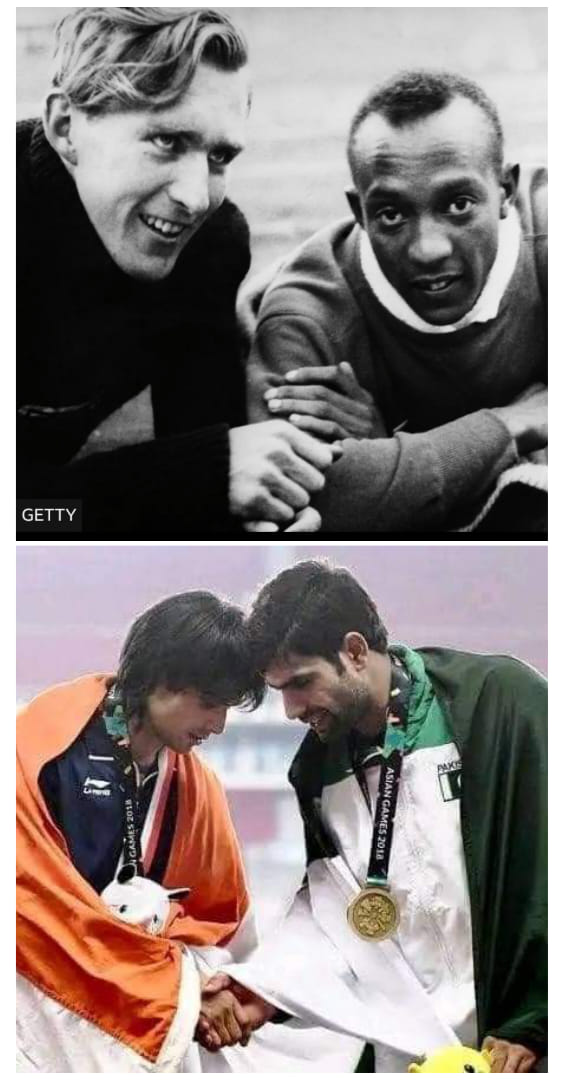
Neeraj Chopra and Arshad Nadeem's pic from 2018 Asian games, who later went on to create OR (Olympic record) and PR (Personal Record)  in Olympics  2024 Paris reminded me of Luz Long and Jesse Owens  form 1936 Berlin Olympics. 

There is a gap of 88 years between the photographs. But the message remains the same. Hatred and bigotry has no role in sports.

1936 Berlin Olympics would be the only time Owens and Long would compete against each other.

Owens and Long, both born in 1913, were at the peak of their athletic powers when they locked horns in Berlin. But that is where the similarities ended; their beginnings and journeys to the Games were polar opposites.

A 20th-century icon, Owens' story has been widely told. He was the grandson of former slaves and the youngest of 10 children in a family of Alabama tenant farmers.

At Berlin Olympics, during the time of Hitler, Luz and Owens became friends amidst the game, and it is even said that Luz supported Owens in winning the gold and he was happy for his friend. 

Owens went on to add the 200m and 4x100m titles to his wins in the 100m and long jump and would take home four gold medals from the German capital.

But he angered authorities by refusing to compete in a meeting in Sweden immediately after the Games, instead returning home to take advantage of his new-found fame and a clutch of commercial opportunities.

The decision would result in Owens being banned from competing by the American Athletic Union - effectively ending his sporting career.

Owens was still given a hero's welcome in a special homecoming ceremony in New York, but an incident at a party thrown in his honour at the Waldorf Astoria proved that despite his Olympic glory, nothing had changed.

On arriving at the hotel, Owens was directed away from the lobby by a doorman to a side entrance he was told was for tradesmen and black people.

Long left Berlin as Olympic silver-medallist, national champion and European long-jump record holder.

He would go on to extend that mark to 7.90m the following year - a record that stood until 1956.

But he could not escape scrutiny or suspicion.

Long did not compete again after the outbreak of World War Two, instead focusing on his career as a lawyer.

Heinrich, his youngest brother, was killed in action. Devastated by the loss, Long attempted to plot a course through the war for his own family.

He married Gisela in 1941, and they had a son - Julia's father - in November of that year, naming him Kai Heinrich, after his lost brother.

By then, Long had been drafted into the military, initially carrying out duties away from the frontline.

However, in 1943 Long was shipped out to Sicily with the 10th Battery Parachute Anti-Aircraft Regiment. A month later, he would send his final letter home to Gisela, who, by this time, was heavily pregnant with their second son, Wolfgang Matthias.

Gisela received notification on 30 July that her husband was missing in action, presumed dead. It was only after another seven years that the details were confirmed and his grave, in the German section of honour at the American military cemetery in Gela, was found.

One widely repeated myth involves a vivid letter supposedly written by Long to Owens from the "dry sand and wet blood" of north Africa. It calls on Owens to return to Germany to find his son if Long fails to make it home.

One of the lines reads: "Tell him, Jesse, what times were like when we not separated by war, tell him how things can be between men on this earth."

Unbearably poignant, but almost certainly untrue.

Long never served in north Africa. Neither family have seen such a letter and both question the likelihood and logistics of it being written and delivered.

Both their grand children now share especial bonds. 

Fast forward to some 80 years later...
Hitler was promoting Aryanism when Jesse Owens happened! History is repeating!  


Like brothers we now have Arshad Nadeem and Neeraj Chopra . One from Pakistan. Other from India. A motherland divided in 1947 into two countries which are now at loggerheads. 

Arshad Nadeem was spectacular with an Olympics record of 92.97m & another monster throw at 91.79m. 

Arshad Nadeem was Born to a mason in Khanewal, Punjab. He Underwent training in his backyard. Villagers used to donate money for his competition expenses across the world
He had no assistance from Government of Pakistan for Tokyo Olympics and no major sponsorships recently. He requested on Social Media to replace his Old Javelin
Finally, smashes the Olympic Record and is an Olympic Champion.


Neeraj narrative is of dominance and assertion, of winning and achievement. It is positive rather than negative, overtly national as opposed to the covertly anti-national. Neeraj is India’s answer to questions posed at us, a retort to every kind of probing in the sporting realm. Of consistency, and working under pressure. His parents were agriculturalists in Haryana. He enrolled himself in a gymnasium in Panipat after locals teased him about his obesity. While training there, he saw few javelin throwers practicing at the nearby Shivaji stadium and took up the sport and started his training in 2010. 

With the weight of expectations on his shoulders, Neeraj Chopra channelled strength to leap beyond the pressure and bring home silver. A true warrior's spirit! He is from Indian Military. 

Pressure of a billion plus fans every time he has walked in to throw the last few years and an ordinary Olympic campaign forcing him to carry the burden almost alone. No sporting great has overcome so many challenges. The pressure of a billion plus, performing at a Games where a loss is similar to a criminal conviction with a billion sitting in judgment. Neeraj plays a passion and one that drives the world’s most populous nation. 


Now we have social media, and world can see and read what is happening, indeed true 

If mothers ran the world, this world would be safe and sweet place to live in. This is what their mothers said after the match:

Arshad Nadeem's mother: "Neeraj Chopra is like a son to me. I prayed for him too."

Neeraj Chopra's mother: "We're happy with silver. The one who won gold (Arshad Nadeem) is also my child."


What does it teach? Not just grace, humility, respect and peace but also that:

  • One need to focus on hard work and not the result, give the best and be content.
  • Your competitors effort is just as important as yours. Be graceful. 
  • Do your best and be happy with your performance.
  • We are all siblings. 

May the bond of friendship and understanding build countries. 

And the news after:


Wednesday, August 07, 2024

Left to Tell ~ Immaculée Ilibagiza & Steve Erwin (80 of 2024)


"Left to Tell: Discovering God Amidst the Rwandan Holocaust" by Immaculée Ilibagiza is a profoundly moving and inspirational memoir that recounts the author's harrowing experiences during the Rwandan genocide. Immaculée's storytelling captures the unimaginable horrors of the genocide while also offering a message of faith, hope, and forgiveness.

Immaculee Ilibagiza grew up in a country she loved, surrounded by a family she cherished. But in 1994 her idyllic world was ripped apart as Rwanda descended into a bloody genocide. Immaculee's family was brutally murdered during a killing spree that lasted three months and claimed the lives of nearly a million Rwandans. Incredibly, Immaculee survived the slaughter. For 91 days, she and seven other women huddled silently together in the cramped bathroom of a local pastor while hundreds of machete-wielding killers hunted for them. The triumphant story of this remarkable young woman's journey through the darkness of genocide will inspire anyone whose life has been touched by fear, suffering, and loss.

The narrative follows Immaculée's journey from a peaceful and loving childhood to the devastating events of the 1994 Rwandan genocide. The author's ability to convey the intense emotions and challenges she faced during those dark times is both gripping and heart-wrenching. Her survival, both physically and spiritually, becomes a testament to the resilience of the human spirit.

What sets "Left to Tell" apart is Immaculée's profound spiritual transformation amidst the horrors she witnesses. The book explores how faith and prayer became essential tools for survival and healing during the darkest moments of her life. Immaculée's discovery of God's presence amid such profound suffering adds a powerful layer to the narrative.

The themes of forgiveness and reconciliation are also central to the book. Immaculée's ability to forgive those who committed unspeakable atrocities demonstrates an extraordinary strength of character. Her journey towards forgiveness, despite the unimaginable pain she endured, serves as a powerful example for readers grappling with their understanding of humanity and forgiveness.

The writing style is straightforward yet deeply evocative, allowing readers to connect with Immaculée's experiences on a personal level. The memoir not only serves as a historical account of the Rwandan genocide but also imparts important lessons about the human capacity for cruelty and, ultimately, the healing power of forgiveness.

In conclusion, "Left to Tell" is a powerful and thought-provoking memoir that goes beyond recounting historical events. Immaculée Ilibagiza's resilience, faith, and capacity for forgiveness make this book a testament to the strength of the human spirit in the face of unimaginable adversity. It is a must-read for those seeking stories of hope and healing in the aftermath of profound tragedy.

Rwanda was assigned to Germany during the Berlin Conference of 1884. Belgian forces then took over the country after World War I. In the early 1930s, Belgium introduced a system that could have sown the earliest seeds of a permanent division by classifying the population into three ethno-racial groups - the Hutu that formed most of the population (84 %), the Tutsi (15%) and the Twa (1%). Compulsory identity cards were issued that specifically called out the ethnicity that each citizen belonged to. Tutsis though lesser in number were considered the elite and resentment against them by the Hutus grew as years went by. This was further abetted by the Belgian administration and the Catholic Church. Rumors of killing of Dominique Mbonyumutwa, a Hutu sub-chief in 1959 marked the beginning of the Rwandan Revolution. A Hutu dominated republic was created and the country gained independence from Belgium in 1962. This in turn led to a mass exodus of Tutsis to neighboring countries including Congo. They began agitations to return to their homeland immediately. However, most of them remained in exile for the next three decades.


The Rwandan Patriotic Front was formed in the 1980’s, and the first attempt at an attack on Rwanda was made in October 1990. It was under the leadership of Paul Kagame that the RPF gained more strength and started a guerilla style war. The next four years followed with peace negotiations and occasional wars. Meanwhile, the Hutu gained more power in the country and there were sporadic incidents of killing of those Tutsis that remained in the country. The assassination of the then Rwandan President Juvénal Habyarimana on 6th April 1994 ignited the fire of the horrendous genocide that lasted for four months. Almost a million Tutsis were supposed to have been killed in the most heinous manner during this time. The post primitive of weapons like machetes, clubs and other blunt objects were used against them.

 “What can I do? What can I say?” asks Kiki as the play begins.

Odile Gakire Katese, popularly known as Kiki is a Rwandan playwright, director and cultural entrepreneur who has worked extensively to record the lives of those that were killed during the Rwandan genocide of 1994. As people walk into the theater and take their seats, she is seen seated on a chair thinking, scribbling something on a notepad now and then, tearing off the pages one after another, crumpling it and throwing it on the ground. Eight women walk in, dressed in bright blue, their hair braided in bright pink, blue and orange.  They seat themselves behind their drums, four on each side. They are members of Ingoma Nshya, the Women Drummers of Rwanda.

Kiki’s parents had fled to Congo in the 1960’s and she was born there in 1976. She first returned to Rwanda twenty years later. She didn’t know the country or its language. The only thing she knew was that almost two third of her tribe was killed. Who were they, how did they look like, what was their story were the questions she started asking. In an interview to intermission magazine before the world premiere of her play in 2019 she says,

“It’s important to remind people that before they were killed, they were people. If we only remember how they died, the attention is not put on the victim, it’s put on the perpetrator. It’s important that we archive life.”

It was this quest for life that led her to letter writing as a form of healing for victims and their relatives as well as the perpetrators. She travelled across rehabilitation centers, coaxing people to write letters to dead husbands, brothers, sisters, parents, aunts, uncles, grandparents and friends who were killed or tortured. The perpetrators were asked to write to their victims. As in any other war-torn area, women were traumatized the most. Almost half a million of them were subjected to sexual violation and mutilation. Forget about writing it down, they couldn’t even bring themselves to talk about it. The shame was too deep.

Kiki asks,

“Why do we find it so difficult to write our stories down? Is it because once written, we will not be able to change it? Or is it that we were all perpetrators, and victims at some point in time?”

She brings in an adaptation of a Cherokee folklore ‘Grandmother Spider steals the Sun’ to carry the performance forward. Each letter, every snippet of the story and her interceding commentary is accompanied by the haunting, powerful songs and drumbeats by the women.

A perpetrator asks his victim, “What can I say?”

A grown man asks his younger brother, “Why did you run away from me? You said you can out run them. I heard the man who broke your back say at the trial that you looked straight at his eyes and said, ‘my brother will find and kill you.’ Where are you now, how are you?”

A killer’s daughter asks him, “Did you really kill those people?” He denies it. The daughter goes to the trial to know the truth. Seeing her there he doesn’t say a word. He is ashamed. She finally goes in disguise and her father admits to what he did. Kiki asks here what she thinks of him now. “He was a bad man,” she responds.

A daughter asks her father, “Why did you leave the house that day? Do you still think of me?”

Kiki talks about the family that she doesn’t know about. Her father didn’t know who his father was. His mother and a sister of his were the only ones that had reached Congo. Her father would never talk about the other members of his family. For Kiki it had been a huge void in her life. “Whose incisors have I inherited? Who gave me my freckles?” she had always wondered.

“How do we undo the un-undo-able? We let them live again.”

While entering the hall, each of us were given a piece of paper and a pencil. Kiki asks us, “Each of you, please draw a picture of your grandfather for me. I am searching for mine. I will select one of yours and take him with me.” She selects one that said, “You can have my grandpapa.” The background on the stage also serves as a screen for kind of a shadow puppetry where the letters, pictures of the people that wrote them or whom they wrote about are shown. We are shown the various grandfathers that she has collected from across the world. While we are trying to draw our grandfathers, the women drummers give a thundering performance that elicits a standing ovation.

In 2004 Kiki created Ingoma Nshya - New Drum or New Power breaking free from a centuries old tradition of forbidding women from drumming. “Drumming is a mark of respect to the King, performed only by a few selected men. It denotes power. That is wanted I wanted for these women who were left powerless. Many were reluctant to join at first. Music and drumming gave them the power of healing, of joy.”

She adds as an aside, “Men have whispered in my ears that there is a sexual connotation to drumming. It needs sticks and only men have it. Well, we have bigger ones is what I told them. Ha!”

Their bodies sway to the beats, they jump high in joy, the power in their hearts flows through their arms onto the handmade drums. Are drums the primal modes of conveying emotions, of communicating beyond language, I wonder. The rhythm takes me back home, to our chenda melam and the Tamil dabban kuthu. How is it that folk music sounds similar across the world? The voice and tone of the singers, the nuances of their tunes, seem to be the same. Music and dance, the most powerful healer. For these women, the trauma of the genocide is being drummed away slowly but surely.

How a certain a minority race was targeted by a majority, how radio was used to instill fear and to spread mass propaganda, how neighbours and even family that knew you since the day you were born turn against you and kill you, how the genocide was planned meticulously over the years, is chilling. The similarities to what happened during the partition of our country and what we see all around today is scary. What is heartening in this case though is how a country and its rulers decided to heal themselves. As for whether it will last and for how long, Kiki says, ‘We can only hope.”

Inhabitants of  Rwanda

The earliest inhabitants of what is now Rwanda were the Twa, a group of aboriginal pygmy hunter-gatherers who settled in the area between 8000 BC and 3000 BC and remain in Rwanda today. Between 700 BC and 1500 AD, a number of Bantu groups migrated into Rwanda, and began to clear forest land for agriculture. Historians have several theories regarding the nature of the Bantu migrations: one theory is that the first settlers were Hutu, while the Tutsi migrated later and formed a distinct racial group, possibly of Cushitic origin. An alternative theory is that the migration was slow and steady from neighbouring regions, with incoming groups bearing high genetic similarity to the established ones, and integrating into rather than conquering the existing society. Under this theory, the Hutu and Tutsi distinction arose later and was not a racial one, but principally a class or caste distinction in which the Tutsi herded cattle while the Hutu farmed the land. The Hutu, Tutsi and Twa of Rwanda share a common language and are collectively known as the Banyarwanda.

The population coalesced, first into clans (ubwoko), and then, by 1700, into around eight kingdoms. The Kingdom of Rwanda, ruled by the Tutsi Nyiginya clan, became the dominant kingdom from the mid-eighteenth century, expanding through a process of conquest and assimilation, and achieving its greatest extent under the reign of King Kigeli Rwabugiri in 1853–1895. Rwabugiri expanded the kingdom west and north, and initiated administrative reforms which caused a rift to grow between the Hutu and Tutsi populations.These included uburetwa, a system of forced labour which Hutu had to perform to regain access to land seized from them, and ubuhake, under which Tutsi patrons ceded cattle to Hutu or Tutsi clients in exchange for economic and personal service. Although Hutu and Tutsi were often treated differently, they shared the same language and culture, the same clan names, and the same customs; the symbols of kinship served as a unifying bond between them.

Rwanda and neighbouring Burundi were assigned to Germany by the Berlin Conference of 1884, and Germany established a presence in the country in 1897 with the formation of an alliance with the king. German policy was to rule the country through the Rwandan monarchy; this system had the added benefit of enabling colonization with small European troop numbers. The colonists favoured the Tutsi over the Hutu when assigning administrative roles, believing them to be migrants from Ethiopia and racially superior. The Rwandan king welcomed the Germans, using their military strength to widen his rule. Belgian forces took control of Rwanda and Burundi in 1917 during World War I, and from 1926 began a policy of more direct colonial rule. The Belgians modernised the Rwandan economy, but Tutsi supremacy remained, leaving the Hutu disenfranchised.

In the early 1930s, Belgium introduced a permanent division of the population by classifying Rwandans into three ethnic (ethno-racial) groups, with the Hutu representing about 84% of the population, the Tutsi about 15%, and the Twa about 1%. Compulsory identity cards were issued labeling (under the heading for "ethnicity and race") each individual as either Tutsi, Hutu, Twa, or Naturalised. While it had previously been possible for particularly wealthy Hutus to become honorary Tutsis, the identity cards prevented any further movement between the groups and made socio-economic groups into rigid ethnic groups.

The ethnic identities of the Hutu and Tutsi were reshaped and mythologized by the colonizers. Christian missionaries in Rwanda promoted the theory about the "Hamitic" origins of the kingdom, and referred to the distinctively Ethiopian features and hence, foreign origins, of the Tutsi "caste". These mythologies provide the basis for anti-Tutsi propaganda in 1994.

The Year of the Runaways ~ Sunjeev Sahota (79 of 2024)

 Courtesy : Nandakishore Verma


The book is structured into four sections, which accord with the seasons, beginning in winter. In each section, we learn about a character’s backstory. The four main characters are South Asian immigrants seeking a new life in Yorkshire. Avtar and Randeep already live in a rundown, communal house. Tarlochan, or “Tochi,” moves in with them when he arrives in Yorkshire. Narinder, Randeep’s wife, already lives in the UK and marries Randeep so he can stay there.

Their biggest concern is an immigration raid, and what they’ll do if they’re caught. They try to stay under the radar, working in menial jobs, such as sewer maintenance and food service, so no one notices them. Their main fear is going back to the misery they left behind in India. We learn about each of their histories in turn through flashbacks.

India is a beautiful country if you are privileged (read upper-caste, rich and preferably male). Otherwise, it's a sewer pit. The only thing any right-thinking youth (who doesn't belong in the above-mentioned category) will want to do with respect to the country is get out as fast as possible, to one of those "phoren"* paradises like the USA, Canada or Western Europe.

But of course, the prosperity one imagines exists in those countries is also the province of the privileged - something one learns to one's disadvantage after the crossing is made. The grass is always greener on the other side.

This the tale of a handful of young men - two from Punjab and one from Bihar - who reach England, their promised land, only to see their dreams turn into nightmares. It is also the tale of a Sikh girl, a citizen of the UK, whose tale becomes unintentionally entwined with tales of these three runaways. It takes a while before the characters tell each other about their lives back home.

Tarlochan Kumar (Tochi) is a Chamaar from Bihar - one of the most vilified and victimised castes of India - who has come to England illegally to make money by hook or crook, to offset the disadvantages of birth. His whole family has been murdered by "upper" caste goons. Tochi,  watched his whole family die in a massacre, and he’s traumatized by the experience. He lost his pregnant sister, his brother, and his parents. Because he is a “chamaar,” or part of the lowest caste group in India, he struggled to survive back home and can’t face the thought of going back. He worked in a brick factory for two years before he had the money to come to England; he spends this time grieving his lost family. In Yorkshire, he works in a shop, but he lies about his caste so he can get the job. When the family that owns the shop finds him a girl to marry, he can’t, because he lied about his caste. He must leave the job when they find out, however, he gets another when he offers to work for less pay. Tochi ends up leaving the group home and living in a flat under Narinder’s. When Randeep goes missing before an immigration inspection, he helps Narinder look for him. They strike up a fond friendship and exchange thoughts on equality and the caste system. They understand each other better by the end of the book. However, all is not well for Tochi. Avtar steals from him to pay his debts, and Tochi attacks him. He leaves Avtar in a very bad way and goes to Spain to find work because he knows he can’t stay in England. Tochi later marries and has children. During the epilogue, Narinder sees him and his family watching a play, but she doesn’t disturb them. She’s comforted to know that Tochi found happiness.

Randeep Sanghera is a callow youth, whose comfortable middle class world has gone up in smoke because of his father's mental illness and an act of sexual indiscretion in college which gets him expelled. He is on a fake marriage visa provided by Narinder Kaur, a pious young Sikh woman who is determined to provide a life to at least one person through this personal sacrifice. He flunked college because he spent his time looking after his ill father, and then he was expelled for raping a classmate. He doesn’t live with Narinder, but he knows the flat well enough to pass immigration inspections. Narinder didn’t meet Randeep before marrying him; she left her fiancé so she could perform this duty. Randeep and Narinder grow closer and become friends as the novel progresses, no longer seeing each other simply out of circumstance. However, they never love each other romantically, and they divorce when they get the opportunity. Narinder later marries her previous fiancé and scatters her father’s ashes back home in India after he dies of a stroke. It’s not clear she and Randeep will remain friends, but there is no ill will between them. 

And finally, there is Avtar Singh Nijjar, who has sold a kidney and taken money from a loan shark to get to England on a student visa, to earn money and support his family at home as well as carve out a future for himself. He is in love with Randeep's sister. He worked as a train conductor and secretly dated Randeep’s sister, Lahkpreet. When Avtar lost his job after a car crash, he sells a kidney to get the money for a student visa in England. In Yorkshire, he struggles to find work and juggle job hunting with studying for exams. When he goes to London to sit his exams and retain his visa, street creditors find him and beat him up for not paying his loans back. Avtar later marries Lahkpreet when he returns to India. He finishes his student visa but can’t secure work, so he steals chickens with Randeep for money. They’re eventually traced by immigration officials, and although they escape, Avtar knows he can’t make his life in England if he wants to ever feel safe.

This is an essentially bleak tale, set in the twilight world of illegal immigrants who, as underpaid workers, support the economy of Britain. There are villains aplenty here in the shape of money-grubbing employers, but no heroes (except for Narinder, whose supremely innocent saccharine-sweet goody-goody nature is sometimes puke-inducing, to tell the truth). These young men fight, cheat and steal to keep body and soul together and to keep their dream of "Vilayat"** alive. But all said and done, they are not totally unlikeable, because in such circumstances, we feel that we would have also done the same.

The story is well-written, and once picked up, the book is hard to put down. But at some point of time, the reader feels that it could all have been condensed into a thinner volume. One does not have to read pages and pages about the hardships of the protagonists to appreciate the inhuman nature of the world out there. And the ending, when it comes, is surprisingly downbeat - it's as though the author said: "Enough! Let me stop this!", put down his pen, attached an epilogue, and send the manuscript on to the publishers.