Friday, June 13, 2025

Love louder. Tomorrow is never promised.


Whenever I hear of an accident, I feel guilty - because in the philosophy of  safety people, all accidents are preventable. So in a way, we are all collectively responsible.

We still don't know what happened with the Ahmedabad - Gatwick flight: but there was a lacuna somewhere - either with the flight, or with the way it was operated. There is no guarantee that a mistake would result in an accident. But when it does, it gives rise to such horrific incidents.

How do we spot these potentially dangerous mistakes? That's when something  safety people call "near miss" is a good indicator. A near miss is an error which could have resulted in an accident, but didn't. By identifying and logging near misses, we can foresee accidents.

Why mention this now? In the recent past, there have been many instances where Air India flights were delayed or cancelled due to engine trouble. There have been incidents where an airborne plane had to return to its origin or divert to a nearby airport due to technical glitches. We witnessed it during last May during our Calcutta trip. 

These were all near misses, showing that there is something that is seriously wrong with Air India's fleet. One wonders whether they were attentive enough. Or maybe, the pressures of meeting schedules forced them to run with a less-than-one-hundred-percent fit aircraft.

My heart goes out to the people who met their untimely ends, and to their grieving relatives. It's all the more distressing, knowing that maybe it could have been prevented.

🙏😞


Certainly this may be inaccurate in quoting planes. But anyone posting it is doing it unknowingly - because they are trying to make sense of suffering. There is too much of it in the world and news of war, ships and planes in sequence can be overwhelming. Due diligence of facts or reason can slip at times like these. We can be sensitive to that.

Especially to the young upcoming doctors who could never bloom.

 "When a flight is airborne, tragedy strikes without discrimination economy, business, first … it makes no difference. We’re all in the same sky, held by the same hope and the same fragility. Sometimes, we wear our privileges like a badge, forgetting that compassion is the only seat that truly matters.

I was deeply shaken yesterday by the heartbreaking Air India  tragedy. My heart aches for the lives lost, for the loved ones left behind, and for the crew who give their best every single day at 35,000 feet.


I’ve known that kindness personally."


There's a script which seems to be at play. Across twitter, Youtube etc.

This is being played out by Western "Pilots".

The script goes:

- I‘m an airline pilot with X,000hrs of experience


- The flaps are only slightly extended


- The landing gear is still extended, which should have been retracted at this altitude


- The aircraft is at a high angle of attack, which confirms the insufficient flap setting


- They combine the two to make it into a case for Pilot Error/ human error


- Erase possibility of Engine failure


- Erase any possibility of Boeing 787 having any issues.


- They all exclusively use only a single video, which was when the plane was about to crash.

What they conveniently don't address:

- The Mayday call from the pilot


- Sudden stop of all communication


- The fact that the plane was actually at an altitude of 400 ft relative to ground. Ahmedabad is at an altitude of 200 ft.


- The Plane seems to have no power and falls


- The complete take off video exists which depicts the whole take off. NO change in flaps are noticed. Thus negating the theory of 'withdrawing flaps' instead of under carriage.


- The Plane was recently 'refurbished' by a Turkish firm

This is orchestrated noise generation. There's no chance that so many voices start emanating the same script, given facts to the contrary was already out, without inducement, incentives and orchestration. Why?

The noise about Bird hit stopped as soon as the CCTV footage of complete take off was out.

I hope people are taking note. Both the choreography and the actors. They need to be tracked.


This incident teach us a lesson to be patient, when the delay is announced. There could be a serious issue and they trying to fix it instead of trying to be ontime.

So many stories. Only person saved was the one seated in 11A which is the option people least prefer in flight. The ex CM on Gujrat Vijay Rupanis all vehicle numbers were 1206.


Two granddaughters came to attend their grandmothers birthday 


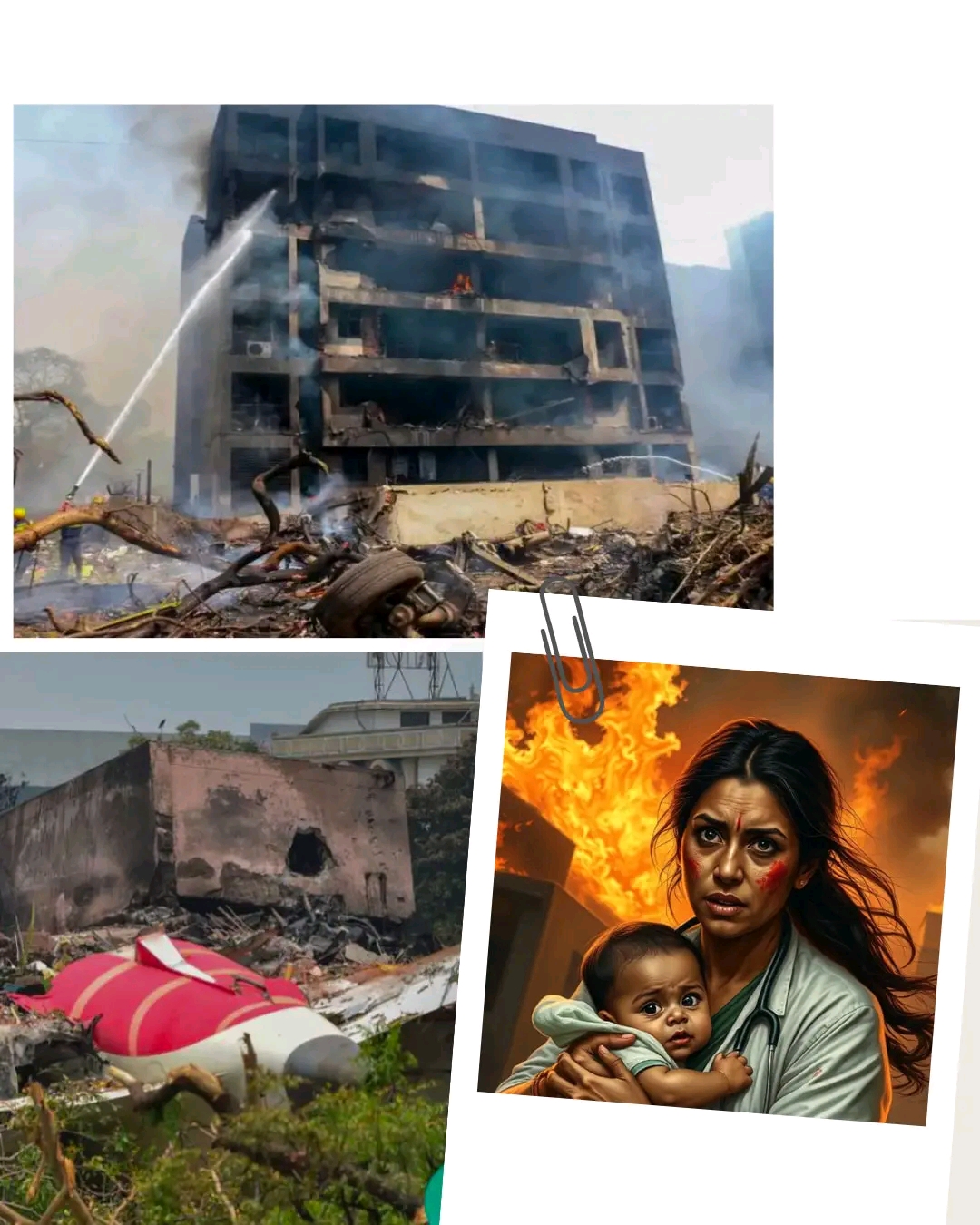
A Mother’s Bravery Amid Flames: Dr. Manisha & Baby Dhyaansh 👩‍👦

On the afternoon of June 12, 2025, when Air India Flight AI-171 crashed into the BJ Medical College hostel in Ahmedabad, chaos erupted. But within that chaos, one mother became a symbol of unimaginable courage.

Dr. Manisha, a homeopathy doctor, was inside the hostel room with her 8-month-old baby, Dhyaansh, when the aircraft tore through the building. The room caught fire almost instantly.

Without hesitation, Dr. Manisha shielded her son, grabbed him, and ran through flames and falling debris to escape the wreckage. Her body was severely burned, but she did not let go. Somehow — through smoke, screams, and chaos — she made it out, still holding baby Dhyaansh.

She was rushed to Civil Hospital Ahmedabad with burns on over 35% of her body. Her son, Dhyaansh, sustained approximately 25% burns and was admitted to the ICU at KD Hospital.

Their survival is nothing short of miraculous.

Her husband, Dr. Kapil, a urology student, has been by their side since the tragedy. He has described their survival as “a second life given by God,” and their medical community has rallied around them with prayers and donations to support the long road of recovery ahead.

This story is not just about tragedy — it is about the instinct of a mother, the power of love, and the bravery it takes to run into hell for your child.

May Dr. Manisha and baby Dhyaansh heal fully — may their scars become symbols of strength, not sorrow.

They remind us that even in the darkest moments, love fights back.

Disclaimer: This story is based on true events and verified sources. The accompanying image of a mother and child has been generated using AI to symbolically and respectfully represent the individuals involved. It is not an actual photograph of Dr. Manisha or baby Dhyaansh.


They weren't PASSENGER
They weren't CREW
They were STUDENT
FUTURE DOCTOR
Sitting in the mess HALL
Whhen the Sky came crashing down

They cleared NEET
One of the toughest exam in INDIA
HOURS,DAYS,YEARS of STUDY
Sacrificed sleep,outing,birthdays
All for a single white coat DREAM

Mybe they had 
half a plate of DAL in front of them
Maybe they were laughing with friends
Maybe they were just tired,hungry 
waiying for the next lecture.

In s3conds,an aircraft fell from the sky...
and with it
FELL FUTURE
FELL STORIES
that will never be told.

They didn't know it was coming
They didn't get a moment to run

Just one crash and silence
No warning fell from the sky

Just metal
Just FIRE
And in second
There tomorrow was gone

their parents prayed for the success
their siblings bragged
"MY BROTHERS BECOMING A DOCTOR"
 Today,their homes echo with a name
No longer answer3d
they were morethan roll numbers
morthan white coats in training

they were dream in motion taken too SOON...
THEY were hope,and that hope
was buried in rubble to deserve better

A white coat,not a white sheet
A stethoscope,not a statistic

well remember you
not as victim
But as WARRIORS
Who never got to fight.

REST WELL

          MEDICOS OF B.J. MEDICAL COLLEGE

You were meant to save lives
and in our hearts
 YOU ALWAYS WILL.


The FAA inspects foreign carriers to ensure they meet safety standards before being allowed to fly to the US. The FAA does this through its International Aviation Safety Assessment (IASA) program, which assesses the Civil Aviation Authority (CAA) of each country that has carriers operating to the US. 
Here's a more detailed explanation:
ICAO Standards:
The FAA uses International Civil Aviation Organization (ICAO) standards, established by the Chicago Convention, to determine if a country's CAA provides adequate oversight of its carriers. 
IASA Assessment:
The IASA program evaluates whether the foreign CAA meets these ICAO standards, ensuring they can effectively oversee their carriers' safety operations. 
Category 1 Rating:
If a CAA is assessed to meet ICAO standards, the FAA gives it a Category 1 rating. This means the airlines from that country can operate in the US and participate in code-share agreements with US carriers. 
DOT Involvement:
The Department of Transportation (DOT) also plays a role in this process. When a foreign airline applies for authority to operate in the US, the DOT provides the FAA with a copy of the application to ensure they are meeting safety standards. 
Hazardous Materials Inspections:
The FAA also conducts Hazardous Materials Aviation Safety Inspections (HMASI) on both US and foreign air carriers to ensure compliance with hazardous materials regulations. 
Foreign Air Carrier Security:
The FAA also has regulations and advisory circulars related to foreign air carrier security, including procedures for security checks and training for


A war within, and a war without…


242 human beings locked their seatbelt,
Locking their fate in a huge metal casket.

Cell Phones had hardly reached airplane mode,
Chewing gums had hardly pour its flavour down the throat.

Bags in the cargo were still rearranging themself,
The last minute entry proudly rested on the rest.


Some fed-up of waiting, nagged for take off,
Some scrolling the list of movies to watch.
Some trying to fit their earpods in place,
Some turning pages of the fancy air-shop.
Some taking selfies to post on Instagram,
Some making mind maps to shine and wear crowns.


A man in business class, stretched his legs,
Pressed the button meant to give him due rest.
A woman in the aisle, peeped through the lane,
while a toddler was staring through the window pane.
An old man waved goodbye to the departure gate,
When a teenager was fantasising about her fate.


A regular flyer, meanwhile, closed his eyes and slept ignoring all,
Ready to weave dreams in the lap of the swinging hall.

Tall buildings were supposed to be left behind, and belittle them giving drinkers high.
The runway was supposed to look mere a line, and disappear soon with the flying time.


The pilot started playing with his friendly knobs, 
Unaware of the monster waiting for the sobs.
Barely a minute, and his hands became tight, as his brain went into ‘fight or flight’
His long flying hours and intellect failed,
When destiny intervened and black clouds hailed.


When the Man-made toy drifted like a tide,
‘Mayday’ ‘Mayday’ ‘Mayday’...his heart cried.
Not only 242, but thousands of others were in his sight
God knows if it was craft or his heart that held him tight


One who loosened his seatbelt,
One who missed her flight,
One who was serving others and missed his meal
One whom destiny had removed from the scene
Among the remnants, these stand tall
Bhagvad Gita, an eternal piece, hulking over all.


It's a message to the Men of blue planet,
Their act is still small, and The Director is watching all.


Stay Humble. Stay aligned within and without.
Without your loved ones, without your losses,
Because GOD has plans for you, before you become ashes.

Dr. Sonal Gupta
Jai Shree Krishna🙏🏻


Seat 11A: Two Lives, One Miracle ✈️


In 1998, Thai singer Ruangsak Loychusak survived a devastating plane crash. Thai Airways flight TG261 went down in a swamp, claiming lives and leaving deep scars. Ruangsak made it out — shaken, haunted, and unable to fly again for ten years.


But fate wasn’t finished with seat 11A.


In 2025, after the tragic crash of Air India flight AI171, only one passenger emerged alive: Vishwash Kumar Ramesh. And where was he sitting?

Seat 11A.

The exact same place Ruangsak had occupied in his own brush with death.


When Ruangsak heard, he posted just a few words:

"Survivor of a plane crash in India. He sat in the same seat as me. 11A."

And then:

"My condolences to all those who lost."


No one can explain a coincidence like that. Two men, years apart, both surviving the impossible — from the same seat.


Sometimes, the universe whispers in numbers.

And sometimes, those whispers feel like miracles.


https://theheartysoul.com/a/cyqtzydlql/why-you-should-avoid-seat-11a/?fbclid=IwZXh0bgNhZW0CMTEAAR4iwplfXpSPujKPPCWo0lMNUFFRHpQjP1mKLnZdZVvgBp0XoPcWGJWkQKB56Q_aem_sJ3KdRnodTtYQUyptvnB9Q

Thursday, June 12, 2025

The Limits to Growth

 What is the LTG Report?

"The Limits to Growth" (LTG) is a pioneering environmental study published in 1972 by Donella Meadows, Dennis Meadows, Jørgen Randers, and William Behrens for the Club of Rome. It used computer modeling (World3 system) to simulate the long-term consequences of exponential economic and population growth with finite resource supplies.


Key Concepts from LTG

Finite Resources: The Earth has limits—food, minerals, water, and energy are not unlimited.


Exponential Growth: Human consumption and population have grown exponentially, putting pressure on natural systems.


Overshoot and Collapse: If growth continues unchecked, the system overshoots resource limits and may collapse.


Sustainability Scenarios: The report presents different pathways (business-as-usual, stabilized growth, and resource efficiency) and their effects on population, pollution, and industry.


🧩 Conceptual Diagram – World3 Model (LTG System)

Here’s a simplified visual description of the World3 model (used in the LTG report):


        +-----------------------+

        |    Natural Resources |

        +-----------------------+

                   |

                   v

        +-----------------------+

        |   Industrial Output   |

        +-----------------------+

         |       ^       |

         v       |       v

  +-------------+|  +--------------+

  | Food Output ||  | Pollution    |

  +-------------+|  +--------------+

         |       |

         v       |

     +----------------+     

     | Population     |<----------------------+

     +----------------+                      |

         ^     |                             |

         |     v                             |

  +-----------------------+          +-----------------+

  | Capital Investment in |          | Life Expectancy |

  |   Agriculture & Health|          +-----------------+

  +-----------------------+

🔁 Key Interactions:

Population increases → more food & industrial demand.


More output → more pollution & faster depletion of resources.


Eventually → strain on the environment leads to reduced growth & well-being.


📈 LTG's Future Scenarios

Business-as-usual: Leads to overshoot and collapse (resource depletion and pollution).


Stabilized world: Requires significant policy change, reduced consumption, and technology use.


Technological optimism: Not enough alone unless paired with policy and behavioral change.


📚 Want the Full Report?

The original 1972 report and its follow-ups (Beyond the Limits, Limits to Growth: The 30-Year Update, 2052) are available as books and some PDFs are available online through academic repositories.

https://ltgplc.com/investor-information/ltg-results-reports-presentations/


The New Education Policy (NEP) 2020

 The New Education Policy (NEP) 2020 is a landmark reform introduced by the Government of India to transform the Indian education system. It replaced the 34-year-old National Policy on Education (1986) and aims to make education more holistic, flexible, multilingual, and skill-oriented to meet the demands of the 21st century.


🧾 What is the New Education Policy (NEP) 2020?

🔑 Key Features:

New School Structure:


Replaces the 10+2 structure with 5+3+3+4 (Foundational, Preparatory, Middle, Secondary).


Focuses on Early Childhood Care and Education (ECCE).


Language and Multilingualism:


Promotes mother tongue/regional language as the medium of instruction till Grade 5 or 8.


Encourages three-language formula.


Holistic Curriculum:


Integration of arts, sports, coding, and vocational subjects from an early age.


Focus on conceptual understanding, not rote learning.


Assessment Reforms:


Shift from high-stakes board exams to continuous and competency-based evaluation.


Introduction of National Assessment Centre (PARAKH).


Higher Education Overhaul:


Multidisciplinary approach (e.g., arts + science combinations).


Four-year undergraduate programs, with multiple exit options.


Plans to reduce affiliating colleges and set up Higher Education Institutions (HEIs) as autonomous and research-focused.


National Education Technology Forum (NETF):


Promotes the integration of digital tools, AI, and EdTech in classrooms.


Establishment of National Curriculum Framework (NCF):


For school, teacher, and adult education.


Teacher Training:


Introduction of a 4-year integrated B.Ed. degree as mandatory by 2030.


✅ How Has It Helped So Far?

💡 Early Positive Impacts:

Curriculum changes have begun in some CBSE and state boards, including foundational literacy and numeracy missions (like NIPUN Bharat).


Many universities have adopted the multi-entry, multi-exit flexibility in UG programs.


Vocational education pilots are running in several states.


Initiatives like DIKSHA, SWAYAM, and eVidya have boosted digital learning.


National efforts have begun to translate textbooks into Indian languages through schemes like the Bharatiya Bhasha Pustak Scheme.


🔮 What Changes Could It Bring in the Future?

🚀 Potential Transformations:

Reduced Academic Pressure: Exams will focus on understanding rather than memory.


Better Career Flexibility: Students can explore and combine subjects across streams.


Stronger Regional Representation: Learning in local languages can improve early education.


Skilled Workforce: With vocational training and internships from school itself.


Global-Standard Higher Education: Indian institutions may rise in global rankings with multidisciplinary and research-focused models.


Tech-Integrated Learning: Classrooms may become more engaging with AI, gamification, and digital content.


Boost to Indian Knowledge Systems: Sanskrit, classical arts, Indian philosophy, and regional histories will get more focus.


🧭 Challenges to Watch:

Implementation varies across states due to language and infrastructure gaps.


Teacher training and mindset change are essential for real impact.


Monitoring quality and uniformity in public vs private schools remains a concern.


📝 In Summary:

The New Education Policy 2020 is a bold and comprehensive plan to redefine how education works in India—from kindergarten to PhD. It has already begun shaping curricula, assessments, and learning environments, and promises a future that is more inclusive, practical, and student-focused.


Transformative Reforms In Higher Education: NEP

 Transformation begins by participation 

https://www.youtube.com/@IFHEofficial/streams

Session 1: https://www.youtube.com/watch?v=zqUH0FkCMPA


 Professor Sitaram - Chief Guest. 

Two -Day International Conference on Transformative Reforms In Higher Education. Organised by IFHE Hyderabad

1) Professor B.J. Rao - chairman AICTE: Vice Chancellor, University of Hyderabad. 

Professor Rangarajan could not come. 

IFHE's achievements. 

5th year of NEP

Welcome

Wisdome.

2) Strategy - L S Ganesh - Vice Chancellor - ICFAI foundation of higher education   - Movement in academy. 

Critical points to implement success of NEP:

1. No Limit to Growth

The Limits to Growth (LTG) is a 1972 report: The model was based on the work of Jay Forrester of MIT

X axis as today , tomorrow, ....so on till  next millineum. 

Y axis start with me, my family.....till you reach enternality

Limits to growth : Professor

People say me now or me today, but this perception is very important. 

2. Concept of Synergy 

Leander paes and Mahesh Bhupati, individual ranks, behind but together No.1

Biggest block is our ego. 

3. Degree in Philosophy is the greatest degree. 


3) Online: Lt. Gen. (Dr.)M.D. Venkateshan: Doctor, Army, Academics

from 41 minutes - was not clear, so could not understand. 


at 1:04 Thank you very much and Jai Hind

4) Visionary, Scholar, Prof. Dr. T. G. Sitharam, Chairman, AICTE - Chief Guest


The Engineer , The Academician and The Leader who never forgot his rules

Implementation of NEP 2020, to deliberate on Best Practice. 

Make it not just aspirational but operational reality. 

It is not a reform but transformative vision document of 63 pages, to reimagine.

Equity, quality, accountability and affordability. 

Freedom to choose where young mind to flow, Skill deep and vast. 

Quote by Hon. PM. "Skill, Reskill, Hiskill"

Paradigm shift : Focus on self learning, technology assisted learning and collaborative learning. 

Fragmented to integrated governance. 

Central theme: Flexibility, life long learning. 

Multiligulisam, inclusivity. 

15 days back, first graduates of computer science in Marathi. 

This enhances the accessibility to students. 

Level 4.5 to 8, NE Technology programme. 

Internationalisation - Venkatesh - India to become Global Hub of Education. 

Wholistic, Inclusive and Technology enabled. 

Direct Impact is seen in students enrollment. 

4.5 crore students in higher education with female 43%; 60% increase in universities. 

16 IITs now today 23, 13 to 21 in IIM's.

26k crores to 30k crores invest in Education. 

Stronger Industry academic collaboration. 

Today we are the 3rd largest start up in the world. 

One nation - One Subscribtion. : Unique program by Govt. of India. 

Bharathya Basha Pustak Scheme. The Bharatiya Bhasha Pustak Scheme is a Government of India initiative, introduced in the Union Budget 2025–26 by Finance Minister Nirmala Sitharaman . The scheme is implemented under the Ministry of Education, in alignment with NEP 2020, and coordinated through bodies like the University Grants Commission (UGC) and the Bharatiya Bhasha Samiti (a committee within the Ministry) 

The scheme is brought out by the central government, spearheaded by the Ministry of Education, with key implementation roles taken on by the UGC and Bharatiya Bhasha Samiti.

Time for collaboration. For easier transformation. You should be able to take courses from anywhere. 

Faculty training is important. 

Success of NEP on the impact it generates, the entrepreneurs it make .

It gives us a compass. 

Education is about Enlightenment. Employability is a key aspect. 

AICTE, CII, Niti Ayog. 8 crore MSME's are there in India. 

Our Engineers are there in every country of the world. 

We have redefined Literacy, anybody, can do a digital signature and enter into transactions. 

Vikasit Bharat by 2047. 

World of disruption, education is not mandatory but needed. 

Civil engineer - PWD, Electrical Engineer - KSEB Once upon a time. But no more. 

Empower board of studies. Make campuses inclusive. 

Let's work together!

Education system, not only the best in the world. But the best.  Already we are. 

5) Release the conference material. 

6) Dr. Sanjeev: Vote of Thanks

Inaugural program concluded for the two day conference. 


Day 1: Afternoon: Values


Panalist: B Jagadishrao. Vice chancellor from University of Hyderabad.


Day 1 -12 th June noon session summary 

Summary: Reflections on Indian Higher Education and Indian Knowledge Systems

The discussion centers on the relevance, challenges, and potential of Indian wisdom and education systems in the modern context. It emphasizes the need to revisit and rejuvenate traditional Indian knowledge frameworks to address contemporary educational and societal challenges.

Key Themes:

Indian Wisdom as a Global Template:

Ancient Indian civilization posed fundamental questions about existence and consciousness, offering deep philosophical insights through texts like the Vedas and Upanishads.

The Gurukula system emphasized experiential learning, observation, and spiritual growth, contrasting with today’s transactional education models.

Challenges of Scale and Access:

With a large youth population, India faces the challenge of delivering quality education at scale.

Online education is expanding but its effectiveness remains uncertain.

There is a risk of the demographic dividend turning into a liability if education doesn't reach all effectively.

Need for Intellectual Independence:

Despite political and economic independence, intellectual decolonization is still incomplete.

Creativity and innovation are often stifled by rigid, top-down educational structures and cultural hierarchies.

A mindset shift is needed to foster openness, inquiry, and self-confidence.

Integrating Indian Knowledge with Modern Science:

Indian knowledge systems are philosophical, not mystical, and can complement modern science and technology.

Education should help students discover their innate capabilities, not just prepare them for technical careers.

Real-world problems in India require context-specific scientific approaches, which can enrich global science.

The Role of Technology and AI:

The rise of AI introduces a new paradigm where machines may dominate content creation.

There is a need to preserve and promote original human thought and creativity.

Indian philosophical frameworks can offer balance and ethical grounding in this technological age.

Call for Reflection and Reorientation:

The current education model prioritizes wealth and technology over values and purpose.

A cultural shift is needed to integrate Indian knowledge systems into daily life—at home, in schools, and in society.

Individuals must pause, reflect, and align their actions with deeper values for personal and societal well-being.


Day 2: 13th June 2025

https://www.youtube.com/watch?v=zB8lzf3WB1k

Prof B.S Murthy

Standing on the shoulders who have come before us, we are able to see far ahead. Attribute everything achieved to the people who I have been able to associate with.  That is how teachers are born.  God, Ramarao and Rangarajan are Guru's/Mentors. 

You become what you believe in. 

Keep reading. 

Good student should have 3 things:

  1. Have fire in your belly, not just for a job. Be in a place where you are happy. Freedom should not have price tags. 
  2. You should be able to go to bed, thinking about the problems you have solved during the day.
  3. Catch hold of an youngster and excite them about your results. You should be able to drive others with your excitements
Be passionate about what you do.

Have your country above any other. Have a desire that our country should be the best. Example Growth of Japan comes from Passion. 

Focus on your studies. Get as many credits as possible. 

5 year plans. - Plan change adoption. 

Whatever you do, be the best in that. 

Let children do what they want and be the best in that. 

Parents should not force children to do what they want. 

Flexibility and freedom are important. 

We need to provide all facilities to our students for their growth. Provide opportunity for innovation. 

Speaks about different programs offered by IIT, batches and courses including PHD. 

What is the quality of a good teacher? - Being a student always. 

When you are in a class, looking at students face you get to know if you are a good teacher or not. 

It is easy to complain and put the ball in another's court and complain. 

Ajai Chowdhary book Just Aspire 'A is much stronger than R' - A is aspiration, R is resources

Growth is not in academia, industry , it must come from within. 

Nothing succeeds like success. 

International Collaboration

Less than 10% today go for PHD, unlike before where many more were interested. 

Bring flexibility to your programs. 

M.Tec You choose what you want to do. 

CS graduates, create experts in the area . - Computational Engineering. - Inter disciplinary program. 

Murthy - packaging for Semi Conductor packaging. 

Freedom is there, you have to take it. Nobody will give it.


Dr . Venugopal Rao


Tuesday, June 10, 2025

Fredrick Forsyth passes away

 Fredrick Forsyth passes away. The 'Jackal' is no more. Called back at 87.


Sad news 😢

The best of his books - The Day of the Jackal.

Edward Fox was perfect as the assassin.

Ken Follett's The Eye of the Needle is his best.

 Donald Sutherland was the sharpest of Needles.

 One of his best books was The Shepherd.

A novella which  did not fit into the definition of a thriller but was so engrossing

Loved The Odessa File and The Dogs of War the most. Didn't read his most famous The Day of the Jackal. There was a precision to his writing that many similar writers lacked. His detailed description of operation strategies are more thrilling to read than his description of actual action. His protagonists also have unique anti-hero tendencies that make them more three dimensional.

The day of the jackal and the Odessa file took the world by storm...were made into equally good movies.

The cover of the Odessa File was simply too good.

The SS was highlighted  and gave a unique look

BBC News - Frederick Forsyth: Life as a thriller writer, fighter pilot, journalist and spy 

https://www.bbc.com/news/articles/cley59le6d8o

 https://www.theguardian.com/books/2025/jun/09/frederick-forsyth-day-of-the-jackal-author-and-former-mi6-agent-dies-aged-86?CMP=Share_iOSApp_Other


In "The Day of the Jackal," the elusive assassin, known only as "The Jackal," is rumored to have been involved in the assassination of Rafael Trujillo, the dictator of the Dominican Republic. Specifically, a rumor circulated by a Secret Intelligence Service officer suggests that The Jackal might have stopped Trujillo's car with a rifle shot, allowing a group of partisans to finish him off. While this is a rumor within the novel and not a confirmed fact, it's a significant piece of the Jackal's alleged background and helps establish him as a dangerous and capable assassin.


This may be a fact as the Algerian dissidents where searching the market for the best assassin in the world to kill de gaulle.though devils alternative & fourth protocol are not discussed like day of the jackal they are equally good .in devils alternative written in the 80’s Forsyth brings in Ukrainian dissidents as main protagonists much before Ukraine became a separate state.fourth protocol brings in a chilling scenario of Britain being taken over by Soviet Union under Andropov.the idea is put forth by former British spy Kim philby.fist of god is about a British agent sabotaging Saddam Hussein’s master plot.only Forsyth has written thrillers based on such varied political subjects.he has written dogs of war after participating in a coup attempt in Equatorial Guinea.there won’t be anyone like him in our generation


Cochin City described


*Cochin City described*:

1.  *Fort Kochi*

So artsy and hip that even the mosquitoes there wear linen shirts and sip on cold brew. Locals walk like they're in a Wes Anderson film, and tourists act like they discovered it first.

2.  *Kakkanad*

Where everyone claims to work in IT but nobody can explain what exactly they do. And the traffic? Enough to make you question your life choices... while aging visibly in the auto queue.

3.  *Edappally*

The place where Lulu Mall is the only personality trait. You came for groceries and left 3 hours later with a sofa, a piercing, and an existential crisis.

4.  *Panampilly Nagar*

Every building is a café. Even the dog grooming center has latte art. Everyone here dresses like they're attending Milan Fashion Week, even if they're just buying milk.

5.  *Aluva*

Only known for the airport and river. If you tell someone you're from Aluva, they immediately ask how close you live to the airport. That's your entire identity.

6.  *Kaloor*

Has a stadium, but good luck finding a match that starts on time or finding parking without developing high blood pressure.

7.  *Vytilla*

Basically the Bermuda Triangle of Cochin traffic.

Once you enter the Vytilla junction, you never come out the same.

8.  *Thevara*

Feels like someone tried to make it posh but got distracted halfway. One side has mansions, the other side has potholes deeper than your ex's emotional issues.

9.  *Tripunithura*

Still living in its royal past. Residents act like they have a personal connection with the Kochi Maharaja, even if their current kingdom is a 2BHK with peeling paint.

10.  *Marine Drive*

The official hangout spot for couples who think holding hands in public is rebellion. Also, where dreams of early morning walks go to die due to the stink of the backwaters.


Ancient Churches from Kochi ~ John Alexander

 There are 8 churches in Kerala which tradition says, were built by Apostle St Thomas between 52 ( he landed in Muziris) and 63 AD, before he left for Madras ..taking the land route via Keezhadi, near Madurai. He was killed in 73 AD on St Thomas Mount and buried I'm San Thome church.

After Vasco da Gama landed at Calicut in 1498, the Portuguese etc established themselves at Cochin, Goa (They gave Bombay to England's Charles II, as dowry for Catherine of Braganza) Though they lost control.of Cochin to the Dutch in 1663, they retained Goa, Daman, Diu.


Church built by Apostle Thomas, 60 AD.


Basilica at Valarpadam (1524)


St Francis Church, Fort Cochin and (below) tomb of Vasco da Gama


Bom Jesus Basilica, Goa, consecrated 1605, contains body of St Francis Xavier.


Monday, June 09, 2025

Aparan and Radha Madhavam


Watched two malayalam movies this weekend:

Aparan (1988) Directed by: P. Padmarajan Starring: Jayaram, Shobana, Parvathy, Madhu


It was Jayaram's debut movie. 

Padmarajan’s “Aparan” is a haunting psychological thriller that explores the theme of identity, fate, and societal perception. Jayaram, in his debut role, plays both the innocent K. Vishwanathan and his criminal lookalike—a duality that forms the heart of the film. The story unfolds with an increasing sense of unease, as the protagonist struggles to reclaim his identity from a shadow that he never chose.

Padmarajan’s nuanced direction combines suspense with philosophical depth. The film subtly critiques how society is quick to judge based on appearances, and how reputation, once stained, is hard to cleanse. The cinematography and background score heighten the tension, while performances—particularly from Madhu and Shobana—add emotional layers.

Aparan remains one of Malayalam cinema’s finest psychological dramas. It’s intelligent, layered, and tragically relevant even today.


1990 Malayalam film Radha Madhavam, directed by Suresh Unnithan, starring Thilakan, Geetha, and Jayaram

Radha Madhavam is a sensitive, layered portrayal of relationships, loneliness, and power dynamics, set against the backdrop of the art world and an unconventional household.

Thilakan plays Madhavan Thampi, a once-renowned playwright living in isolation with his muse, Radha (played by Geetha), a woman much younger than him. Their relationship, though not legally bound by marriage, is one of companionship, intellect, and emotional complexity. When a young theatre artist (Jayaram) enters their lives, the fragile balance is disrupted, leading to emotional upheaval, jealousy, and an unmasking of hidden insecurities.

Thilakan delivers a masterclass in subtlety. His portrayal of a man torn between creative passion, possessiveness, and aging vulnerability is deeply affecting.

Geetha shines as Radha — a woman with quiet strength, caught between gratitude, love, and a growing desire for independence. Her eyes often convey what words don’t.

Jayaram is earnest as the newcomer whose arrival unintentionally causes emotional chaos. His role is both a catalyst and a mirror to the older characters’ suppressed truths.

The film delves into:Unconventional relationships and how society perceives them, Emotional dependency vs. intellectual companionship. The ego of a fading artist struggling with irrelevance. The quiet resilience of a woman who has built her life around someone else's brilliance.

Suresh Unnithan’s direction is subtle and intimate. He gives space for silences, long stares, and carefully staged confrontations, allowing emotions to simmer.

Lohithadas’s writing is sensitive and poetic, filled with meaningful dialogue that explores human fragility without melodrama. Vidyadharan’s music complements the mood of the film — melancholic, poetic, and restrained.

Break Ke Badh


Break Ke Baad, Deepika Padukone & Imran Khan ; Abay and Aliya. Reltionship dont happen with space but by being together. 

Sharmila Tagore as Ayesha was amazing. 'Breaking things come easily to me, think I was not meant for love. '

'Break Ke Baad' is about a couple, who take a Break from their decade old relationship. It's the chick who decides to do so. From there on, it's just how the boy tries to bring back things properly. The idea is fresh, and to give the writer-director his due, he even successfully starts the film.

With Break Ke Baad, debutante director Danish Aslam tries his hand at the rom-com genre, and – barring the clichéd climax – manages to make a breezy film with some sweet moments thrown in and the running time kept to an ideal two hours.

The film starts with a small boy and girl mouthing off Mogambo’s dialogues from Mr India. The imaginatively shot title sequence draws references from various Hindi films of the 90s, from Tezaab to Jeeta Wohi Sikandar to Kuch Kuch Hota Hai.

Abhay (Khan) and Aaliya (Padukone) grow up together in an era of love stories, and are in a relationship for close to 10 years. Abhay, the more sensible and the less ambitious of the two, is stuck with his dad’s cinema business and leads a mundane life. His only dose of adventure is in the form of an outgoing, bindaas girlfriend – Aaliya.

Going against stereotypes, it’s Aaliya who’s commitment-phobic in this case, while the boy is the more traditional one who wants to settle down.

Aaliya wants to explore the world, become an actor if her divorced mother (Tagore) allows so, and lead an uncomplicated life without having to worry about responsibilities.

She decides to go away to Gold Coast, Australia to pursue a course in mass communications, even though she actually wants to run away from all those who are close to her and pursue a career in acting.

The two lovers try to make the relationship work over a long distance, but insecurities creep in. When Abhay lands up in Australia, it pisses off Aaliya who is feeling stifled in her relationship and she breaks up with him. The film then narrates the story of the two ex-lovers after their break up.

The problems of space in a relationship, that Break Ke Baad explores, is something that is instantly relatable and the dialogue between the protagonists (by Renuka Kunzru) are very real too, seeming more like conversation than words rehearsed from a script. At times, the film reminds you of last year’s Love Aaj Kal, also about a couple breaking up and their life thereafter.

There are some really endearing moments between the two lovers, and the chemistry between Khan and Padukone is cute. While Khan is the more restrained among the two, Padukone gets to flaunt histrionics, which she does quite confidently too. It’s definitely the most notable performances of the two actors in a short career so far.

Vishal-Shekhar’s songs compliment the film’s theme well – 'Dooriyan' being the best of the lot – and director Aslam does well by not making the actors lip-synch to any of them. The supporting cast, made up of Tagore, Shahana Goswami and ex-veejay Yudi, pitch in with good performances too.

The film, though, could have done without the predictable climax where Aaliya realises she ‘loves’ Abhay. And is gate-crashing the other’s wedding – or landing up at the airport, for that matter – the only way to end all fairy tale romances?

However, Aslam stays away from over-the-top antics, keeping the narrative simple. The film may not be among the best love stories ever made, but it delivers two hours of decent entertainment and leaves you with a smile at the end of it.

Rom-Com of Bollywood. 

Sunday, June 08, 2025

BOTM Suggestions


Synopses of the books for those who like to have a snapshot of their contents before voting for BOTM 😀:

*The Vegetarian by Han Kang (South Korea):*
Yeong-hye decides to quit eating meat following a series of dreams, only to evoke opposition from the people around her as her act becomes rebellious against societal norms in a country like South Korea. The author is also the 2024 Nobel Prize winner in Literature.

*A Horse Walks into a Bar by David Grossman (Israel):*
Dovaleh Greenstein, a standup comedian, invites his childhood friend Avishai Lazar, who is a retired judge now, to his show. The judge is the narrator of this story, and the audience who came expecting an evening of laughter sees the performer crumbling down before their eyes haunted by his past decisions that affected his relationships.

*Flights by Olga Tokarczuk (Poland):*
A novel set between the 17th and 21st centuries and presented in the form of numerous vignettes telling the story of various characters and explores the concept of travel interwoven with those of human body, migration, death, etc. The author is also the 2018 Nobel Prize winner in Literature.

*Celestial Bodies by Jokha Alharthi (Oman):*
The story of three sisters from a village in Oman and how they go about the process of marriage in their different ways against the backdrop of a changing Oman, giving deep insight into the Omani society from its traditional to modern faces.

*The Discomfort of Evening by Lucas Rijneveld (Netherlands):*
Ten-year-old Jas lives her peculiar life in the family's dairy farm in the rural Netherlands, until the death of her brother shakes the family's stability and overwhelms her mental state with increasingly disturbing fantasies.

*At Night All Blood is Black by David Diop (France):*
During World War I, the Senegalese man Mademba Diop is killed in the fight between the French and the Germans. Following this, his brother Alfa Ndiaye repeatedly crosses into the enemy lines to kill a German and bring a severed hand every time. His action was appreciated initially by his fellow soldiers, but soon they understand that he is spiralling into madness.

*Tomb of Sand by Geetanjali Shree (India):*
An 80-year-old lady, recovering from the depression following her husband's death, decides to travel to Pakistan while the childhood trauma of the Partition still lingers in her mind. She defies conventions, shocking her family who had been thinking themselves to be more modern. The novel explores the idea of borders, between countries, religions and genders.

*Time Shelter by Georgi Gospodinov (Bulgaria):*
Psychiatrist Gaustine opens a clinic to help Alzheimer's patients. Different floors of the clinic represents different decades in the past and is set up with artefacts from the past collected by the unnamed narrator by travelling across countries. Soon a conundrum arises as healthy people throng the clinic to escape the horrors of the present and seek shelter in the past.

*Kairos by Jenny Erpenbeck (Germany):*
It tells about the relationship of a young student and a much older writer fuelled by a passion for art, music, and culture, nevertheless only to crumble like the collapse of East Germany, against the backdrop of which the story is set.

*Heart Lamp: Selected Stories by Banu Mushtaq (India):*
A collection of 12 short stories depicting the lives of Muslim women in South India dealing with societal pressures, gender inequality, and resilience. The stories handle serious themes, but not without their share of humour and witticisms.

Friday, June 06, 2025

exObjects ~ A.T.Boyle and Shinie Antony (28 of 25)


Here is my gift 🎁 from the 7th anniversary celebration,  gift exchange.  To the unknown secret Santa a huge Thank You. Once you read 'exObjects' by A.T.Boyle and Shinie Antony, indeed 'you won't look at object the same way again'. 

As the coauthor Shiny Antony rightly mentions, objects don't just belong to someone, " they are snapshots of where we come from, who we used to be. The present  is the past". Each object carries memories of people and places, loved and lost but not forgotten. 

The book has some beautiful pictures of some of the objects. The stories do have in common.  Teak used in the making of rural doorframe in Devasiachan Benny's account turns into chair beloved by Shinie Antony's dad. A flotsam dressing table passed on from generations in Shashi Deshpandes 'Reflections', connects to wooden chemistry bench in 'Quartet Turned Trilogy' by A.T. Boyle. 

In 'Love Letters' Jaishree Mishra write about women wearing coat above saree, Ramon Sen provides perspective on ties in 'Tie-ing up the blues' , cloth of childhood engendered by Jerry attaches to the reminiscences of Sauma Afreen and Devasiachan Benny. Gujrat Kottary writes 'A Tale of two Kurtas' expressing her father's personality. Vikram Sampat convinces us of the power of good food and conversation to promote empathy.  Running through the collection is compassion. 

As I read them, I also wonder of late why am I fascinated by Anthology? Is it because of the varied perspectives?